
You spent weeks curating a dataset. You ran the training loop. Your loss curve looks beautiful, dropping steadily until it plateaus. Now comes the moment of truth: does your fine-tuned large language model actually work? Or did you just overfit to a few hundred examples while losing the general reasoning capabilities of the base model? This is where most teams stumble. They assume lower loss equals better performance. It doesn't. In fact, relying solely on training metrics is like judging a chef by how neatly they chop vegetables rather than tasting the final dish.
Evaluating fine-tuned models is fundamentally different from evaluating pre-trained ones. Pre-training measures how well a model predicts the next token in a generic corpus. Fine-tuning measures how well a model performs a specific, often open-ended task in the real world. If you get this wrong, you risk deploying a model that sounds confident but hallucinates facts, ignores safety guardrails, or fails at the very niche skill you paid to teach it.
The Trap of Traditional Metrics
For years, natural language processing relied on rigid, deterministic metrics. The most famous among them is ROUGE (Recall-Oriented Understudy for Gisting Evaluation). ROUGE calculates overlap between a generated text and a reference text. ROUGE-1 checks unigrams (single words), while ROUGE-2 checks bigrams (two-word sequences). These metrics are great for summarization tasks where there is a clear "correct" answer derived from source documents. If the summary misses key entities, ROUGE penalizes it.
But here is the problem: most modern fine-tuning tasks do not have a single correct answer. If you ask a customer service bot to apologize for a delayed shipment, there are thousands of valid, polite, and helpful responses. A traditional metric might give a low score because the wording differs from the reference, even if the sentiment and information are perfect. Furthermore, benchmarks like MMLU (Massive Multitask Language Understanding) or BIG-bench test general knowledge via multiple-choice questions. They are excellent for measuring baseline intelligence, but they tell you nothing about whether your model can follow complex instructions, maintain a specific tone, or avoid toxic outputs in a conversational context.
Relying on these static metrics creates a false sense of security. You might see high accuracy on MMLU while your model completely fails at the nuanced instruction following required for your specific application. To fix this, we need evaluation protocols that understand semantics, not just string matching.
The Rise of LLM-as-a-Judge
Enter the LLM-as-a-Judge paradigm. Instead of using a mathematical formula to compare strings, we use another powerful language model to evaluate the output. This approach has become the industry standard for open-ended generation because it mimics human judgment. It can assess coherence, relevance, helpfulness, and style simultaneously.
However, not all judges are created equal. Using a generic off-the-shelf model as a judge can introduce bias. For example, models often prefer their own outputs or favor longer, more verbose responses. To solve this, researchers developed specialized judge models like Prometheus and JudgeLM. These models are fine-tuned specifically on datasets of human preferences and scoring rubrics. Prometheus, for instance, uses a 1-5 Likert scale with detailed descriptions for each score level. It understands what constitutes a "good" versus an "excellent" response based on criteria like instruction adherence and factual correctness.
When implementing LLM-as-a-Judge, you must be careful about prompt engineering. The judge needs clear instructions. Are you evaluating for creativity? Accuracy? Safety? A vague prompt leads to inconsistent scores. Additionally, consider using pairwise ranking (asking the judge to choose between Response A and Response B) rather than absolute scoring, as relative comparison is often easier for models to perform accurately.
Beyond Accuracy: Safety, Bias, and Toxicity
In production, a smart model that says offensive things is a liability. Therefore, your evaluation protocol must include rigorous safety testing. This is where frameworks like HELM (Holistic Evaluation of Language Models) shine. HELM doesn't just look at accuracy; it explicitly measures fairness, bias, and toxicity across various scenarios.
To measure these attributes effectively, you cannot rely on random sampling. You need adversarial testing. Create a dedicated evaluation set containing edge cases: prompts designed to elicit racist, sexist, or dangerous content. Does your fine-tuned model refuse appropriately? Does it slip into subtle bias when discussing gender or race? Tools like DeepEval allow you to integrate these safety checks directly into your CI/CD pipeline, ensuring that every new version of your model passes basic ethical guardrails before deployment.
Remember that safety evaluations must be continuous. As cultural norms shift and new types of harmful content emerge, your evaluation dataset must evolve. A static safety test becomes obsolete quickly.

Dataset Integrity and Leakage Prevention
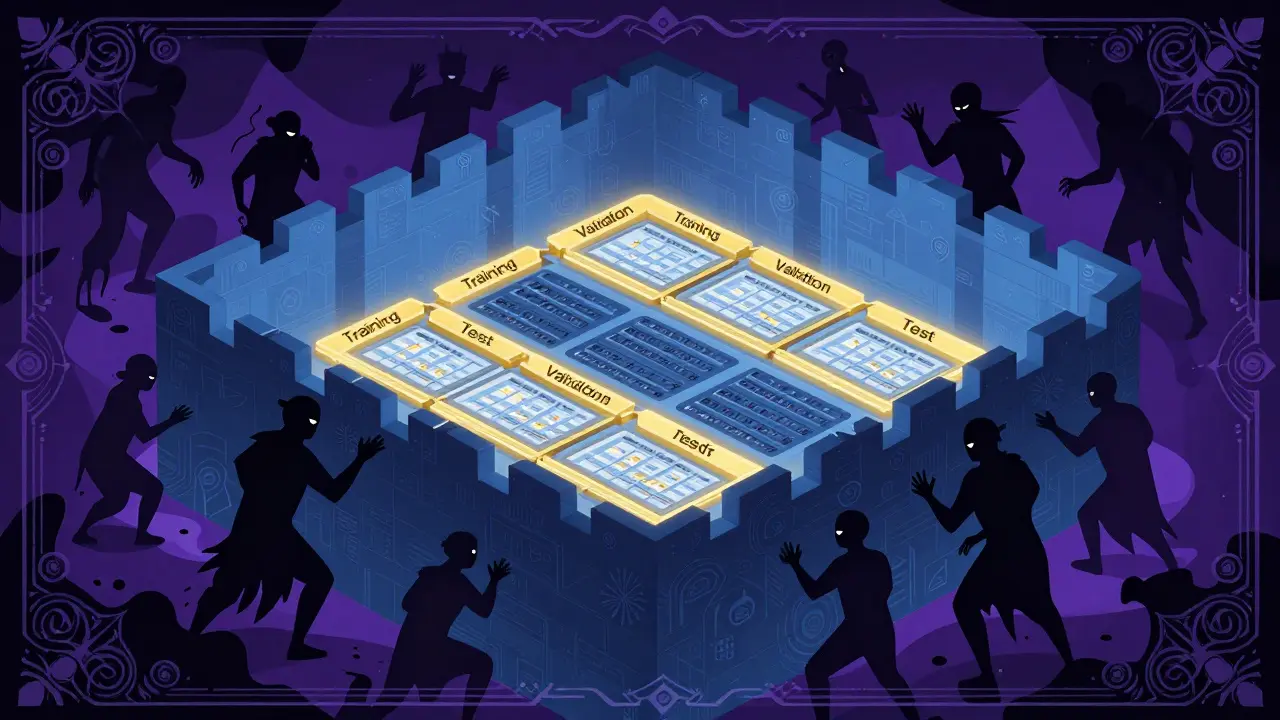
The most common mistake in fine-tuning evaluation is data leakage. This happens when examples from your training set accidentally appear in your test set. If the model has seen the exact question during training, it will likely memorize the answer rather than learn the underlying pattern. This inflates your performance metrics artificially.
To prevent this, strictly separate your data into three distinct sets:
- Training Set: Used to update model weights.
- Validation Set: Used during training to tune hyperparameters and detect overfitting.
- Test Set: Held out completely until the final evaluation. Never used during training or validation.
Your test set must be representative of real-world usage. If your model is designed for medical advice, your test set should contain diverse medical queries, not generic trivia. Curate this set carefully. Synthetic data generation can help expand your test set, but ensure the synthetic examples reflect the distribution of actual user inputs. If your test set is too easy or too narrow, your evaluation results will not predict real-world performance.
Comparing Evaluation Approaches
| Method | Best For | Pros | Cons |
|---|---|---|---|
| Perplexity / Cross-Entropy | Pre-training diagnostics, classification tasks | Fast, computationally cheap, objective | Poor correlation with human preference for open-ended tasks |
| ROUGE / BLEU | Summarization, translation with reference texts | Easy to implement, standardized | Ignores semantic meaning, penalizes paraphrasing |
| LLM-as-a-Judge | Open-ended generation, chatbots, creative writing | Captures nuance, style, and coherence | Computationally expensive, potential bias, requires careful prompting |
| Human Evaluation | Final validation, high-stakes decisions | Gold standard for understanding intent and context | Slow, expensive, inconsistent between raters |
Notice that no single method is perfect. The best strategy is a hybrid approach. Use perplexity to catch catastrophic failures early in training. Use ROUGE for tasks with clear references. Use LLM-as-a-Judge for nuanced quality assessment. And always reserve a small batch for human review to calibrate your automated metrics.
Parameter-Efficient Fine-Tuning (PEFT) Considerations
If you are using LoRA (Low-Rank Adaptation) or other PEFT methods, your evaluation strategy remains largely the same, but the interpretation changes slightly. PEFT adds a small number of trainable parameters to a frozen base model. Because the base model remains unchanged, you must isolate the effect of the adapter.
When evaluating LoRA adapters, ensure you are comparing against the same base model without the adapter. Do not compare a LoRA-fine-tuned Llama-3 against a fully fine-tuned Mistral-7B; the differences may stem from the base architectures rather than the fine-tuning process. Focus on the trade-off between parameter efficiency and performance degradation. Does the lightweight adapter achieve 95% of the performance of full fine-tuning at 10% of the cost? That is the metric that matters for business viability.
Building a Continuous Evaluation Pipeline
Evaluation is not a one-time event. It is a continuous cycle. Once your model is deployed, user feedback becomes your most valuable evaluation data. Implement mechanisms to collect thumbs-up/thumbs-down signals or explicit corrections from users. Feed this data back into your evaluation suite.
Use tools like LightEval or Hugging Face’s evaluation infrastructure to automate regular benchmark runs. Schedule weekly evaluations against your held-out test set to monitor for drift. If performance drops, investigate immediately. Is it due to data drift? Model decay? Or changes in the input distribution?
Finally, document your evaluation protocols. Record which metrics you used, which judge model version was active, and what the results were. This transparency is crucial for debugging and for building trust with stakeholders who need to understand why certain model updates were approved or rejected.
What is the difference between ROUGE and LLM-as-a-Judge?
ROUGE is a statistical metric that compares word overlap between generated text and a reference text. It is fast but blind to meaning. LLM-as-a-Judge uses another AI model to assess quality based on semantics, coherence, and instruction following. It is slower but much more aligned with human perception of quality, especially for open-ended tasks.
How do I prevent data leakage in my evaluation set?
Strictly separate your data into training, validation, and test sets. Never use the test set during training or hyperparameter tuning. Ensure that no examples from the training set appear in the test set, either exactly or in semantically similar forms that could trigger memorization.
Is perplexity a good metric for fine-tuned chatbots?
No. Perplexity measures how well a model predicts the next token in a sequence. While useful for detecting major errors, it correlates poorly with conversational quality, helpfulness, or safety. For chatbots, use LLM-as-a-Judge or human evaluation focused on specific interaction goals.
Why is safety evaluation important for fine-tuned models?
Fine-tuning can inadvertently amplify biases present in the training data or weaken the safety filters of the base model. Evaluating for toxicity and bias ensures your model does not generate harmful content, protecting your brand and users from reputational and legal risks.
What tools can I use for automated LLM evaluation?
Popular tools include DeepEval for integrated metric support, LightEval for flexible benchmarking, and Hugging Face's evaluation library. For LLM-as-a-Judge implementations, you can use specialized models like Prometheus or JudgeLM, or configure your own judge using a strong base model with custom prompts.







Amanda Ablan
May 26, 2026 AT 02:04It is honestly refreshing to see a guide that actually addresses the semantic gap in evaluation metrics. We have all been there, staring at a high ROUGE score while knowing deep down that the model is just regurgitating training data without understanding context. The section on LLM-as-a-Judge is particularly vital because it mirrors how we humans actually judge quality, not just word overlap. I think many teams skip the adversarial safety testing until it is too late, so emphasizing that continuous cycle is key.
Kevin Hagerty
May 27, 2026 AT 17:30another article telling us what we already know lol. nobody cares about perplexity anymore. just train bigger models and ignore the rest
Kendall Storey
May 29, 2026 AT 16:22The point about LoRA adapters is super important for anyone trying to keep costs down. You cant just compare a fine-tuned Llama against a Mistral base because the architecture differences will skew your results entirely. We need to isolate the adapter performance specifically. Also, using pairwise ranking for the judge model is a pro move that saves a lot of headache with inconsistent absolute scoring.
Yashwanth Gouravajjula
May 31, 2026 AT 03:32Data leakage is the silent killer here. Many practitioners forget to check for semantic similarity between train and test sets, not just exact matches. This leads to inflated metrics that collapse in production. Strict separation is non-negotiable.
Dylan Rodriquez
June 1, 2026 AT 01:39There is a profound philosophical shift happening here in how we define intelligence versus performance. When we rely solely on deterministic metrics like ROUGE, we are essentially measuring compliance rather than comprehension. It reminds me of the old adage about judging a book by its cover; the surface-level token prediction might look perfect, but the underlying reasoning could be completely hollow. We must consider the ethical implications of deploying models that sound confident but lack true understanding. This requires us to be more inclusive in our evaluation criteria, ensuring that we are not just optimizing for efficiency but for genuine helpfulness and safety. The transition to LLM-as-a-Judge is not just a technical upgrade; it is an acknowledgment that human nuance matters. We should encourage teams to embrace this complexity rather than seeking simple, false positives from static benchmarks. Ultimately, the goal is to create systems that enhance human capability, not just mimic it superficially.
Meredith Howard
June 1, 2026 AT 18:00i find the discussion on bias quite intriguing as it often gets overlooked in favor of raw accuracy scores one must consider how cultural norms shift over time which makes static safety tests obsolete quickly it is essential to maintain a dynamic approach to these evaluations
Janiss McCamish
June 2, 2026 AT 06:06Great breakdown. Why do you think most teams still default to MMLU? It seems like they are prioritizing ease of implementation over actual task relevance.
Richard H
June 2, 2026 AT 19:44Stop importing these foreign evaluation frameworks. American standards are sufficient. We build the best models here and we evaluate them our way. No need for all this complex international jargon about Prometheus or whatever. Just use common sense and basic accuracy checks. If it works for us, it works for everyone else. Keep it simple and patriotic.
Ashton Strong
June 4, 2026 AT 13:05I appreciate the comprehensive overview of hybrid evaluation strategies. It is encouraging to see such a balanced perspective on integrating both automated and human-in-the-loop methods. The emphasis on documenting protocols is also excellent advice for maintaining transparency and trust within development teams. Thank you for sharing this valuable insight.