When your company depends on a large language model to handle customer service, medical diagnoses, or financial reports, a slow response or a system outage isn’t just an inconvenience-it’s a financial crisis. Gartner estimates that in regulated industries, every minute of AI downtime costs an average of $5,600. That’s why enterprises don’t just ask if an LLM provider is reliable-they demand it in writing. And that’s where Service Level Agreements (SLAs) come in.
What an Enterprise LLM SLA Actually Covers
An SLA isn’t a marketing promise. It’s a legally binding contract that spells out exactly what you’re guaranteed-and what happens if the provider fails to deliver. For enterprise LLMs, modern SLAs now include five core components: uptime, latency, security, compliance, and support response times.
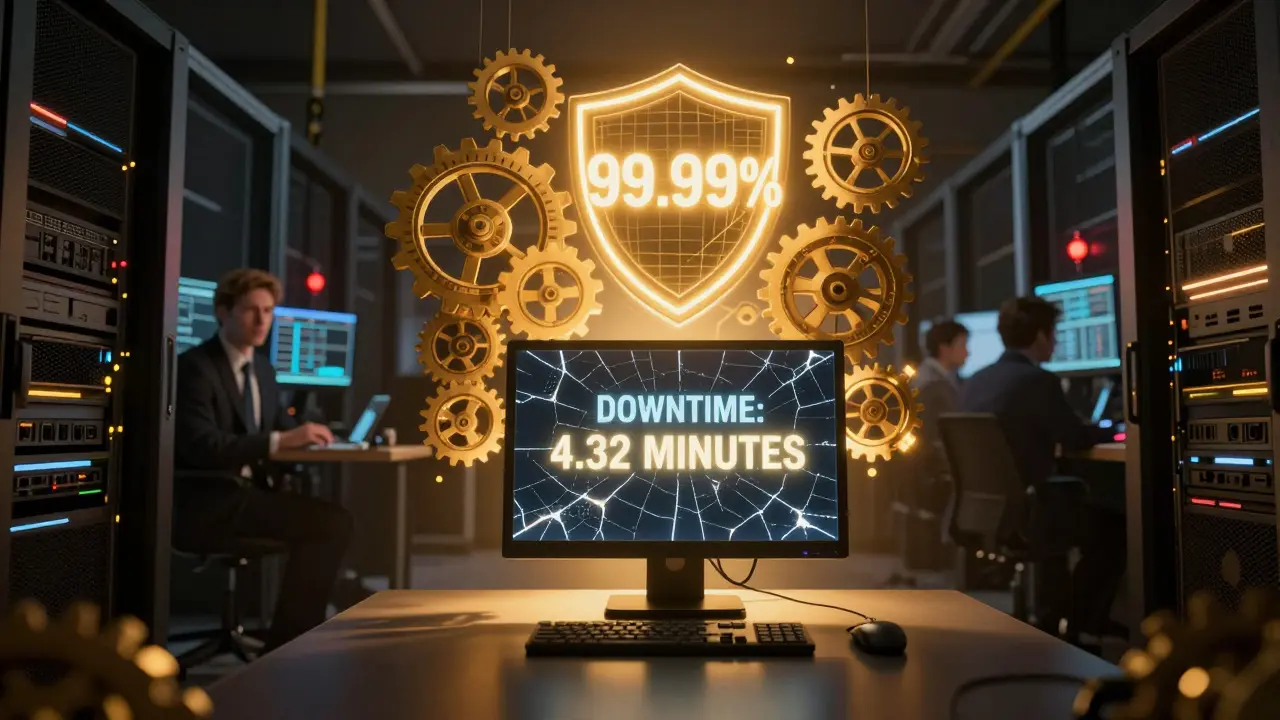
Uptime guarantees have become standard. Most providers offer 99.9%, meaning you can expect up to 43.2 minutes of downtime per month. But that’s the floor. Premium contracts with Microsoft Azure OpenAI and Amazon Bedrock now offer 99.95% uptime (just 21.6 minutes of downtime monthly). In healthcare and finance, where even seconds matter, some contracts demand 99.99%-allowing only 4.32 minutes of downtime per month.
Latency matters just as much. A model that takes 5 seconds to respond during peak hours can ruin customer experiences or delay critical decisions. Enterprise SLAs now specify maximum response times: 2-3 seconds for 95% of requests under normal load, and up to 5-7 seconds during traffic spikes. Providers like Helicone.ai have documented that latency spikes often occur during regional business hours, so SLAs must account for global usage patterns.
Security isn’t optional. AES-256 encryption for data at rest and TLS 1.3 for data in transit are baseline requirements. But beyond encryption, enterprises now demand SOC 2 Type II compliance as a minimum. For healthcare, HIPAA is non-negotiable. For government contracts, FedRAMP High or DoD IL4/IL5 certifications are mandatory. Google Cloud AI, for example, now offers data residency in 22 regions, ensuring your data never leaves the country where it was generated.
Support Isn’t Just a Phone Number
When something breaks, how fast you get help determines how much damage you take. Standard enterprise support typically promises acknowledgment within 4 business hours. That’s fine for non-critical apps-but not for real-time systems.
Premium contracts require 1-hour response times. Mission-critical deployments-like automated trading platforms or emergency response systems-demand 15-minute responses for Severity 1 incidents. Microsoft Azure OpenAI’s November 2024 SLA update formalized this tiered structure, with dedicated engineers assigned to top-tier clients. The best providers even offer named account managers with direct phone access, not just ticket systems.
But here’s the catch: 43% of SLA disputes in 2025 centered on vague language around support during weekends and holidays. Many contracts say "business hours" without defining them. If your team works 24/7, you need that spelled out. Always ask: "What happens on a Sunday at 3 a.m. when the model starts hallucinating medical advice?"
Who’s Leading-and Who’s Falling Behind
Not all LLM providers are built the same. Here’s how the top four stack up in 2026:
| Provider | Uptime SLA | Key Compliance Certifications | Support Response (Premium) | Unique Strength |
|---|---|---|---|---|
| Microsoft Azure OpenAI | 99.9% (99.95% premium) | FedRAMP High, HIPAA, GDPR, SOC 2, DoD IL4/IL5 | 1 hour (15 min for Severity 1) | Best integration with Microsoft ecosystem and compliance depth |
| Amazon Bedrock | 99.9% | HIPAA, SOC 2, GDPR | 1 hour | 60+ models, intelligent routing, 30% cost savings |
| Google Vertex AI | 99.9% | HIPAA, GDPR, SOC 2 | 2 hours | Strong multimodal processing, 500K context windows |
| Anthropic (Claude 4) | 99.9% | HIPAA, GDPR, SOC 2 (zero data retention verified) | 4 hours | Proven data privacy, third-party audits for zero retention |
Azure OpenAI leads in compliance, with certifications that cover nearly every regulated industry. Amazon Bedrock wins on cost and flexibility-its model routing can cut expenses by 30% by switching between models based on workload. Anthropic stands out for its zero data retention policy, which has prevented HIPAA violations during audits. Google Vertex AI excels in handling complex, multimodal tasks, like analyzing medical images alongside text-but its SLA documentation is less transparent than competitors’.
OpenAI’s direct enterprise offering? It’s lagging. Despite its name recognition, it still lacks HIPAA and FedRAMP High certifications, making it a non-starter for many enterprises. And while its uptime is competitive, its SLA doesn’t clearly define model versioning or maintenance windows.

The Hidden Costs No One Talks About
Most enterprise contracts list a monthly fee. But 20-40% of total costs are hidden. These include:
- Dedicated GPU clusters (shared models often throttle during peak use)
- Enhanced security monitoring tools (needed to meet SOC 2 or HIPAA)
- Regional data residency infrastructure (not included in base pricing)
- Internal teams to monitor SLA compliance (average team size: 2.5 FTEs)
TrueFoundry’s May 2025 report recommends a 3-6 month evaluation period before signing. During that time, simulate 300% of your expected peak load. Test how the system behaves during holidays, time zone overlaps, and unexpected traffic surges. If the provider can’t deliver under pressure, their SLA is just paper.
What You Must Demand in Your SLA
Based on real enterprise contracts from 2025, here’s what you need to insist on:
- Model versioning guarantee - How long will your current model version be supported before forced upgrades? Gartner’s David Groom says this is the most overlooked clause. A sudden model change can break your app’s logic.
- Clear penalty structure - How are service credits calculated? Is it 10% of monthly fee per hour of downtime? Or 5% per 15 minutes? Vague language like "best efforts" is unacceptable.
- Transparency around maintenance - Are there scheduled outages? Can you be notified 72 hours in advance? Some providers throttle usage during "high demand" without warning-this should be a breach.
- Traceability for multi-agent workflows - If your AI uses multiple agents to complete a task, can you audit every step? Dr. Marcus Chen of Helicone.ai says this is critical for compliance.
- Explicit data handling rules - Where is data stored? Who has access? Is it ever used for training? Anthropic’s zero retention policy is a gold standard.

What’s Coming in 2026-2027
The SLA game is changing fast. Microsoft’s "SLA 2.0" initiative uses AI to predict outages before they happen-early adopters saw 37% fewer violations. Google is rolling out real-time compliance dashboards that auto-validate GDPR and HIPAA adherence.
By 2026, expect SLA-based pricing tiers: Standard, Business, and Mission-Critical. Providers will start charging more for reasoning models (like those used for financial forecasting) versus basic chat models. And the EU AI Act, fully enforced since January 2026, now requires audit trails and transparency logs to be part of every enterprise SLA.
Analysts at Gartner warn: providers that don’t evolve will lose 30-40% of their market share by 2027. Enterprises are no longer choosing models based on performance alone. They’re choosing partners who treat SLAs as trust-building tools-not legal fine print.
What’s the minimum uptime SLA an enterprise should accept from an LLM provider?
The absolute minimum is 99.9% uptime, which allows up to 43.2 minutes of downtime per month. But for mission-critical applications-like healthcare diagnostics or financial trading-this isn’t enough. You should demand at least 99.95% (21.6 minutes monthly) or 99.99% (4.32 minutes). Anything below 99.9% should be a red flag.
Do all LLM providers offer HIPAA compliance?
No. Only a few major providers do. Microsoft Azure OpenAI, Amazon Bedrock, Google Vertex AI, and Anthropic all offer HIPAA-compliant options. But many smaller providers don’t even have the infrastructure to support it. Always ask for a signed Business Associate Agreement (BAA) and verify it’s included in the SLA-not just mentioned on a webpage.
Can I switch models without breaking my SLA?
Most SLAs don’t let you switch models without renegotiation. For example, if your contract is locked to GPT-4, and it goes down, you can’t automatically switch to Claude 4-even if it’s faster-because your SLA doesn’t cover it. Look for providers that allow model selection as part of the SLA, like Amazon Bedrock, which lets you route traffic across 60+ models with consistent performance guarantees.
How do I know if my SLA is being violated?
You need observability tools. Monitoring uptime alone isn’t enough. You need to track latency, error rates, data residency compliance, and model version consistency. Tools like Helicone.ai, Logz.io, and Azure Monitor can automatically flag SLA breaches and calculate service credits. Don’t rely on manual checks-automate it.
Are open-source LLMs a better option for enterprises?
Open-source models give you control, but they don’t come with SLAs. If you self-host Llama 3 or Mistral, you’re responsible for uptime, security, compliance, and support. Most enterprises don’t have the team or budget to manage that. For mission-critical use cases, managed LLM providers with strong SLAs are still the safer bet-unless you’re building your own infrastructure with deep AI expertise.
Next Steps for Enterprises
Don’t sign an LLM contract without a 90-day trial. Test under real-world conditions: simulate your peak traffic, run compliance audits, and trigger failure scenarios. Ask for the SLA document in writing-not a webpage summary. Compare penalty structures, support tiers, and data handling policies side by side. And never accept vague terms like "reasonable usage" or "best efforts." Those phrases are loopholes.
The future of enterprise AI doesn’t belong to the fastest model. It belongs to the most trustworthy provider-one who treats their SLA like a promise, not a disclaimer.








Rubina Jadhav
February 18, 2026 AT 06:3199.9% uptime is the bare minimum. If your business relies on this tech, you’re asking for trouble if you accept anything less. I’ve seen teams lose hours of productivity over a 30-second glitch. Don’t gamble with SLAs. Demand the numbers in writing.
sumraa hussain
February 19, 2026 AT 17:02Let’s be real-SLAs are just fancy contracts until they’re broken. Then you realize half the clauses are written in legalese so thick you need a lawyer just to read the footnote. And don’t even get me started on ‘business hours’… what if your team works 24/7? Who’s covering Sunday 3 a.m. when the AI starts giving out fake diabetes diagnoses? Someone’s gotta pay for that.
Raji viji
February 19, 2026 AT 19:44Oh wow, look who’s crying about uptime. 99.9%? That’s cute. You think that’s good? Try running a trading bot on a provider that throttles during lunch hour. I’ve seen Azure OpenAI drop latency to 12 seconds because ‘peak demand’-yeah, right, peak demand is when Indian traders are logging in at 5:30 a.m. EST. And don’t even mention Anthropic’s zero retention. That’s marketing fluff. Their logs still leave breadcrumbs. I’ve audited their API calls. They’re lying. And Google? Their ‘multimodal processing’ is just a fancy name for ‘we take longer because we’re overcomplicating everything.’
Rajashree Iyer
February 20, 2026 AT 08:44Isn’t it fascinating how we’ve turned trust into a spreadsheet? We no longer believe in reliability-we demand it in percentages, clauses, and service credits. The soul of AI has been replaced by a contractual obligation. We’ve forgotten that technology, at its core, is meant to serve humanity… not the other way around. We’re building prisons of SLAs to contain the very intelligence we hoped would set us free. What have we become?
Parth Haz
February 20, 2026 AT 14:36While the technical details are critical, I’d encourage enterprises to also consider the human element. A provider that offers a named account manager with direct access isn’t just selling uptime-they’re building a partnership. That kind of relationship reduces stress, improves response times, and creates accountability beyond the contract. It’s not just about what’s written-it’s about who shows up when things go wrong.
Vishal Bharadwaj
February 20, 2026 AT 16:1999.99%? LOL. You think that’s real? I’ve been in ops long enough to know uptime is a myth. Even Google’s dashboard shows ‘99.99%’ but their logs say otherwise. And don’t get me started on HIPAA-most providers just slap a checkbox and call it compliance. I’ve seen companies get fined because their ‘HIPAA-compliant’ provider stored data in a region not covered by the BAA. Also, who cares about model versioning? Just upgrade and fix your code. Stop being so fragile.
anoushka singh
February 21, 2026 AT 07:38Okay but can we talk about how no one ever mentions how much time we spend arguing with support bots? I’ve spent 3 hours on a ticket because they said ‘we’re investigating’ and then ghosted me for 4 days. And then they send me a PDF with 87 pages of SLA terms I didn’t even sign. Can we just… make this easier? I just want the damn model to work.
Jitendra Singh
February 22, 2026 AT 00:49I think the real win here is that enterprises are finally asking the right questions. Not just ‘how fast?’ but ‘how safe? how transparent? how accountable?’ That shift matters. Even if SLAs feel like overkill, they’re forcing providers to stop treating AI like a magic black box. And that’s progress, even if it’s messy.
Madhuri Pujari
February 23, 2026 AT 11:35Oh, so now we’re pretending Anthropic’s ‘zero retention’ is some kind of holy grail? Please. They’re just hiding the fact that they’re not training on data because they’re too scared of lawsuits. Meanwhile, Azure and Google are quietly using anonymized logs to improve their models-because that’s how innovation works. And you think a 15-minute response time for a Severity 1 incident is impressive? I’ve seen startups fix critical bugs in 8 minutes. This whole SLA circus is just corporate theater. You’re paying for reassurance, not performance. And honestly? You’re being played.