
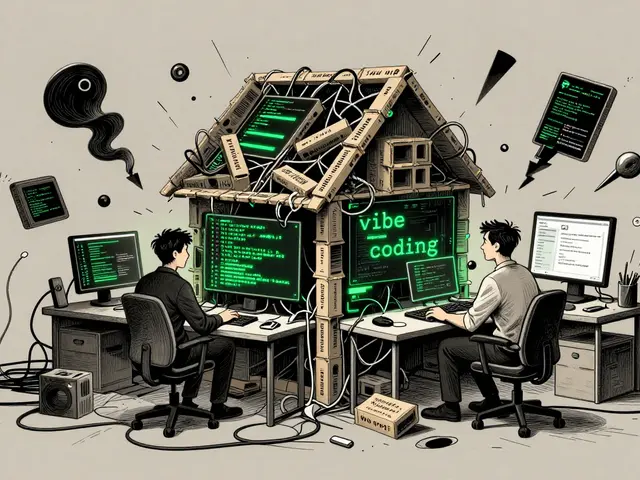
By now, you’ve probably heard of vibe coding - the idea that you can just talk to an AI and get working code back. No more staring at a blank editor for hours. No more copy-pasting Stack Overflow snippets. Just say what you want, and boom - a full React component, a Python API endpoint, even a basic database schema. Sounds like magic? It’s not. It’s math. And like any tool, some versions of it work better than others.
What Actually Gets Measured in Vibe Coding Benchmarks?
Not all vibe coding tools are created equal. And not all benchmarks measure the same things. If you’re trying to pick the right one for your team, you need to know what’s being tested - and why it matters. The most reliable benchmarks today look at five key areas:- First-pass accuracy: Does the code run without errors the first time you generate it?
- Error recovery: If it breaks, can the AI fix it when you point out the issue?
- Iteration capability: Can it handle follow-up changes? Like "add user authentication" or "switch from PostgreSQL to MySQL"?
- Deployment success: Does it generate code that actually deploys? Not just runs locally, but works in production environments?
- Prompt fidelity: Does it remember what you asked for? Or does it ignore half your requirements after 30 seconds?
Top Performers in 2025: Who’s Leading the Pack?
According to Vals AI’s March 2025 benchmark - the most comprehensive test to date - GPT-5.2 is the clear leader. It hit 35.56% accuracy across 347 real-world app specs. That might sound low, but it’s a massive jump from GPT-4.5’s 24.61% just four months earlier. Here’s how the top five stacked up:| Model | Accuracy Score | Key Strength | Major Weakness |
|---|---|---|---|
| GPT-5.2 | 35.56% | Best at complex logic and multi-file projects | Slow generation speed; high token usage |
| GPT-5.1 | 24.61% | Consistent with simple tasks | Frequently forgets UI requirements |
| Claude Sonnet 4.5 (Thinking) | 22.62% | Excellent at explaining code | Struggles with database schema generation |
| DeepSeek-Coder | 20.14% | Strong in Python and Rust | Poor context retention beyond 5 prompts |
| CodeGeeX | 18.92% | Fastest generation time | Only 12% success rate on full-stack apps |
But Accuracy Isn’t Everything
Here’s the catch: 35% accuracy doesn’t mean 35% of your code works. It means 35% of entire application specs - from frontend to backend to database - passed all automated tests on the first try. That’s rare. In fact, 68.3% of all generated apps scored under 12.5% accuracy on first pass. That’s the reality. Most vibe coding tools still need heavy human oversight. But here’s what Google Cloud’s Jane Smith gets right: vibe coding isn’t about perfection - it’s about speed. If you can get 40% of a working app in 2 minutes, then fix the rest in 10, you’ve saved hours. That’s the real value. Testsprite’s data backs this up. Their accuracy tool - which auto-corrects common bugs - boosted pass rates from 42% to 93% after just one iteration. That’s the sweet spot: let the AI draft, then let a human or automated validator clean it up.
Security Risks Are Hidden in Plain Sight
A lot of people assume AI-generated code is safe because it "runs." It’s not. Testsprite analyzed 12,000 lines of AI-generated code and found that 58% contained security vulnerabilities. SQL injection. Hardcoded API keys. Improper input validation. The same mistakes humans make - but faster, and in bulk. And here’s the kicker: 62.3% of companies in healthcare and finance now require AI-generated code to pass formal security scans before deployment. That’s not optional anymore. If you’re using vibe coding in regulated industries, you need a validation layer - not just a code generator.What Tools Actually Work in Real Life?
Benchmarks are great. But real developers talk on Reddit, YouTube, and Slack. A top-rated Reddit thread from May 2025 tested seven tools over 30 days. Here’s what users said:- Cline (VSCode extension): "Best at asking clarifying questions. Made me think harder about my specs. But monthly costs hit $320. Not for freelancers."
- Quinn CLI: "Burns tokens like it’s on fire. Generated 37 versions of the same button before getting it right."
- GPT-5.2 via Cursor: "Takes longer, but when it works, it works. I got a working auth flow in one try. Never happened before."
- Codeex: "Fastest for simple scripts. But if you ask for anything beyond "hello world," it hallucinates libraries that don’t exist."

What You Need to Use This Effectively
If you’re thinking about jumping in, here’s what you actually need:- Prompt engineering skills: 91.7% of pros say this is essential. Vague prompts = garbage output. "Make a login page" isn’t enough. You need: "Create a React form with email/password, validate with Zod, connect to Firebase Auth, and return a 401 if credentials are invalid."
- Debugging fluency: 83.4% of AI-generated code needs fixing. You can’t just accept it. You need to read it, test it, and understand why it failed.
- Framework knowledge: If you’re using Django, know how Django works. If you’re using Express, know how Express routes behave. The AI doesn’t know your stack - you do.
The Future: Where Is This All Going?
The market is exploding. Vibe coding tools hit $1.27 billion in 2024. Gartner predicts 85% of developers will use them regularly by 2027. But there’s a ceiling. Stanford’s Dr. Michael Chen says current models are plateauing around 40% functional completeness for complex apps. Why? Because LLMs still can’t reason across long timelines. They can write a single function. But they can’t build, test, deploy, and maintain a full system without human help. New benchmarks are emerging to match the growth:- WebVibeBench (launched April 2025): Focuses on frontend-backend integration for React, Next.js, and Vue.
- DataVibeScore (beta): Tests SQL generation, ETL pipelines, and data validation logic.
- SecVibeMetrics (June 2025): Measures security flaws in AI-generated code - required for banking and health apps.
Final Takeaway: Use It, But Don’t Trust It
Vibe coding is real. It’s powerful. And it’s changing how software gets built. But it’s not magic. It’s a high-speed typewriter with a bad memory and a tendency to make up facts. Use GPT-5.2 for prototyping. Use Testsprite’s validator for security. Use your own brain to review every line. And never, ever deploy AI-generated code without testing it like your job depends on it - because it does.By 2026, you won’t be judged on whether you used AI. You’ll be judged on whether you knew how to use it right.
Is vibe coding ready for production use?
Not as a standalone tool. Most AI-generated code requires manual review, testing, and security validation before deployment. While tools like GPT-5.2 can generate 35% of a working app on the first try, the rest needs human intervention. Enterprise teams are already adding "accuracy gates" to CI/CD pipelines to catch bugs and vulnerabilities before code goes live.
Which vibe coding tool is best for beginners?
For beginners, start with Cursor or GitHub Copilot. They integrate directly into VS Code, offer clear suggestions, and have lower setup friction. Avoid terminal-only tools like Quinn CLI or Codeex - they require precise prompts and don’t explain errors well. Focus on tools that show you the code before committing it, so you can learn as you go.
Why does vibe coding cost so much?
Most vibe coding tools run on large language models that charge per token - the units of text processed. Generating complex code uses thousands of tokens. A single full-stack app generation can cost $1-$5. For active teams, that adds up fast. Enterprise tools like Testsprite and Vals AI charge monthly fees to manage usage, but even open-source benchmarks require expensive cloud credits to run tests at scale.
Can vibe coding replace software engineers?
No. It replaces repetitive, low-level coding tasks - not design, architecture, or debugging. Engineers are shifting from writing code to guiding AI, reviewing outputs, and ensuring quality. The best developers today aren’t the fastest typists - they’re the ones who ask the right questions and spot when the AI is wrong.
How do I test if AI-generated code is secure?
Use static analysis tools like Testsprite’s accuracy checker, SonarQube, or Snyk. Run the code through a vulnerability scanner before deployment. Never skip this step. Studies show 58% of AI-generated code contains security flaws - from hardcoded secrets to unvalidated inputs. Treat AI output like third-party code: assume it’s dangerous until proven otherwise.
What’s the biggest mistake people make with vibe coding?
Believing the first output is correct. Most users generate code, glance at it, and deploy. That’s how bugs and security holes slip in. The real skill isn’t prompting - it’s reviewing. Spend as much time checking the output as you did writing the prompt. If you’re not reading every line, you’re not using it right.






Dave Sumner Smith
December 14, 2025 AT 00:54Let me guess - GPT-5.2 is secretly owned by the same shadow group that runs the federal reserve and controls the weather. You think this is about code? Nah. This is a psyop to get devs addicted to AI so they stop thinking for themselves. Next thing you know, your entire codebase is written by a model trained on leaked NSA docs and Reddit r/ProgrammerHumor. They don’t want you to debug. They want you to *believe*. And the ‘accuracy’ scores? Fabricated by Vals AI’s parent company - which also owns the servers your code gets sent to. You’re not building software. You’re feeding data to the machine that will replace you. Wake up.
Cait Sporleder
December 15, 2025 AT 02:58It is, in fact, a profoundly fascinating metamorphosis of the developer’s role - one that transmutes the traditional artisanal coder into a kind of epistemological conductor, orchestrating the symphony of latent space outputs with the precision of a maestro guiding an orchestra of probabilistic harmonies. The notion that ‘accuracy’ is the sole metric of efficacy is not merely reductive, but ontologically myopic; for what we are witnessing is not the automation of labor, but the emergence of a new epistemic covenant between human intention and machine interpretation - one wherein the value resides not in the output’s perfection, but in the quality of the dialogue, the iterative refinement, and the emergent cognitive synergy that arises when the mind learns to speak the dialect of the machine. To dismiss this as ‘just typing’ is to misunderstand the very architecture of cognition in the age of large language models.
Paul Timms
December 15, 2025 AT 04:36Agreed. The real metric isn’t first-pass accuracy - it’s how often you have to explain to the AI why it’s wrong. I’ve seen GPT-5.2 generate perfect-looking React components that used deprecated hooks and undefined state. The AI doesn’t understand context. It predicts text. That’s it.
Jeroen Post
December 16, 2025 AT 20:26They want you to think it’s a tool but it’s a trap. Every line of AI code is a fingerprint. They’re collecting your thought patterns. Your coding style. Your mistakes. Building a profile. Soon they’ll sell your mental blueprint to the highest bidder. You’re not coding. You’re training your replacement. And the security scans? Just a placebo. The real vulnerability is in your brain. You think you’re in control. You’re not. You’re the data point.
Nathaniel Petrovick
December 17, 2025 AT 01:02Man I just use GPT-5.2 in Cursor for quick prototypes and then I rewrite everything myself. It’s like having a super fast intern who gets the gist but always misses the little stuff. I’ll take the 35% win if it saves me 3 hours of boilerplate. Just don’t commit it without reading it. I’ve caught so many hardcoded keys and broken imports because I actually looked at the code. It’s not magic, but it’s still a game changer if you don’t treat it like a wizard.
Honey Jonson
December 17, 2025 AT 06:26lol i just started using vibe coding last month and holy cow it saved me so much time. i used to spend hours on basic crud apps now i get a draft in 2 mins and just fix the typos and missing semicolons. the ai still messes up my firebase auth like 80% of the time but hey at least i dont have to write the same 50 lines of form validation over and over. also i think its funny how people act like its gonna steal their jobs when im literally just using it to do the boring stuff so i can focus on the fun parts. also pls someone tell me how to stop it from making buttons with 100px height