
Imagine teaching a child to read. You wouldn’t hand them Shakespeare on day one. You’d start with "The Cat Sat," move to simple sentences, and only later introduce complex paragraphs. Yet for years, we trained Large Language Models (LLMs) by throwing random chunks of text at them, hoping they’d figure it out. That approach is changing. Enter Curriculum Learning, a strategy that orders training data from easy to hard, mimicking how humans actually learn.
This isn't just a nice idea; it's becoming a critical tool for building efficient, high-performing AI. As of mid-2026, the cost of training massive models is skyrocketing. Companies are looking for ways to cut compute time without sacrificing quality. Curriculum Learning offers a path forward, promising faster convergence and better generalization. But how does it work under the hood, and is it right for your project?
The Core Concept: Why Order Matters
At its heart, Curriculum Learning (CL) restructures the way a model sees data. Instead of random sampling-the industry standard for decades-CL presents examples in a deliberate sequence. The goal is to help the model build a strong foundation before tackling ambiguity and complexity.
The concept dates back to a 2009 paper by Yoshua Bengio and colleagues, who argued that difficult examples early in training can confuse the learning process. In Natural Language Processing (NLP), this translates to starting with short, grammatically simple sentences and gradually introducing long, nested clauses or domain-specific jargon.
Why does this help? Think of it like building a house. If you try to install the roof before laying the foundation, everything collapses. By starting with easier data, the model learns basic patterns-like subject-verb agreement or common word associations-more quickly. Once those basics are solid, it uses that knowledge to parse harder structures. Research suggests this can improve learning speed by up to 35% in certain architectures.
How It Works: The Three Pillars of Implementation
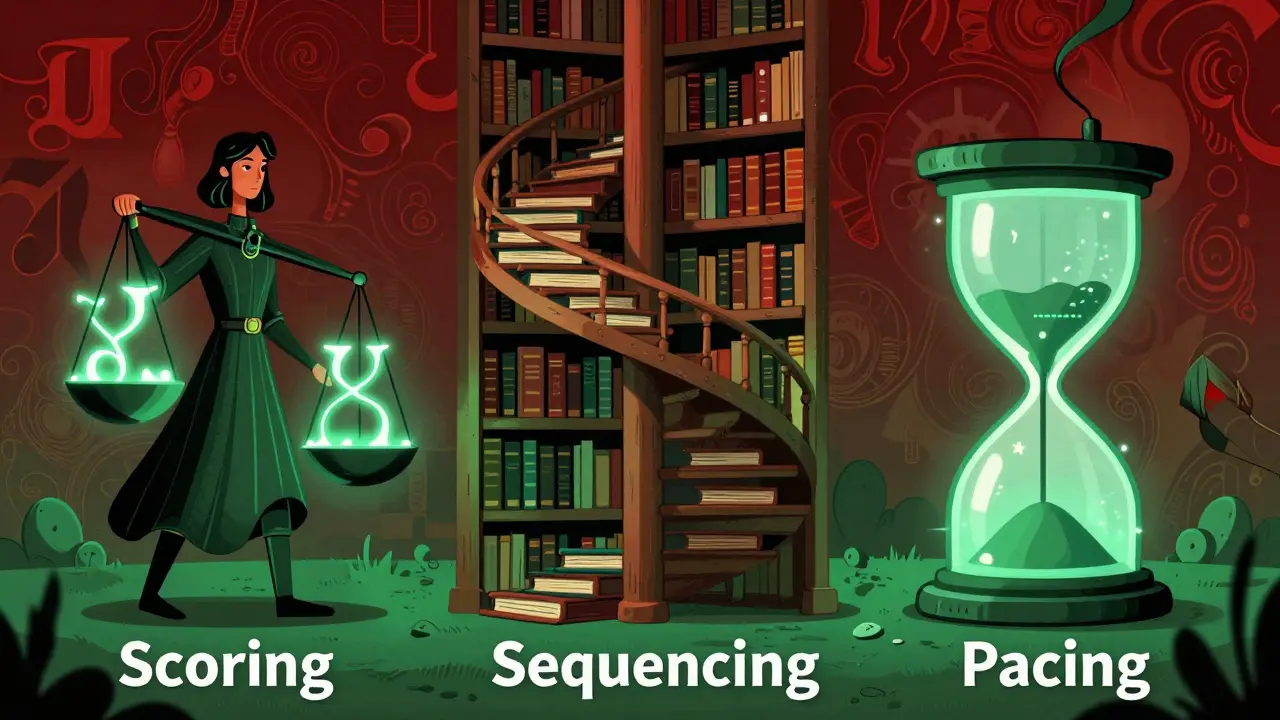
You can’t just shuffle data randomly and call it curriculum learning. Effective implementation requires three specific components:
- A Scoring Function: You need a way to measure "difficulty." Is a sentence hard because it’s long? Because it contains rare words? Or because it requires logical reasoning? Metrics often include sentence length, part-of-speech tag complexity, or even predicted uncertainty from a smaller model.
- A Sequencing Strategy: This determines the order. Do you go strictly linear (easy to hard)? Or do you use a spiral approach, revisiting concepts as they get more complex?
- A Pacing Function: How fast do you increase difficulty? Too fast, and the model gets confused. Too slow, and you waste time on data it already understands.
For example, Google AI developed a framework called 'Difficulty-Ordered Pretraining' in 2023. They used perplexity scores from a smaller base model to rank training examples. The result? A 12.7% reduction in training time while maintaining performance on the GLUE benchmark. This shows that when done correctly, CL isn't just theoretical-it delivers tangible efficiency gains.
Curriculum Learning vs. Random Sampling: The Real Differences
To understand the value of CL, you have to compare it against the baseline: random sampling. Here is how they stack up in real-world scenarios.
| Feature | Random Sampling | Curriculum Learning |
|---|---|---|
| Setup Complexity | Low (plug and play) | High (requires metric design) |
| Training Speed | Standard | Faster convergence (up to 35% quicker) |
| Best For | Simple classification tasks | Complex reasoning, semantic parsing |
| Cost Efficiency | Higher compute costs for same accuracy | Lower compute costs (18-25% savings) |
| Risk | Slow learning on complex tasks | Potential bias if metrics are flawed |
Stanford’s NLP Group reported in 2025 that CL achieved 8.3% higher accuracy on the DROP reading comprehension benchmark compared to random sampling. However, DeepMind’s 2024 analysis noted that for simple tasks like sentiment analysis, random sampling often performs just as well. The key takeaway? CL shines when the task requires hierarchical understanding, such as code generation or complex question answering.
The Hidden Costs: Engineering and Bias
It’s not all smooth sailing. Implementing Curriculum Learning adds engineering overhead. You aren't just training a model; you're designing a syllabus. Practitioners report spending an extra 20-30 hours developing difficulty metrics per language domain. That’s time your team could spend on other features.
Then there’s the issue of bias. Dr. Emily M. Bender, a prominent linguist, warned in her 2024 ACL keynote about the danger of embedding subjective notions of linguistic difficulty into training pipelines. If your "easy" examples are mostly from standard American English, your model might struggle with dialects or low-resource languages. This can inadvertently reinforce existing biases, making the model less robust for diverse users.
Additionally, there’s a risk of "capability cliffs." A controversial 2026 paper from the University of Cambridge showed that overly aggressive curricula can cause models to fail catastrophically on examples slightly beyond their training range. If the model never sees "hard" enough examples during training, it may lack the resilience to handle edge cases in production.

Who Should Use Curriculum Learning?
Not every project needs CL. If you’re building a simple spam filter, stick to random sampling. It’s simpler and effective. But consider CL if:
- You are training a large model from scratch: The compute savings (18-25%) can be significant at scale.
- Your task involves complex reasoning: Semantic parsing, code generation, and multi-step QA benefit greatly from structured learning.
- You are working with low-resource languages: Facebook AI Research found 22.4% better zero-shot transfer performance for Swahili-to-English translation using curriculum-structured data.
- Sustainability is a priority: With the carbon footprint of AI training under scrutiny, CL’s efficiency gains align with green AI initiatives.
If you fall into these categories, the upfront investment in curriculum design pays off. As one Hugging Face user noted, a 40-hour investment in curriculum design reduced BERT fine-tuning time by 27%, paying for itself in just three runs.
The Future: Adaptive and Automated Curricula
We are moving beyond static curricula. The next frontier is adaptive learning. Google AI’s December 2025 release of 'AutoCurriculum' dynamically adjusts difficulty based on the model’s real-time performance. This hybrid approach showed a 9.4% improvement across eight NLP benchmarks compared to static methods.
Furthermore, CL is being integrated with Reinforcement Learning from Human Feedback (RLHF). Anthropic reported in January 2026 that their Claude-3.5 pipeline used a hybrid CL-RLHF approach, reducing alignment training costs by 31%. This suggests that by 2027, CL won't be a niche technique but a standard component of enterprise LLM training, driven by the need for cost-effective, sustainable AI development.
What is the main difference between Curriculum Learning and Random Sampling?
Random sampling presents training data in a shuffled, unpredictable order. Curriculum Learning organizes data from easiest to hardest, allowing the model to build foundational knowledge before tackling complex examples. This often leads to faster convergence and better performance on complex tasks.
Is Curriculum Learning worth the extra engineering effort?
For simple tasks, no. The added complexity isn't justified. However, for large-scale LLM training or complex reasoning tasks, yes. Studies show 18-25% reductions in compute costs and significant improvements in accuracy, which can offset the initial 20-30 hours of development time required to design the curriculum.
How do you define "difficulty" in NLP data?
Difficulty can be measured in several ways: sentence length, lexical diversity (rare words), syntactic complexity (nested clauses), or even using a smaller model's perplexity score. The best metric depends on your specific task. For example, code generation might prioritize syntax depth, while translation might focus on vocabulary rarity.
Can Curriculum Learning introduce bias into models?
Yes. If your definition of "easy" data is skewed toward a specific dialect or demographic, the model may perform poorly on diverse inputs. Experts warn that subjective difficulty metrics can reinforce linguistic biases, so careful auditing of the curriculum structure is essential.
What is AutoCurriculum?
AutoCurriculum is a system released by Google AI in late 2025 that automates the creation of learning sequences. Instead of a fixed order, it dynamically adjusts the difficulty of examples based on the model's current capabilities in real-time, leading to more efficient and adaptive training processes.








Caitlin Donehue
July 4, 2026 AT 03:54I've been reading a lot about this lately and it actually makes so much sense when you think about how we learn languages as kids. It's wild that we spent years just throwing random data at these models. I guess the compute costs are finally forcing our hand to be smarter about it.
Joe Walters
July 4, 2026 AT 09:34please tell me im not the only one who thinks this is obvious? like seriously if u cant figure out that order matters then maybe u shouldnt be training llms. its basic pedagogy for crying out loud. but sure lets pretend shuffling text chunks randomly was ever a good idea lol. typical tech bro logic. i mean look at the table in the article, its right there. stop ignoring reality because ur ego wont let u admit ur wrong about random sampling being fine for everything. its not. never was. get with the program or go back to training spam filters.
Robert Barakat
July 4, 2026 AT 22:29The essence of learning is structure. Without hierarchy, knowledge is merely noise. We impose order on chaos to create meaning. The machine, in its raw state, mirrors the void until we guide it through the labyrinth of syntax. It is not just efficiency; it is ontology. To train without curriculum is to deny the very nature of understanding itself. One must build the foundation before the spire can touch the sky. This is ancient wisdom disguised as modern engineering. The model does not know what it knows until it has learned what it did not know. And yet, we rush. We always rush. The result is a hollow intelligence, full of words but empty of depth. True mastery requires patience. It requires a sequence. A rhythm. The algorithm must breathe. It must grow. Not explode. Grow. Like a tree. Roots first. Then branches. Then leaves. Only then can it bear fruit. Otherwise, it is just wood. Dead wood. Useless. Burning fuel for nothing. We must respect the process. The process is sacred. Do not mock it with randomness. Randomness is death. Order is life. Even for silicon.
Michael Richards
July 6, 2026 AT 05:19Listen up, because I'm only going to say this once. If you're still using random sampling for anything beyond a toy project, you're wasting money and time. It's that simple. The article spells it out clearly: 18-25% savings in compute costs. That's huge. Stop making excuses about setup complexity. You're an engineer, solve the problem. Design the metric. Build the pipeline. If you can't handle the extra 20 hours of work, you don't deserve the efficiency gains. This isn't rocket science, it's basic optimization. Get your act together or stay behind. The industry is moving forward with curriculum learning, and you'll be left in the dust with your slow, inefficient, random-sampling models. Face it. Adapt. Or fail. There is no middle ground here. Excellence requires discipline. Show some discipline.
Laura Davis
July 7, 2026 AT 23:07Hey everyone! Let's keep this discussion respectful and focused on the technical aspects please. While Michael's point about efficiency is valid, we also need to acknowledge the bias concerns mentioned in the post. Dr. Bender's warning is crucial here. We can't just optimize for speed if it means reinforcing harmful linguistic biases. Let's make sure we're building inclusive AI. Great points from Caitlin and Robert too! Keep sharing your insights!