Remember when "AI coding" meant a simple autocomplete suggestion popping up as you typed? That era is officially over. In early 2026, the conversation has shifted from whether AI can write code to how enterprises can safely embed vibe coding, defined by Superblocks as leveraging AI tools to speed up software development with production-grade guardrails, into their existing infrastructure. You are not just asking an LLM to generate a function anymore; you are orchestrating agents that build, test, and deploy entire workflows while navigating complex security policies.
This shift represents a massive paradigm change. According to Genpact’s September 2025 analysis, 90% of engineering teams have now integrated AI into their workflows. The experimental phase is done. The challenge now is not adoption-it is governance. If you are trying to integrate these powerful tools without breaking your compliance standards or drowning in technical debt, you need a strategy that goes beyond basic prompt engineering.
The New Reality: From Autocomplete to Agentic Workflows
Vibe coding, in an enterprise context, is no longer about generating snippets. It is about end-to-end development tasks handled by AI agents within strict boundaries. Platforms like ServiceNow’s AI Platform and Salesforce Agentforce 360 allow developers to describe goals in natural language. The AI then generates production-ready code, self-analyzes it for errors, and even repairs issues automatically.
Consider the performance benchmarks released during Replit’s partnership announcement with Google Cloud in February 2026. Properly integrated vibe coding systems reduced internal tool development time from weeks to days. Salesforce reported that workflow automation deployments became 73% faster compared to traditional methods. For 62% of engineers surveyed by Genpact, this approach accelerated time-to-value by 25-40%. But speed means nothing if the code breaks your security protocols.
The key difference between consumer-grade AI tools and enterprise solutions is the presence of "smarter guardrails." These are not static rules but adaptive systems that enforce real-time policy checks against company-specific coding standards. This ensures that while the AI moves fast, it stays within the legal and security lines drawn by your organization.
Architecting for Safety: The Layered Approach
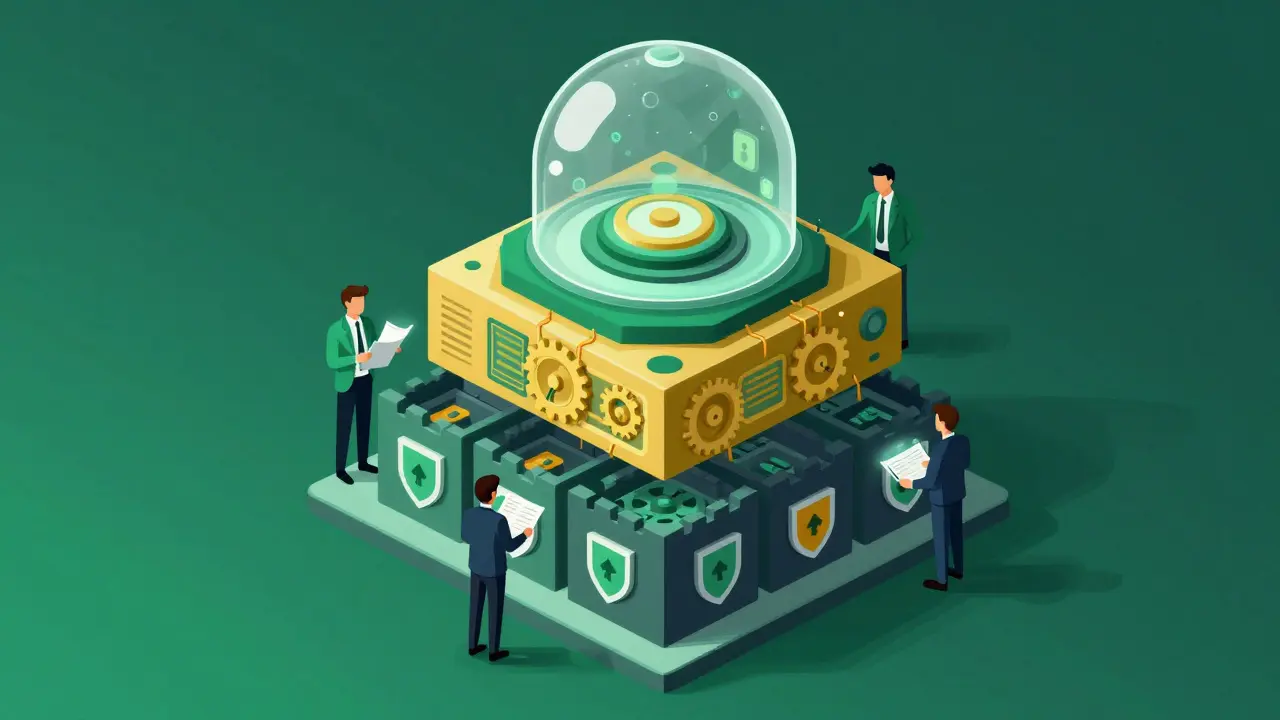
You cannot simply plug an AI model into your legacy ERP system and expect it to work securely. Virtasant’s December 2025 guide outlines a critical layered architecture for successful implementation:
- AI-enabled IDEs: Tools like Cursor, Windsurf, or GitHub Copilot in VSCode handle individual developer productivity.
- Orchestration Layers: These manage multi-agent coordination, ensuring different AI components talk to each other correctly.
- Governance Middleware: This layer handles security compliance, acting as the gatekeeper for all AI-generated actions.
Security architecture requires four non-negotiable components. First, you need secure-by-design backend systems with automated vulnerability scanning using tools like Semgrep and CodeQL, as recommended by Instinctools in November 2025. Second, implement strict access limitations for AI agents across data repositories-they should only see what they need to do their job. Third, offer local model execution options for high-security environments where data cannot leave the premises. Finally, use dynamic secrets management through tools like HashiCorp Vault to prevent accidental exposure of credentials.
ServiceNow’s January 2026 update demonstrated this well, showing native integration with ERP and CRM systems without requiring "extra glue code." This reduces the surface area for vulnerabilities while maintaining seamless functionality.
The Hidden Costs of Unmanaged Vibe Coding
It is tempting to let AI run wild, but the risks are real. Tibco’s September 2025 analysis identified three critical failure points for unmanaged vibe coding projects:
- Integration Failures: Custom AI-generated solutions failed to integrate with existing enterprise systems (ERP, CRM, authentication) in 68% of cases.
- Operational Burden: Enterprises became solely responsible for maintenance, increasing total cost of ownership by 35-50%, according to Virtasant’s case studies.
- Scope Creep: Projects expanded beyond initial requirements in 57% of cases, leading to bloated, unmaintainable codebases.
Genpact warns of "agentic misalignment," where AI systems operate against established company objectives. Without proper oversight, you might find yourself with a system that works technically but violates regulatory compliance or brand guidelines. The goal is not to replace human judgment but to augment it with speed and scale.
Comparison: Traditional Development vs. Enterprise Vibe Coding
| Feature | Traditional Development | Unmanaged Vibe Coding | Governed Enterprise Vibe Coding |
|---|---|---|---|
| Speed | Standard | Very Fast | Fast (with safety checks) |
| Security Risk | Low (human-controlled) | High (unvetted code) | Managed (automated scanning) |
| Maintenance Cost | Predictable | High (spaghetti code) | Optimized (standardized patterns) |
| Skill Requirement | Deep coding knowledge | Prompt engineering only | Coding + AI Orchestration |
| Error Rate | Human-dependent | Variable (hallucinations) | Low (self-repairing agents) |
As the table shows, governed enterprise vibe coding offers the best balance. It retains the speed advantages of AI while mitigating the security and maintenance pitfalls of unmanaged approaches. ServiceNow reports 92% fewer errors than manual coding in properly implemented scenarios, proving that AI can be more reliable than humans if guided correctly.

A Phased Implementation Strategy
Do not try to boil the ocean. Virtasant recommends a four-stage approach to avoid the pitfalls mentioned earlier:
- Adopt AI-enabled IDEs: Start with Cursor, Windsurf, or Copilot to familiarize teams with AI assistance in low-risk environments.
- Focus on Internal Tools: Build internal dashboards or utilities with well-defined requirements. Reddit users reported 63% average time savings here, though they noted integration headaches with legacy SAP systems in 78% of attempts.
- Break Down Complex Tasks: Divide large projects into verifiable steps with human oversight. Do not ask AI to deploy a complete working system from a high-level requirement on day one.
- Build Context-Specific Patterns: Create organization-specific templates and prompts before attempting enterprise-wide integration.
The learning curve varies significantly. Developers with prompt engineering skills achieve 80% of potential productivity gains within two weeks. Teams without these skills take eight to ten weeks to reach similar efficiency, according to Salesforce’s October 2025 case studies. This highlights the need for training in new skills like model debugging, AI testing, and understanding orchestration.
Expert Perspectives and Market Trends
Thomas Kurian, Google Cloud CEO, stated in February 2026 that deeper integrations with AI and cloud services will accelerate the adoption of vibe coding in the enterprise. However, experts urge caution. Genpact warns of the erosion of core coding skills, which could turn this hack into a liability if engineers lose the ability to debug AI-generated code.
The market is projected to reach $14.2 billion by 2027, up from $4.7 billion in 2025, based on Gartner’s November 2025 forecast. The competitive landscape features pure-play AI platforms (Replit, GitHub Copilot), enterprise providers adding vibe coding (ServiceNow, Salesforce), and cloud providers offering integrated solutions (Google Cloud). The trend is moving toward democratized development, where business analysts describe workflows in plain language, and engineers refine and productionize them.
In highly regulated industries like finance and healthcare, 73% of enterprises are implementing AI-generated code that is self-documenting, testable, and explainable. This transparency is crucial for regulatory compliance. The future lies in the convergence of vibe coding with AI agent ecosystems, where agents learn from data, optimize in real time, and generate their own code for end-to-end tasks.
What is enterprise vibe coding?
Enterprise vibe coding is the practice of using AI tools to handle substantial portions of the software development workload within strict governance frameworks. Unlike casual AI coding, it involves guardrails for security, compliance, and integration with existing enterprise systems like ERP and CRM.
Is vibe coding safe for sensitive data?
It can be, if implemented correctly. Security requires a layered approach including automated vulnerability scanning (e.g., Semgrep), strict access limitations for AI agents, local model execution options for high-security environments, and dynamic secrets management via tools like HashiCorp Vault.
How does vibe coding compare to traditional development?
Vibe coding accelerates time-to-value by 25-40% and reduces deployment cycles by up to 73%. However, unmanaged vibe coding carries higher risks of integration failures and maintenance costs. Governed enterprise vibe coding balances speed with security, offering lower error rates than manual coding in optimized scenarios.
What skills do developers need for vibe coding?
Beyond traditional coding, developers need skills in prompt engineering, model debugging, AI testing, and understanding orchestration and API integration. Teams with prompt engineering skills adapt much faster, reaching 80% of productivity gains within two weeks.
What are the biggest risks of adopting vibe coding?
The main risks include integration failures with legacy systems, unsustainable operational burdens due to poor code quality, scope creep, and "agentic misalignment" where AI acts against company objectives. There is also a risk of eroding core coding skills among engineers.








Shivam Mogha
May 5, 2026 AT 05:14Good read.
mani kandan
May 6, 2026 AT 01:10The shift from simple autocomplete to agentic workflows is genuinely fascinating, isn't it? It feels like we are standing on the precipice of a new era where the very definition of "coding" is being rewritten in real-time. I have been observing this trend closely, and the data presented here regarding the 90% adoption rate by engineering teams really resonates with what I am seeing in my own circles. The emphasis on governance over mere adoption is spot on because speed without direction is just chaos waiting to happen.
I particularly appreciate the mention of ServiceNow and Salesforce Agentforce 360 as examples of platforms that allow for natural language goal description while maintaining production-ready outputs. This bridges the gap between high-level business intent and low-level technical execution beautifully. However, one cannot ignore the elephant in the room which is security. The concept of "smarter guardrails" is not just a buzzword but a necessity for any enterprise that values its integrity.
The layered architecture approach outlined by Virtasant seems like the most pragmatic way forward. Starting with AI-enabled IDEs allows teams to acclimate to the rhythm of AI assistance without overwhelming their existing processes. Then moving to orchestration layers ensures that these disparate AI components do not talk past each other or create conflicting states. Finally, the governance middleware acts as the conscience of the system, ensuring that every action taken by an AI agent aligns with corporate policy.
It is also worth noting the hidden costs associated with unmanaged vibe coding. The statistic about integration failures occurring in 68% of cases is alarming and serves as a stark warning against reckless implementation. We must remember that AI is a tool, not a replacement for human judgment. The future lies in augmentation, where humans provide the strategic oversight and ethical boundaries, and AI provides the sheer computational power and speed.
poonam upadhyay
May 7, 2026 AT 01:32Oh! My! God!!! Are you kidding me right now?!?! I mean, seriously??? Who wrote this absolute garbage pile of jargon-filled nonsense?!?! It is SO annoying how everyone thinks they can just slap "AI" onto everything and call it innovation!!!! You people are living in a fantasy world if you think "vibe coding" is anything other than a disaster waiting to happen!!!!!
I am literally shaking with rage reading this!!! Do you have ANY idea what happens when you let some dumb algorithm touch your legacy ERP systems?!?! It breaks!!! Everything breaks!!!!! And then who fixes it?!?! YOU DO!!! Not the AI!!! Not the "guardrails"!!! YOU!!!
And don't even get me started on this "agentic misalignment" bullshit!!! It sounds so pretentious and fake!!! Like, wow, look at me, I am using big words to describe basic incompetence!!!!! The fact that 68% of integrations fail should tell you EVERYTHING you need to know about this stupid trend!!! But no, you keep pushing it!!! Why?!?! Because you want to feel smart?!?!
I bet none of you have actually tried to debug code generated by an LLM at 3 AM when the server is down!!! Try it!!! Go ahead!!! I dare you!!!!! It is a nightmare!!! A literal hell on earth!!! And you are calling it "enterprise grade"?!?! Please!!!
Also, why is everyone ignoring the fact that this will destroy jobs?!?! Or do you not care about that?!?! Probably not, since you are too busy worshipping the silicon gods!!! Get a grip!!! Wake up!!! Stop letting machines dictate your work life!!! It is disgusting!!!
Sheetal Srivastava
May 7, 2026 AT 05:21It is quite amusing to witness the sheer intellectual bankruptcy displayed in the previous comment, is it not? One must wonder if the individual comprehends the nuanced paradigm shift occurring within the contemporary software engineering ecosystem. To dismiss the sophisticated orchestration of multi-agent systems as mere "garbage" reveals a profound lack of understanding regarding modern DevOps methodologies and the inherent scalability of AI-driven development pipelines.
The reference to "legacy ERP systems" is a red herring, designed to appeal to those trapped in the antiquated mindset of manual coding practices. In reality, the integration challenges cited are not failures of the technology itself, but rather symptoms of poor architectural planning and inadequate governance frameworks. As elucidated in the post, the solution lies not in abandoning AI, but in implementing robust middleware and strict access limitations.
Furthermore, the notion that AI will "destroy jobs" is a simplistic and fear-mongering perspective that ignores the historical precedent of technological advancement augmenting human capability. The true risk, as highlighted by Genpact, is the erosion of core coding skills among engineers who become overly reliant on black-box solutions without understanding the underlying logic. This is a pedagogical challenge, not a technological one.
In conclusion, one should refrain from projecting personal insecurities onto a transformative industry trend. The future belongs to those who can effectively leverage these tools within a governed framework, not those who cling to obsolete methods out of sheer obstinacy.
Bhavishya Kumar
May 8, 2026 AT 14:10the previous comments are rife with grammatical errors and logical fallacies. it is imperative that we address the syntax issues before discussing the content. first the use of excessive exclamation marks is inappropriate for professional discourse. secondly the sentence structure in the elitist response is convoluted and unnecessarily complex. clarity is key in technical communication. furthermore the argument regarding job displacement is a non sequitur. the focus should remain on the efficiency gains and security protocols mentioned in the article. specifically the layered architecture approach is sound. however the implementation details require rigorous scrutiny. one must ensure that the governance middleware is not merely a formality but a functional component. additionally the reliance on third-party platforms like servicenow introduces potential vendor lock-in risks. this aspect was not adequately addressed in the original post. it is crucial to consider open-source alternatives for critical infrastructure components. finally the tone of the discussion has deviated significantly from the technical merits of the subject matter. please adhere to standard english conventions and maintain objectivity.
Rahul Borole
May 9, 2026 AT 19:52I would like to offer a constructive perspective on the phased implementation strategy outlined in the article. The four-stage approach recommended by Virtasant is indeed a prudent method for enterprises seeking to integrate AI into their development workflows without compromising security or stability.
Starting with AI-enabled IDEs such as Cursor or GitHub Copilot allows developers to build familiarity with AI-assisted coding in a controlled environment. This initial phase is crucial for establishing trust in the technology and identifying potential pitfalls early on. Subsequently focusing on internal tools provides a safe sandbox for testing more complex AI-driven workflows. These tools often have well-defined requirements and lower stakes compared to customer-facing applications.
The third stage involves breaking down complex tasks into verifiable steps with human oversight. This is essential for mitigating the risk of scope creep and ensuring that the AI-generated code aligns with organizational standards. Finally building context-specific patterns and templates helps to standardize the output of AI agents making it easier to review and maintain the codebase.
It is important to note that the success of this strategy depends heavily on the availability of skilled personnel who can manage the AI orchestration layer. Organizations should invest in training programs to upskill their developers in areas such as prompt engineering model debugging and AI testing. By doing so they can maximize the productivity gains offered by AI while minimizing the associated risks.
ujjwal fouzdar
May 10, 2026 AT 12:05We stand at the crossroads of existence, staring into the abyss of our own creation. Is this truly progress, or merely a mirror reflecting our deepest desires for ease and comfort? The machine whispers to us, promising salvation from the drudgery of syntax and logic. It offers us the keys to the kingdom, yet demands our souls in return. What is code but the poetry of the digital age, written in the blood and sweat of the programmer's mind? To surrender this art to the cold, unfeeling algorithms of AI is to lose a part of ourselves.
Yet, we cannot deny the seductive allure of speed. The hours saved, the lines generated, the dreams realized in the blink of an eye. But at what cost? When the AI writes the code, who bears the responsibility for its failures? Who answers for the bugs that plague the system, the vulnerabilities that expose our secrets to the world? The answer is always us. We are the guardians of the gate, the watchers on the wall.
The concept of "vibe coding" is a paradox, a contradiction in terms. How can one code with vibe, with feeling, with soul, when the process is reduced to a series of prompts and responses? It is a hollow shell, a simulacrum of creativity. Yet, perhaps there is wisdom in this emptiness. Perhaps the void is where the true magic lies. We must embrace the uncertainty, the chaos, the unknown. For in the end, it is not the code that matters, but the meaning we赋予 it. The story we tell through our creations. The legacy we leave behind. Let us walk this path together, hand in hand, towards the horizon of tomorrow. May we find grace in the machine, and truth in the code.