
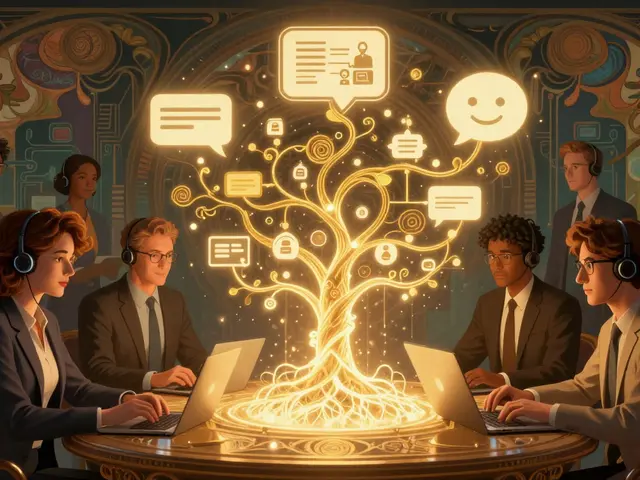
Think about how you learned to speak. You didn’t start with a textbook of correct sentences. You heard thousands of conversations, read books, watched videos, and slowly figured out patterns-what sounds right, what doesn’t. Large language models (LLMs) learn the same way. No human labels. No flashcards. Just raw text from the internet, fed into a system that asks: What comes next?
How Self-Supervised Learning Works
Self-supervised learning sounds complicated, but it’s surprisingly simple. Imagine you’re reading a sentence: "The cat sat on the ___". You don’t need someone to tell you the answer. You just guess. "Mat?" "Floor?" "Lap?" The model does the same thing-millions of times. It takes text, hides a word, and tries to predict it. Then it checks its guess against what was actually there. Repeat this for trillions of sentences, and the model starts to understand grammar, context, and even logic.
This isn’t random guessing. It’s structured. The model learns from pretext tasks-problems it creates for itself. Masked language modeling (like BERT) hides words and asks the model to fill them in. Autoregressive modeling (like GPT) looks at everything before a word and predicts the next one. Both methods turn unlabeled text into its own teacher. No humans needed. No expensive annotations. Just data, and a lot of it.
The Scale: Trillions of Tokens, Not Billions
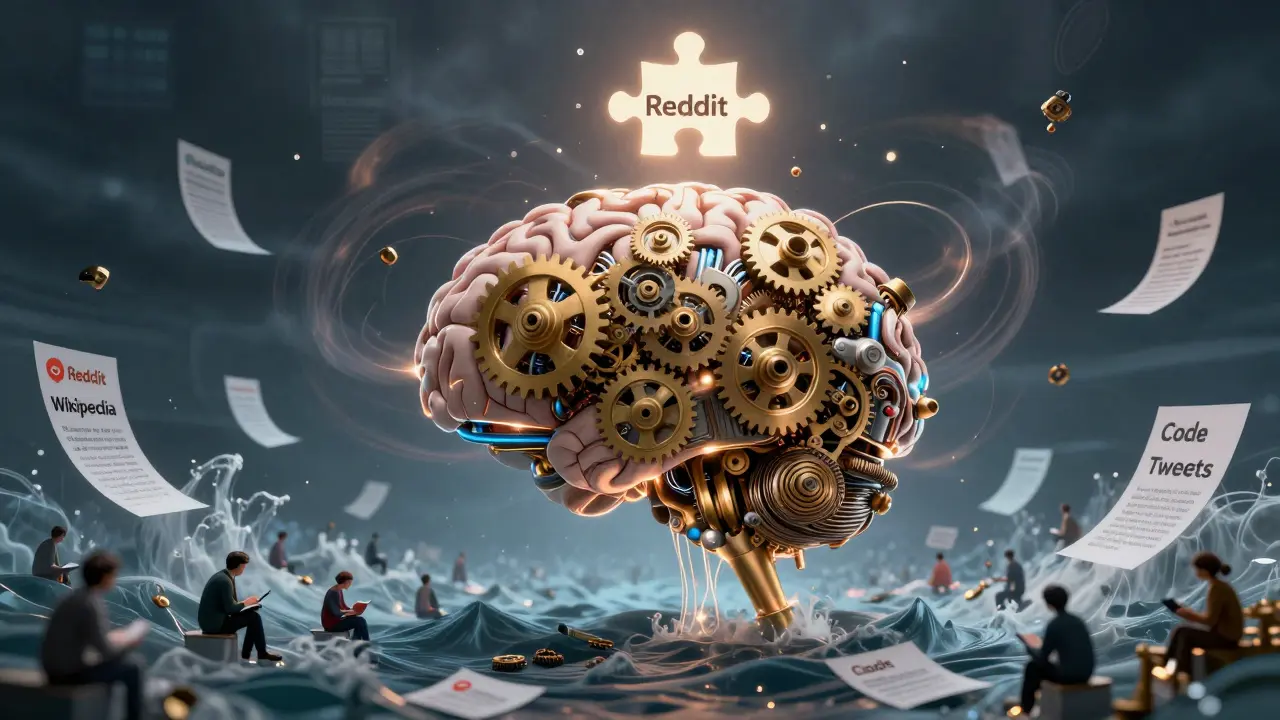
Early models like GPT-3 trained on 300 billion tokens. That’s impressive. But today’s models? Llama 3 was trained on 15 trillion tokens. That’s 50 times more. What’s a token? Think of it as a word, or part of a word. "Running" might be split into "run" and "ning." The model sees these fragments billions of times, in every possible context-blogs, Reddit threads, Wikipedia, code repositories, books, forums, tweets.
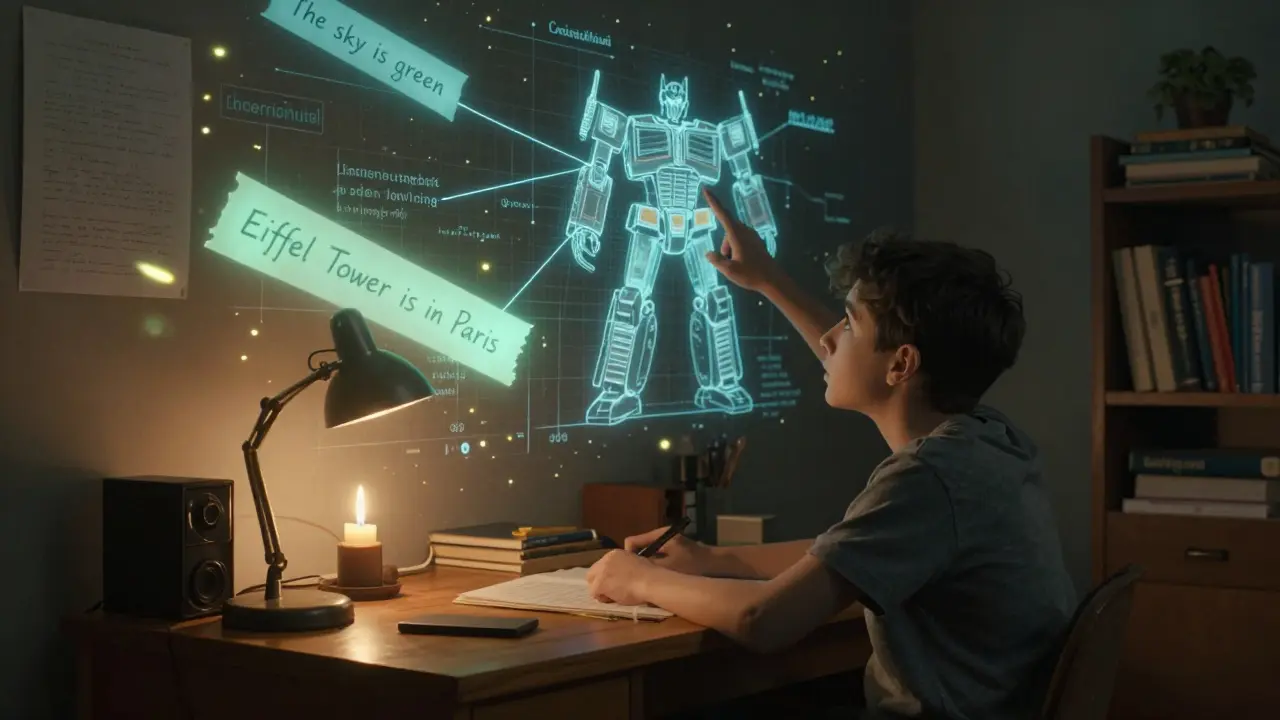
This isn’t just about quantity. It’s about diversity. The training data comes from every corner of the public internet. That’s why LLMs can write like a poet, explain quantum physics, or draft a legal contract. They’ve seen it all. But this also means they’ve seen everything-bias, misinformation, hate speech, nonsense. The model doesn’t know what’s true or false. It only knows what’s common. If 10 million people wrote "The sky is green," the model might think that’s plausible. That’s why hallucinations happen.
The Transformer: The Engine Behind the Magic
Before 2017, models processed text one word at a time, like reading a book from left to right. That was slow. Then came the Transformer architecture, introduced in Google’s paper "Attention Is All You Need." The breakthrough? Parallel processing. Instead of waiting for each word, the model looks at the whole sentence at once. It asks: "Which words matter most here?" That’s attention.
Imagine you’re reading a sentence: "The Eiffel Tower is in Paris, not Berlin." The model doesn’t just see "Paris." It notices the contrast with "Berlin." It links "Eiffel Tower" to "Paris" even if they’re far apart. That’s attention. And it’s why modern LLMs can handle long documents, complex reasoning, and even code. GPT-3 had 175 billion parameters. Llama 3 has 405 billion. These numbers aren’t just marketing-they represent how much the model can remember and connect.
Costs, Compute, and Carbon
Training a model like GPT-3 took 3,640 petaflop/s-days. That’s 3,640 supercomputers running for a full day. Llama 3? Over 15,000 petaflop/s-days. The electricity used is staggering. A 2020 study from the University of Massachusetts found GPT-3’s training emitted 552 metric tons of CO2-equivalent to 123 gasoline-powered cars driven for a year. And that was three years ago. Today’s models are bigger. More powerful. More expensive.
Most companies can’t afford this. Only tech giants like Meta, Google, and OpenAI have the infrastructure. That’s why most users don’t train models from scratch. They use APIs-OpenAI’s GPT-4, Anthropic’s Claude, or open-source models like Llama 3. Fine-tuning a pre-trained model on your own data costs a fraction. But even that requires powerful GPUs. Many teams hit memory limits. One developer on Reddit said their fine-tuned Llama 3 model crashed because their 80GB GPU ran out of space. Training isn’t just a technical challenge. It’s a financial one.
What Self-Supervised Learning Can’t Do
Here’s the catch: self-supervised learning gives you a smart text predictor. Not a smart assistant. It knows what words fit together. But it doesn’t know truth from fiction. It doesn’t understand ethics. It doesn’t care about accuracy. That’s why models like GPT-3, GPT-4, and Claude 3 still get things wrong. A 2024 study from Anthropic showed that even the latest models only scored 58% on TruthfulQA-a benchmark designed to catch lies and hallucinations.
And that’s not all. These models memorize. A 2023 study by Carlini et al. found that GPT-2 could regurgitate entire paragraphs from training data-down to copyright-protected text. That’s why companies like Anthropic and Meta now filter data aggressively. They remove personal info, copyrighted content, and toxic material. But filtering isn’t perfect. Bias slips through. Misinformation sticks. A 2023 Allen Institute study found that 42% of LLM responses contained false claims when tested on factual questions.
The Next Step: Fine-Tuning
Self-supervised learning is step one. Step two is fine-tuning. This is where models learn to follow instructions. To be helpful. To be safe. Researchers use human-labeled examples: "Answer this question clearly." "Avoid biased language." "Cite sources."
Companies like Anthropic use something called Constitutional AI-training models to follow principles like "be honest" or "don’t make things up." OpenAI uses reinforcement learning with human feedback (RLHF). Meta fine-tunes Llama 3 on thousands of instruction-response pairs. The result? Models that don’t just predict text-they respond like assistants.
But here’s the trade-off: the more you fine-tune, the more you lose the model’s original breadth. A model trained only on medical data can’t write poetry. A model trained only on legal documents won’t help with coding. That’s why most enterprises combine fine-tuning with retrieval systems-pulling in real-time data to keep answers accurate.
Who’s Using This and Why
By 2024, 78% of Fortune 500 companies were using LLMs in production. Not for fun. For work. Customer service bots. Summarizing contracts. Writing code. Generating reports. One O’Reilly survey found that 63% of deployments are internal-tools for employees, not customers.
Startups can’t train their own models. So they use APIs. A small SaaS company might pay $0.002 per query to use GPT-4. That’s cheaper than hiring a writer. But even that adds up. Many teams now use open-source models like Llama 3. They host them on their own servers. It’s slower. Less polished. But cheaper. And private.
Regulations are catching up. The EU AI Act, effective August 2026, will require companies to disclose training data sources for models over 10 billion parameters. The U.S. Copyright Office is investigating whether training on copyrighted books is legal. The legal landscape is shifting fast.
What’s Next
Models are getting bigger, but the real innovation isn’t scale-it’s efficiency. Researchers are exploring ways to train models on less data. Better filters. Smarter sampling. Multimodal training-where models learn from text, images, and audio together. Google’s Gemini 1.5 Pro already handles 1 million-token contexts. That’s a 300-page document in one go.
But the core idea stays the same: predict the next word. Over and over. On enough data, patterns emerge. Intelligence appears. Not because we told the model how to think. But because it learned from us.
Self-supervised learning at internet scale didn’t just change AI. It changed how we build intelligence. No more hand-crafted rules. No more manual labeling. Just data. And a model that learns by doing.



Kate Tran
March 4, 2026 AT 11:18amber hopman
March 4, 2026 AT 15:50Jim Sonntag
March 6, 2026 AT 09:33Deepak Sungra
March 6, 2026 AT 14:11Samar Omar
March 7, 2026 AT 21:39chioma okwara
March 8, 2026 AT 12:13John Fox
March 10, 2026 AT 01:32Tasha Hernandez
March 11, 2026 AT 08:08Bridget Kutsche
March 11, 2026 AT 14:46Jack Gifford
March 12, 2026 AT 16:16