Imagine building a startup where nearly every line of code is written by an AI, not a human. That’s not a sci-fi prediction-it’s the reality for a quarter of Y Combinator's Winter 2025 batch. These founders didn’t just use AI as a helper; they embraced vibe coding, a term coined by Andrej Karpathy in early 2025, where developers describe what they want in plain English and let large language models (LLMs) handle the rest. The result? Codebases that are up to 95% AI-generated. But here’s the catch: does this speed come at the cost of stability, security, and sanity?
If you’re a founder, developer, or tech enthusiast wondering whether vibe coding is the future or a fad, you’re asking the right questions. This article breaks down what happened inside YC’s latest cohort, what the data says about code quality, and how you can decide if this approach fits your next project.
What Exactly Is Vibe Coding?
Vibe coding isn’t just using autocomplete on steroids. It’s a distinct workflow defined by accepting AI-generated code without deeply reviewing its internal logic. Andrej Karpathy, former AI lead at Tesla and OpenAI co-founder, described it as "fully giving in to the vibes"-you prompt the model, run the code, see if it works, and iterate via natural language feedback rather than manual debugging.
This differs sharply from traditional AI-assisted development. If you review, test, and understand every line the AI writes, you’re using an LLM as a typing assistant. In vibe coding, the understanding is often deferred or skipped entirely. The developer acts more like a product manager than an engineer, guiding the output through high-level instructions rather than low-level control.
The Y Combinator Data Point
In March 2025, Jared Friedman, managing partner at YC, revealed a startling statistic during a YouTube conversation: 25% of startups in the Winter 2025 batch had codebases that were 95% AI-generated. Some reports cited 90%, but either way, the trend is undeniable. This wasn’t limited to small tools; these were funded companies aiming for real markets.
YC leadership, including CEO Garry Tan and general partner Diana Hu, publicly endorsed this shift. They framed it not as a shortcut, but as a new baseline for rapid prototyping. For many founders, the goal was speed-to-market over architectural purity. If you can launch an MVP in days instead of months, why spend weeks perfecting class structures?
The Quality Trade-Off: What the Data Shows
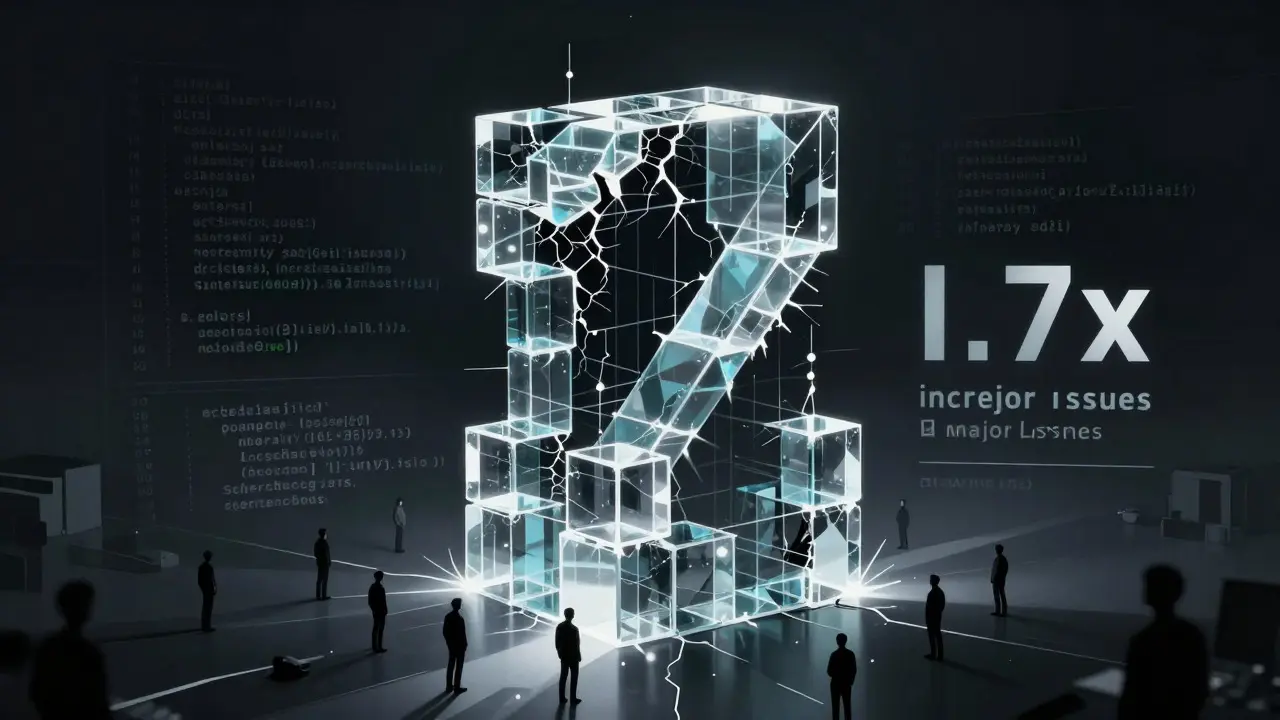
Speed sounds great until things break. A December 2025 analysis by CodeRabbit examined 470 open-source pull requests and found that AI-co-authored code contained 1.7 times more major issues than human-written code. Let’s break that down:
| Metric | Human-Written Baseline | AI-Co-Authored Increase |
|---|---|---|
| Major Issues (Logic/Security) | 1x | +70% |
| Logic Errors (Control Flow/Dependencies) | 1x | +75% |
| Security Vulnerabilities | 1x | +174% |
| Readability Issues | 1x | Significant Increase |
These aren’t minor formatting quirks. We’re talking about flawed control flows, incorrect dependencies, and misconfigurations that can crash production systems. Security vulnerabilities appeared 2.74 times more frequently in AI-generated code. For a startup handling user data, that’s a non-trivial risk.
Why Does This Happen? The Limits of Current LLMs
Large Language Models don’t "think" like engineers. They predict the next token based on patterns in training data. When problems get complex, those patterns blur. Gary Marcus, a cognitive scientist, argued that vibe coding often results in remixing existing solutions rather than solving novel problems. If the AI hasn’t seen a similar edge case, it might hallucinate a solution that looks right but fails under load.
Developers on Hacker News reported that while simple queries worked instantly, complex refactoring tasks led to inconsistent advice. One developer noted that for a straightforward database query fix, the AI nailed it. For a nuanced React component refactor, the AI repeatedly suggested keeping inefficient code. This variability means you can’t blindly trust the output-you need "taste," as Diana Hu put it, to spot when the model is off-base.
Scalability: The Million-User Question
Garry Tan raised a critical question: "Let's say a startup with 95% AI-generated code goes out [in the market], and a year or two out, they have 100 million users on that product. Does it fall over or not?"
Debugging AI-generated code is harder because the original intent might be lost. If you didn’t write the code, you might not know why a specific function exists. As codebases grow, the complexity of prompts required to maintain them increases exponentially. At some point, writing the prompt becomes harder than writing the code itself. This is the scaling wall many vibe coders hit after the initial prototype phase.
Who Should Use Vibe Coding?
Vibe coding isn’t one-size-fits-all. Here’s a quick decision framework:
- Great for: Weekend projects, internal tools, MVPs, and prototypes where speed matters more than long-term maintenance.
- Risky for: Financial systems, healthcare apps, high-security platforms, and products expected to scale rapidly without a dedicated engineering team.
If you’re a solo founder with no technical background, vibe coding lets you build something tangible fast. But if you’re building a core product feature that will define your company’s reputation, you’ll likely need human oversight sooner than later.
Practical Tips for Surviving the Vibe
If you’re diving into vibe coding, don’t go in blind. Experienced practitioners suggest these guardrails:
- Use Strict Type Systems: Languages like TypeScript catch errors that LLMs often miss. Enforce strict typing to reduce runtime surprises.
- Prioritize Test Coverage: Since you’re not reading every line, tests become your safety net. Write comprehensive unit tests before accepting AI code.
- Simplify Regularly: AI tends to over-engineer. Schedule regular refactoring cycles to simplify code and remove bloat.
- Prompt for Clarity: Ask the model for "clean, simple, and elegant code." Explicit constraints help guide the output toward maintainable patterns.
The Bigger Picture: Homogenization of Software
There’s a subtle ecosystem impact too. LLMs gravitate toward popular libraries seen frequently in training data. This creates a homogenization effect where newer, innovative open-source tools struggle to gain traction because the AI doesn’t "know" them well. Over time, this could stifle diversity in the software stack, pushing everyone toward the same few frameworks.
Moreover, AI doesn’t submit bug reports. If a library has a flaw, human developers notice and report it. AI just works around it silently. This reduces feedback loops that keep open-source projects healthy.
Final Thoughts: Adapt, Don’t Abandon
Vibe coding is here to stay, but it’s not a replacement for engineering fundamentals. The YC data shows it works for getting ideas out the door fast. The CodeRabbit data warns that it introduces risks that compound over time. The smartest approach? Use vibe coding to accelerate the boring parts, but keep humans in the loop for architecture, security, and critical logic.
As we move deeper into 2026, expect tools to evolve. Fine-tuned models and better integration with execution environments will reduce errors. But for now, treat AI-generated code like a junior developer’s first draft: useful, promising, but always requiring review.
Is vibe coding suitable for production environments?
It depends on the criticality. For MVPs and internal tools, yes. For high-stakes production systems handling sensitive data or high traffic, pure vibe coding is risky without rigorous testing and human review. Most successful teams use a hybrid approach.
Do I still need to learn programming if I use vibe coding?
Yes. Understanding basic concepts helps you judge the AI's output, debug unexpected behaviors, and structure your prompts effectively. Without foundational knowledge, you may struggle to identify when the AI is generating plausible but incorrect code.
What are the biggest security risks with AI-generated code?
The main risks include insecure defaults, improper input validation, and outdated library versions. Studies show AI code has nearly 3x more security vulnerabilities than human code, often due to hallucinated API usage or missing error handling.
How does vibe coding differ from standard AI-assisted coding?
Standard AI-assisted coding involves reviewing and understanding generated code. Vibe coding accepts the output with minimal review, relying on functional testing rather than structural comprehension. The key difference is the level of human engagement with the code's internal logic.
Can vibe coding scale to millions of users?
It can, but it requires significant investment in refactoring and optimization post-launch. Initial AI code is rarely optimized for scale. Successful scaling usually involves bringing in experienced engineers to restructure the codebase once the product gains traction.