
You’ve built the prototype. It works. The stakeholders are impressed. But then you hit the "production cliff."
It’s the moment every AI team dreads. Your GPT-4 APIa proprietary language model endpoint that charges per token and offers immediate access to state-of-the-art capabilities bill jumps from $50 to $5,000 in a week because an agentic loop went infinite. Or your latency spikes to four seconds per response because the provider is overloaded. Or legal stops the project because sending customer data to a third-party server violates GDPR.
This isn’t a failure of technology. It’s a failure of architecture. Most teams treat Large Language Models (LLMs) like traditional software libraries-install them once and forget them. They aren’t. They are probabilistic, expensive, and volatile. The gap between a working demo and a hardened production system is where most AI projects die.
The Prototype Trap: Why APIs Feel Like Magic
Let’s be honest about why we start with APIs. It’s fast. You don’t need to buy GPUs. You don’t need to hire an MLOps engineer to manage clusters. You just write a Python script, call the endpoint, and get a result.
In the early stages, this is exactly what you want. You’re testing product-market fit. You’re using tools like LangChaina framework for developing applications powered by language models, enabling chain building and prompt management to stitch together prompts and logic. You might use FastAPIa modern, fast web framework for building APIs with Python 3.7+ based on standard Python type hints to expose your logic. This stack lets you validate if users actually care about your feature before spending six months on infrastructure.
But there’s a hidden cost to this speed. When you rely entirely on external APIs, you surrender control over three critical levers:
- Cost Predictability: Per-token pricing scales linearly with usage. If your app goes viral, your margins vanish overnight.
- Latency Consistency: You’re at the mercy of the provider’s network load and queue times.
- Data Privacy: Every prompt leaves your environment. For healthcare, finance, or legal tech, this is often a dealbreaker.
I’ve seen teams build brilliant prototypes that they couldn’t launch because the cost per interaction was too high to sustain. The prototype worked; the business model didn’t.
Production Hardening: The Case for Open-Source LLMs
When you move to production, the goal shifts from "does it work?" to "can it scale reliably and affordably?" This is where Open-Source LLMslanguage models like Llama, Mistral, or Falcon that allow self-hosting, fine-tuning, and full data control enter the picture.
Self-hosting isn’t just about saving money. It’s about sovereignty. Consider a real-world case study involving an enterprise contract review system. The team started with GPT-4 via API. It worked well for structuring clauses. But as volume grew, two things happened: costs spiraled, and latency became unacceptable for high-volume clients.
They transitioned to a production-hardened stack:
- Model: An open-source base model fine-tuned with LoRA (Low-Rank Adaptation)a parameter-efficient fine-tuning method that updates only a small subset of weights, reducing memory requirements.
- Infrastructure: Deployed on AWS SageMaker with auto-scaling endpoints.
- Orchestration: LangChain combined with CrewAIa framework for orchestrating multi-agent systems, allowing specialized agents to collaborate on complex tasks for validation.
- Monitoring: LangSmithan observability platform for debugging and monitoring LLM applications for tracing and Prometheus for latency metrics.
The results were stark. They achieved a 58% reduction in document review time. More importantly, inference latency dropped to 1.2 seconds per page, and costs fell by 45% compared to the API-only approach. The ROUGE score-a metric for evaluating text generation quality-improved by 12% because the model was fine-tuned specifically on their legal domain.
This isn’t just a nice-to-have. In regulated industries, it’s mandatory. Self-hosting ensures zero data leakage. You comply with HIPAA or GDPR by keeping data on-premise or in private cloud instances. You also gain the ability to customize behavior without waiting for a vendor’s roadmap.
The Cost Equation: When Does Self-Hosting Pay Off?
Don’t jump to self-hosting blindly. Hardware is expensive. A single NVIDIA A100 GPU can cost tens of thousands of dollars, and you’ll need 40GB to 800GB of VRAM depending on your model size. You also need engineers who understand Kubernetes, Docker, and quantization.
So, how do you decide? Look at your volume.
| Factor | API-Based (e.g., GPT-4) | Self-Hosted (e.g., Llama 3) |
|---|---|---|
| Upfront Cost | Near zero | High (Hardware + Engineering) |
| Marginal Cost | High (Per-token fees) | Low (Fixed infrastructure cost) |
| Break-Even Point | Best for low/variable volume | Best for high, consistent volume |
| Latency Control | Variable (Network dependent) | Predictable (Local optimization) |
| Data Privacy | Risk of exposure | Full control |
If you’re processing thousands of requests daily, the per-token fees will eventually exceed the cost of running a dedicated GPU cluster. I’ve seen teams break even within three months of launching a high-traffic feature. If you’re building a niche tool with sporadic usage, stick with APIs.
The Hybrid Approach: Best of Both Worlds
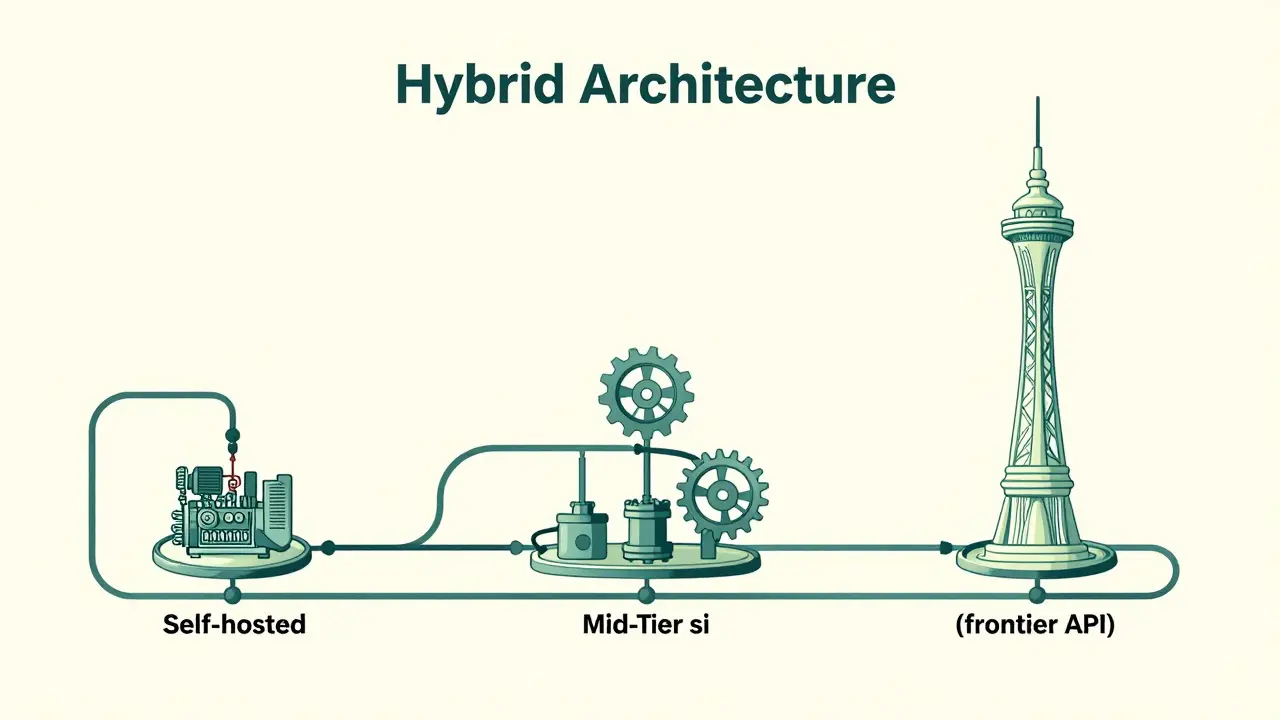
Here’s the secret that mature AI teams know: you don’t have to choose one or the other. The most robust architectures are hybrid.
Imagine routing your traffic intelligently:
- 70% of requests: Go to a lightweight, self-hosted open-source model like Llama 3 8B. These handle routine queries cheaply and quickly.
- 20-25% of requests: Route to mid-tier APIs for complex reasoning tasks where the open-source model struggles.
- 5-10% of requests: Send to frontier models like GPT-4 for edge cases requiring maximum accuracy.
This tiered routing can reduce costs by 60-80% while maintaining performance. You’re not just saving money; you’re diversifying risk. If the API provider goes down, your core functionality still runs on your local servers.
Add Semantic Cachinga technique that stores responses to similar queries, returning cached results when new inputs exceed a similarity threshold (e.g., 0.95 cosine similarity) to the mix. If a user asks a question that’s 95% similar to one asked ten minutes ago, return the cached answer. In repetitive domains like customer support, cache hit rates can reach 50-70%, slashing both latency and cost.
Operational Maturity: Monitoring the Unpredictable
Traditional software is deterministic. Input A always produces Output B. LLMs are not. This is why "prompt drift" happens. A prompt that works perfectly in development fails in production because real users ask questions in ways you didn’t anticipate.
To harden your system, you need rigorous evaluation:
- Automated Metrics: Use scripts to check for basic compliance (e.g., JSON format, length limits) on 100% of outputs.
- LLM-as-Evaluator: Use a stronger model to grade the output of your primary model on a sample of 10-20% of traffic. Check for relevance, tone, and hallucination.
- Human Review: Reserve budget for humans to review high-stakes decisions (5-10% of traffic). This feedback loop is essential for retraining.
Monitor weekly. Sample 100 production inputs and compare them against your baseline. If performance degrades by more than 5%, trigger an investigation. Remember, providers update their models silently. What worked last month might behave differently today.
Next Steps for Your Architecture
If you’re currently prototyping, keep using APIs. Validate your idea. But start planning for the transition now. Abstract your model calls behind a unified interface. Don’t hardcode GPT-4 into your business logic. Build adapters so you can swap providers later.
Track your token usage meticulously. Calculate your break-even point for self-hosting. Identify which parts of your workflow are latency-sensitive or privacy-critical. These are your first candidates for moving to open-source models.
The future isn’t API vs. Open-Source. It’s intelligent orchestration. The teams that win will be those that treat LLMs not as magic black boxes, but as scalable, measurable, and manageable components of their infrastructure.
When should I switch from API to self-hosted LLMs?
Switch when your monthly API costs exceed the amortized cost of hardware and engineering maintenance, typically after reaching consistent high-volume usage. Also consider switching immediately if you face strict data privacy regulations like HIPAA or GDPR that prohibit sending data to third parties.
What is LoRA and why is it important for production?
LoRA (Low-Rank Adaptation) is a fine-tuning technique that allows you to customize a large language model for specific tasks without updating all its parameters. It significantly reduces memory requirements and training time, making it feasible to deploy custom models on limited hardware resources.
How does semantic caching reduce costs?
Semantic caching stores previous responses and checks if new queries are semantically similar (e.g., >0.95 cosine similarity). If a match is found, it returns the cached response instead of calling the LLM. This can reduce API calls by 50-70% in repetitive domains like customer support.
Is it worth using a hybrid architecture?
Yes. A hybrid approach routes simple tasks to cheaper, self-hosted models and complex tasks to powerful APIs. This balances cost efficiency with performance, reduces dependency on a single provider, and optimizes latency for different types of user queries.
What tools are essential for monitoring LLM production systems?
Essential tools include LangSmith or Arize for LLM-specific observability (tracking prompts, outputs, and costs), Prometheus and Grafana for infrastructure metrics (latency, throughput), and vector databases for storing context and enabling feedback loops.