Stop Typing, Start Reviewing: The New Way to Teach Code
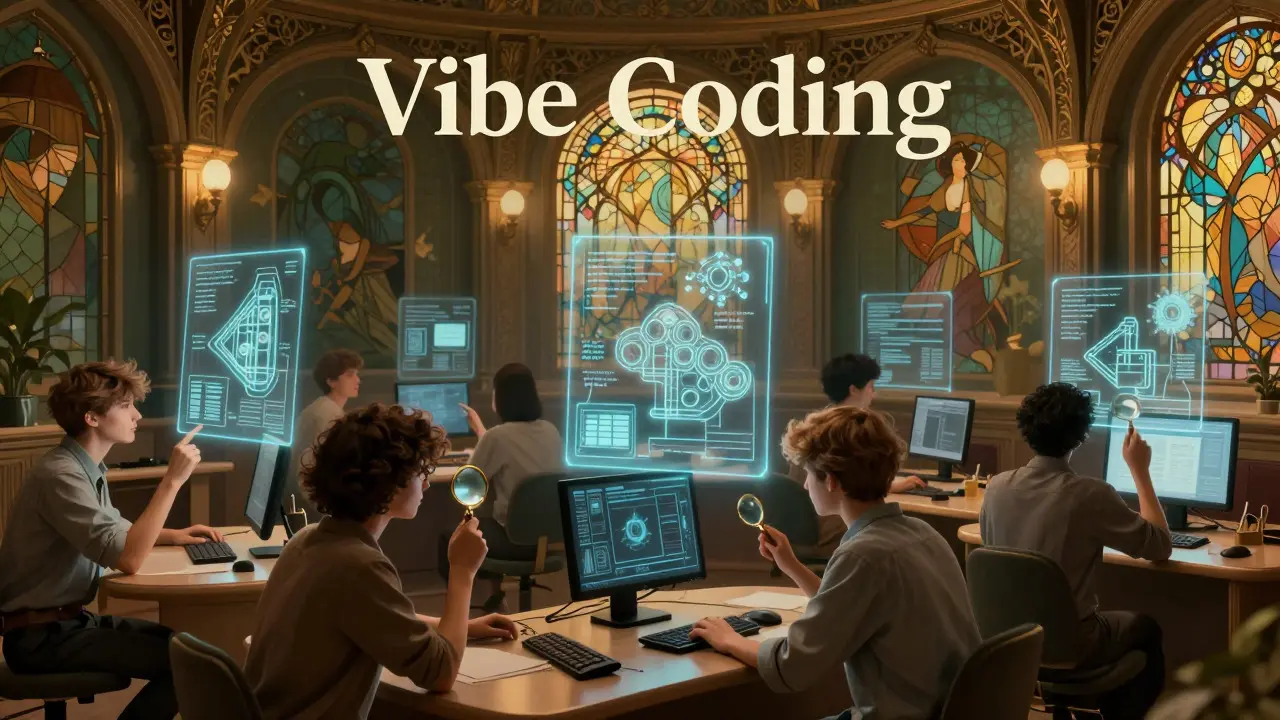
Imagine a classroom where students don't spend their first semester memorizing syntax rules or debugging missing semicolons. Instead, they sit back, describe what they want in plain English, and watch an AI build it. Then, the real work begins: they tear that code apart to understand why it works.
This is Vibe Coding, defined as an emerging pedagogical approach that leverages AI-assisted coding tools to teach software architecture principles through the deliberate inspection and analysis of AI-generated code. It’s not just about getting code written faster; it’s a fundamental shift in how we teach the skeleton of software-its architecture.
For decades, computer science education followed a strict ladder: learn variables, then loops, then functions, and only after years of climbing do you touch concepts like Model-View-Controller (MVC) or microservices. But in 2026, that ladder feels broken. Tools like Google AI Studio and platforms like Vibecode have democratized the creation of complex applications. The challenge for educators isn't teaching kids how to write code anymore; it's teaching them how to judge it.
Why Traditional Methods Are Failing Students
Let’s be honest about the current state of coding education. Most universities still rely on lecture-based instruction, where professors explain abstract concepts while students struggle to connect them to the messy reality of building software. According to a Stanford Learning Analytics study from January 2024, 63% of students fail to connect low-level code to higher-level design patterns. They can write a function, but they don’t know where it fits in the bigger picture.
This gap creates a crisis. When these students graduate, they bring accumulated technical debt into companies. An IEEE Educational Technology Study from September 2024 found that student projects often carry 27.3% more technical debt than professional equivalents because the foundational architectural understanding was never solidified. Furthermore, inconsistent coding patterns make collaboration nearly impossible, a frustration reported by 68.7% of instructors in an ACM survey.
The old way assumes that if you master the bricks, you’ll eventually understand the blueprint. Vibe coding flips this assumption. It argues that if you start with the blueprint-the architecture-you’ll quickly learn why the bricks are placed where they are.
How Vibe Coding Works in the Classroom
So, what does a vibe coding lesson actually look like? It starts with a prompt. A student asks an AI tool to "build a simple e-commerce page with a shopping cart." The AI generates the code instantly. In a traditional class, this might be considered cheating. In a vibe coding class, this is the textbook.
The core methodology relies on the Vibe Programming Framework, which establishes core educational principles including 'Verification Before Trust' requiring students to fully understand AI-generated components before implementation. Here is the typical workflow:
- Generation: The student uses natural language to generate a functional application using tools like Replit or Google AI Studio.
- Inspection: Instead of running the app, the student opens the code editor. They must identify the architectural patterns used. Where is the data stored? How does the frontend talk to the backend?
- Verification: The framework mandates that students achieve 95% comprehension of the generated components. They answer structured questions like, "Why did the AI choose a REST API here instead of GraphQL?"
- Refinement: Only after explaining the architecture in their own words do they modify the code, perhaps adding a feature or fixing a bug.
This process turns every student into a code reviewer. It mirrors the actual job market, where senior developers spend more time reviewing pull requests than writing new lines from scratch.

The Data Behind the Shift
Is this just a trendy idea, or does it actually work? The numbers suggest it’s highly effective, provided it’s done correctly. A University of Washington CS Department study from August 2024 showed that students using vibe coding achieved 42% faster comprehension of architectural patterns compared to those in traditional lecture-based courses.
However, there is a catch. These same students required 18% more time for initial code inspection activities. This is a crucial trade-off. You aren't saving time on the learning curve; you are investing time upfront to gain speed later. Google’s case studies highlight that beginners created functional web applications with proper MVC architecture in just 3 hours, versus 14 hours using traditional methods. That’s a massive efficiency gain once the inspection muscle is built.
But beware of "prompt dependency." An IEEE SIGCSE white paper from May 2024 warned that 57% of students initially focus exclusively on getting working code rather than understanding the underlying structure. Without structured protocols, retention drops sharply. UC Berkeley’s pilot program found that without the Vibe Framework’s verification steps, students retained only 32% of architectural concepts. With the protocols, that number jumped to 78%. The difference isn't the AI; it's the discipline of inspection.
| Feature | Traditional Syntax-First | Vibe Coding (Inspection-First) |
|---|---|---|
| Starting Point | Variables and Loops | Full Application Blueprint |
| Primary Skill | Syntax Memorization | Code Review & Analysis |
| Time to Architectural Proficiency | 12-18 Months | 3-6 Months |
| Risk Factor | Disconnection from Real-World Patterns | Prompt Dependency / Superficial Understanding |
| Best For | Low-Level Systems Programming | Full-Stack Web Development |
Tools Powering the Revolution
You can’t do vibe coding with a text editor and a compiler alone. You need platforms that facilitate inspection. Several key players are shaping this landscape in 2026.
Google AI Studio is a leading platform providing 'blueprint' visualization before full code generation, allowing students to inspect architectural decisions at multiple abstraction levels. Its recent "Architecture Lens" feature automatically highlights structural decisions in the code, making it easier for novices to see the forest for the trees. As of late 2024, it offers a free tier for education, lowering the barrier to entry significantly.
Then there’s Vibecode, a specialized platform launched in February 2024 that focuses heavily on mobile and interactive learning. Their "Pinch to Build" menu allows students to customize apps through direct interaction while seeing corresponding code changes in real-time. This visual feedback loop is critical for connecting abstract code to tangible results. While its documentation scores lower than Google’s (3.8/5 vs 4.6/5), its dedicated educational workflows are robust.
Replit Edu also plays a major role, offering version history and inspection logs that help maintain academic integrity. At $15 per student per year, it’s a cost-effective option for schools looking to integrate these tools without breaking the budget.
The Instructor’s Dilemma: From Lecturer to Guide
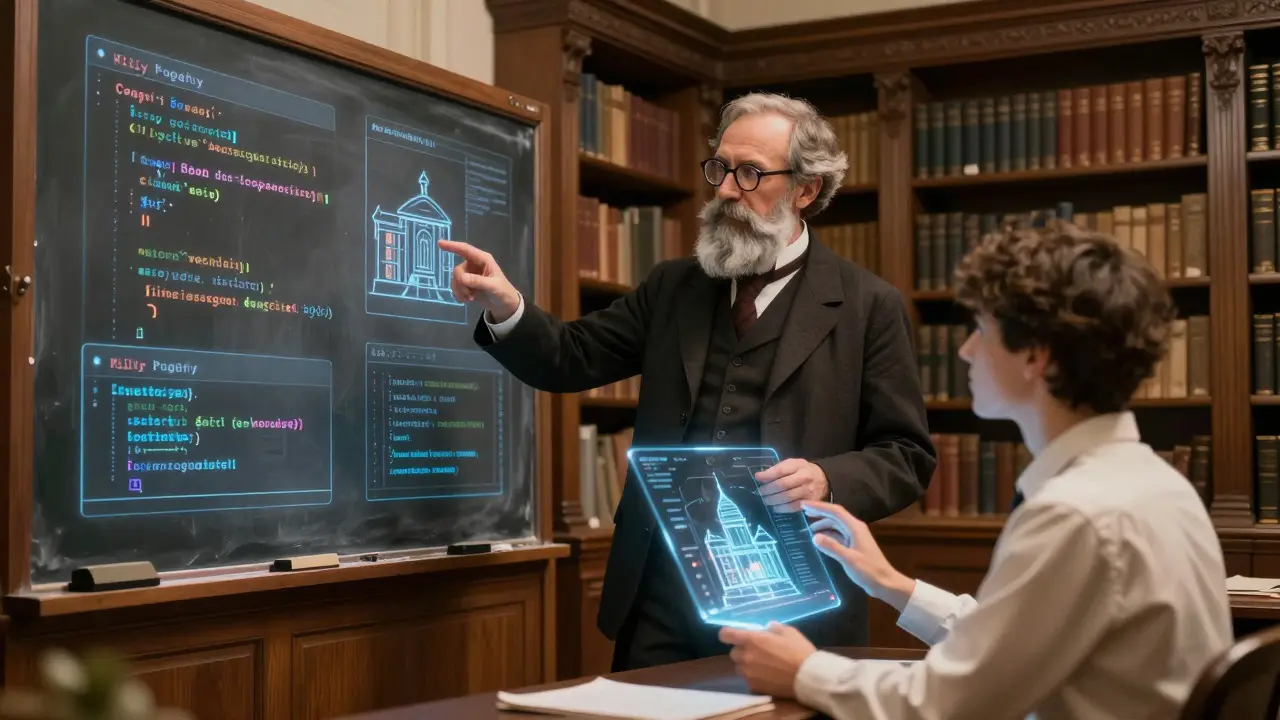
If vibe coding is so great, why isn’t every school doing it? The biggest hurdle isn’t technology; it’s culture. Professor Mark Thompson from the University of Texas noted in November 2024 that the hardest part was retraining instructors. Teachers had to stop being the sole source of truth and become experts in guiding code inspection.
Instructors now need certification. The Vibe Programming Framework specifies a 40-hour training process covering prompt engineering and verification techniques. Stanford’s Graduate School of Education found that instructors take 6-8 weeks to become proficient in this methodology. During this transition, teachers must resist the urge to fix students' prompts. Instead, they ask: "What did the AI decide here, and do you agree?"
This shift empowers students but demands more from educators. It requires a move away from grading syntax correctness toward grading architectural reasoning. Can the student explain why a component uses 15% more memory but reduces API calls by 40%? If yes, they pass. If they just copied the prompt, they fail.
Challenges and Risks to Watch
No methodology is perfect. Vibe coding has its critics. Dr. Barbara Liskov, a Turing Award recipient, expressed concerns in June 2024 about "conceptual gaps in foundational understanding" when students skip traditional programming paradigms. There is a valid fear that students might become proficient at prompting but lack the deep, granular understanding needed for low-level systems programming or hardware resource management.
Indeed, adoption rates reflect this divide. While 83% of institutions teaching full-stack development use vibe coding, only 17% adopt it for systems programming. It excels at teaching modern web architectures like Next.js but struggles where precise control is paramount.
Another risk is "architectural concept drift." The IEEE identified in December 2024 that AI models might generate inconsistent patterns across different prompts, confusing students who expect uniformity. To combat this, Version 2.0 of the Vibe Framework introduced requirements for documenting architectural trade-offs with specific metrics, forcing students to confront inconsistencies head-on.
The Future of Code Education
We are standing at an inflection point. Gartner predicted in December 2024 that by 2026, 80% of introductory computer science courses would incorporate some form of AI-assisted code inspection. LinkedIn’s workforce report showed a 210% year-over-year increase in job postings requesting experience with AI-assisted development. The industry is moving fast, and education must keep up.
By 2027, the ACM Education Board predicts that vibe coding with architectural inspection will become the standard first approach to teaching software development. Traditional syntax-first instruction will likely be reserved for specialized, low-level courses. This isn't about replacing human intelligence with AI; it's about augmenting human judgment. We are teaching students not just to build, but to critique, refine, and architect. And in a world flooded with AI-generated content, the ability to inspect and verify is arguably the most valuable skill a developer can possess.
What is vibe coding in education?
Vibe coding in education is a teaching method where students use AI tools to generate code and then learn by inspecting, analyzing, and refining that code. Instead of starting with basic syntax, students act as code reviewers, focusing on understanding software architecture and design patterns from day one.
Does vibe coding replace learning to code manually?
Not entirely. While vibe coding shifts the focus to high-level architecture and inspection, manual coding skills remain important for debugging and low-level systems programming. However, for full-stack web development, vibe coding accelerates proficiency by allowing students to engage with complex structures earlier in their learning journey.
What are the best tools for teaching vibe coding?
Popular tools include Google AI Studio, which offers architectural visualization features; Vibecode, known for its interactive "Pinch to Build" interface; and Replit Edu, which provides strong version history and inspection logging capabilities. Each platform supports the inspection-first methodology in different ways.
How do educators prevent students from becoming dependent on AI?
Educators use frameworks like the Vibe Programming Framework, which enforces "Verification Before Trust." Students must demonstrate 95% comprehension of AI-generated code through structured questioning and documentation before they can modify it. This ensures they understand the logic, not just the output.
Is vibe coding suitable for all types of programming?
Vibe coding is highly effective for full-stack web development and modern application architecture. However, it is less suitable for low-level systems programming or embedded systems, where precise control over hardware resources and memory management is critical and less amenable to high-level AI generation.