
Imagine you are standing in a massive library with millions of books. You need to find specific information about "quantum physics." You don't read every book cover to cover. Instead, you scan the spines (the keys) for titles that match your interest (the query). Once you find a relevant spine, you pull the book off the shelf and read its pages (the value) to get the actual answer.
This is exactly how Large Language Models process context using attention mechanisms work under the hood. It sounds simple, but the mathematics behind this process-specifically the Key, Query, and Value projections-are what allow AI to understand language rather than just predicting the next word randomly.
If you have ever wondered why transformers are so powerful compared to older models like LSTMs, the answer lies in these three matrices. They transform raw text into a system where words can "talk" to each other across long distances. Let’s break down what these matrices actually learn during training and why they matter.
The Database Analogy: Understanding Q, K, and V
To grasp the concept of Attention Mechanisms in transformer models, we need to strip away the complex calculus for a moment. Think of the attention mechanism as a lookup table or a database search engine.
In this analogy, there are three distinct roles:
- The Query (Q): This is the question. It represents what a specific token (word or part of a word) is looking for in the rest of the sentence. For example, if the model is processing the pronoun "it," the Query asks, "What noun does 'it' refer to?"
- The Key (K): This is the label on the file folder. Every token in the sequence has a Key that describes its identity and characteristics. The Key allows the model to quickly check if it matches the Query. If the Query is looking for a "cat," the Key helps identify which tokens are indeed cats.
- The Value (V): This is the content inside the file. Once the model finds a match between a Query and a Key, it retrieves the Value. The Value contains the actual semantic information needed to update the representation of the current token.
Without this separation, the model would have to compare every word against every other word in a clumsy, inefficient way. By splitting the job into searching (Query), identifying (Key), and retrieving (Value), the transformer achieves a level of efficiency that made modern AI possible.
How the Matrices Are Created: Linear Transformations
Where do these Queries, Keys, and Values come from? They are not hardcoded. They are generated through Linear Algebra operations on input embeddings.
When text enters an LLM, it is first converted into numbers called embeddings. These embeddings are dense vectors that capture some initial meaning of the word. However, these raw embeddings aren't optimized for attention yet. To create the Q, K, and V vectors, the model applies three separate learned weight matrices to the input embedding:
- $W_q$: The weight matrix for Queries
- $W_k$: The weight matrix for Keys
- $W_v$: The weight matrix for Values
Mathematically, if $X$ is the input embedding, then $Q = X W_q$, $K = X W_k$, and $V = X W_v$. These matrices are parameters that the model learns during training. Each layer of the transformer has its own set of these matrices, allowing different layers to focus on different aspects of the language, such as grammar in early layers and abstract reasoning in deeper layers.
The Math of Matching: Dot Products and Scaling
Once the Q, K, and V vectors are created, the model needs to calculate how much attention one word should pay to another. This happens through a dot product.
The model takes the Query vector of the current token and computes the dot product with the Key vectors of all other tokens in the sequence. A high dot product score means the Query and Key are similar-they align well. A low score means they are unrelated.
However, there is a catch. If the vectors are too large, the dot products can become extremely huge, causing numerical instability during training. To fix this, the original Transformer paper introduced a scaling factor: dividing the dot products by the square root of the dimension ($\sqrt{d}$). This keeps the values in a manageable range.
After scaling, the results pass through a Softmax function. Softmax converts these raw scores into probabilities that sum up to 1. Now, instead of just saying "this word is related," the model says, "this word contributes 40% of the importance, that word contributes 10%, and the rest contribute negligible amounts."
Finally, these attention weights are applied to the Value vectors. The output is a weighted sum of the Values. This new vector becomes the updated representation of the token, enriched with context from the words it attended to.
| Component | Analogy | Function in Model | Learned From |
|---|---|---|---|
| Query (Q) | Search Question | Determines what info is needed | Weight Matrix $W_q$ |
| Key (K) | File Label | Identifies token relevance | Weight Matrix $W_k$ |
| Value (V) | File Content | Provides actual semantic data | Weight Matrix $W_v$ |
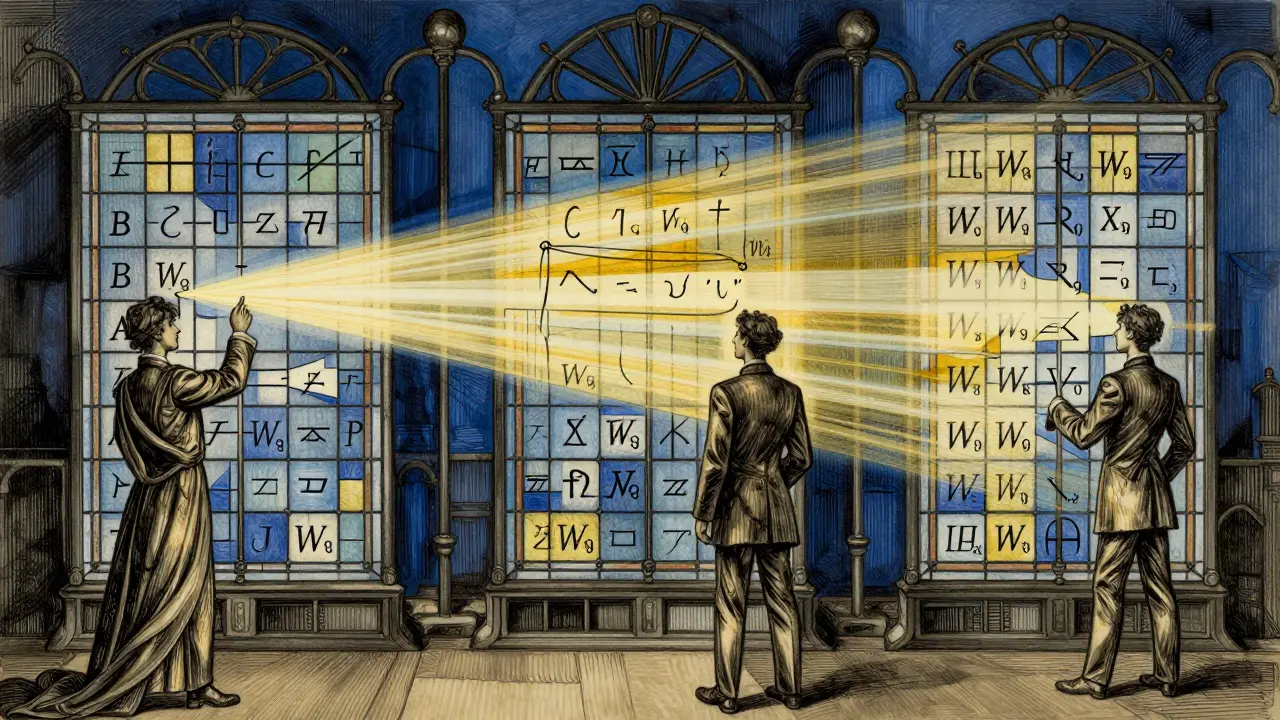
What Do These Matrices Actually Learn?
This is the core question. During training, the model adjusts the weights in $W_q$, $W_k$, and $W_v$ via backpropagation. But what patterns emerge in these matrices?
Queries learn to ask specific questions. In early layers, Queries might learn to look for syntactic partners, like finding the verb that goes with a subject. In deeper layers, Queries might learn to look for logical contradictions or thematic connections across paragraphs. The Query matrix essentially encodes the "intent" of the token within the current context.
Keys learn to be searchable metadata. Keys evolve to highlight features that make tokens distinguishable. For instance, a Key for the word "bank" might emphasize financial contexts in one attention head and geographical contexts in another. This allows the same word to trigger different associations depending on the surrounding text.
Values learn to carry rich representations. While Keys are about identification, Values are about substance. The Value matrix learns to project the token's embedding into a space where it can be easily combined with other tokens. If a token is important, its Value vector will contain strong signals that dominate the weighted sum.
Crucially, these matrices are task-specific. They are not universal constants. They are shaped by the data the model was trained on. If you train a model on code, the QKV matrices will learn to prioritize syntax trees and variable scopes. If you train it on novels, they will prioritize character relationships and narrative flow.
Mult-Head Attention: Specialization Through Parallelism
A single set of QKV matrices isn't enough to capture the complexity of language. That’s why transformers use Multi-Head Attention parallel attention mechanisms.
Instead of one Query, Key, and Value projection, the model uses multiple sets-often eight, sixteen, or more. Each "head" has its own $W_q$, $W_k$, and $W_v$ matrices. This allows different heads to specialize in different types of relationships simultaneously.
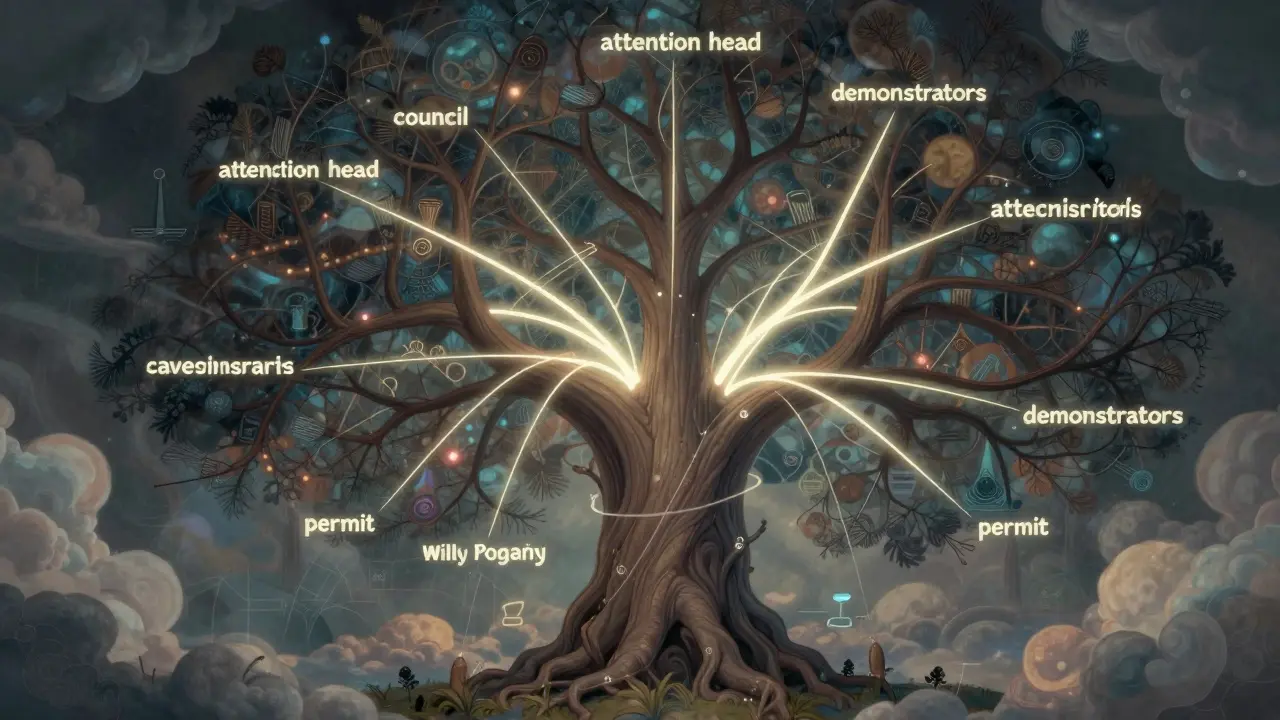
For example, in the sentence "The city council refused the demonstrators a permit because they feared violence":
- One attention head might focus on the grammatical structure, linking "council" to "refused" and "demonstrators" to "permit."
- Another head might focus on coreference resolution, trying to determine who "they" refers to. It will attend strongly to either "council" or "demonstrators" based on the semantic cues in the Value vectors.
By running these calculations in parallel, the model builds a rich, multi-dimensional understanding of the text. The outputs of all heads are concatenated and passed through a final linear transformation, merging these diverse perspectives into a single coherent representation.
Why This Beats Recurrent Neural Networks
Before transformers, the standard approach for sequence modeling was Recurrent Neural Networks (RNNs) including LSTM and GRU architectures. RNNs process text one word at a time, passing a hidden state from one step to the next.
This sequential nature creates two major problems:
- Slow Training: You cannot parallelize the computation. You must wait for word 1 to finish before starting word 2.
- Vanishing Gradients: Information from the beginning of a long sentence often fades away by the time the model reaches the end. This makes it hard to connect distant words.
The QKV attention mechanism solves both issues. Because the dot product calculation $QK^T$ can be done for all tokens simultaneously, training is massively parallelizable. Furthermore, since every token can directly attend to any other token regardless of distance, the model maintains full context awareness. The word "it" at the end of a page can still attend to "the cat" at the beginning without the signal degrading.
Practical Implications for Developers
Understanding QKV projections isn't just academic; it has practical implications for anyone working with LLMs.
Context Window Limits: The computational cost of attention scales quadratically with sequence length ($O(n^2)$) because every Query must compare against every Key. This is why increasing context windows is expensive. Techniques like FlashAttention optimize the memory access patterns of these matrix multiplications to speed things up.
Prompt Engineering: When you write a prompt, you are essentially crafting the Queries that the model will generate. Clear, specific prompts help the model form sharper Queries, which leads to better matching with relevant Keys in its pre-trained knowledge base.
Fine-Tuning: When fine-tuning a model, you are adjusting these $W_q$, $W_k$, and $W_v$ matrices (or adapters around them) to specialize the attention patterns for your specific domain. You are teaching the model what to look for (Query), how to recognize it (Key), and what to extract (Value) in your unique dataset.
Conclusion: The Engine of Context
The Key, Query, and Value matrices are the heart of the transformer revolution. They transform static embeddings into dynamic, context-aware representations. By learning to separate the act of searching, identifying, and retrieving, these matrices enable LLMs to handle the ambiguity and complexity of human language with remarkable precision.
As models grow larger and more efficient, the fundamental QKV structure remains unchanged. It is a robust, elegant solution to the problem of context, proving that sometimes the best way to understand a sentence is to let every word talk to every other word.
What is the difference between Query and Key in attention?
The Query represents what a token is looking for, while the Key represents how a token identifies itself. Think of the Query as a search term and the Key as the index entry. They are computed separately using different weight matrices ($W_q$ and $W_k$) to allow the model to flexibly match concepts.
Why is scaling by square root of d necessary?
Scaling prevents the dot products between Queries and Keys from becoming too large. Large values push the Softmax function into regions with very small gradients, which slows down or stops learning. Dividing by $\sqrt{d}$ keeps the variance stable, ensuring effective gradient flow during training.
Do QKV matrices change during inference?
No, the weight matrices ($W_q$, $W_k$, $W_v$) are fixed after training. During inference, the model uses these learned weights to project the input embeddings into Q, K, and V vectors. The vectors themselves change with every input, but the transformation rules remain constant.
How does Multi-Head Attention improve performance?
Multi-Head Attention allows the model to focus on different types of relationships simultaneously. One head might track grammar, another might track semantic similarity, and another might track positional dependencies. This specialization leads to a richer, more nuanced understanding of the text.
Can I visualize what the attention heads are doing?
Yes, tools like BERTology or Transformers.js allow you to visualize attention maps. You can see which words are attending to which others. Often, you'll find that specific heads consistently attend to syntactic structures like subject-verb pairs or pronoun-noun references.






om gman
July 13, 2026 AT 00:25oh look another article explaining the obvious to people who should already know this stuff, truly groundbreaking journalism here folks
Andrea Alonzo
July 13, 2026 AT 11:18I have to say that while the library analogy is certainly charming and accessible for those just beginning their journey into the world of machine learning, it does somewhat oversimplify the intricate dance of high-dimensional vector spaces that actually occurs within the transformer architecture. When we consider that each token's embedding is projected into multiple subspaces simultaneously through multi-head attention, the simple notion of scanning a spine becomes less about linear retrieval and more about complex, parallel semantic matching across various conceptual dimensions. It is fascinating to think about how the model learns to distinguish between syntactic roles and semantic meanings in different heads, almost like having multiple librarians with specialized expertise working on the same query at once, which really highlights the elegance of the design despite its computational cost.
Edward Nigma
July 14, 2026 AT 10:31thats not even right tho, the matrices dont actually learn anything meaningful they just overfit to statistical noise in the training data, everyone knows these models are basically stochastic parrots with no real understanding of context or meaning
Bineesh Mathew
July 14, 2026 AT 20:44the existential dread one feels when contemplating that our very language is reduced to mere dot products and softmax probabilities is palpable, we are but vectors in a cold mathematical void screaming into the abyss of gradient descent
Saranya M.L.
July 14, 2026 AT 21:13Your explanation of the scaling factor is technically accurate but lacks the rigorous depth expected from someone claiming to understand transformer architectures. The division by the square root of d is not merely a heuristic fix for numerical instability; it is a fundamental requirement derived from the variance properties of the dot product of random vectors. If you do not scale, the variance of the dot product grows with the dimensionality, pushing the softmax function into regions where gradients vanish, effectively halting learning. This is basic linear algebra applied to deep learning, yet many practitioners still treat it as magic rather than mathematics.
Francis Laquerre
July 15, 2026 AT 05:43It is absolutely breathtaking how this mechanism allows for such profound connections across vast distances in text. The way the Query seeks out the Key and retrieves the Value feels almost poetic in its efficiency, a digital symphony of information retrieval that has revolutionized how we interact with language itself. I find myself marveling at the sheer ingenuity required to map human communication onto such elegant mathematical structures.
Caitlin Donehue
July 16, 2026 AT 12:30i guess so
Jeanne Abrahams
July 17, 2026 AT 01:52Oh, please. Another day, another buzzword salad pretending to explain AI. You guys really think comparing attention mechanisms to a library search makes you smart? It’s cute, in a desperate kind of way. Meanwhile, down here in reality, we’re dealing with actual engineering constraints and the sheer absurdity of O(n^2) complexity being sold as a miracle.
Oskar Falkenberg
July 18, 2026 AT 12:26hey there i just wanted to chime in and say that while the explanation is pretty solid i think it would be really helpful if we could dive deeper into how the positional encodings interact with these QKV projections because without them the model has no idea where words are in the sequence which is kinda crucial for grammar and all that jazz, anyway just my two cents hope it helps someone out there who might be confused like i was when i first started reading about transformers
michael rome
July 18, 2026 AT 13:49It is imperative that we recognize the formal structure underlying these operations. The separation of concerns into Query, Key, and Value is not arbitrary but reflects a fundamental architectural decision to decouple the mechanism of selection from the content of information. By maintaining strict adherence to this tripartite structure, we ensure that the model can generalize across diverse linguistic phenomena without conflating syntactic dependencies with semantic content. This precision is what distinguishes robust transformer implementations from ad-hoc neural networks.