
Remember when the biggest fear about Generative AI was that it would hallucinate facts or produce nonsensical images? That era is ending. We are moving past the novelty phase of chatbots writing poems or generating cat pictures. The real shift happening right now, in mid-2026, is a transition from passive tools to active partners. These systems are no longer just waiting for your prompt; they are planning, executing, and optimizing workflows on their own. This evolution rests on three pillars: the rise of agentic AI, a dramatic drop in operational costs, and significantly better grounding in reality.
The Shift to Autonomous Agentic Systems
The most visible change in the AI landscape is the move toward autonomy. Traditional AI models were reactive-you asked a question, and they gave an answer. Agentic AI is proactive. It can break down complex goals into smaller tasks, execute them, and correct its own mistakes without human intervention. Think of the difference between a calculator and a financial analyst. A calculator gives you a number when you press buttons. An analyst looks at your entire portfolio, identifies risks, suggests changes, and executes trades based on predefined parameters.
This isn't science fiction anymore. In 2025, enterprise spending on these agentic systems surged, with projections showing growth from under $1 billion to over $51 billion by 2028. Why? Because businesses realized that automation isn't just about speed; it's about capability. Agents can now handle multi-step reasoning. For example, a customer service agent doesn't just look up a policy; it checks inventory, processes a refund, updates the CRM, and sends a follow-up email-all in one continuous flow. According to Boston Consulting Group (BCG), AI agents accounted for 17% of total AI value in 2025 and are projected to reach 29% by 2028. This indicates that nearly a third of the value we get from AI will come from systems that act independently.
However, this autonomy brings new challenges. When an AI makes decisions, who is responsible if it goes wrong? Companies are now implementing "human-in-the-loop" validation for critical decisions. The goal isn't to replace humans entirely but to create a collaborative environment where AI handles the heavy lifting of execution while humans oversee strategy and ethics. This hybrid approach is becoming the standard for mature AI implementations.
Driving Down Costs Through Efficiency
One of the biggest barriers to widespread AI adoption has been cost. Training large language models requires massive amounts of compute power and energy. But the trend is shifting toward efficiency. We are seeing significant reductions in the cost per token and improved model optimization techniques that allow powerful performance on less hardware. This democratization means that smaller companies, not just tech giants, can leverage advanced AI capabilities.
A major driver of this cost reduction is the rise of Synthetic Data. Instead of spending millions collecting and cleaning real-world data, which often involves privacy concerns and legal hurdles, companies are using AI to generate realistic training data. The synthetic data market is growing at over 40% annually. This allows organizations to build robust models without violating privacy laws like GDPR or HIPAA. For instance, healthcare providers can train diagnostic AI on synthetic patient records that mimic real conditions without exposing actual patient identities. This not only cuts costs but also accelerates development cycles.
Furthermore, the ROI on generative AI investments is becoming clearer. Reports indicate that for every dollar invested in generative AI, companies are seeing returns of around $3.70. This positive return on investment is encouraging more businesses to move beyond pilot projects and scale their AI operations. However, there is a catch: the benefits are unevenly distributed. "Future-built" companies-those allocating significant resources to AI-are outperforming laggards by wide margins. They expect twice the revenue increase and 40% greater cost reductions compared to those still on the fence.

Better Grounding: Reducing Hallucinations with RAG
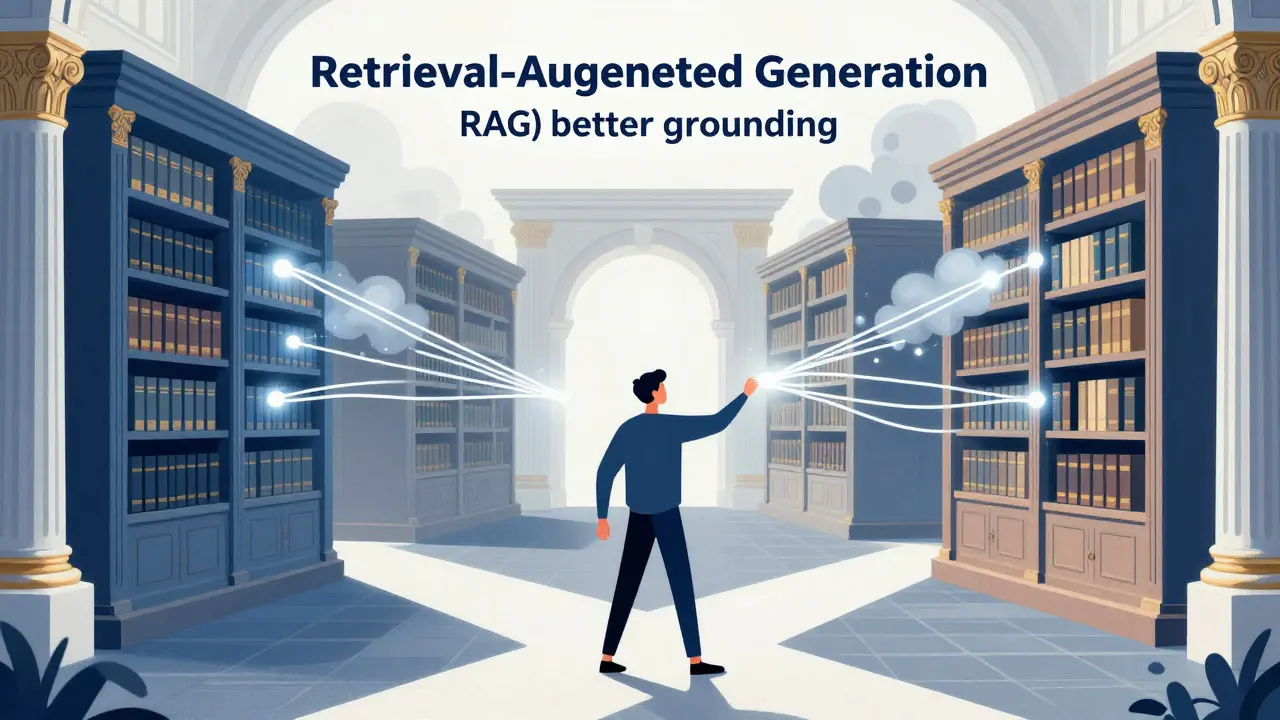
Early versions of generative AI were notorious for making things up. If you asked a question outside its training data, it might confidently provide a false answer. This problem, known as hallucination, has been largely mitigated through better grounding techniques. The most prominent of these is Retrieval-Augmented Generation (RAG). RAG works by connecting the AI model to external, real-time data sources. Before generating an answer, the system retrieves relevant information from a trusted database, ensuring the response is accurate and up-to-date.
Gartner predicts that by 2026, 60% of AI applications will incorporate real-time data retrieval. This is crucial for industries where accuracy is non-negotiable, such as finance, law, and healthcare. Imagine a legal assistant that doesn't just guess at case law but pulls directly from updated court databases. Or a financial advisor that provides advice based on today's market rates, not last year's data. This grounding capability transforms AI from a creative writing tool into a reliable information processor.
Additionally, advancements in "world models" are changing how AI understands context. Yann LeCun, Chief AI Scientist at Meta, argues that future AI will learn like infants do-through sensory input and interaction with the world, rather than just processing text patterns. These world models enable robots and virtual agents to understand physical constraints and causal relationships. For example, Amazon has integrated generative AI into its warehouses to optimize robot movement. The AI doesn't just follow pre-programmed paths; it learns from environmental feedback to streamline order processing dynamically.
| Feature | Traditional AI (2023-2024) | Modern Agentic AI (2026+) |
|---|---|---|
| Interaction Mode | Reactive (Prompt → Response) | Proactive (Goal → Plan → Execute) |
| Data Source | Static Training Data | Real-time Retrieval (RAG) + Synthetic Data |
| Error Handling | Requires Human Correction | Self-Correction & Multi-step Reasoning |
| Cost Structure | High Compute Costs, Low Scalability | Optimized Models, High ROI ($3.70/$1) |
| Hallucination Rate | ~25% in early models | <8% with RAG integration |
Economic Impact and Productivity Gains
The economic implications of these technological shifts are profound. While some experts predict modest productivity gains, others foresee a transformation comparable to the internet or mobile revolution. The Wharton Budget Model projects that generative AI will increase global GDP by 1.5% by 2035. While this number might seem small, it represents trillions of dollars in added value. Over the long term, by 2075, the cumulative effect could be a 3.7% increase in GDP.
On the corporate level, the impact is even more immediate. AmplifAI forecasts a cumulative economic impact of $19.9 trillion by 2030. This growth is driven by increased efficiency in research and development, customer service, and supply chain management. For example, in R&D, AI can simulate thousands of product variations, identifying the best designs before any physical prototype is built. This significantly reduces time-to-market and lowers development costs.
However, there is a risk of widening inequality between companies. BCG highlights a growing divide between "future-built" companies and laggards. Future-built companies allocate 15% of their resources to AI and plan to spend 26% more on IT infrastructure. They are building competitive moats that are hard to cross. Laggards, stuck in "wait and see" mode, risk falling behind permanently. This suggests that AI adoption is no longer optional for businesses that want to remain competitive.
Challenges and Implementation Realities
Despite the optimism, deploying these systems is not plug-and-play. The learning curve for enterprise readiness typically takes 6-12 months. Organizations need to invest in talent, specifically in prompt engineering, data pipeline management, and evaluation frameworks. There is a persistent shortage of skilled professionals who can bridge the gap between technical AI capabilities and business needs.
Regulatory compliance is another hurdle. As AI becomes more embedded in decision-making processes, governments are tightening regulations. The EU AI Act and similar frameworks require transparency and accountability. Companies must ensure their AI systems are explainable and free from bias. This is particularly challenging for black-box models, though newer architectures are improving interpretability.
Moreover, the infrastructure requirements are substantial. Supporting real-time data retrieval and agentic workflows demands robust cloud infrastructure and low-latency networks. Smaller organizations may find these costs prohibitive, leading to further consolidation in the market. Partnerships with cloud providers like Microsoft Azure, Google Cloud, and AWS are becoming essential for scaling AI operations effectively.
Looking Ahead: The Next Three Years
What does the future hold? By 2028, we expect to see agentic AI handling a significant portion of routine cognitive work. Customer service, initial code debugging, and basic content creation will be fully automated. The focus will shift to higher-value tasks where human creativity and judgment are irreplaceable.
We will also see the maturation of multimodal AI. Systems will seamlessly integrate text, images, video, audio, and code. This will enable new forms of interaction, such as voice-controlled agents that can visualize data and generate reports simultaneously. The line between digital and physical worlds will blur as AI-powered robots become more common in logistics, manufacturing, and even home assistance.
Finally, the emphasis on sustainability will grow. As AI consumes more energy, there will be pressure to develop greener algorithms and hardware. Efficient models that deliver high performance with lower carbon footprints will be prioritized. This aligns with broader corporate social responsibility goals and regulatory requirements.
What is the difference between traditional AI and agentic AI?
Traditional AI is reactive, meaning it responds to specific prompts or inputs. Agentic AI is proactive and autonomous. It can set goals, plan multi-step workflows, execute tasks, and self-correct without constant human supervision. Think of traditional AI as a tool you use, and agentic AI as a colleague you delegate to.
How does RAG improve AI accuracy?
Retrieval-Augmented Generation (RAG) connects the AI model to external, real-time data sources. Before answering, the AI retrieves relevant information from these trusted sources. This ensures the response is based on current, verified facts rather than just the static data it was trained on, significantly reducing hallucinations.
Is generative AI worth the investment for small businesses?
Yes, but with caution. With costs dropping and ROI reaching $3.70 for every dollar spent, AI is becoming accessible. Small businesses should start with specific, high-impact use cases like customer support automation or content generation. Avoid trying to boil the ocean; focus on solving one painful problem first.
What is synthetic data and why is it important?
Synthetic data is artificially generated information that mimics real-world data. It is crucial because it allows companies to train AI models without violating privacy laws or exposing sensitive customer information. This is especially important in regulated industries like healthcare and finance.
When will AI agents be widely adopted in enterprises?
Adoption is already underway. In 2025, 65% of companies were regularly utilizing generative AI. By 2028, AI agents are expected to account for 29% of total AI value. The key is starting now to build the necessary infrastructure and talent pool, as the gap between leaders and laggards is widening rapidly.