
It used to be that you could just block access to Generative AI tools and call it a day. That strategy is dead. In fact, trying to ban these tools now often backfires, pushing employees toward unmonitored personal accounts where your company’s most sensitive secrets vanish into the void. The reality of 2026 is stark: while generative AI usage has tripled since 2024, data policy violations involving these systems have doubled. You are no longer asking *if* your team will use AI; you are asking how to keep your intellectual property safe while they do.
This shift marks a critical turning point for enterprise security. Privacy is no longer a peripheral compliance checkbox managed by legal teams in isolation. It has become the operational core of responsible AI governance. If your current approach relies on hope or blanket prohibitions, you are likely exposed. The Cisco 2026 Data and Privacy Benchmark Study highlights that the average organization currently faces over 200 data policy violations involving AI applications every single month. With source code accounting for nearly half of those incidents, the cost of inaction is measured in leaked patents and regulatory fines.
The New Regulatory Landscape Driving Urgent Action
You cannot build an effective governance strategy without understanding the legal ground beneath your feet. The regulatory environment for artificial intelligence has shifted from theoretical discussions to hard enforcement deadlines. For organizations operating globally or in specific US states, the rules have changed dramatically.
In Europe, the EU AI Act went into full effect in 2025, with strict requirements for high-risk systems already active. By August 2026, transparency obligations for generative AI providers and deployers will be fully enforced. This means you must know exactly what data feeds your models and ensure those models adhere to strict safety standards. Meanwhile, in the United States, the patchwork of state laws is tightening. The Colorado AI Act took effect on June 30, 2026, imposing new duties on AI developers and deployers regarding bias, accuracy, and consumer rights. Looking ahead, California’s Automated Decision-Making Technology (ADMT) law triggers compliance obligations starting January 1, 2027, which affects how you handle automated decisions impacting housing, employment, and credit.
The fragmentation across jurisdictions creates a "compliance paradox." TrustArc’s 2026 Strategic Roadmap describes this year as less of a firehose and more of a "swim meet"-you are in deep water, and you need to know how to navigate currents rather than just splash around. The International Association of Privacy Professionals (IAPP) emphasizes the urgent need for a coherent global baseline because relying on local interpretations is no longer sustainable for multinational enterprises.
Why Blocking AI Fails and Governance Wins
Many IT departments instinctively reach for the kill switch when they see employees uploading proprietary documents to public chatbots. However, data shows this is a losing battle. Microsoft’s 2026 Data Security Index reveals that blocking AI entirely has proven futile. Instead, organizations that adopt a governance-first approach experience 63% fewer data policy violations compared to those attempting prohibition.
Why does blocking fail? Because productivity demands drive behavior. When legitimate workflows are obstructed, employees find workarounds. Kiteworks reports that 31% of users upload company data to personal cloud apps every month. Personal instances of ChatGPT are now among the top-controlled personal apps, sitting at 28% alongside Gmail and OneDrive. This "shadow AI" usage is invisible to your security stack, creating massive blind spots.
A governance-first strategy flips the script. Instead of saying "no," it says "yes, but safely." This involves enabling innovation through visibility, control, and policy enforcement. By providing secure, governed environments for AI interaction, you guide users toward safer patterns. Concentric AI notes that strong governance actually helps users work faster because they don't have to worry about accidental leaks-they trust the system to protect them.

Core Technical Controls for Protecting Sensitive Data
To move from theory to practice, you need technical controls that operate at the speed of AI. Traditional data loss prevention (DLP) tools often struggle with the nuance of natural language processing. Effective GenAI data governance requires a layered architecture focused on three key areas: prompt-level guardrails, zero-trust integration, and ruthless data minimization.
- Prompt-Level Guardrails: These controls detect when sensitive material is about to be uploaded or processed without reading the entire employee prompt for privacy reasons. They act as a filter, intercepting requests that contain classified data before they reach the external model API. This prevents the ingestion of trade secrets into public models.
- Zero-Trust Architecture: AI systems should never have broad access to your data lake. Implement role-based permissions so that AI agents only access the specific datasets required for their task. Ensure all interactions flow through secure gateways that enforce these policies dynamically based on data classification and context.
- Data Minimization: TrustArc identifies "ruthless data minimization" as your best defense against privacy scandals. Only provide the AI with the absolute minimum amount of data necessary to perform its function. Anonymize or pseudonymize inputs wherever possible to reduce the risk of re-identification.
Furthermore, you must maintain immutable audit logs. Every interaction between a user, an AI agent, and your data repository must be recorded. These logs are essential for compliance reporting under the EU AI Act and for investigating potential breaches. Without them, you are flying blind.
| Strategy Type | Approach | Risk Level | User Impact |
|---|---|---|---|
| Prohibition | Block all external AI access | High (Shadow AI) | Negative (Productivity Loss) |
| Reactive Monitoring | Detect leaks after they happen | Medium-High | Neutral |
| Governance-First | Enable controlled, visible access | Low | Positive (Safe Productivity) |
Addressing the "Inferred Data" Challenge
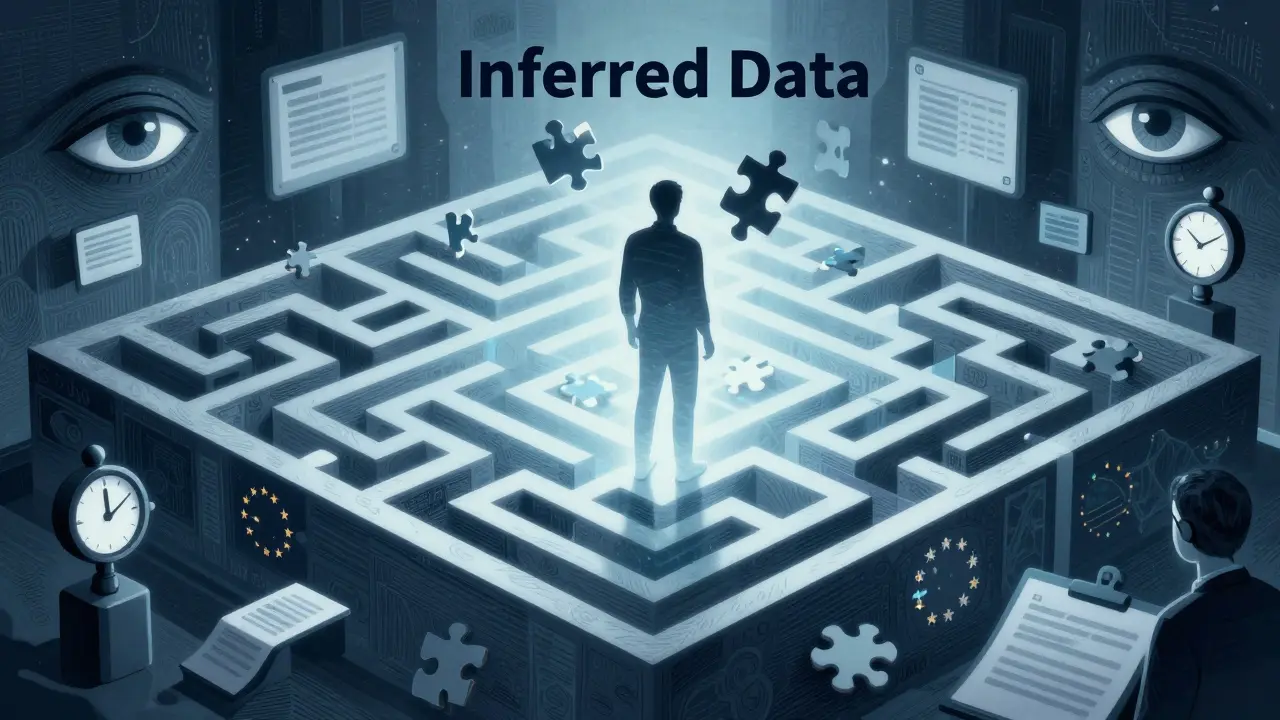
One of the most complex challenges facing privacy professionals in 2026 is the concept of "inferred data." Generative AI models are incredibly good at connecting dots. Even if you scrub direct identifiers like names and social security numbers from your dataset, the AI might infer sensitive attributes about individuals based on non-sensitive inputs.
This creates a "consent paradox." How do you obtain consent for data that was calculated rather than directly collected? Current frameworks struggle here. If an AI infers health conditions from purchasing habits or location data, does that constitute a privacy violation under GDPR or CCPA? Regulators are beginning to say yes. The University of Illinois’ Privacy Everywhere Conference highlighted the need for actionable steps to address these ethical gaps, emphasizing that training and issue response processes must evolve to handle inference risks.
To mitigate this, organizations must implement rigorous bias and fairness testing during the model assessment phase. Nelson Mullins advises developing robust processes for assessing AI models that integrate with existing cybersecurity procedures but specifically address the "full range of AI impact," including potential inferences. You must treat inferred outputs with the same level of caution as explicitly provided sensitive data.
Implementation Roadmap: From Chaos to Control
Building a mature AI governance framework takes time, but the timeline depends heavily on your existing data maturity. According to the Cisco 2026 Benchmark Study, organizations with strong pre-existing data governance can integrate AI controls within 3 to 6 months. Those starting from scratch may need 9 to 12 months.
Start with a "governance reboot." As TrustArc suggests, go back to basics. If your underlying information governance is weak, AI will expose those weaknesses immediately. Re-map your data flows with a specific emphasis on AI inputs and outputs. Identify where sensitive data resides and who currently has access to it.
Next, assemble the right team. You need personnel who understand the intersection of data classification, API integration, and regulatory frameworks. You cannot rely solely on IT or Legal; you need cross-functional collaboration. Key skills include understanding the personal information used to train models, the sensitive data processed during inference, and the varying regulatory requirements across different jurisdictions.
Finally, choose your technology stack wisely. The market has fragmented into two approaches: comprehensive enterprise platforms like TrustArc’s One Platform, which aims to simplify global regulations and automate risk, versus specialist solutions like Concentric AI that focus on specific technical controls such as prompt remediation. Evaluate whether you need a unified command center or targeted point solutions to plug immediate vulnerabilities.
Future Outlook: Consolidation and Enforcement
Looking beyond 2026, the trend points toward regulatory consolidation and intensified enforcement. The EU is pursuing a "Digital omnibus" package designed to support innovation while reducing the complexity of layering multiple laws like the Data Act, AI Act, DSA, and DMA. Expect a move toward a single point of entry for reporting breaches.
In the US, states like California and Texas have well-funded privacy divisions that have already demonstrated a willingness to pursue major investigations into data brokers and sensitive data misuse. Jones Walker notes that the strategic window for reactive privacy approaches has closed. Organizations that embed privacy into their AI governance from the outset will be better positioned for whatever regulatory framework emerges next. Those treating it as an afterthought will face costly remediation and enforcement actions.
The goal is not to stop innovation but to sustain it responsibly. By implementing clear policies, technical guardrails, and continuous monitoring, you protect your sensitive information while empowering your workforce to leverage the power of generative AI safely.
What is the primary purpose of GenAI data governance?
The primary purpose is to control what data generative AI tools can access, how they use that data, and where the processed information flows once outputted. It ensures that sensitive intellectual property and personal data remain protected while allowing employees to use AI for productivity.
How does the EU AI Act affect data governance in 2026?
The EU AI Act imposes strict transparency and safety requirements on high-risk AI systems and generative AI providers. By August 2026, full compliance is mandatory, requiring organizations to document data sources, ensure human oversight, and maintain audit trails for all AI interactions.
Why is blocking AI tools considered a failed strategy?
Blocking AI tools leads to "shadow AI" usage, where employees use unauthorized personal accounts to access AI services. This removes visibility and control, increasing the risk of data leaks. Governance-first approaches that enable safe usage result in significantly fewer policy violations.
What is "inferred data" and why is it a privacy risk?
Inferred data refers to sensitive information that an AI model calculates or predicts based on non-sensitive inputs. For example, an AI might infer health status from shopping habits. This poses a privacy risk because traditional consent mechanisms do not cover data that was derived rather than directly collected.
How long does it take to implement an AI governance framework?
Implementation time varies based on existing data maturity. Organizations with strong pre-existing data governance can integrate AI controls in 3-6 months, while those starting from scratch may require 9-12 months to establish proper mapping, policies, and technical controls.






Caitlin Donehue
June 13, 2026 AT 20:36it's wild how fast the 'just block it' mentality died. i remember when ciso's thought a firewall could stop ai usage, but now we're just watching our devs paste proprietary code into chatgpt on their lunch breaks because the internal tools are too slow or locked down. the shadow ai problem is real and blocking only makes it worse.
Stephanie Frank
June 13, 2026 AT 23:25you people are so naive if you think governance fixes this. it's all corporate buzzword salad to keep lawyers happy while the actual data leaks happen through inference attacks that no dlp tool can catch. the whole premise of 'safe ai' is a joke because the models are trained on everything anyway. stop pretending you have control over what your employees do with unmonitored personal accounts.
Marissa Haque
June 15, 2026 AT 12:50oh my gosh!! yes! exactly!!!
i was reading about the eu ai act and it's terrifying! like, august 2026 is coming up super fast! and we haven't even mapped out our data flows yet! it feels like we're drowning in compliance requirements from every single direction! the transparency obligations are going to crush us if we don't get our audit logs sorted out immediately! who else is panicking about the colorado ai act deadlines?!?
Keith Barker
June 15, 2026 AT 13:30the concept of inferred data changes the ontology of privacy entirely. if the machine knows what you are before you tell it then the contract of consent is void. we are building systems that see through the veil of anonymity by correlating trivial inputs. it is not a technical failure but a philosophical one where we assume separation between user and data still exists
Lisa Puster
June 17, 2026 AT 10:50another article written by consultants trying to sell you more software because they know most companies are failing at basic security. the eu regulations are just another way to stifle innovation while american companies actually build things. but sure let's add another layer of bureaucracy and call it governance. it's pathetic how dependent we've become on these external models for basic tasks instead of keeping data local and secure.
Joe Walters
June 19, 2026 AT 08:08lol imagine thinking you can govern ai. its chaos incarnate. i tried setting up zero trust for our team and everyone just started using their personal phones to bypass it. the drama of trying to enforce policy on people who just want to get work done is exhausting. also why does nobody talk about how much money these enterprise platforms cost? its a rip off for features that barely work half the time.