
What Is Shadow AI, and Why Should You Care?
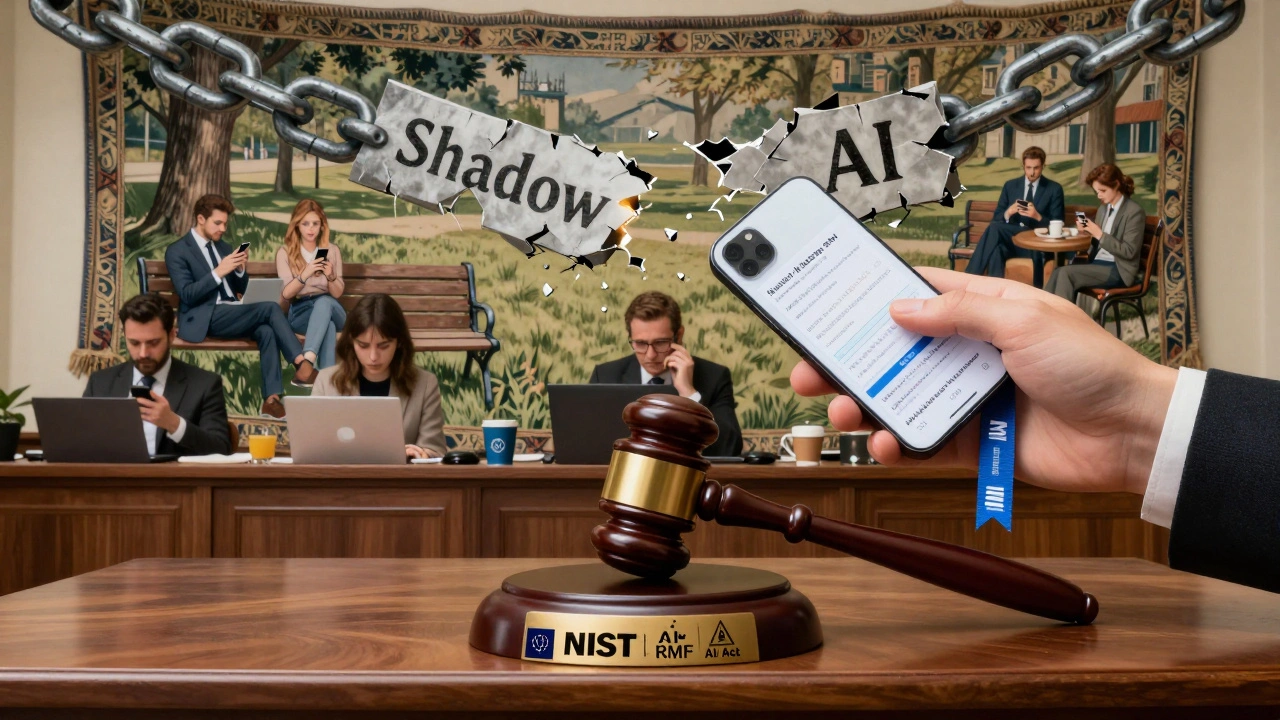
Shadow AI is when employees use AI tools-like ChatGPT, Gemini, or Claude-without IT’s approval. It’s not rebellion. It’s convenience. Someone needs to draft a contract, summarize a meeting, or generate a report, and the fastest tool available is a free AI chatbot. But that chatbot doesn’t know your company’s data policies. It doesn’t know that the document you pasted in contains customer PII, trade secrets, or financial projections. And once that data leaves your network, you lose control.
By 2025, 58% of knowledge workers were using AI tools without permission, according to Microsoft’s Work Trend Index. That’s more than half of your workforce operating outside your security policies. And it’s not just risky-it’s illegal under regulations like GDPR and HIPAA. Fines for data breaches caused by unapproved AI can hit €20 million or 4% of global revenue. That’s not a typo. That’s the law.
Why Shadow AI Keeps Growing (And Why Banning It Doesn’t Work)
People aren’t using Shadow AI because they’re trying to break rules. They’re using it because it works. Fast. Better than the slow, clunky tools your IT department approved. When your internal AI tool takes three weeks to deploy and only does basic summarization, employees will find something that does it in seconds.
Trying to ban AI entirely backfires. One banking client tried it. They blocked all public AI tools on company devices. What happened? Employees started using their personal phones, home laptops, and public Wi-Fi to run AI prompts. Now, you’ve got data leaking from unmanaged devices with no logging, no monitoring, no audit trail. The problem didn’t disappear-it got worse.
Shadow AI isn’t going away. The goal isn’t to stop it. The goal is to bring it into the light.
The Four Pillars of Shadow AI Remediation
Successful remediation isn’t about installing one tool. It’s about building a system. Four key components make it work:
- Inventory everything. You can’t govern what you can’t see. Use automated tools that scan endpoints, cloud apps, and network traffic for AI usage. Tools like Vanta or Zscaler can detect when someone’s using ChatGPT through a browser or a third-party app. Look for patterns: repeated visits to ai.openai.com, uploads to Gemini, or traffic to unknown AI domains.
- Define clear policies. What’s allowed? What’s not? A policy like “No AI tools” is useless. A policy like “Use only approved AI tools for internal documents. Never paste customer data, financial reports, or source code into public AI tools” is actionable. Include examples. Show people what not to do.
- Enforce access controls. Block public AI tools on corporate devices. But don’t just block-offer alternatives. Provide an approved AI assistant with built-in DLP (data loss prevention), audit logs, and role-based permissions. If employees can get the same results safely, they’ll switch.
- Monitor and audit continuously. Compliance isn’t a one-time project. It’s a rhythm. Set up alerts for unauthorized AI use. Require logs for all AI-generated outputs used in decisions. Review them monthly. Treat AI like any other system: track who used it, what they input, what came out, and why.
How Different Companies Handle It
Not every company needs the same solution. Your approach should match your size and risk level.
| Organization Size | Typical Approach | Cost (Annual) | Effectiveness |
|---|---|---|---|
| Large Enterprises (1,000+ employees) | Integrated platforms like Vanta, automated evidence collection, mapped to NIST AI RMF and EU AI Act | $15,000+ | High |
| Mid-Sized (100-999 employees) | Custom NIST-based framework, legal review, IT monitoring | $45,000 (consulting + tools) | Moderate to High |
| Small Businesses (Under 100 employees) | Basic blocking, simple policy, manual reviews | $5,000 | Low (37% less effective than larger firms) |
Healthcare companies that locked down AI tools handling PHI (protected health information) saw an 82% drop in HIPAA violation risks. That’s not luck-it’s policy + control.
What Happens When You Skip Training
Most remediation failures aren’t technical. They’re cultural.
A 2024 Forrester study found that 63% of Shadow AI programs failed because employees weren’t trained. People didn’t understand why the rules existed. They saw them as bureaucracy, not protection.
Successful programs include:
- Short, real-world videos showing how AI leaks data
- Quizzes after training-pass to keep using AI tools
- Stories from other teams: “Here’s how we caught a leak before it became a fine”
- Fast-track approval: If someone needs a new AI tool, they can request it in 24 hours
One Fortune 500 company reduced Shadow AI incidents by 68% in six months-not by blocking tools, but by making the approved ones faster and easier to use. They also gave employees a way to suggest new tools. That’s how you turn users from rebels into partners.
Regulations Are Getting Real-Here’s What’s Changing in 2025-2026
Shadow AI isn’t just an IT problem anymore. It’s a legal one.
- EU AI Act (effective Feb 2025): Classifies AI by risk. High-risk systems (like those used in hiring, finance, or healthcare) require strict documentation, human oversight, and audit trails. Using unapproved AI in these areas is a direct violation.
- U.S. State Laws: 26 states passed 75+ new AI laws in 2025. Many require disclosure when AI is used in decision-making. If your HR team used an unapproved AI to screen resumes, you could be breaking the law.
- SOX & HIPAA: If AI generates financial reports or handles patient data, outputs must be traceable, accurate, and reviewed. No “AI did it” excuses.
NIST’s January 2025 update to the AI Risk Management Framework made one thing clear: continuous monitoring is non-negotiable. If you’re not tracking AI usage, you’re not compliant.

Tools That Actually Help (And Which Ones to Avoid)
You don’t need to build this from scratch. Several tools are built for this:
- Vanta: Integrates with 400+ apps, auto-generates compliance reports, maps controls to NIST, ISO 42001, and EU AI Act. Used by 35% of Fortune 500s. Drawback: steep learning curve. Requires 40-60 hours of training.
- Pruvent: Focuses on vendor risk. Great if you’re using third-party AI tools. Helps review contracts and assess data handling. Implementation takes 8-12 weeks.
- Microsoft Copilot Governance Center (Nov 2025): Built into Microsoft 365. Lets admins see who’s using Copilot, block risky prompts, and enforce policies across Teams, Word, Excel. Best for Microsoft shops.
- Open-source NIST AI RMF: Free. Comprehensive. 120-page guide. But no automation. You’ll need staff who understand it-and most don’t. Only 28% of compliance pros have AI governance skills, per IAPP.
Avoid tools that promise “one-click compliance.” AI governance isn’t a checkbox. It’s a process.
Getting Started: A 4-Phase Plan
Don’t try to fix everything at once. Here’s how to begin:
- Assess (2-4 weeks): Run a scan. Find where AI is being used. Talk to teams. What tools are they using? Why?
- Policy (15-25 hours): Draft a simple, clear policy. Include examples of forbidden actions. Get legal approval.
- Implement (60-100 hours): Block public AI on corporate devices. Roll out approved alternatives. Set up monitoring alerts.
- Maintain (5-10 hours/month): Review logs. Update policy as tools change. Train new hires.
Start small. Pick one department. Fix it. Then expand.
What’s Next? The Future of AI Governance
By 2027, 90% of companies will tie AI usage metrics to executive bonuses. If your team meets compliance goals, everyone gets a bonus. If they don’t, leadership feels it.
Organizations with strong remediation programs will see 40% lower compliance costs and 75% faster AI adoption by 2028. Those who wait? They’ll face 210% more GDPR enforcement actions than they did in 2024.
Shadow AI isn’t going away. But you can turn it from a risk into a strategic advantage-by controlling it, not chasing it.








Jen Becker
December 14, 2025 AT 01:30Ryan Toporowski
December 15, 2025 AT 13:42Samuel Bennett
December 16, 2025 AT 21:01Rob D
December 18, 2025 AT 20:43Franklin Hooper
December 20, 2025 AT 10:52Jess Ciro
December 21, 2025 AT 05:51saravana kumar
December 23, 2025 AT 04:59