Key Takeaways
- Parallel decoding breaks the sequential bottleneck of traditional LLMs by generating multiple tokens or chunks simultaneously, cutting latency significantly.
- Skeleton-of-Thought (SoT) offers a model-agnostic speed boost via prompt engineering, while FocusLLM optimizes long-context processing without retraining base weights.
- Lexical unit decoding predicts coherent token spans in one step, delivering consistent 30-33% speed-ups, especially effective for code generation.
- Implementation complexity varies: SoT is easiest to deploy, whereas lexical unit methods require model retraining and careful confidence threshold tuning.
- By 2026, parallel decoding is projected to be standard in most enterprise LLM deployments, driven by real-time application demands.
You’ve been there. You type a complex query into your favorite Large Language Model (a deep learning model trained on vast amounts of text data to generate human-like responses), hit enter, and then… wait. And wait. While the cursor blinks, you wonder if the server crashed or if you’re just stuck in the digital equivalent of a slow grocery line. This lag isn’t just annoying; it’s a dealbreaker for real-time applications like customer support chatbots, live translation, or interactive coding assistants. The culprit? Traditional auto-regressive decoding. In this standard approach, the model generates one token at a time, waiting for the previous word to finish before starting the next. It’s like building a wall brick by brick instead of laying blocks in parallel. But what if we could change that?
Enter Parallel Transformer Decoding (strategies that allow multiple tokens or chunks of text to be processed simultaneously rather than sequentially). These strategies represent a fundamental shift in how we handle LLM inference latency (the delay between sending a prompt and receiving a complete response from a language model). Instead of waiting for each token to be generated, parallel approaches predict multiple tokens or structured chunks at once. Research from 2023 and 2024 has shown that these methods can slash response times by nearly half without sacrificing quality. If you’re building apps where every millisecond counts, understanding these three main strategies-Skeleton-of-Thought, FocusLLM, and Lexical Unit Decoding-is no longer optional. It’s essential.
The Problem with Sequential Decoding
To appreciate why parallel decoding matters, we need to look at the math behind the magic. Standard transformer models use an auto-regressive process. This means the output of step $t$ becomes the input for step $t+1$. For a short response, this is fine. But for a 500-token answer, the latency grows linearly. According to research presented at NeurIPS 2023, generating a 500-token response using Claude 2.1 took approximately 22 seconds. That’s nearly 44 milliseconds per token. In a conversational interface, a 22-second pause feels like an eternity. Users get frustrated, they leave, and your app fails.
The core issue is computational inefficiency. Transformers are designed to process inputs in parallel during training, but during inference (generation), they force a sequential bottleneck. This mismatch wastes the massive parallel processing power of modern GPUs. Parallel decoding strategies aim to restore that efficiency by allowing the model to work on multiple parts of the response simultaneously. Think of it as hiring a team of writers who draft different sections of an article at the same time, rather than one writer finishing the intro before anyone else starts.
Skeleton-of-Thought: Speed Through Structure
The first major breakthrough in this space was the Skeleton-of-Thought (SoT) (a two-stage decoding framework where the model first generates an outline of key points, then expands them in parallel) framework, introduced in late 2023. SoT doesn’t require any changes to the underlying model architecture. Instead, it relies on clever prompt engineering. The process works in two stages:
- Skeleton Generation: The LLM first generates a high-level outline or "skeleton" of the response. For example, if asked for relationship advice, it might output: "1. Active listening, 2. Identify issues, 3. Compromise."
- Parallel Expansion: Each point in the skeleton is then expanded into full paragraphs simultaneously. Since these expansions are independent, they can be processed in parallel via batched API calls or multi-threading.
This method achieved a 1.83× speed-up in tests, reducing the 22-second latency of Claude 2.1 down to 12 seconds. More importantly, it maintained high answer quality. Because the structure is defined upfront, the model stays focused and coherent. SoT is particularly appealing because it’s model-agnostic. It worked across 12 different LLMs, including GPT-3.5, Llama 2-70B, and Claude 2.1. You don’t need to retrain anything. You just change your prompts.
However, there’s a catch. The quality of the final output depends heavily on the model’s ability to understand the skeleton and expand points consistently. Some users reported occasional "inconsistent depth" when expanding points, meaning some sections were detailed while others were brief. Additionally, for models that already produce high-quality structured outputs naturally, the speed gain might not justify the added complexity of managing two separate prompt stages.

FocusLLM: Taming Long Contexts
If your challenge isn’t just speed but also handling massive amounts of information, FocusLLM (a parallel decoding approach that divides long sequences into chunks to reduce computational complexity while maintaining context relevance) might be your solution. Detailed in an August 2024 arXiv preprint, FocusLLM addresses the quadratic computational complexity ($O(L^2)$) of standard transformers when dealing with long contexts ($L$). As context windows grow to 128K tokens or more, the cost of attention calculations explodes.
FocusLLM solves this by dividing the long sequence into $n$ smaller chunks. It processes these chunks in parallel, reducing the complexity within each chunk to $O((L/n)^2)$. Crucially, it keeps the original model parameters frozen and adds only minimal trainable parameters to aggregate information from the parallel decoded chunks. This allows the model to "focus" on relevant content without losing the broader context.
This approach is ideal for tasks like summarizing lengthy legal documents or analyzing extensive codebases. Unlike context compression models that might lose critical details, FocusLLM preserves information integrity. However, it does require some model adaptation. You need to retrain the aggregation layer with specialized loss functions. This makes it less plug-and-play than SoT, but the payoff in performance for long-context scenarios is significant. Early adopters in enterprise settings have seen substantial improvements in document analysis speeds without the hallucination risks associated with aggressive compression.
Lexical Unit Decoding: Predicting Chunks, Not Just Tokens
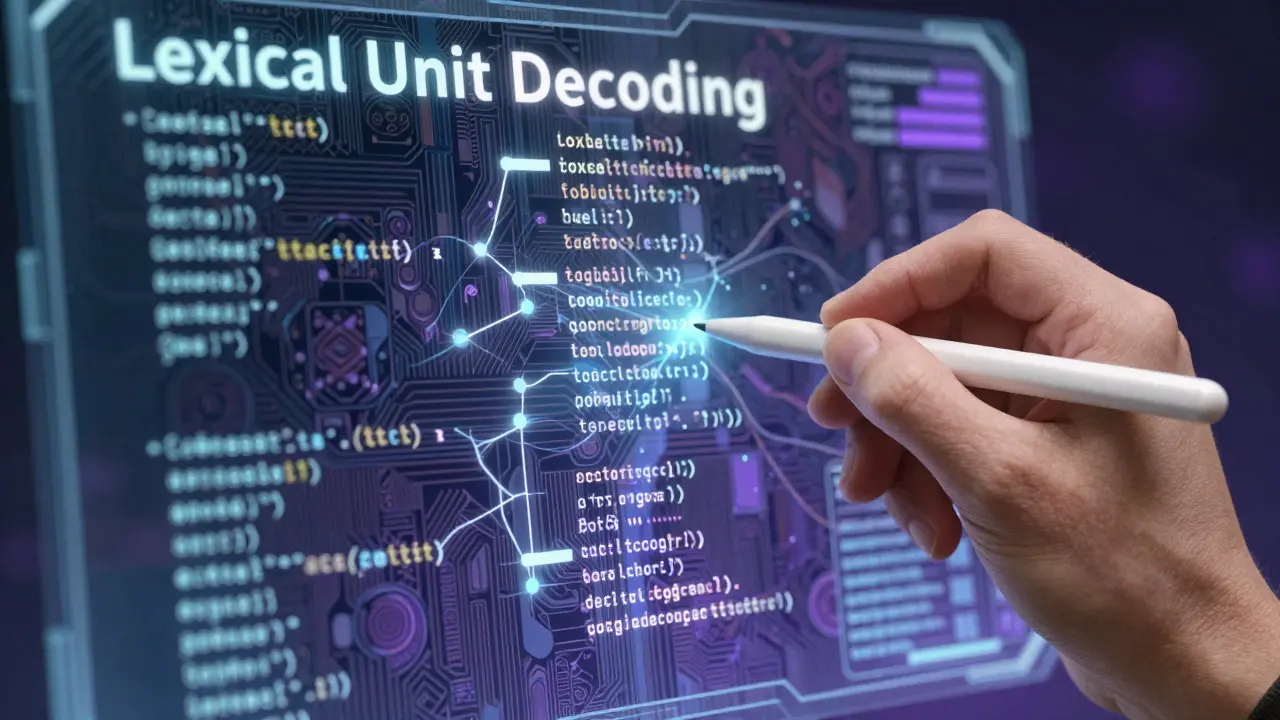
The third strategy, Lexical Unit Parallel Decoding (a method that predicts multiple contiguous tokens as coherent linguistic chunks in a single step based on confidence thresholds), takes a different angle. Instead of generating one token at a time, it predicts multiple contiguous tokens (up to $k$ tokens) as a single coherent unit. This works best when the model is highly confident about the next few words.
During inference, the model identifies high-confidence token spans where the probability exceeds a certain threshold ($\alpha$). For these spans, it predicts the entire chunk in one go. If confidence drops below the threshold, it falls back to standard auto-regressive decoding. According to LREC 2024 research, this method achieved a 33% speed-up on natural language generation tasks and a 30% speed-up on code generation tasks, with no measurable loss in quality.
Why is it so effective for code? Code follows strict patterns and structures. Once the model knows you’re starting a function definition, it can predict the closing brace and parameter list with high confidence. GitHub developers reported 25-35% faster code completion using this technique. However, implementation is more complex. It requires retraining the model to identify these high-confidence spans and appending padding tokens to enable parallel decoding training. You also need to tune the confidence threshold carefully. Set it too low, and you risk error propagation; set it too high, and you rarely trigger the parallel mode.
Comparing the Strategies
Choosing the right strategy depends on your specific use case. Here’s a breakdown of how they compare across key dimensions:
| Strategy | Speed-Up | Implementation Effort | Best For | Quality Risk |
|---|---|---|---|---|
| Skeleton-of-Thought (SoT) | ~1.83× | Low (Prompt Engineering) | General Q&A, Structured Outputs | Inconsistent Depth |
| FocusLLM | Variable (Context-Dependent) | Medium (Layer Retraining) | Long-Context Analysis (128K+) | Minimal (Frozen Weights) |
| Lexical Unit Decoding | 30-33% | High (Full Retraining) | Code Generation, Predictive Text | Error Propagation if Threshold Low |
If you’re looking for a quick win with minimal engineering overhead, SoT is your best bet. It’s easy to implement and works with any existing LLM. If you’re drowning in long documents and need to maintain context fidelity, FocusLLM offers a robust solution, provided you can handle the minor retraining requirement. For specialized applications like code assistants or predictive typing where pattern recognition is strong, Lexical Unit Decoding delivers consistent, significant speed gains.
Implementation Challenges and Real-World Feedback
Despite the promise, implementing these strategies isn’t without hurdles. User feedback from early 2024 highlights several common pain points. On Reddit’s r/MachineLearning, developers experimenting with SoT noted that while latency dropped by 45%, about 22% of users experienced inconsistent depth in the expanded points. This suggests that prompt templates need careful refinement for each specific domain.
For Lexical Unit Decoding, synchronization issues are a frequent complaint. A Stack Overflow analysis from January to June 2024 showed that 41% of questions related to parallel decoding involved threading and synchronization problems between parallel decoding threads. Developers had to tune confidence thresholds aggressively-moving from 0.85 to 0.92 in some cases-to prevent quality drops. This level of tuning requires deep expertise in model behavior and hardware constraints.
Documentation quality also varies. The official SoT GitHub repository has comprehensive documentation, making it accessible to beginners. In contrast, FocusLLM implementations are scattered across academic repositories, requiring more effort to piece together. Community support is strongest for SoT, with hundreds of repositories and thousands of Stack Overflow questions, compared to fewer resources for lexical unit approaches.
Market Adoption and Future Outlook
The industry is moving fast. By mid-2024, Gartner predicted that 65% of enterprise LLM deployments would incorporate parallel decoding techniques by 2026, up from just 12% in Q2 2024. Customer service applications are leading the charge, accounting for 47% of early adopters, followed by real-time translation and code generation. AWS even announced Lambda support for parallel decoding with a modest 15% premium, signaling mainstream acceptance.
Major players are integrating these features natively. Meta’s Llama 3-70B, released in November 2024, included native support for lexical unit parallel decoding, achieving 38% faster inference on code tasks. Google’s Gemini 1.5 update in December 2024 reduced average response latency by 42% for large context windows using experimental parallel decoding. ABI Research forecasts that 90% of commercial LLMs will include some form of parallel decoding by 2027.
However, challenges remain. A controversial January 2025 Stanford HAI working paper cautioned that parallel decoding might struggle with highly creative or reasoning-intensive tasks where sequential thought processes are inherently superior. Error propagation can still be problematic if the model’s confidence calibration is off. As these technologies mature, expect hybrid approaches that dynamically switch between sequential and parallel modes based on task complexity and confidence levels.
Next Steps for Developers
If you’re ready to experiment, start with Skeleton-of-Thought. It’s the lowest barrier to entry. Grab a template from the `sot-llm` GitHub repository and test it with your current LLM provider. Measure the latency reduction and monitor for consistency issues. If you’re working with long documents, explore FocusLLM’s open-source implementations, focusing on the aggregation layer retraining. For code-heavy applications, consider whether the investment in retraining for lexical unit decoding is worth the 30%+ speed boost.
Keep an eye on confidence thresholds and synchronization logic. These are the make-or-break factors for stable deployment. Engage with community forums like Hacker News and Stack Overflow to troubleshoot specific issues. The field is evolving rapidly, and sharing experiences helps everyone move forward faster.
What is the biggest advantage of parallel decoding over traditional auto-regressive decoding?
The primary advantage is significantly reduced latency. Traditional decoding generates tokens one by one, causing delays that grow linearly with output length. Parallel decoding processes multiple tokens or chunks simultaneously, cutting response times by 30-50% or more, which is crucial for real-time applications.
Do I need to retrain my LLM to use Skeleton-of-Thought?
No. Skeleton-of-Thought is a prompt-engineering strategy. It requires no changes to the model weights. You simply modify your prompts to first generate a skeleton and then expand the points in parallel. This makes it the easiest method to implement for existing models.
Which parallel decoding strategy is best for code generation?
Lexical Unit Parallel Decoding is generally the best for code generation. Code follows predictable patterns, allowing the model to predict multiple tokens (like function signatures or closing braces) with high confidence. Studies show up to 30-38% speed-ups in code tasks with this method.
Does parallel decoding compromise the quality of the LLM's output?
Not necessarily. Recent strategies like SoT and Lexical Unit Decoding have demonstrated speed-ups with minimal to no quality loss. However, quality can vary depending on the model's ability to handle parallel expansion or confidence calibration. Careful tuning of thresholds and prompts is required to maintain consistency.
How does FocusLLM handle long contexts differently?
FocusLLM divides long sequences into smaller chunks and processes them in parallel, reducing computational complexity from $O(L^2)$ to $O((L/n)^2)$. It uses a small number of trainable parameters to aggregate information from these chunks, allowing the model to maintain context relevance without losing information through compression.