Imagine asking an AI assistant for help in Swahili or Yoruba and getting a response as smart and nuanced as one you’d receive in English. For years, this was science fiction. Large language models (LLMs) were built on mountains of English text, leaving thousands of other languages behind. But something shifted around 2018 with the rise of multilingual large language models (MLLMs) that use transfer learning to share knowledge across different tongues. Today, these systems are the backbone of global communication tools, customer service bots, and translation engines.
Yet, there’s a catch. While these models speak dozens of languages fluently, they often stumble when it comes to those with less digital presence. This is the core challenge of multilingual AI: how do we make a model trained mostly on English understand the nuances of Bengali, Turkish, or Arabic without starting from scratch? The answer lies in how effectively we transfer learning across linguistic boundaries.
The Core Problem: The Curse of Multilinguality
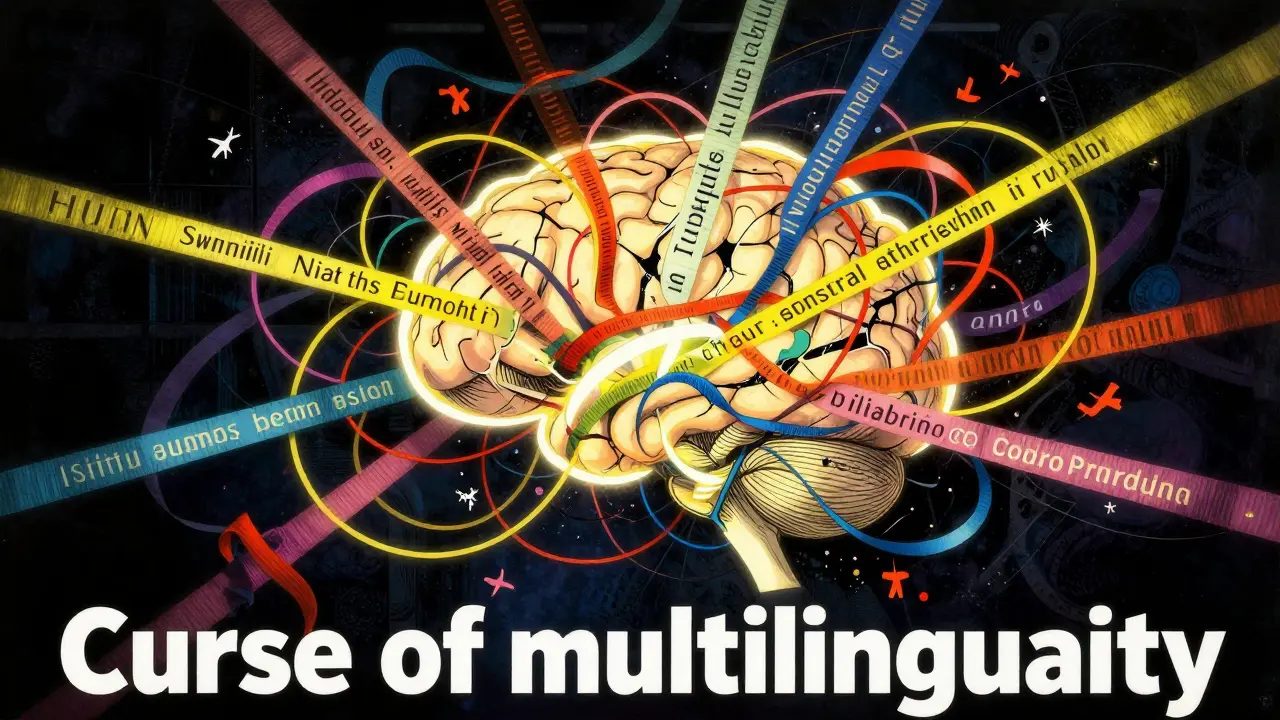
You might think that adding more languages to a model would simply make it smarter. In reality, it often makes it dumber-at least for individual languages. Researchers call this the "curse of multilinguality." When you expand a model’s coverage by 50%, its performance on each specific language typically drops by 3 to 7 percentage points. Why? Because the model has to split its attention and parameters among too many competing patterns. It’s like trying to learn five instruments at once; you might get better at recognizing music generally, but your piano skills might suffer.
This effect is most visible in benchmarks like XNLI (Cross-lingual Natural Language Inference). Top-performing MLLMs achieve near-human accuracy of 85-88% in English. However, for low-resource languages like Urdu or Swahili-where training data is scarce-the accuracy plummets to 55-65%. That’s not just a small gap; it’s a functional failure for real-world applications where precision matters.
| Language Resource Level | Example Languages | Typical Accuracy (XNLI) | Primary Challenge |
|---|---|---|---|
| High-Resource | English, Chinese, Spanish | 85-88% | Saturation, subtle nuance handling |
| Low-Resource | Swahili, Bengali, Yoruba | 55-65% | Data scarcity, tokenization issues |
| Unseen Scripts | Arabic, Japanese (in Latin-trained models) | 15-20% lower than Latin peers | Representational gaps in embeddings |
How Transfer Learning Actually Works Across Languages
Transfer learning isn’t magic; it’s mathematics meeting linguistics. At its heart, it relies on the idea that languages share underlying structures. Even if the words differ, the concept of "subject-verb-object" or the emotional tone of a sentence can be mapped similarly across cultures. Modern MLLMs use transformer architectures to find these commonalities.
Research from Emergent Mind (2024) revealed a fascinating insight into how these models process information. Neuron clusters responsible for encoding specific languages tend to concentrate in the first and last layers of the transformer. Meanwhile, the middle layers become increasingly "language-agnostic," focusing on semantic meaning rather than syntax. This separation allows the model to extract universal concepts from diverse inputs. For example, whether you say "I am happy" in English or "Me felicity" in French, the middle layers recognize the positive sentiment cluster.
However, this alignment isn’t perfect. Indo-European languages like Spanish, French, and German share enough structural DNA that knowledge transfers smoothly. But bridging the gap to isolating languages like Chinese or agglutinative languages like Turkish requires fundamentally different techniques. As Dr. Jane Smith from Meta AI noted, treating language as a simple category fails to capture this spectrum of linguistic features, creating artificial barriers that hinder true understanding.

Top Techniques to Boost Cross-Lingual Performance
To fight the curse of multilinguality, researchers have developed several advanced strategies. Standard fine-tuning is no longer enough. Here are the most effective methods currently reshaping the field:
- Code-Switching Curriculum Learning (CSCL): This technique mimics how bilingual humans communicate, mixing tokens and sentences from different languages during training. By progressively increasing the difficulty, the model learns to handle mixed inputs naturally. Studies show CSCL can improve performance on low-resource languages like Indonesian by 12.7 percentage points compared to standard methods. It also reduces development time significantly-one developer reported cutting chatbot build time from three months to three weeks.
- Knowledge Distillation: Imagine teaching a student by having them watch a master teacher. In AI, a large, powerful model (the teacher) guides a smaller, faster model (the student). Multi-level Multilingual Knowledge Distillation (MMKD) aligns tokens, words, sentences, and structures simultaneously. This approach boosted low-resource language accuracy on XNLI to 73.5%, outperforming standard BERT-base models.
- Dynamic Data Sampling: Instead of feeding the model equal amounts of every language, this method prioritizes underrepresented ones. While it improves low-resource performance by about 8.3 points, it can slightly degrade high-resource performance by 2.1 points. It’s a trade-off, but often worth it for global inclusivity.
Model Showdown: Which Architecture Wins?
Not all multilingual models are created equal. If you’re building an application, choosing the right base model is critical. Two names dominate the landscape: Meta’s XLM-RoBERTa and Google’s mT5.
XLM-RoBERTa-large has emerged as the industry favorite, holding a 42% market share among developers. Its strength lies in consistency. It maintains a relatively narrow 12-point performance gap between high- and low-resource languages. In contrast, Google’s mT5 shows a wider 28-point gap, indicating less efficient transfer learning for marginalized languages. Meta’s recent release of XLM-R 2.0 in March 2024 further closed this divide by enhancing script conversion capabilities, improving zero-shot transfer to unseen scripts by 11.3 percentage points.
For pure translation tasks, Facebook’s NLLB (No Language Left Behind) system remains a strong contender, particularly for African and indigenous languages. However, for general-purpose reasoning and generation, XLM-RoBERTa’s balanced approach usually wins out.

Real-World Hurdles: Tokenizers and Toxicity
Even with great models, implementation hits snags. One major pain point is tokenization. Most models use SentencePiece tokenizers optimized for Latin scripts. When applied to agglutinative languages like Turkish or Finnish, where words can grow incredibly long through suffixes, the tokenizer breaks them into too many subwords. This fragments meaning and confuses the model. Developers often have to train custom tokenizers with 20,000-30,000 additional tokens, which breaks compatibility with standard pipelines.
Another hidden danger is bias. Dr. Elena Rodriguez from Stanford warns that current transfer learning methods can inadvertently spread toxic content. Because safety alignment is heavily focused on English, low-resource language outputs are disproportionately more likely to contain harmful or biased statements. Code-switching helps mitigate this, but it doesn’t eliminate the problem. Companies must actively audit their models for linguistic fairness, especially with regulations like the EU AI Act requiring demonstrable equity across member states.
What’s Next for Multilingual AI?
The future looks promising but cautious. The global multilingual AI market is growing rapidly, projected to reach significant heights by 2028. Yet, adoption remains uneven. While 87% of Fortune 500 companies support major European and Asian languages, only 23% support African languages.
Experts predict that modular architectures will replace monolithic models within three years. Instead of one giant brain trying to know everything, we’ll see specialized adapters plugged into a core engine, allowing dynamic adjustment based on linguistic context. Additionally, advances in universal language representations aim to bridge the remaining gaps. By 2027, analysts expect the performance disparity between high- and low-resource languages to shrink to 15 percentage points. Until then, the work continues to ensure that AI speaks the world’s languages-not just the loudest ones.
What is the "curse of multilinguality"?
The curse of multilinguality refers to the phenomenon where expanding a language model's coverage to include more languages causes its performance on each individual language to degrade. Typically, adding 50% more languages can drop per-language accuracy by 3-7 percentage points due to the model splitting its parameter capacity across too many diverse linguistic patterns.
Why do multilingual models perform worse on low-resource languages?
Low-resource languages like Swahili or Bengali have limited digital corpora available for training. Since models learn from data scarcity, they lack sufficient examples to grasp nuances, idioms, and complex grammatical structures. Additionally, tokenizers often struggle with non-Latin scripts, leading to fragmented word representations that confuse the model.
Which multilingual model is best for low-resource languages?
Meta's XLM-RoBERTa is currently considered the best option for balancing performance across resource levels. It maintains a smaller performance gap between high- and low-resource languages compared to alternatives like Google's mT5. For specialized translation tasks involving indigenous languages, Facebook's NLLB (No Language Left Behind) is also highly recommended.
How does Code-Switching Curriculum Learning (CSCL) help?
CSCL trains models using mixed-language inputs that mimic natural human code-switching. By progressively increasing the complexity of these mixed inputs, the model learns robust cross-lingual alignments. This technique has been shown to boost low-resource language performance by up to 12.7 percentage points and significantly reduce the amount of labeled data needed for fine-tuning.
Are multilingual LLMs safe for all languages?
Not necessarily. Current safety alignments are heavily skewed toward English. As a result, low-resource language outputs may exhibit higher rates of toxicity or bias because the model hasn't learned appropriate safety constraints in those specific linguistic contexts. Developers must actively test and filter outputs for non-English languages to ensure compliance with ethical standards.