
Imagine having a massive library where every single book is open and being read at once every time you ask a simple question. That's how a traditional dense model works-it uses every single parameter for every single word it generates. Now, imagine instead a library with a hyper-efficient librarian who knows exactly which three books contain your answer and only opens those. That is the core magic of Mixture-of-Experts is a neural network architecture that decouples model capacity from computational cost by using sparse, input-dependent activation. By only waking up a small fraction of its brain for any given task, a model can possess the knowledge of a trillion-parameter giant while only paying the energy bill of a much smaller system.
For anyone running these models in production, the primary tension is between Mixture-of-Experts (MoE) efficiency and the sheer physical memory required to keep those experts ready. While you save on the "thinking" part (compute), you don't save on the "storage" part (VRAM). This creates a unique set of trade-offs that can either make your AI service incredibly cheap to run or a nightmare for your infrastructure team.
How the MoE Engine Actually Works
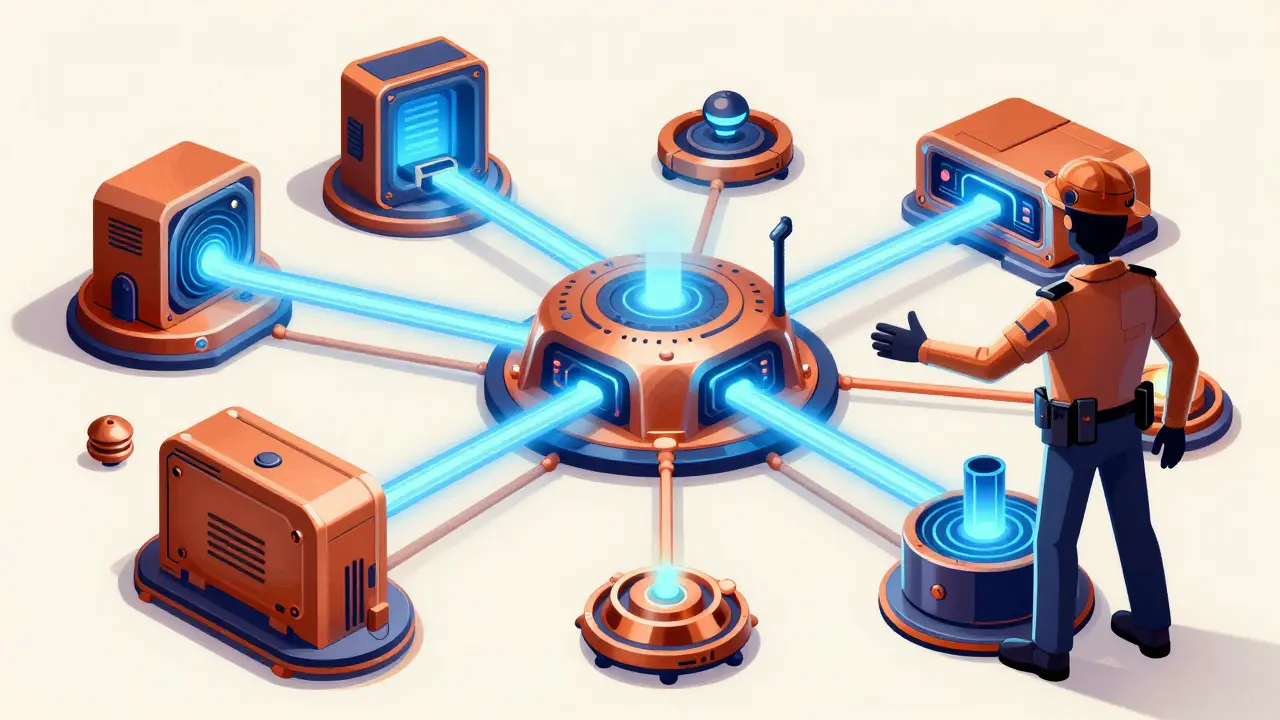
In a standard transformer, you have feed-forward networks (FFNs) that process data. MoE replaces these static layers with a set of specialized subnetworks, known as experts. But how does the model know which expert to use? That's where the Gating Mechanism comes in. This learned router acts like a traffic cop, analyzing the incoming token and deciding which experts are best equipped to handle it.
Take Mixtral as a real-world example. It transforms every layer into an expert layer containing eight different experts. However, it doesn't use all eight. For every token, it only activates two. This means while the model has 47 billion parameters in total, it only uses about 13 billion parameters per forward pass. You get the reasoning power of a large model with the speed and cost of a medium-sized one.
| Feature | Dense Model | MoE Model |
|---|---|---|
| Compute per Token | High (All parameters active) | Low (Only selected experts active) |
| VRAM Requirements | Proportional to active size | High (Must store all experts) |
| Training Complexity | Standard / Stable | High (Requires load balancing) |
| Scaling Potential | Linear cost increase | Sub-linear compute cost increase |
The Massive Wins: Compute and Speed
The most striking advantage of MoE is the sheer amount of compute you save. Research shows that MoE models can deliver 4 to 16 times the compute savings at the same level of perplexity (a measure of how well the model predicts text) compared to dense models. If you're scaling a project, this is the difference between a sustainable budget and a financial black hole.
We've seen this play out with the Switch Transformer, which reported a 7-fold speedup during pretraining. More recently, DeepSeek-v3 pushed the envelope even further by using an FP8 mixed precision training framework. This allowed them to train a massive MoE model for an estimated $5.6 million-a fraction of what a dense model of similar capacity would cost. They also paired this with Multi-head Latent Attention (MLA), which crushed the KV cache size by over 93%, making inference significantly leaner.
The Hidden Costs: Memory and Management
If MoE is so fast, why isn't every model an MoE? Because memory is a brutal constraint. While you only compute with a few experts, you must store all of them in memory. If you have eight experts of 7 billion parameters each, you need 56 billion parameters' worth of VRAM, even though you only use 13 billion parameters for a single token. This can lead to high hardware costs and requires sophisticated sharding across multiple GPUs.
There is also the "routing tax." The gating network adds a layer of computational overhead. For very small models or trivial tasks, the time it takes to decide which expert to use can actually outweigh the time saved by using a smaller subnet. Furthermore, training these models is like herding cats. You have to carefully monitor load balancing to ensure the model doesn't just rely on one "favorite" expert while the others stay idle, which would waste the architecture's potential.
Solving the Memory Gap with Compression
To fight the VRAM hunger, researchers are developing smarter ways to shrink experts. A notable breakthrough is Expert-Selection Aware Compression (EAC-MoE). Instead of just blindly compressing the model, it uses quantization-aware router calibration. Essentially, it figures out which experts are rarely used and prunes them or compresses them more aggressively. This has been shown to reduce memory usage by 4 to 5 times and boost throughput by up to 1.7 times, with almost no loss in accuracy.
Another interesting path is knowledge integration from unselected experts. Systems like HyperMoE try to sneak in some useful signals from the experts that weren't picked. It's a way of getting a little extra "intelligence" for free without increasing the runtime cost of the forward pass.

Is MoE Right for Your Project?
Choosing between MoE and Dense depends entirely on where your bottleneck lies. If you are limited by GPU compute (TFLOPS) but have plenty of VRAM, MoE is a no-brainer. It allows you to scale your model to trillions of parameters without needing a nuclear power plant to run inference.
However, if you are deploying on edge devices or limited hardware where memory is the primary constraint, a dense model or a heavily quantized small model might be more stable. MoE models also tend to be pickier during fine-tuning. You might find that the sample efficiency is lower than a dense model, meaning you need more high-quality data to get the experts to specialize correctly for a specific domain.
Does MoE make the model actually smarter?
Not necessarily "smarter" in a general sense, but it allows for much higher capacity. Because different experts can specialize in different domains-like one for coding, one for creative writing, and one for mathematics-the model can store more nuanced knowledge without becoming too slow to use.
Why is training MoE harder than dense models?
The main issue is routing stability. If the gating mechanism doesn't balance the load, some experts get over-trained while others are ignored. This requires specialized loss functions and careful hyperparameter tuning to ensure all experts are utilized effectively.
How does MoE affect inference latency?
At low batch sizes, MoE typically reduces latency because fewer parameters are processed per token. At high batch sizes, it increases throughput, allowing you to serve more users simultaneously compared to a dense model of the same total parameter count.
Can I convert a dense model into an MoE model?
Yes, techniques like "upcycling" allow researchers to take a pre-trained dense model and split its layers into multiple experts. This provides a head start in training, as the model doesn't have to learn basic language patterns from scratch.
What is the relationship between MoE and KV cache?
While MoE primarily affects the feed-forward layers, it is often paired with attention optimizations. For example, DeepSeek-v3 uses Multi-head Latent Attention (MLA) alongside MoE to reduce the memory footprint of the KV cache, which is critical for handling long conversations efficiently.
Next Steps and Troubleshooting
If you're planning to move toward an MoE architecture, start by auditing your VRAM. If your current hardware is already at 90% capacity with a dense model, an MoE model of equivalent total parameters will crash your system. Consider looking into 4-bit or 8-bit quantization early in the process.
For those experiencing "expert collapse" (where only a few experts are being used), check your auxiliary loss settings. Most MoE frameworks use a balancing loss to force the router to distribute tokens more evenly. If you're seeing unstable training, try reducing the learning rate specifically for the gating network to prevent the router from making erratic shifts early in the training process.






Shivam Mogha
April 4, 2026 AT 21:09VRAM is definitely the bottleneck here.
mani kandan
April 6, 2026 AT 08:19Totally agree with the point on VRAM, it's a real beast to tame. The way MoE manages to slice through compute costs while keeping the intelligence intact is honestly some wizardry. It feels like we're finally moving away from just throwing more raw power at the problem and actually getting clever with the architecture. I've been eyeing the DeepSeek-v3 approach because that MLA optimization is just absolute gold for anyone trying to handle long-context windows without their GPU screaming in agony. It's a fascinating trade-off between physical memory and operational speed.
poonam upadhyay
April 7, 2026 AT 16:02Omg!!! Why is everyone so obsessed with the hardware part???!!! It's just so... bland!!! Let's talk about how this is basically just a digital version of a fragmented brain!!! Absolutely chaotic energy in those routing layers, isn't it???!!! I bet the training process is just a total nightmare of screaming tensors and weeping GPUs!!! Just utterly delicious drama in the backend!!!
Rahul Borole
April 8, 2026 AT 18:15The implementation of auxiliary loss for load balancing is a critical technical detail that deserves more attention. For those attempting to implement this from scratch, I highly recommend meticulously monitoring the router's distribution metrics to avoid the aforementioned expert collapse. It is truly an exhilarating time to be working in the field of LLM optimization, and these sparse architectures provide a sustainable pathway toward achieving trillion-parameter scale without necessitating unrealistic hardware expenditures. Let us continue to push the boundaries of what is computationally feasible through these innovative routing mechanisms.
Sheetal Srivastava
April 10, 2026 AT 02:11The banal focus on simple VRAM constraints is simply pedestrian. One must consider the nuanced epistemological implications of sparse activation; it is essentially a manifestation of modularity that transcends the crude linear scaling of dense models. The stochastic nature of the gating mechanism introduces a level of latent complexity that most practitioners fail to grasp, remaining trapped in a paradigm of superficial throughput metrics. While the masses marvel at a few gigabytes of memory, the true intellectual challenge lies in the convergence stability of the router within a high-dimensional manifold. It is quite exhausting to explain these transcendental architectural shifts to those who only view AI through the lens of a spreadsheet.
Bhavishya Kumar
April 10, 2026 AT 06:04the technical precision of the comparison table is acceptable however the lack of consistent capitalization in some of the industry terminology throughout such discussions is often regrettable throughout the sector