
The Magic of Zero-Shot Learning
Zero-Shot Learning is when you give an LLM a task it hasn't been specifically trained for, and it just handles it. It doesn't rely on a set of examples you provide in the prompt; instead, it leans on the sheer volume of knowledge it absorbed during its initial training. Think of it as a student taking a test on a topic they read about once in a general encyclopedia. They might not be an expert, but they can use logic and general knowledge to find the right answer.
This approach is a game-changer for speed. You don't have to spend hours curating a dataset of "correct" answers. For example, if you want a model to classify a customer email as "Urgent" or "Not Urgent," you simply tell it: "Classify this email." For broad tasks, this is often plenty. In some specialized tests, models like Flan-T5 have shown impressive precision rates around 0.94 in zero-shot scenarios. It's the fastest way to prototype an idea because the setup time is virtually zero.
When to Level Up to Few-Shot Learning
Sometimes, a general instruction isn't enough. If your task is highly specific-like writing medical reports in a very particular brand voice or extracting niche data from legal contracts-the AI might struggle to guess the exact format you want. This is where Few-Shot Learning comes in. Instead of just giving an instruction, you provide a few high-quality examples (usually between 2 and 10) within the prompt. This is often called "in-context learning."
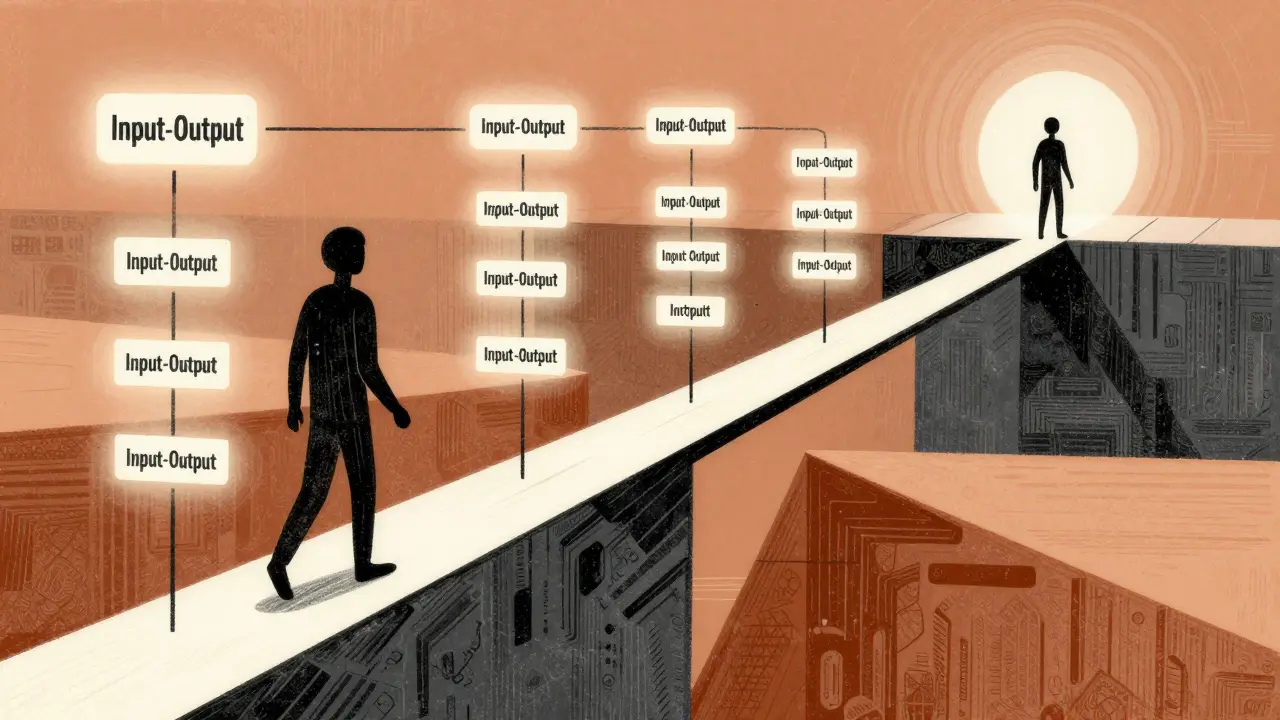
By showing the model, "Input: X, Output: Y," you are effectively giving it a map. You aren't changing the model's weights (which is what happens during training), but you are guiding its attention. For instance, in healthcare, using few-shot prompting has helped organizations cut the time it takes to develop diagnostic tools by 40%. When the cost of an error is high-like in a clinical setting-providing these few examples creates a safety rail that ensures the output is consistent and follows a strict pattern.
| Feature | Zero-Shot | Few-Shot |
|---|---|---|
| Setup Speed | Instant | Slower (requires curation) |
| Data Needed | None | 2-10 examples |
| Accuracy | Moderate (General tasks) | High (Domain-specific tasks) |
| Consistency | Can vary | High stability |
| Best Use Case | Quick prototyping, general AI chat | Regulatory, Brand-specific, Niche data |
The Technical Trade-offs: Precision vs. Effort
Choosing between these two isn't just about how much data you have; it's about your risk tolerance. If you're building a tool for internal brainstorming, zero-shot is your best friend. But if you're dealing with PubMedBERT-level complexity-where you're extracting relations from biomedical texts-you'll find that zero-shot often falls short of state-of-the-art specialized models. While LLMs are great at question-answering, they can stumble on complex relation extraction without a few guiding examples.
Interestingly, some open-source models like Llama-3-8B-Instruct or Mistral-7B-Instruct can be deployed on local networks to keep data secure. When you combine these local models with few-shot prompting, you get a system that is both private and highly accurate, without the need for a massive labeled dataset that would typically be required for traditional machine learning.

A Practical Framework for Decision Making
So, how do you actually decide which one to use in your project? Start by asking yourself three questions: How much time do I have? How critical is the accuracy? Do I have a gold-standard example of what a "perfect" answer looks like?
- Go Zero-Shot if: You need a result in seconds, you're performing a general task (like summarizing a news article), and you have a human in the loop to double-check the output.
- Go Few-Shot if: You need the output to follow a strict format (like JSON or a specific legal style), you're working in a narrow domain like drug clinical exposure, or you've noticed the model is consistently making the same type of mistake.
A pro tip for few-shot prompting: don't just pick any examples. Pick examples that represent the variety of data the model will see. If you're classifying sentiment and only give "Positive" examples, the model might get confused when it sees a "Negative" one. Give it one of each to establish the boundaries.
Future Horizons: Beyond Simple Prompting
We are seeing a shift toward more sophisticated ways of handling these capabilities. Researchers at institutions like MIT are exploring how LLMs can solve problems they've never encountered by chaining these reasoning steps together. We're moving toward a world where the model doesn't just follow a few examples, but actually asks you for the examples it needs to be successful.
As we integrate these into fact-checking pipelines and automated document analysis, the ability to switch between zero and few-shot modes will allow us to scale AI across industries where data is scarce. You no longer need 10,000 labeled images or documents to build a useful tool; sometimes, just three well-chosen examples are enough to move the needle from a toy project to a professional-grade application.
Does few-shot learning require retraining the model?
No, few-shot learning does not change the model's underlying weights. It is a form of in-context learning where the examples are provided in the prompt. Once the conversation or session ends, the model "forgets" those examples unless they are included in the prompt again.
How many examples are typically enough for few-shot prompting?
Generally, 2 to 10 examples are sufficient. Adding too many examples can sometimes overwhelm the model's context window or lead it to over-fit on the specific examples provided rather than generalizing the rule.
Can zero-shot learning be as accurate as a fine-tuned model?
In some general tasks, yes. However, for highly specialized fields like medical relation extraction, specifically trained models (like PubMedBERT) often still outperform zero-shot LLMs. The gap is closing, but the narrow expert models still hold an edge in precision.
What is the biggest risk of relying on zero-shot learning?
The biggest risk is inconsistency and hallucinations. Because the model is guessing the intent based on general knowledge, it may produce an answer that looks correct but is factually wrong or formatted incorrectly for your specific needs.
Which LLMs are best for few-shot tasks?
Most modern, high-parameter models excel at this. Models like GPT-3.5-turbo, Gemini-1.5-flash, and Llama-3-8B-Instruct are designed specifically to follow instructions and can easily pivot their behavior based on a few provided examples.








Nathan Jimerson
April 12, 2026 AT 21:54This is such a helpful breakdown of a complex topic! It's really exciting to see how these tools are becoming more accessible for everyone to use in their daily work.
Sandy Pan
April 13, 2026 AT 01:27There is something profoundly poetic about the idea of a machine "learning" from a mere handful of whispers. We are essentially mirroring the human cognitive leap from intuition to guided reasoning. It makes me wonder if the gap between zero-shot and few-shot is actually a reflection of how we ourselves perceive the boundary between innate knowledge and acquired skill. The tragedy of the context window is that it's a fleeting memory, a ghost of a lesson that vanishes the moment the session ends. Truly a digital Sisyphus.
Andrew Nashaat
April 14, 2026 AT 02:52The lack of a comma after "say" in the first paragraph is absolutely criminal!!! It's honestly exhausting how people just ignore basic punctuation in the age of AI... also, the moral implications of relying on these"black boxes" for medical data are terrifyingly overlooked!!! We need way more accountability!!!
Gina Grub
April 14, 2026 AT 11:00absolute chaos in the latent space if you think zero-shot handles edge cases. the stochasticity is just wild without a proper few-shot anchor. total hallucination fest if the temperature is too high and the prompt is mid. literally a disaster waiting to happen for any production pipeline
Amanda Ablan
April 14, 2026 AT 14:19For anyone struggling with the curation part of few-shot, I've found that using a "diverse-set" approach works best. Instead of picking the easiest examples, try to pick the most confusing ones. It helps the model understand the boundaries much better and reduces those annoying edge-case errors.
Dylan Rodriquez
April 15, 2026 AT 11:05I love how this encourages us to think about the quality of our inputs. If we want the AI to be a better partner, we have to be better teachers. It's a wonderful symbiotic relationship where we refine our own understanding of a task by trying to explain it to the model through a few perfect examples. Everyone should try experimenting with this to see where their specific workflow hits the wall with zero-shot.
Meredith Howard
April 16, 2026 AT 04:28it is quite fascinating how the shift toward local deployment like Llama 3 ensures data sovereignty while maintaining high utility through in context learning the intersection of privacy and performance is a critical area of study for modern enterprises