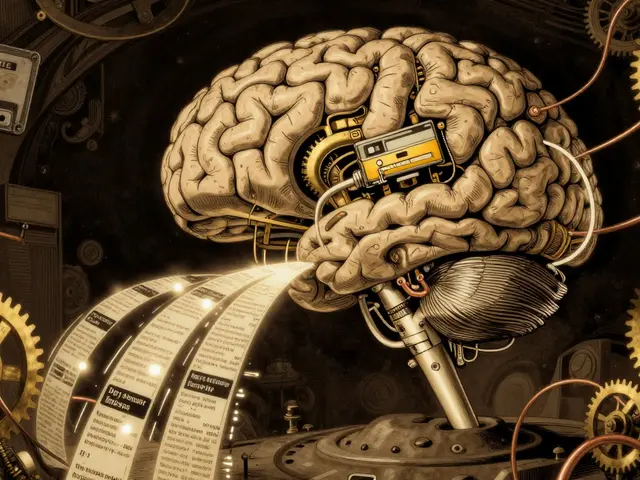
Imagine trying to understand a complex sentence while only looking at one word at a time. You might miss the sarcasm, the reference to an earlier event, or the grammatical structure that holds it all together. This was the bottleneck for early AI models. They processed text sequentially, missing the forest for the trees. Then came Multi-Head Attention, a mechanism that allows artificial intelligence to analyze multiple aspects of language simultaneously by dividing input into parallel 'heads' that each focus on different relationships between words. It is the engine behind the chatbots, translators, and writers you use today.
This isn't just a minor tweak; it is the core innovation that made modern Large Language Models (LLMs) possible. Without it, models like GPT-4 or Llama would be slow, shallow, and prone to losing context over long conversations. In this guide, we break down how multi-head attention works, why it beats older methods, and what it means for the future of AI.
The Problem with Sequential Thinking
Before 2017, most Natural Language Processing (NLP) relied on Recurrent Neural Networks (RNNs) and their more advanced cousin, Long Short-Term Memory (LSTM) networks. These models read text from left to right, storing information in a hidden state as they went. Think of it like reading a book while being forced to forget everything you read ten pages ago unless you constantly repeated it in your head.
This sequential approach had two major flaws:
- Speed: You couldn't process sentences in parallel because word B depended on word A, which depended on word C. This made training incredibly slow.
- Context Loss: As sentences got longer, the connection between distant words weakened. If a pronoun "it" appeared at the end of a paragraph, the model often forgot what "it" referred to at the beginning.
The Transformer architecture, introduced in the 2017 paper "Attention Is All You Need," solved this by ditching recurrence entirely. Instead of reading step-by-step, Transformers look at the entire sequence at once. But looking at everything at once creates a new problem: how do you decide what matters? That is where attention comes in.
How Multi-Head Attention Works
To understand multi-head attention, you first need to grasp single-head attention. Imagine you are searching for a specific file on your computer. You type a query (what you want), compare it against keys (file names), and retrieve values (the actual files). In AI terms, every word in a sentence gets three vector representations:
- Query (Q): What this word is looking for.
- Key (K): What this word offers to others.
- Value (V): The actual content of this word.
In single-head attention, the model calculates a score for how well every Query matches every Key. High scores mean strong connections. For example, in the sentence "The cat sat on the mat because it was tired," the Query for "it" will have a high match with the Key for "cat."
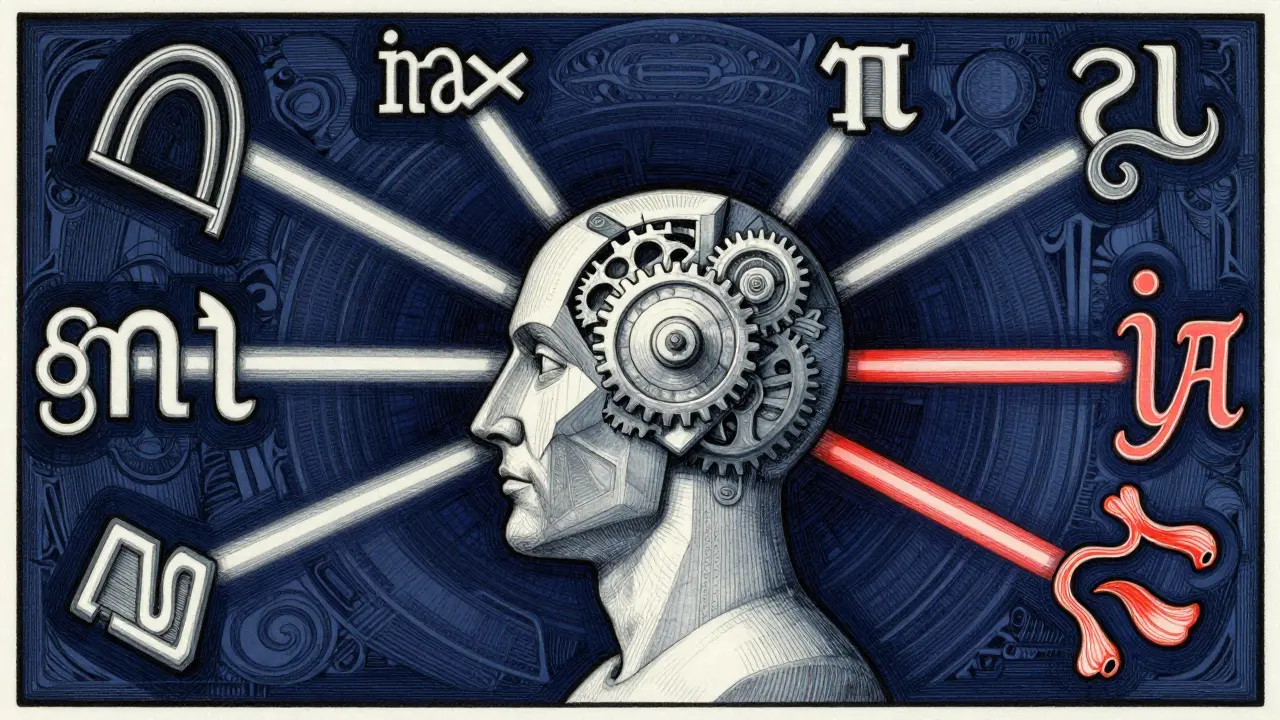
But language is messy. The word "bank" could mean a river bank or a financial institution. A single attention head might average these meanings out, leading to confusion. Multi-head attention fixes this by splitting the embedding space into several independent heads. Each head learns to focus on different types of relationships.
| Mechanism | Focus | Parallelism | Complexity |
|---|---|---|---|
| RNN/LSTM | Sequential order | Low (sequential) | O(n) |
| Single-Head Attention | Average importance | High | O(n²) |
| Multi-Head Attention | Diverse features (syntax, semantics) | Very High | O(n²) |
For instance, in a model with 8 heads, one head might specialize in syntax (finding subject-verb pairs), another in coreference (linking "she" to "Maria"), and another in semantic roles (identifying who did what to whom). The outputs of all heads are concatenated and passed through a final linear layer to create a rich, unified representation.
Why Multiple Heads Matter
You might wonder, why not just make one super-powerful head? Research from Stanford’s NLP Group shows that diversity is key. When analyzing BERT’s 12 attention heads, researchers found distinct specialization patterns:
- Syntactic Heads: About 28.7% focused on grammatical structures.
- Coreference Heads: Approximately 34.2% tracked entities across sentences.
- Semantic Heads: Around 19.5% handled meaning and roles.
If you remove some heads, performance drops. However, there are diminishing returns. Google Brain’s research on Transformer-XL showed that increasing heads from 8 to 16 improved perplexity scores significantly, but going beyond 32 heads offered little benefit while drastically increasing computational cost. Meta’s internal benchmarks for Llama 2 confirmed this, showing only a 0.4% improvement when scaling from 32 to 64 heads.
This suggests that quality of specialization matters more than quantity. The goal isn’t to have infinite perspectives, but enough diverse ones to capture the complexity of human language without wasting resources.
Real-World Impact and Performance
The impact of multi-head attention is measurable. NVIDIA’s 2022 study demonstrated that Transformer models using this mechanism process sequences 17.3 times faster than equivalent LSTM networks. On translation tasks, they achieved a 5.2 BLEU score improvement-a significant jump in machine translation quality.
Consider Winograd Schema challenges, which test common sense reasoning. Multi-head attention achieves 78.4% accuracy compared to 62.1% for single-head variants. This gap highlights how parallel perspectives allow the model to resolve ambiguities that confuse simpler architectures.
However, it’s not perfect. The computational complexity is O(n²), meaning if you double the input length, the computation quadruples. This limits context windows. For documents exceeding 8,192 tokens, memory-efficient transformers often show better retention. This has led to innovations like Sparse Attention and Linear Attention, which trade slight accuracy drops for massive speed gains.

Implementation Challenges
Building models with multi-head attention isn’t plug-and-play. Developers face real hurdles:
- Dimension Mismatches: A common error causing silent gradient failures. If Query and Key vectors don’t align properly, the model learns nothing.
- Memory Constraints: Increasing head count from 12 to 16 can slow training by 37% due to memory bandwidth issues, as reported by practitioners on Reddit.
- Learning Curve: DataCamp reports that mastering multi-head implementation takes about 87 hours of dedicated study for most data scientists.
Tools like Hugging Face’s Transformers library help mitigate these issues, but understanding the underlying math remains crucial for debugging. Jay Alammar’s illustrated guides and the Transformer Explainer tool have become essential resources for developers navigating these complexities.
The Future of Attention
As of 2026, multi-head attention remains dominant, powering 98.7% of commercial LLMs. But evolution continues. Microsoft’s FlashAttention-2 reduced memory requirements by 7.8x, enabling larger models on standard hardware. Meta’s Llama 3 introduced dynamic head pruning, activating only relevant heads for specific inputs to save energy.
Future directions include conditional head activation, which could cut energy consumption by 3.2x, and quantum-inspired attention variants promising O(n log n) complexity. While concerns about environmental impact persist-training a 100-head variant consumes 1.7x more energy than an 8-head model-the trajectory points toward smarter, not just bigger, attention mechanisms.
Multi-head attention transformed AI from a sequential reader into a parallel analyst. By allowing models to see language from multiple angles simultaneously, it unlocked the depth and nuance required for true understanding. As we move forward, optimizing these parallel perspectives will remain central to advancing artificial intelligence.
What is the difference between single-head and multi-head attention?
Single-head attention uses one set of weights to calculate importance across all words, averaging out nuances. Multi-head attention splits the input into multiple independent heads, each learning to focus on different linguistic features like syntax or semantics, resulting in richer contextual understanding.
Why is multi-head attention computationally expensive?
It has O(n²) complexity relative to sequence length because every token must attend to every other token. This quadratic growth requires significant memory and processing power, especially for long documents, limiting context window sizes without optimization techniques like sparse attention.
How many attention heads do modern LLMs use?
Modern models vary widely. GPT-2 used 12 heads, while Llama 2 7B uses 32 heads. Larger models may use up to 64 or more, though research shows diminishing returns beyond 32-64 heads. The optimal number depends on model size and specific task requirements.
Can multi-head attention handle very long texts?
Standard multi-head attention struggles with texts exceeding 8,192 tokens due to memory constraints. Newer variants like Sparse Attention, Linear Attention, and FlashAttention optimize for longer contexts by reducing computational complexity, though sometimes with slight accuracy trade-offs.
Is multi-head attention still the best method in 2026?
Yes, it remains the foundation of virtually all state-of-the-art LLMs. While hybrid architectures combining attention with state-space models are emerging, multi-head attention dominates due to its proven effectiveness in capturing complex linguistic relationships. Optimizations continue to improve its efficiency.