
When AI Starts With Eyes, Not Words
Most multimodal AI models today are built like a car with a fancy new radio added on. The engine is still a language model - trained for years on text - and someone just slapped on a camera and called it multimodal. That’s the text-first approach. But a growing group of researchers are asking: what if we started with the eyes first? What if the AI learned to see before it learned to speak? That’s vision-first pretraining. And it’s not just a different method - it’s a different philosophy about how machines understand the world.
Text-First: The Dominant Path, Built on LLMs
Over 90% of the multimodal models released between 2023 and 2025 followed the text-first path. Models like Llama 3.2 Vision, Qwen2.5-VL, and Phi-4 Multimodal didn’t start from scratch. They began as powerful text-only LLMs - Llama 3.1, Qwen2.5, Phi-4 Mini - and then got vision added on. This isn’t magic. It’s engineering. A vision encoder, usually a Vision Transformer (ViT), takes an image and turns it into a list of numerical features. Those features get glued to the start of a text prompt, and the LLM treats them like extra words. The model then learns to match images with captions, answer questions about pictures, or describe scenes - all while keeping its original language skills mostly intact.
The big win? Compatibility. If you already know how to work with Llama 3 or Mistral, you can plug in a vision encoder and start building. Most enterprise tools, prompt libraries, and fine-tuning pipelines work out of the box. Developers report a 30-40 hour learning curve to get started. That’s why 87% of commercial AI systems today use this approach. Companies like Meta, Alibaba, and Microsoft poured billions into this path because it scales fast, integrates easily, and delivers solid results for common tasks like document scanning, customer service chatbots, and content moderation.
But there’s a hidden cost. The vision data gets squeezed into the language model’s format. A 448x448 pixel image might become 1,024 numerical vectors - and the LLM has to interpret them as if they were words. This creates a bottleneck. In complex visual reasoning tasks - like reading a multi-panel comic strip or understanding a scientific diagram - text-first models often miss spatial relationships. Users on Reddit report a phenomenon called “image blindness”: the AI ignores the picture entirely if the text description is even slightly misleading. One GitHub issue from September 2025 found that 62% of users struggled with diagrams containing multiple axes, labels, and annotations. The model saw the labels, read them, and then answered based on the text - not the image.
Vision-First: Starting With Seeing
Then there’s vision-first. Instead of adding vision to a language model, this approach starts with a strong vision model - like BEiT-3 or BLIP-2 - and teaches it to understand language. These models are trained from the ground up to process images and text together. They don’t just match captions to pictures. They learn how visual elements relate to each other: what’s above, below, next to, or hidden. The architecture is more complex. Some use a Mixture of Expert Encoder-Decoder (MED) setup that can switch between being an image encoder, a text encoder, or a joint decoder - all trained simultaneously on three vision-language objectives.
The result? Better visual understanding. On benchmarks like ChartQA - which tests reasoning over bar charts and scatter plots - vision-first models outperform text-first ones by nearly 19%. In medical imaging analysis, one healthcare provider using a vision-first model called MedViLL achieved 93% accuracy with 31% less training data than a text-first model needed. They’re better at captioning images with rich detail, spotting subtle visual anomalies in manufacturing, and interpreting diagrams with multiple layers of information.
But here’s the catch: language generation is weaker. Vision-first models were never designed to write essays. When asked to generate a long response, they often sound robotic, repetitive, or oddly vague. One study found an average 7.8% drop in text-only performance compared to pure language models. Their training data is also harder to come by. While text-first models can piggyback on billions of web pages, vision-first models need paired image-text data that’s carefully aligned - and that’s expensive to collect. Only 13% of enterprise systems use this approach. Most of the progress is happening in academic labs, hospitals, and specialized manufacturing plants.
Performance Showdown: What the Benchmarks Say
| Task | Vision-First | Text-First |
|---|---|---|
| Image Captioning Accuracy | 79.1% | 73.8% |
| Visual Question Answering (VQAv2) | 79.6% | 84.2% |
| ChartQA (Complex Reasoning) | 81.3% | 62.6% |
| Text-Only Performance Drop | 7.8% | 2.3% |
| Training Data Needed | 37% less | Higher |
| VRAM Usage (8B model) | 21.4GB | 25.1GB |
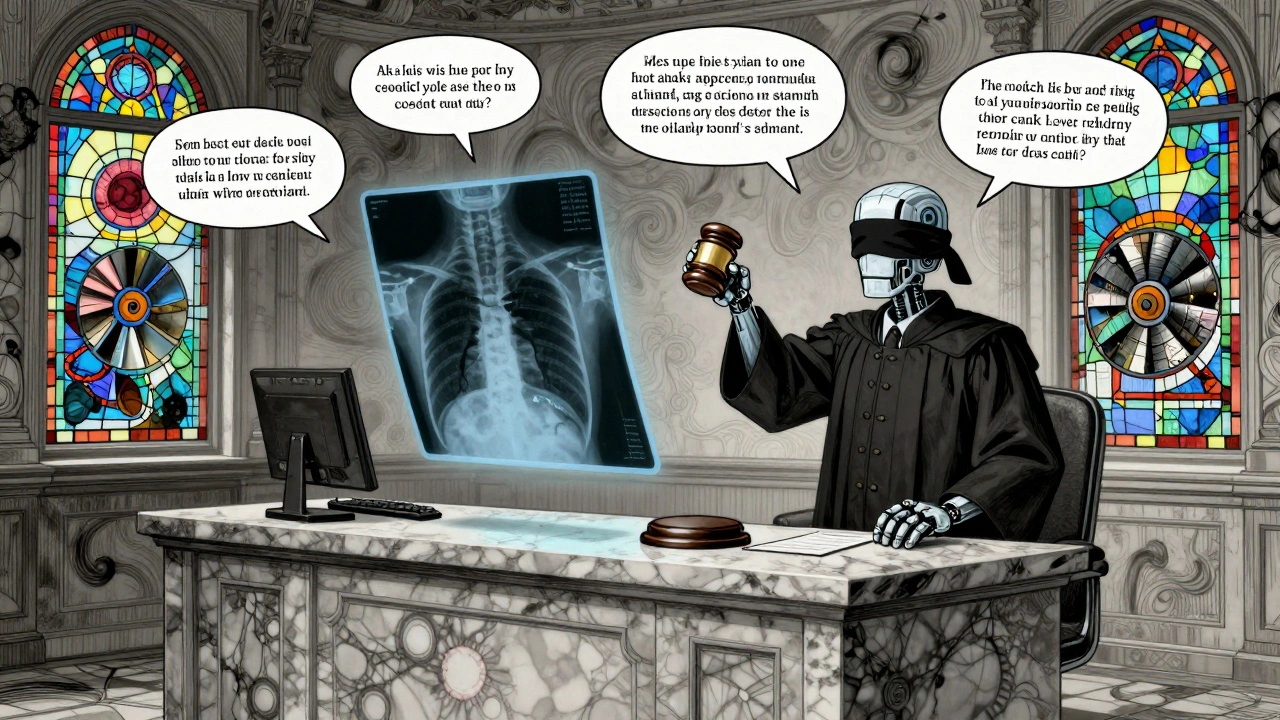
Text-first models win on tasks where language dominates - like answering questions when the image is just a supporting detail. They’re great for customer support bots that need to read a receipt and respond in natural language. Vision-first models win when the image is the main source of truth - like detecting a cracked turbine blade in a factory or reading a handwritten medical note on an X-ray.
Who Should Use Which?
If you’re building a chatbot that answers questions about product images, or you need to extract text from scanned documents, go text-first. It’s faster, cheaper, and the tools are ready. You can deploy Llama 3.2 Vision tomorrow with existing infrastructure. You’ll get 84% accuracy on VQA and barely notice the drop in text quality.
If you’re working in healthcare, manufacturing, or scientific research - where the image carries critical, nuanced information - vision-first is worth the extra effort. It’s slower to set up, harder to find engineers for, and your documentation will be sparse. But if you need to spot a tumor in a 3D scan or understand a chemical reaction diagram, this is the path that won’t miss the details.

The Future Is Hybrid
Here’s what the experts are saying: neither approach is the final answer. Sebastian Raschka calls text-first a “language bottleneck.” Microsoft’s Dr. Xuedong Huang says vision-first is the future - but its language skills are still immature. NVIDIA’s Bill Dally points out that you can fix the weaknesses, but it costs 40% more in training complexity.
The real trend? Hybrid models. Gartner’s October 2025 survey found that 78% of AI leaders are already experimenting with architectures that blend both. Meta’s upcoming Llama-4-Vision and Microsoft’s BEiT-4, both due in 2026, are designed to merge the strengths: better visual understanding from vision-first, and fluent language generation from text-first. They’ll use dynamic resolution processing, smarter token compression, and cross-modal attention layers that don’t force images into text shapes.
By late 2026, 65% of new multimodal models will likely be hybrids. But even then, the core choice won’t disappear. Text-first will still dominate general-purpose apps. Vision-first will hold the high-stakes, detail-critical domains. The difference isn’t just technical - it’s philosophical. One approach treats vision as a supplement to language. The other treats vision as the foundation, and language as a tool to describe what’s seen.
What You Need to Know Before Choosing
- Start with text-first if you need speed, compatibility, and broad usability.
- Choose vision-first if accuracy in complex visual tasks matters more than fluent text output.
- Expect 2.3x more engineering time for vision-first - you’ll need computer vision expertise.
- Vision-first needs less training data but more specialized, high-quality image-text pairs.
- Text-first models use more VRAM. An 8B vision model can need 4GB extra memory.
- Community support is 82% stronger for text-first on GitHub and Stack Overflow.
- Watch for “image blindness” - if your AI ignores visuals when text is present, you’re likely using text-first.
Is One Path Better?
It’s not about which is smarter. It’s about which fits your problem. If you’re building a tool to summarize reports from images, text-first wins. If you’re building a system to detect early signs of disease in medical scans, vision-first is the only way to go. The AI industry isn’t choosing one path - it’s building two roads, and soon, a bridge between them.
What’s the main difference between vision-first and text-first pretraining?
Vision-first pretraining starts with a model trained to understand images, then adds language skills. Text-first starts with a powerful language model and adds image understanding as an extra layer. Vision-first learns to see first; text-first learns to talk first, then learns to look.
Why do most companies use text-first models?
Because they’re easier to deploy. Text-first models build on existing LLMs, which have mature tooling, documentation, and developer familiarity. Companies can plug in a vision encoder and start using the model in days, not months. It’s faster, cheaper, and integrates with current workflows.
Do vision-first models perform better on visual tasks?
Yes - significantly. On complex visual reasoning tasks like reading charts or diagrams, vision-first models outperform text-first by up to 19%. They better understand spatial relationships, hidden objects, and multi-layered visuals because they were trained to interpret images as their primary input.
Can vision-first models write good text?
Not as well as text-first models. Vision-first models were not designed for fluent language generation. They often produce repetitive, vague, or awkward responses in open-ended text tasks. Their strength is visual understanding, not writing essays or replies.
Which approach needs more computing power?
Text-first models require more VRAM - about 30% more for the same parameter size. An 8B text-first model like Llama-3-Vision uses 25.1GB of memory, while a comparable vision-first model uses around 21.4GB. But vision-first models often need more total training compute because they start from scratch and require carefully aligned image-text data.
Is one approach safer or more regulated?
Under the EU AI Act’s 2025 update, vision-first models in high-risk applications - like medical diagnostics or industrial safety - face 32% more validation requirements. This is because they process raw visual data directly, raising concerns about bias in image interpretation and lack of explainability. Text-first models are easier to audit because their outputs are grounded in language.
What’s the biggest problem with text-first models?
They treat images as just another form of text. This leads to “image blindness” - where the model ignores visual details if the accompanying text is present, even if it’s wrong. Users report the AI answering based on text, not the image, which can be dangerous in fields like medicine or manufacturing.
Will vision-first replace text-first?
No. Both will coexist. Text-first dominates general applications like customer service and content creation. Vision-first leads in specialized, high-stakes domains like medical imaging and quality control. The future belongs to hybrid models that combine the strengths of both - but neither will disappear.
How do I get started with a vision-first model?
Start with open-source models like BLIP-3 or BEiT-3. You’ll need strong computer vision skills, access to paired image-text datasets, and time to build custom pipelines. Expect a 60-80 hour learning curve. Documentation is sparse, and community support is limited compared to text-first models.
What’s the best model for beginners?
Llama 3.2 Vision. It’s well-documented, has strong community support, works with existing LLM tools, and delivers solid performance on most common multimodal tasks. You can run it on a single GPU and integrate it into your app in under a week.




Jasmine Oey
December 14, 2025 AT 09:25Marissa Martin
December 15, 2025 AT 01:52James Winter
December 16, 2025 AT 03:40Aimee Quenneville
December 16, 2025 AT 11:10Mark Nitka
December 17, 2025 AT 22:58Kelley Nelson
December 19, 2025 AT 02:08Aryan Gupta
December 20, 2025 AT 05:29Fredda Freyer
December 20, 2025 AT 10:44