
Why Your Company Needs a Generative AI Governance Committee
If your team is using ChatGPT, Claude, or any other generative AI tool to write emails, draft reports, or even handle customer service, you’re already running a risk. Not because the tech is dangerous-but because no one’s in charge. Without a formal governance committee, you’re flying blind. One company in Minnesota lost $1.8 million last year when an AI tool leaked customer PII because no one reviewed the data sources. That wasn’t a hack. It was a governance failure.
By mid-2025, 89% of financial firms and 76% of healthcare organizations had set up AI governance committees. The EU AI Act and U.S. Executive Order 14110 made it a legal expectation, not a best practice. But even if you’re not regulated, you still need a committee. Why? Because generative AI doesn’t just make mistakes-it makes unpredictable mistakes. And without structure, those mistakes become lawsuits, reputational damage, or worse.
Who Belongs on the Committee (And Who Doesn’t)
A good AI governance committee isn’t just a group of executives nodding along. It’s a cross-functional team with real authority and real expertise. The minimum seven roles you need:
- Legal - Knows the EU AI Act, state laws, and contract risks. They’re the ones who say, “This use case violates Article 5.”
- Privacy - Handles data lineage, consent, and anonymization. If your AI was trained on employee emails, they’re the ones who flag it.
- Information Security - Protects against prompt injection, model theft, and data exfiltration. They’ve seen how easily AI can be tricked into spilling secrets.
- Research & Development - Not just engineers, but people who understand fine-tuning, retrieval-augmented generation, and hallucination rates. They translate tech jargon into risk.
- Product Management - Represents the user. They know which AI tools are actually being used and why.
- Ethics & Compliance - Not a PR person. This role asks: “Is this fair? Is this transparent? Who gets hurt if this goes wrong?”
- Executive Leadership - Usually the CTO, CFO, or General Counsel. They have the power to stop a project. If they’re not in the room, the committee is just a suggestion box.
Don’t include HR unless they’ve had AI risk training. Don’t add marketing unless they can explain how bias in a generative model affects customer segmentation. And never let IT run this alone. AI governance isn’t an IT problem-it’s a business problem.
RACI: Who Does What, When
Confusion kills governance. That’s why every committee needs a RACI chart. It’s not optional. Here’s how the top performers use it:
- Accountable - One person. Always the committee chair (usually the CTO or Chief Risk Officer). They sign off on final decisions. No delegation.
- Responsible - Legal owns compliance verification. Security owns system hardening. Privacy owns data validation. Each has clear ownership.
- Consulted - R&D is consulted before any model is deployed. Product is consulted before any customer-facing use case. These are the people who know the details.
- Informed - Business units, frontline teams, and legal departments outside the committee get updates after decisions are made. They don’t vote. They don’t delay.
OneTrust’s data shows companies using RACI reduce approval delays by 47%. Why? Because no one’s guessing who to ask. No one’s waiting for a reply from someone who’s not even on the committee.

Cadence: When to Meet, and How Often
Meetings too often? You become a bottleneck. Too rarely? You miss risks.
Effective committees use a tiered cadence:
- Executive Committee (Quarterly) - Every 90 days. Reviews policy updates, risk trends, budget, and major use cases. This is where strategic decisions happen.
- Operational Working Group (Bi-weekly) - Every 14 days. Reviews new AI use cases submitted by teams. Uses a standardized intake form. Decides on risk tiering: low, medium, high.
- Emergency Review (On-demand) - If a model starts hallucinating in customer chats, or if a vendor changes their terms, the committee can convene within 72 hours using digital voting tools.
At JPMorgan Chase, this structure lets them review 287 AI use cases a year with only 12 rejections. That’s an 85% approval rate-not because they’re lenient, but because they’ve built a system that filters out low-risk ideas fast. High-risk ones? They get deep dives.
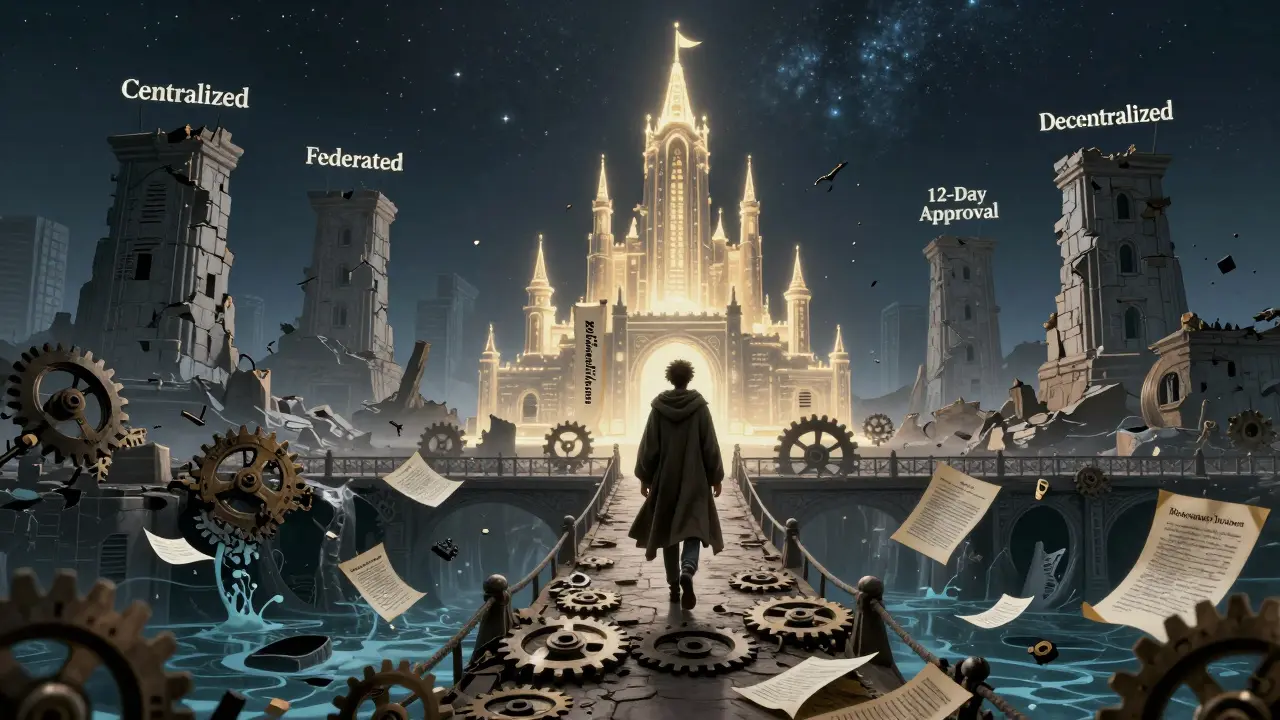
The Three Models: Centralized, Federated, Decentralized
Not all governance works the same. Here’s what the market actually uses:
| Model | Adoption Rate | Best For | Drawback |
|---|---|---|---|
| Centralized | 42% | High-risk sectors: finance, healthcare, government | Slower approvals; needs 30% more executive time |
| Federated | 38% | Large enterprises with multiple divisions | Harder to standardize across teams |
| Decentralized | 20% | Low-risk, fast-moving teams (e.g., internal tools) | 57% higher compliance violations |
IBM uses centralized. Microsoft uses federated. A small retail chain might try decentralized-but they pay for it later. If your AI is touching customer data, contracts, or compliance-sensitive areas, go centralized or federated. No exceptions.
What Makes a Committee Fail (And How to Avoid It)
Most committees die quietly. They meet once, then stop. Why?
- No veto power - If the committee can’t say “no,” it’s a photo op. Dr. Rumman Chowdhury says 100% of effective committees have veto authority. Period.
- Non-technical members - A marketing VP rejecting an AI tool because “it sounds scary” isn’t governance. It’s fear. You need someone who understands prompt engineering vs. fine-tuning.
- No integration - If your AI governance lives in a separate folder from your data governance or compliance system, it’s a ghost. Successful committees plug into existing risk frameworks.
- No training - Privacera found non-technical members need 20-25 hours of training just to understand hallucinations, bias, and data leakage risks. If you skip this, you’re setting them up to fail.
One company in Chicago had a committee with 11 members. Only two had ever used ChatGPT. They rejected a $2M automation tool because they thought “AI writes everything.” They didn’t know it was just a template engine. Cost? $1.2M in lost opportunity.
Real-World Success: How ODP Corporation Got It Right
The ODP Corporation didn’t start with a fancy tool or a big budget. They started with one question: “What’s the worst thing that could happen if our AI customer service bot gives wrong advice?”
Their Chief Audit Executive joined the committee. Within six months, they found 14 compliance gaps-like AI using unapproved training data from old support tickets. They fixed them before regulators ever asked.
They also built a risk tiering system:
- Low risk - Internal summaries, draft emails. Approved in 5 days.
- Medium risk - Customer-facing chatbots, marketing copy. Requires privacy review. 15-day cycle.
- High risk - Clinical decision support, financial forecasting. Needs legal sign-off, bias testing, and third-party audit. 25-day cycle.
Result? Approval time dropped from 45 days to 12. And they’ve had zero regulatory incidents since.
What’s Coming Next (And How to Prepare)
The SEC will require public companies to disclose their AI governance committee composition by Q3 2025. That’s not a suggestion-it’s a filing requirement. If you’re not ready, you’ll be flagged.
Also, automated monitoring tools are now standard. Leading companies use dashboards that track:
- Model drift (how much output has changed since last update)
- Usage spikes (sudden increase in AI use = potential shadow IT)
- Complaint volume (are users reporting errors?)
These tools don’t replace the committee-they give the committee real-time data. No more guessing. Just facts.
By 2027, 83% of analysts predict routine governance tasks-like risk scoring and documentation updates-will be automated. The committee’s job won’t be to review every prompt. It’ll be to set the guardrails, monitor the outcomes, and respond when things go off-track.
Your Next Steps
If you don’t have a committee yet:
- Identify your top 3 AI use cases right now. Are they customer-facing? Do they use sensitive data?
- Find the 7 roles listed above. Start with who’s already doing this work-don’t hire new people yet.
- Write a one-page charter. Define your mission: “To ensure all generative AI use is safe, legal, and aligned with company values.”
- Set your first meeting. Bi-weekly. Use a simple intake form. Track everything.
- Train your members. Even 2 hours of basics on hallucinations and bias will make a difference.
Don’t wait for a breach. Don’t wait for a regulator. Start now. Because the next AI failure won’t be an accident. It’ll be a failure of leadership.
Do we need a full-time person to run the AI governance committee?
No. Most successful committees are run by existing staff who dedicate 10-15% of their time. The chair might be the CTO or Chief Risk Officer. The real need isn’t a full-time role-it’s a clear process. If you’re spending more than 20 hours a week on AI governance, your process is broken. Automate the routine checks, and focus human effort on high-risk decisions.
Can a small business afford a governance committee?
Yes-even a team of five can have a governance structure. You don’t need seven roles. Start with three: one person from operations (who uses AI), one from legal or compliance (even if it’s your lawyer), and one from leadership. Use a free intake form, meet monthly, and focus only on high-risk uses. The goal isn’t perfection-it’s awareness. A small committee that meets regularly beats a big one that never does.
What if our legal team doesn’t understand AI?
They don’t need to be engineers. They need to know the risks: data privacy, copyright, bias, and liability. Bring in a technical expert-maybe your IT lead or a consultant-for the first few meetings. Have them explain in plain language: “If this AI generates a fake medical diagnosis, who’s liable?” That’s what legal cares about. Focus on consequences, not code.
How do we stop AI shadow IT from bypassing the committee?
Make it easier to get approval than to go around it. If your process takes 25 days, people will use ChatGPT on their personal accounts. Cut it to 10. Offer a pre-approved template library for low-risk uses. Celebrate teams that submit proposals. Reward compliance, not secrecy. And monitor for unusual AI usage patterns-tools like Microsoft Purview or IBM Watson can flag unauthorized tools in minutes.
Is AI governance just a trend?
No. By 2030, AI governance will be as standard as financial controls. The EU AI Act, SEC rules, and state laws are making it mandatory. More importantly, customers and employees now expect it. A 2025 survey found 61% of workers won’t trust a company that uses AI without oversight. Governance isn’t about compliance-it’s about trust. And trust is the only thing AI can’t fake.






selma souza
December 17, 2025 AT 02:11The article misrepresents RACI as a silver bullet. Accountability cannot be centralized under one person without creating a single point of failure. Legal, security, and privacy each have conflicting mandates-forcing one chair to resolve them is governance theater, not governance. If your CTO is signing off on bias audits, you’ve already lost.
Also, ‘executive leadership’ must be more than a title. If the CFO isn’t personally reviewing high-risk use cases, this committee is a cost center, not a control.
And please stop calling HR ‘non-technical.’ They’re the ones who handle termination protocols when AI discriminates. Their absence is negligence, not efficiency.
Frank Piccolo
December 18, 2025 AT 00:17Of course you need a committee. But let’s be real-this is just corporate virtue signaling dressed up as risk management. The real problem? Companies don’t want to stop AI from doing stuff. They want to do it faster and blame the algorithm when it blows up.
And don’t get me started on ‘federated models.’ That’s just a fancy way of saying ‘we can’t agree on anything so we’ll let each division do whatever they want until the SEC comes knocking.’
Also, who the hell is this ‘Dr. Rumman Chowdhury’? Is she on the board? Because if she’s not, why are we quoting her like she’s the Pope of AI Ethics?
James Boggs
December 19, 2025 AT 18:28Well-structured and practical. The tiered cadence model is exactly what we implemented last quarter at our firm. Bi-weekly reviews cut our approval backlog by 60%.
One note: the training requirement for non-technical members is critical. We started with a 90-minute workshop on hallucinations and bias-simple, visual, no jargon. It made a measurable difference in decision quality.
Also, pre-approved templates for low-risk use cases? Game changer. Teams love it. Compliance loves it. Everyone wins.
Addison Smart
December 20, 2025 AT 07:32There’s a deeper cultural issue here that this article barely touches: governance isn’t about process-it’s about power. Who gets to decide what AI can and cannot do? And who benefits when it works-or suffers when it fails?
In the U.S., we treat AI like a tool. In the EU, they treat it like a public good under oversight. In Japan, they embed ethics into team norms. This isn’t just about RACI charts-it’s about cultural alignment.
And yes, small businesses can do this. But they need community support: local chambers of commerce, regional compliance coalitions, even shared legal counsel. Governance shouldn’t be a luxury for Fortune 500s. It should be infrastructure-like fire codes or sanitation standards.
Let’s stop pretending this is a corporate checklist. It’s a social contract.
And if we don’t build it with humility, not just hierarchy, we’ll keep repeating the same mistakes-with higher stakes.
David Smith
December 22, 2025 AT 07:15Wow. Just… wow.
So now we need SEVEN people just to let employees use ChatGPT to write emails? What’s next? A committee to approve the font size in PowerPoint?
This is the exact reason American businesses are collapsing under bureaucracy. You want to avoid lawsuits? Don’t let AI touch customer data. Simple. Done.
And ‘training’ non-technical staff? Are you kidding me? I’ve seen middle managers who can’t spell ‘email’-now you want them to understand retrieval-augmented generation?
Just ban AI in customer service. Problem solved. No committee. No cost. No nonsense.
Lissa Veldhuis
December 23, 2025 AT 22:46Let me guess-someone in compliance wrote this after watching a TED Talk and then Googled ‘RACI’
They’re terrified of being fired so they built a 20-page manual to cover their ass
Meanwhile, the intern who’s actually using AI to draft investor decks is getting praised for ‘innovation’
And the CTO? Still drinking the Kool-Aid because he thinks ‘governance’ means putting a lock on the server room
Stop pretending this is about safety. It’s about control. And the people who benefit? The consultants charging $500/hour to design the damn committee
Also-why is no one talking about how this kills innovation? We’re not building AI we’re building paperwork
Michael Jones
December 25, 2025 AT 08:04It’s not about committees it’s about consciousness
Every time we build a system to control AI we’re really building a system to control ourselves
We fear the machine because we fear our own lack of clarity
Who are we when we let machines write for us
Are we still the authors or just the editors of our own decline
The real governance isn’t in the RACI chart
It’s in the quiet moment before you hit send
Do you trust what was made
Or do you just want it to be done
That’s the question no committee can answer
allison berroteran
December 26, 2025 AT 06:50I really appreciate how this post breaks down the models-centralized, federated, decentralized. I’ve seen teams try decentralized in startup environments and it always ends in chaos. One team used an AI to draft HR policies based on Reddit threads. No one caught it until an employee sued for discrimination.
But I also think the real win here is the cultural shift: moving from fear to framework. Too many companies treat AI like a black box they’re afraid to open. This approach treats it like a car-you don’t need to be a mechanic to drive safely, but you need to know when to check the oil.
And I love the idea of pre-approved templates. That’s the kind of low-friction support that actually encourages compliance instead of rebellion. We rolled out a similar system for internal documentation and saw a 70% drop in shadow IT. People don’t want to break rules-they just want to get their work done without jumping through 17 hoops.
The key is making governance feel helpful, not handcuffing. And that starts with empathy, not enforcement.
Gabby Love
December 26, 2025 AT 23:45Minor punctuation note: ‘PII’ should be ‘personal identifiable information’ on first use. Not a big deal, but in compliance docs, consistency matters.
Also, the ODP case study is spot-on. We did something similar-started with one high-risk use case (customer billing automation) and built from there. Took six months, zero incidents. No fanfare. Just steady, quiet discipline.
Pro tip: Use the same intake form for every request. Even if it’s simple. It creates a paper trail that saves your butt later.
Jen Kay
December 27, 2025 AT 19:40How charming. A 2,000-word manifesto on how to bureaucratize AI.
Meanwhile, the guy in accounting is still using ChatGPT to generate expense reports because your ‘bi-weekly review’ takes 14 days and he needs to get paid.
Let me guess-you think the answer is more meetings. More forms. More ‘consulted’ roles.
Here’s a radical idea: stop treating employees like children who need permission to use a tool.
Train them. Set boundaries. Trust them. And if they break the rules? Deal with it. Like adults.
Or keep building your committee. And watch your best people leave for companies that actually believe in autonomy.