You've probably seen the clips: a developer typing a few vague sentences into a chat box and watching an entire application spring to life. This is vibe coding, and it's fundamentally changing how we think about building software. But there's a catch. If you treat every project like a "vibe," you might find yourself spending three days debugging a security hole that a traditional approach would have caught in minutes. On the other hand, treating an AI like a rigid coworker in a formal pair programming setup can kill the very creative momentum that makes these tools exciting.
The real question isn't which one is better, but which one fits the task you're doing right now. Are you sketching a rough prototype for a client meeting tomorrow, or are you hardening an authentication module for a FinTech app? The answer dictates whether you should lean into the flow of vibe coding or the structure of AI pair programming.
Quick Summary: Which one to use?
- Vibe Coding: Best for rapid prototyping, boilerplate generation, and "flow state" development. Use it when speed is more important than perfect architecture.
- AI Pair Programming: Best for complex logic, security-critical modules, and long-term maintainability. Use it when you need a "navigator" to challenge your assumptions.
- The Hybrid Win: The most productive teams use vibe coding to build the skeleton and AI pair programming to refine the muscle and skin.
What Exactly is Vibe Coding?
At its core, Vibe Coding is a solo developer workflow where the human acts as a high-level director, using natural language prompts to describe desired outcomes while the AI handles the implementation details. It's less about writing lines of code and more about guiding a "vibe" toward a working product. You aren't worrying about the specific syntax of a loop; you're telling the AI, "Make the landing page feel like a modern SaaS app with a dark mode toggle and a pricing grid," and letting the tool do the heavy lifting.
This approach relies heavily on Large Language Models (LLMs) like GPT-4 or Gemini 1.5. Because it minimizes context switching, developers often report a massive surge in productivity. In fact, data from Memberstack shows that prototyping speed can jump by 40-60% when using this method. However, the trade-off is a "verification tax." Since you aren't steering every line of code, you might spend 15-25% more time debugging unexpected AI hallucinations or inconsistencies in the logic.
Understanding AI Pair Programming
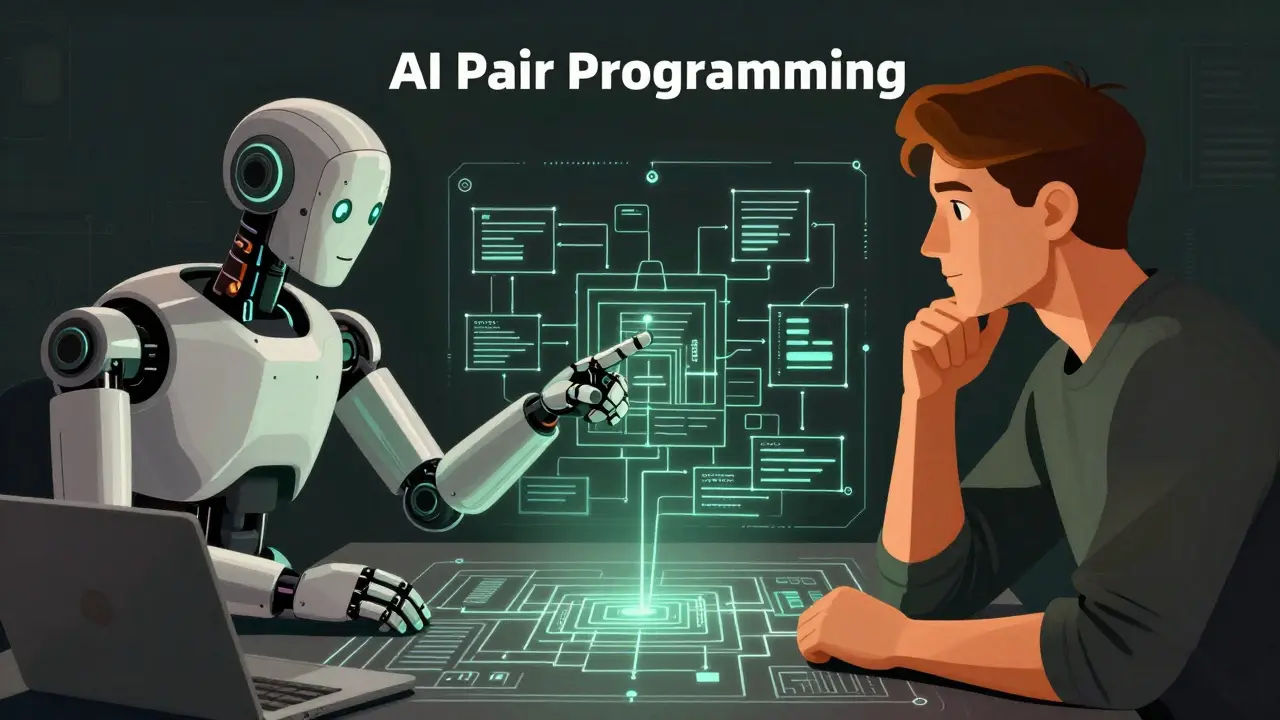
While vibe coding is a solo flight, AI Pair Programming is a collaboration. It adapts the classic industry practice of pair programming-where two humans sit at one keyboard-but replaces the second human with an AI assistant. In this setup, the roles of "Driver" (the one typing) and "Navigator" (the one reviewing and planning) shift dynamically between the human and the AI.
Unlike the "just do it" nature of vibe coding, AI pair programming is an iterative dialogue. You might write a function and ask the AI, "Is there a more efficient way to handle this memory allocation?" or "What edge cases am I missing in this validation logic?" This approach recaptures the quality gains of traditional pairing-which historically improved code quality by about 15%-without the massive cost of paying two senior developers to do the work of one.
Head-to-Head: Comparison of Workflows
| Feature | Vibe Coding | AI Pair Programming |
|---|---|---|
| Primary Goal | Rapid delivery & prototyping | Code quality & robustness |
| Human Role | Prompter / Director | Collaborator / Architect |
| Speed (Prototyping) | Extremely High (40-60% faster) | Moderate |
| Risk Level | Higher (Potential security gaps) | Lower (More human oversight) |
| Best For | Boilerplate, UI sketches, MVP | Business logic, APIs, Security |
When to Lean Into the Vibe
Vibe coding is your best friend when you're in the "exploration" phase. If you're trying to prove a concept or build a Minimum Viable Product (MVP), spending hours meticulously designing a class hierarchy is a waste of time. Use vibe coding when:
- Generating Boilerplate: Nobody likes writing the same 50 lines of setup code for every new project. Vibe coding can cut this time by up to 55%.
- UI/UX Prototyping: When you need to see how a feature looks and feels before committing to the backend architecture.
- Learning New Frameworks: It's a great way to get a "working version" of a project in a language you're not fluent in, allowing you to reverse-engineer the AI's output.
Just be careful. Research from Legit Security warns that uncritical vibe coding can increase vulnerability density by 22%. If you're building a prototype that will eventually handle real user passwords or credit card data, don't let the "vibe" replace a security audit.
When to Switch to Pair Programming
Once the "vibe" has given you a working prototype, it's time to put on your architect hat. AI pair programming is essential when the cost of a bug is higher than the cost of slower development. Switch to this mode when:
- Implementing Complex Logic: When you have nuanced business rules that the AI can't possibly know from its training data.
- Security-Critical Code: For authentication, authorization, and encryption. You need to be the Navigator here, questioning every suggestion the AI makes.
- Refactoring Legacy Code: When you're working with a massive existing codebase, you need a structured dialogue to ensure a change in one module doesn't break ten others.
This is where tools like GitHub Copilot and Gemini Code Assist really shine. Instead of asking for a whole page, you're asking for a specific optimization. You're using the AI to challenge your logic, not just to write the code for you.
The Hybrid Strategy: The Pro Workflow
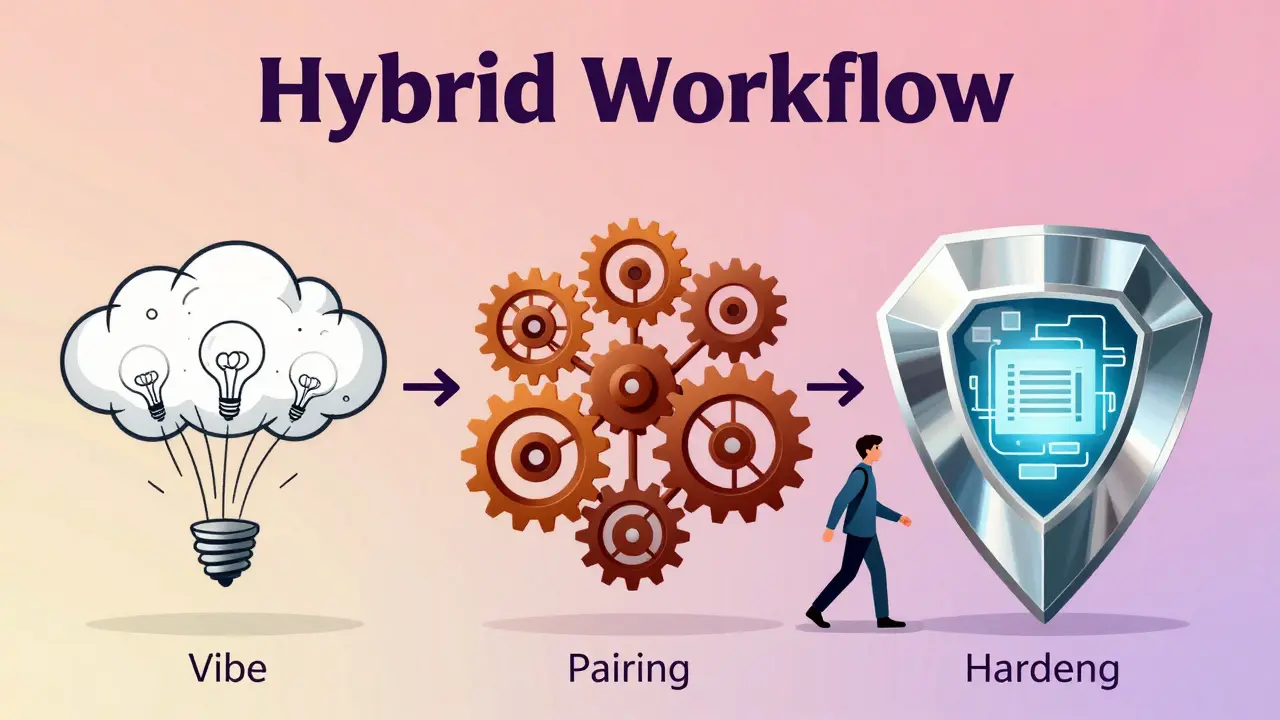
The most successful developers aren't choosing one or the other; they're switching between them based on the lifecycle of the feature. This is often called "hybrid pair programming." According to a Google engineering case study, teams that followed this sequence saw 35% faster feature delivery without sacrificing quality.
Here is how a professional hybrid workflow usually looks:
- The Vibe Phase: Use high-level prompts to generate the initial structure and UI. Get the "vibe" right. Get the basic functionality working.
- The Pairing Phase: Go through the generated code line-by-line. Use the AI as a pair programmer to identify edge cases, optimize loops, and add error handling.
- The Hardening Phase: Use specific security prompts (e.g., "Check this code for OWASP Top 10 vulnerabilities") and perform a final human-led code review.
Common Pitfalls to Avoid
The biggest danger in the AI era is automation bias-the tendency to trust the AI's output because it looks confident and is formatted correctly. We've all seen the horror stories on Stack Overflow where a developer wasted days debugging an AI-generated module that looked perfect but had a critical logic flaw.
To avoid this, you need to develop a skill set in Prompt Engineering. It's not just about knowing the "magic words," but about knowing how to constrain the AI. Instead of saying "Write a login function," try "Write a login function using Argon2 for hashing, ensuring it's resistant to timing attacks, and return a standardized JSON error response." The more constraints you provide, the less you have to rely on a "vibe" and the more you're actually programming.
Is vibe coding only for beginners?
Not at all. While beginners use it to get started, senior developers use vibe coding to eliminate the drudgery of boilerplate and accelerate the prototyping phase. The difference is that seniors know exactly when the "vibe" ends and the need for rigorous engineering begins.
Does vibe coding replace the need for learning how to code?
Actually, it makes deep knowledge more important. To effectively "vibe code," you must be able to read and critique the AI's output. If you can't spot a security flaw or a performance bottleneck in the generated code, you aren't vibe coding-you're just guessing. The ability to act as a critical evaluator is the new core competency for developers.
Which tools are best for each approach?
Most modern tools support both. GitHub Copilot is widely used for both due to its integration with VS Code. Gemini Code Assist is particularly strong for those deeply integrated into the Google Cloud ecosystem. The "tool" matters less than the "intent"-how you prompt the AI determines if you're vibe coding or pair programming.
How much time does it take to get good at this?
Google's research suggests a learning curve of about 6-8 weeks for experienced developers to become proficient prompters. This involves moving from basic requests to complex, constrained prompting and establishing a personal workflow for reviewing AI code.
Can vibe coding be used for production code?
Directly? It's risky. Indirectly? Yes, as long as it's the first step in a larger process. Vibe coding is for the "rough draft." Production code requires the transition to AI pair programming and traditional human code reviews to ensure security and stability.


mark nine
April 24, 2026 AT 10:19honestly vibe coding is just how most of us work anyway we just prompt the a-i to do the boring stuff and then we clean it up later it's a huge time saver
Scott Perlman
April 24, 2026 AT 23:28this is so cool
Madeline VanHorn
April 26, 2026 AT 11:28imagine calling this vibe coding like it's some new thing. it's just lazy programming for people who can't actually architect a system from scratch. real devs don't need a vibe to write a basic api
Glenn Celaya
April 27, 2026 AT 09:10lmao a a a a look at the 'devs' now thinking they can skip the fundamentals. your 'vibe' is just a bunch of bugs waiting to hapen in production and honestly its embarrassng how much people fall for this hype without knowing what a pointer even is
Wilda Mcgee
April 27, 2026 AT 21:47I think we can look at this as a fantastic opportunity to bridge the gap for newcomers! By using a sparkling mix of both styles, we can help juniors get the dopamine hit of a working prototype while gently guiding them toward the sophisticated art of rigorous review. It's all about creating a welcoming environment where the tools amplify our human intuition rather than replacing it with a black box.
Ian Maggs
April 29, 2026 AT 13:31One must wonder... if the 'vibe' becomes the primary interface for creation, does the actual code become a mere artifact... a ghostly remnant of a thought process that no longer requires manual articulation??? The ontological shift here is staggering... truly... staggering...
Chuck Doland
April 30, 2026 AT 05:59The philosophical inquiry posed regarding the nature of code as an artifact is quite profound. However, we must remain vigilant; the intellectual rigor of software engineering demands that the human remain the ultimate arbiter of correctness. To succumb entirely to the convenience of natural language generation is to risk a systematic atrophy of the analytical skills that allow us to diagnose deep-seated architectural failures.
Eva Monhaut
April 30, 2026 AT 11:14This hybrid approach feels like a breath of fresh air! It's such a vivid way to keep the creative spark alive while still keeping the foundation rock-solid. I love the idea of dancing between high-level dreaming and meticulous polishing to get a product that's both imaginative and stable.
Nicholas Carpenter
May 2, 2026 AT 03:08It's really encouraging to see these frameworks emerging. While it's important to keep a firm boundary between a prototype and production code, the productivity gains here are genuinely exciting for everyone involved.