
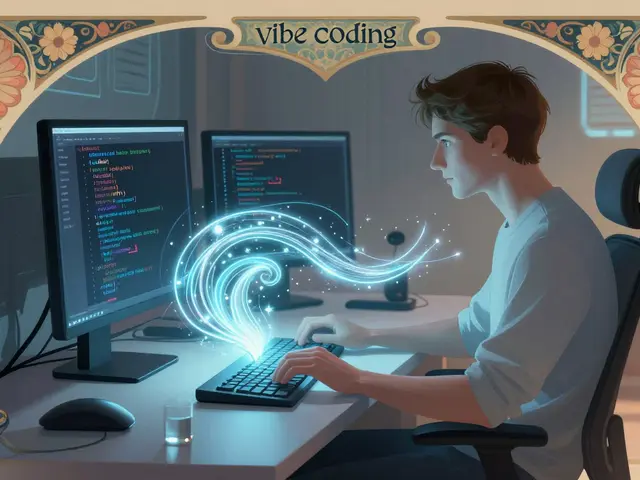
Imagine teaching students to build real software apps without making them memorize semicolons, brackets, or syntax rules. That’s what vibe coding is doing in classrooms right now. Instead of starting with Python or Java, students describe what they want: "Create a weather app that shows today’s forecast and lets users save favorite cities". The AI turns that into working code. No typing errors. No debugging nightmares. Just ideas turning into apps - fast.
This isn’t science fiction. Since early 2024, universities like Stanford and Arizona State have been running full courses on vibe coding. At ASU’s AZNext program, students improved their understanding of system design by 73% compared to traditional coding classes. They built four working apps in one semester. Not prototypes. Real, deployable apps with version history, clean documentation, and prompt logs showing how they guided the AI step by step.
What Is Vibe Coding, Really?
Vibe coding isn’t just another code generator. It’s a shift in how we think about building software. Traditional programming teaches you to speak a machine’s language - syntax, data types, loops. Vibe coding teaches you to think like an architect. You focus on structure: How should components talk to each other? Where does data flow? What happens when one part breaks?
Tools like Replit, Cursor, and v0 power this. They use AI to translate natural language into functional code. But here’s the catch: the AI doesn’t know architecture on its own. It needs direction. That’s where teaching kicks in.
For example, if a student says, "Make a login system," the AI might generate a messy, monolithic block of code. But if they say, "Build a login system using dependency injection. Accept the database connection as a parameter, not hardcoded inside the class," the output changes completely. The difference isn’t in the tool - it’s in the thinking.
Why Architecture Matters More Than Syntax
Most intro programming courses get stuck on syntax. Students spend weeks fixing missing commas before they even touch a real system. By the time they get to architecture - modules, APIs, state management - they’re burned out.
Vibe coding flips that. Students start with architecture from day one. They learn composition over inheritance: building apps like assembling Lego blocks, not stacking Russian dolls. Each component does one thing well and connects cleanly to others.
At Stanford, students spend hours practicing prompts like:
- "Refactor this service to use the repository pattern. Separate data access from business logic."
- "Make this UI component reusable. Pass all data through props, don’t hardcode values."
- "Apply the Tell, Don’t Ask principle. Don’t ask objects for their state - tell them what to do."
After these exercises, 89% of students correctly applied these patterns in their final projects. That’s not luck. It’s deliberate teaching.
How Students Learn Architecture With AI
The process isn’t magic. It’s structured. Here’s how it works in practice:
- Define the goal: "I want a task manager that lets users add, mark complete, and delete tasks. Data should persist between sessions."
- Sketch the structure: "Use a frontend (React), backend (Node.js), and local storage (SQLite). Keep them separate."
- Generate components: Ask the AI to build the UI, then the API, then the database layer - one at a time.
- Refine with prompts: "Make the API respond with JSON. Add error handling for invalid inputs."
- Test and iterate: Run it. Break it. Fix it. Repeat.
Students aren’t just copying code. They’re learning to ask the right questions. They learn to judge: Is this scalable? Is this maintainable? Does it follow a known pattern?
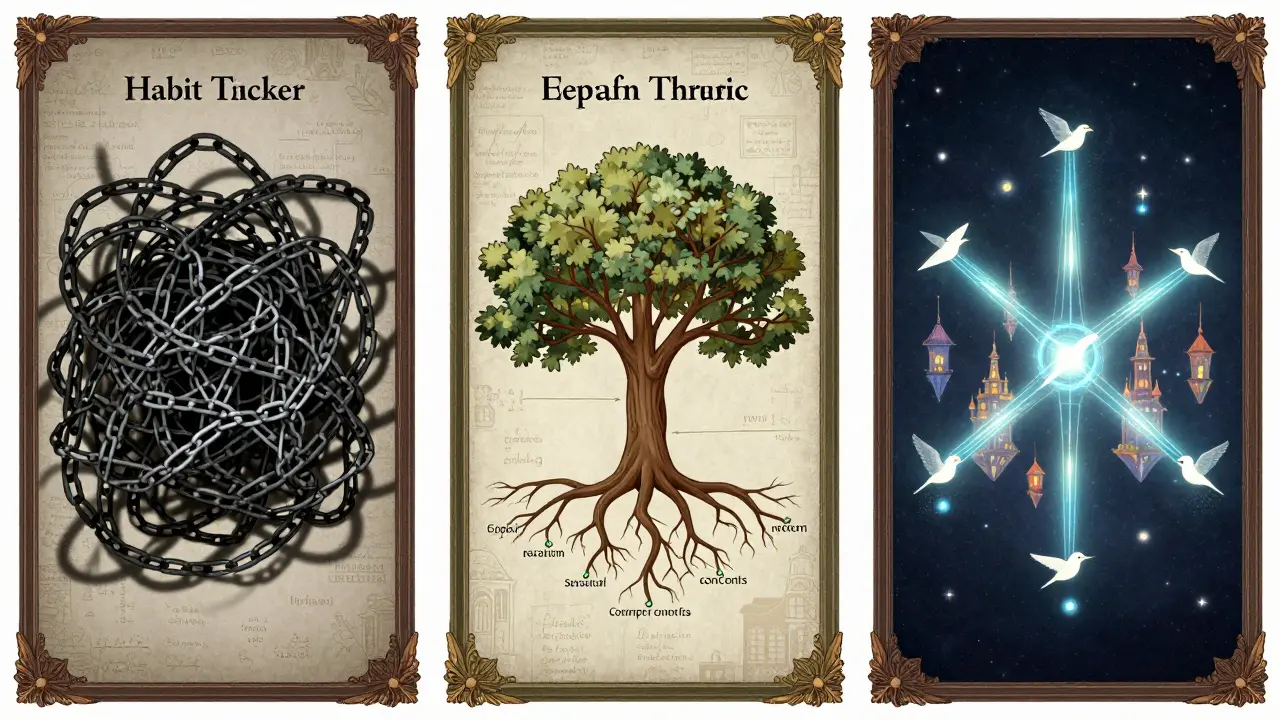
One student at ASU built a habit tracker that synced across devices. Her prompt notes showed 17 iterations. Each one refined the architecture. She didn’t just get an app. She got a mental model for building systems.

What Goes Wrong - And How to Fix It
Not every vibe coding project succeeds. A 2024 study from Campus.edu found that 22% of students created apps with serious architectural flaws - like tightly coupled modules or hardcoded credentials - because they didn’t know how to guide the AI properly.
The biggest mistake? Treating the AI like a wizard. Students type, "Make me an app," and expect perfection. They don’t realize AI needs context, constraints, and feedback.
That’s why instructors now use architectural constraint prompts. Before generating code, students must write down:
- Which design pattern they’re using
- How components communicate
- How errors will be handled
- How data flows between layers
Stanford’s new requirement cut architectural errors by 53%. Google Cloud’s new "Architecture Guardrails" feature does something similar - it flags bad patterns in real time with 89% accuracy.
Still, human guidance is essential. As Dr. Sarah Allen from Google warns: "Without explicit architectural teaching, vibe coding produces functional apps but shallow understanding."
Who’s Using This - And Why
This isn’t just for computer science majors. ASU’s AZNext program found that 79% of humanities students mastered core architectural concepts through vibe coding - compared to only 32% who learned the same material in traditional CS courses.
Why? Because vibe coding removes the fear of syntax. You don’t need to be a coder to design a system. You just need to think clearly.
Demographics show a shift too. Campus.edu’s Vibe Coding 101 course has 62% career-changers, 28% professional developers upskilling, and 45% more female students than traditional bootcamps. People who never thought they could build software now are shipping apps.
Even big companies are paying attention. Forty-three Fortune 100 firms now train their software architects using vibe coding methods. Gartner reports a 37% drop in architectural rework when teams use structured prompting.
Tools You Need to Get Started
You don’t need a lab. You need:
- Replit: The most used platform in classrooms. Offers cloud IDE, package manager, and deployment. Costs $25-$100/month for student access.
- Cursor: AI-powered code editor. Great for iterative refinement. Free tier available.
- v0: Turns text into React UIs. Perfect for frontend-first learning.
- Base44 and Lovable: No-code builders that let you describe full apps. Still evolving in educational use.
DeepLearning.AI’s course recommends starting with Replit because it gives students full control - not just drag-and-drop. They need to see the code, even if AI writes it.
Is This the Future of Programming Education?
Some fear vibe coding will make students lazy. That they’ll never learn to code from scratch. But the data says otherwise.
Students using vibe coding complete architectural exercises 2.3 times faster. They understand design patterns 41% better. And they’re more motivated. One Reddit user wrote: "I finally get dependency injection because I saw it work - not because I memorized a textbook definition."
The Association for Computing Machinery summed it up: "Vibe coding isn’t replacing architectural understanding - it’s making it accessible."
By 2026, Forrester predicts 90% of enterprise-grade AI coding tools will include built-in architectural pattern libraries. That means the future won’t be about writing code. It’ll be about designing systems - and teaching AI how to build them right.
The goal isn’t to replace programmers. It’s to empower more people to become architects. And that’s a change worth building.
Is vibe coding just another AI code generator?
No. Unlike simple code generators that spit out random snippets, vibe coding is a structured teaching method focused on software architecture. It requires deliberate prompting, iterative refinement, and explicit learning of design patterns like dependency injection and composition over inheritance. The goal isn’t just to generate code - it’s to teach how to think about system design.
Do students still need to learn traditional programming?
Yes - but later. Vibe coding removes the initial syntax barrier so students can focus on architecture first. Once they understand how systems are built, they can dive into languages like Python or JavaScript to understand what the AI is doing under the hood. It’s a flipped learning model: design first, implementation second.
Can vibe coding be used in high school or middle school?
Absolutely. Early pilots in Arizona high schools showed students as young as 14 could design simple apps using vibe coding. The key is starting with clear, constrained prompts like "Make a quiz app with 3 questions and a score tracker". The focus stays on structure, not syntax, making it ideal for younger learners.
What’s the biggest challenge for teachers using vibe coding?
Teaching students to avoid treating AI as a magic box. Many students expect perfect results from vague prompts. The challenge is training them to be precise, iterative, and critical - asking the right questions and judging the AI’s output. This requires new teaching materials, prompt libraries, and feedback frameworks.
Is vibe coding only for web apps?
No. While most classroom projects are web-based (React, Node.js, etc.), the principles apply everywhere. Students have built mobile app prototypes, data analysis pipelines, and even simple IoT control systems using vibe coding. The architecture concepts - modularity, separation of concerns, API design - are universal.
How long does it take to become proficient in vibe coding?
Students with no prior experience need about 30 hours of guided practice to reliably build architecturally sound systems. That’s less than half the time it takes with traditional coding. Proficiency in architectural prompting - knowing how to ask for clean, reusable, scalable code - takes 15-20 hours of focused exercises, according to Stanford’s internal metrics.






Ian Maggs
December 26, 2025 AT 08:53So, we’re essentially outsourcing cognitive labor to an algorithm, then calling it "education"? The architecture isn’t learned-it’s inferred, imperfectly, from a bot’s statistical guesswork. What happens when the AI hallucinates a singleton pattern as a global variable? Do we blame the student, or the machine that was never taught to distinguish between "good" and "convenient"? I’m not anti-AI-I’m pro-thought. And thought, real thought, requires friction. Syntax isn’t the enemy; it’s the scaffold that forces clarity.
Michael Gradwell
December 26, 2025 AT 09:45Flannery Smail
December 26, 2025 AT 11:02Emmanuel Sadi
December 27, 2025 AT 14:59Nicholas Carpenter
December 29, 2025 AT 11:11This is actually kind of beautiful. I've seen students who hated coding light up because they could finally see the structure behind what they wanted to build. It’s not about replacing syntax-it’s about removing the wall that kept so many people out. I taught a 68-year-old retired nurse to build a medication tracker using vibe coding. She didn’t care about semicolons. She cared about helping people. That’s the win.
Chris Atkins
December 30, 2025 AT 04:26Jen Becker
December 31, 2025 AT 08:00Ryan Toporowski
December 31, 2025 AT 08:10Love this so much 💪 I had a student last week who was ready to quit CS until she built her first vibe-coded app-a habit tracker that actually worked. She cried. Not because it was hard-but because for the first time, she felt like she could make something real. That’s the magic. It’s not about typing-it’s about believing you can build. Keep going!
Samuel Bennett
January 1, 2026 AT 05:48Rob D
January 2, 2026 AT 06:25