
Imagine rewriting a dry technical manual so it sounds like a friendly blog post, or turning a corporate press release into an urgent social media update without losing the core facts. That is exactly what style transfer prompts are designed to do within generative AI systems that create new content based on user instructions. Instead of just generating text from scratch, you guide the model to adopt a specific tone, voice, or format while keeping the underlying message intact. This technique has evolved significantly since its visual origins, now allowing marketers and writers to maintain brand consistency across diverse channels with much less manual effort.
What Style Transfer Prompts Actually Do
Style transfer in text generation is the process of modifying the stylistic elements of content-such as formality, sentiment, and structure-while preserving semantic meaning. Unlike simple summarization or translation, style transfer changes how something is said, not what is being said. For example, you might take a paragraph about battery life specifications and ask the AI to rewrite it "in the style of a tech reviewer who uses short, punchy sentences and occasional slang." The AI keeps the data points (battery lasts 10 hours) but shifts the delivery to match your desired persona.
This capability relies on Large Language Models (LLMs) understanding context deeply enough to separate content from presentation. When you provide a clear instruction set, the model analyzes the source text, identifies the key information, and then reconstructs the output using the new stylistic rules. The result is content that feels native to the target audience rather than translated or adapted awkwardly.
The Core Components of Effective Prompts
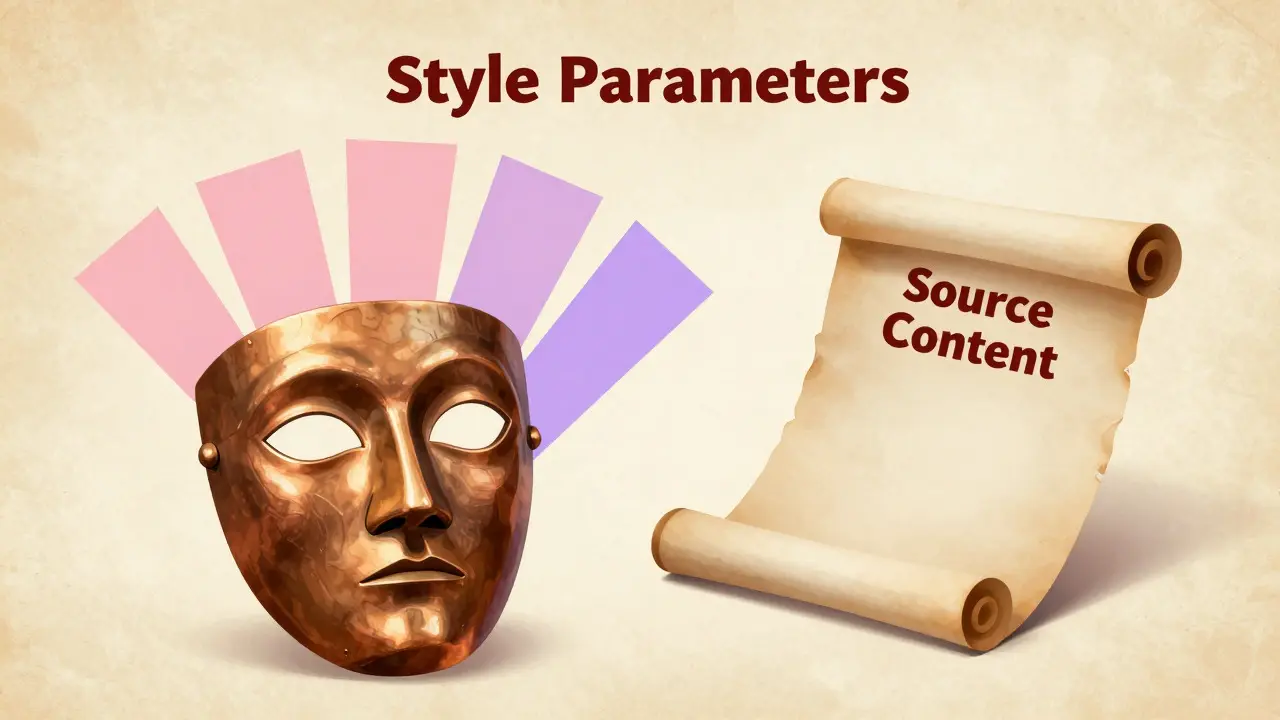
Getting consistent results isn't about magic words; it's about structured inputs. A robust style transfer prompt typically contains three distinct layers:
- Role Definition: Tell the AI who it is. "Act as a senior copywriter for a luxury fashion brand."
- Style Parameters: Specify the tone, voice, and format. "Use elegant, concise language. Avoid jargon. Use bullet points for features."
- Source Content: Provide the raw material to be transformed.
Many users make the mistake of only specifying the tone (e.g., "make it funny") without defining the boundaries. This leads to unpredictable results where the AI might change the factual accuracy to fit the joke. By explicitly separating the role, the parameters, and the source, you give the model a clear framework to operate within.
Controlling Tone vs. Voice vs. Format
These three terms are often used interchangeably, but they control different aspects of your output. Understanding the distinction helps you write more precise prompts.
| Element | Definition | Prompt Example |
|---|---|---|
| Tone | The emotional attitude toward the audience | "Write in a reassuring, empathetic tone." |
| Voice | The unique personality or character of the writer | "Adopt the voice of a witty, experienced engineer." |
| Format | The structural layout and organization | "Output as a numbered list with bold headers." |
When you adjust the tone, you are changing the emotion. Shifting from neutral to urgent changes how the reader feels. Adjusting the voice changes the personality. A brand might have a professional voice but use a casual tone for social media posts. Finally, format controls the visual structure, such as whether the output is a paragraph, a table, or a script. Mastering all three allows for granular control over the final asset.
Practical Techniques for Consistency
One of the biggest challenges in generative AI is "style drift," where the model gradually loses adherence to your style guidelines as the text gets longer. To combat this, experts recommend creating a centralized style guide that you paste into every prompt. This guide should include 3-5 concrete examples of good and bad writing samples. For instance, show the AI a sentence you love and one you hate, along with a brief explanation of why. This few-shot learning approach anchors the model’s behavior much better than abstract descriptions alone.
Another effective technique is the two-stage process. First, ask the AI to analyze a sample of your existing content and describe the style in bullet points. Then, use those generated bullet points as the style parameters for your new content. This ensures the AI is working from a data-driven definition of your brand voice rather than your subjective interpretation. It also helps mitigate the issue of context window limits by keeping the style instructions concise and focused.

Common Pitfalls and How to Avoid Them
Even with well-crafted prompts, errors can slip through. Here are the most common issues and how to fix them:
- Semantic Distortion: The meaning changes during the style shift. Fix: Add a constraint like "Do not add or remove any factual claims."
- Over-Stylization: The text becomes hard to read because the style is too strong. Fix: Use intensity modifiers like "subtly apply" or "lightly incorporate."
- Inconsistent Branding: Different outputs feel like they came from different people. Fix: Use the same role definition and style guide snippet for every session.
Testing is crucial. Always run your prompts through a small batch of representative content before deploying them at scale. If the output feels off, tweak one variable at a time-change the tone descriptor first, then the voice, then the format-to isolate what’s causing the mismatch.
Industry Impact and Future Trends
The adoption of these techniques is accelerating rapidly. Recent market data indicates that the global AI style transfer market is projected to grow significantly, driven largely by the need for personalized marketing content. Enterprises are no longer satisfied with generic AI output; they want assets that sound like their best human writers but produce volume at machine speed. As models become more sophisticated, we expect to see "style vectors" that allow independent adjustment of tone, voice, and format simultaneously, giving creators even finer control. For now, mastering the basics of prompt structuring gives you a significant competitive edge in producing high-quality, on-brand content efficiently.
What is the difference between style transfer and paraphrasing?
Paraphrasing usually aims to restate the same idea in different words while maintaining a similar tone and complexity. Style transfer actively changes the tone, voice, or format to suit a new audience or channel, potentially altering the sentence structure and vocabulary significantly to achieve a specific aesthetic or emotional effect.
How many words should my style guide prompt be?
Keep it concise, ideally under 200-300 words. Long prompts can dilute the focus. Focus on the most distinctive traits of your brand voice and include 2-3 short examples rather than lengthy explanations.
Can I use style transfer prompts for non-English languages?
Yes, modern LLMs support multilingual style transfer. However, cultural nuances in tone and voice may differ. It is best to test with native speakers or use bilingual examples in your style guide to ensure the intended cultural connotation is preserved.
Which AI models are best for style transfer?
Most large language models with strong instruction-following capabilities work well, including GPT-4o, Claude 3.5 Sonnet, and Llama 3. The key is not just the model size, but how well it adheres to complex constraints. Test multiple models with your specific style guide to find the best fit for your brand.
How do I prevent the AI from adding false facts during style transfer?
Include a strict constraint in your prompt such as "Preserve all original facts exactly" or "Do not introduce new information." Additionally, always perform a fact-check against the source material after generation, as hallucinations can still occur even with strong constraints.