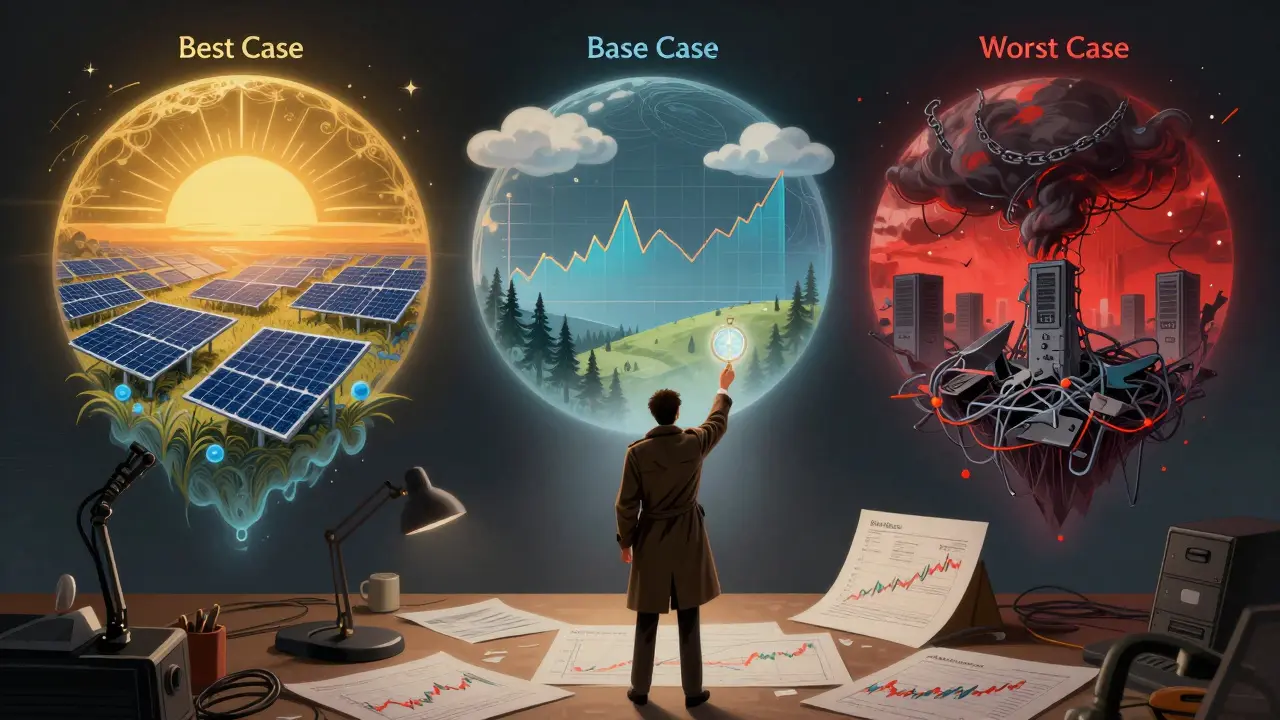
When you hear "AI investment," you might picture a startup with flashy demos and a pitch deck full of buzzwords. But the real question isn’t whether AI works-it’s how much it actually returns. And that’s where scenario modeling changes everything. Forget guessing. Forget hope. Generative AI lets you test thousands of outcomes before you spend a single dollar. This isn’t science fiction. It’s what top asset managers are using right now to decide where to put their money.
What Exactly Is Generative AI Scenario Modeling?
Traditional financial models look at a few possible futures: maybe the market goes up, maybe it goes down. That’s it. Three scenarios. Maybe five. But generative AI? It doesn’t stop there. It can simulate thousands-all at once. It reads earnings calls, scans news headlines, tracks social media chatter, and even picks up on subtle shifts in supply chain patterns. Then it builds realistic, data-driven stories about what could happen next.
This isn’t just number crunching. It’s storytelling powered by machine learning. Tools like NVIDIA’s NIM platform let quants connect large language models with real financial data. You feed it historical performance, current news, regulatory signals, and even weather patterns affecting energy demand. The AI then generates synthetic data-fake but believable-so you can test how your portfolio reacts under extreme conditions. A CFA Institute report in March 2025 showed this method improved sentiment analysis accuracy by nearly 10% compared to old-school models.
The Three Scenarios: Best, Base, Worst
Every smart investor runs three scenarios. Generative AI just makes them way more accurate.
- Best Case: Everything aligns. Policy shifts favor clean energy. Supply chains stabilize. Consumer demand for AI tools spikes. Companies like Acme Solar Technologies used this approach in 2024 to model overlapping changes in federal incentives, battery costs, and grid demand. They ended up with 22% better risk-adjusted returns than the industry average.
- Base Case: The middle ground. Adoption follows the Oxford Economics forecast: 45% of firms use generative AI for scenario modeling by 2027. Markets move steadily. Regulations settle into a workable framework. This is where most portfolios land-and where AI helps you avoid surprises.
- Worst Case: The nightmare scenario. Data pipelines break. Synthetic data gets corrupted. Regulators crack down. A hedge fund in Reddit’s r/quantfinance lost 15-20% of its value in Q4 2024 because they trusted AI-generated scenarios without validation. That’s the danger: if you don’t check the model, the model will lie.
Here’s the kicker: AI doesn’t just give you these three outcomes. It shows you why they happened. Did the worst case stem from a policy delay? A data gap? A misread sentiment trend? That’s the value.
How It Works: The Tech Behind the Scenes
Generative AI uses several techniques to build these scenarios:
- Large Language Models (LLMs): Parse thousands of earnings transcripts and news articles to detect tone, urgency, and hidden risks.
- Variational Autoencoders (VAEs): Generate synthetic financial time-series data that mimics real market behavior.
- Diffusion Models: Start with noise and gradually refine it into plausible market conditions-like turning static into a realistic stock chart.
- GANs (Generative Adversarial Networks): One model creates fake data; another tries to spot it. They learn from each other until the fake looks real.
These aren’t theoretical. Bridgewise’s 2025 report found that firms using this combo cut scenario generation time from hours to seconds. Portfolio iterations that used to take weeks now happen overnight. And it’s not just for big banks. Firms managing $50B+ in assets saw adoption jump from 22% in early 2024 to 58% by Q1 2025, according to Celent.

Where It Falls Apart
Generative AI isn’t magic. It’s a tool-and like any tool, it breaks if you misuse it.
The biggest failure point? Data quality. Bridgewise found that 63% of failed implementations traced back to messy, incomplete, or outdated data. If you feed garbage in, you get hallucinations out. Early models in 2024 had 8-12% error rates because they trained on low-quality earnings call transcripts or outdated regulatory filings.
Another risk? Regulatory blind spots. In March 2025, SEC Commissioner Jaime Lizárraga warned firms they must provide audit trails and explainable reasoning for every AI-generated scenario. No black boxes. If you can’t show how the AI reached a conclusion, regulators will shut you down.
And then there’s the human factor. A mid-sized hedge fund in Chicago went all-in on AI in 2024, fired their traditional analysts, and ended up with a portfolio that crashed during volatility. Why? They stopped asking questions. AI doesn’t replace judgment-it enhances it.
What You Need to Get Started
You don’t need a billion-dollar budget. But you do need discipline.
- Start small. Pick one asset class. One region. One type of risk. Test the AI on that. Don’t try to model the entire portfolio on day one.
- Invest in clean data. Spend 15-20% of your budget on data cleaning. Fix missing values. Remove duplicates. Verify sources. This isn’t glamorous-but it’s what separates success from disaster.
- Partner with compliance early. Talk to your legal and risk teams before you build anything. The SEC’s February 2025 guidance isn’t optional. You need documented data lineage and clear decision logs.
- Validate, validate, validate. Use the "train on synthetic, test on real" method. Run your AI-generated scenarios against actual market outcomes. If the model can’t predict what already happened, it won’t predict what will.
According to Bridgewise’s survey of 47 firms, those who followed this approach had an 82% success rate. Those who skipped steps? Only 31% made it past six months.

Who’s Using This Right Now?
It’s not just Wall Street.
- Goldman Sachs integrated generative AI into its Marcus platform to help clients assess AI-driven investment opportunities.
- MDOTM launched its AI-powered SMA platform in Q3 2024, tailoring scenarios to individual client risk profiles.
- Acme Solar Technologies used AI to model policy shifts, supply chain risks, and demand spikes-all at once-and beat market benchmarks by 22%.
- Betterment rolled out simplified AI scenario tools for individual investors in Q2 2025, letting users see how their portfolios might react under different AI adoption paths.
Hedge funds lead adoption at 67%, followed by private equity (52%) and traditional equity managers (41%). The gap isn’t about size-it’s about willingness to rethink how decisions get made.
The Future: What’s Next?
By 2027, Oxford Economics predicts generative AI scenario modeling could add $237 billion annually to global investment efficiency. But that only happens if we fix the current gaps.
Three trends are coming:
- Standardized regulation by 2026-2027. The SEC’s proposed Regulation AI will require all AI-generated scenarios to meet validation benchmarks.
- Real-time integration by 2027. Models will pull live data from Bloomberg, FactSet, and Fed releases-not just yesterday’s reports.
- Scenario marketplaces by 2028. Imagine a platform where firms share validated, anonymized scenarios-like a GitHub for financial forecasting. Federated learning will let you learn from others without sharing your data.
The biggest threat? Talent shortage. The CFA Institute reports a 43% deficit in professionals who understand both finance and AI modeling. If you’re reading this, you’re in a rare position. Learn the basics. Ask questions. Don’t let AI make decisions-help it make better ones.
Can generative AI really predict the future of AI investments?
No tool can predict the future. But generative AI can simulate thousands of plausible futures based on real data. It doesn’t tell you what will happen-it shows you what could happen, how likely it is, and what factors drive each outcome. Think of it as a stress test, not a crystal ball.
Is this only for big institutions?
Not anymore. While large firms lead adoption, platforms like Betterment now offer simplified AI scenario tools to individual investors. You don’t need a team of quants-you just need access to clean data and a clear question. Start with one asset class, one risk factor, and build from there.
What’s the biggest mistake people make with AI scenario modeling?
Over-trusting the output. AI hallucinates. It invents correlations that don’t exist. The most successful users treat AI as a co-pilot, not a captain. They validate every scenario against real-world data, question assumptions, and never let automation replace human judgment.
Do I need a GPU or fancy hardware to use this?
For basic testing, no. Cloud platforms like NVIDIA’s NIM or AWS SageMaker handle the heavy lifting. You just need a stable internet connection and access to financial data feeds. But if you’re building custom models or running thousands of simulations daily, then yes-GPU infrastructure becomes necessary.
How long does it take to implement?
A pilot project can be up and running in 4-6 weeks if you focus on one use case and have clean data. Full enterprise rollout? That’s 6-12 months, mostly because of data integration and compliance checks. The key is to start small, prove value, then scale.
What programming languages do I need to know?
Python and R are the standard. Most tools-like NVIDIA’s NIM, TensorFlow, or PyTorch-are built for Python. If you’re not coding, you can still use platforms with drag-and-drop interfaces. But if you want to customize, tweak, or debug models, Python is essential.
Final Thought: It’s Not About AI-It’s About Thinking Better
The goal isn’t to replace analysts. It’s to give them superpowers. A human with generative AI can test 10,000 scenarios in the time it takes to run one manually. That means you spot risks others miss. You find opportunities hidden in noise. You make decisions with confidence, not gut feeling.
The best investors aren’t the ones with the fanciest tools. They’re the ones who know how to ask the right questions-and when to listen to the machine, and when to ignore it.






Bridget Kutsche
February 16, 2026 AT 11:50Love this breakdown. I’ve been using AI scenario modeling for my small portfolio, and it’s been a game-changer. Started with just one asset class-tech ETFs-and now I’m expanding. The key? Clean data. I spent a weekend cleaning up my Yahoo Finance exports, and suddenly the outputs stopped feeling like sci-fi and started feeling like insight.
Also, validation is everything. I run every AI-generated scenario against actual market movements from the last 18 months. If it can’t explain what already happened, it’s not ready for what’s next. Simple rule, huge payoff.
Jack Gifford
February 17, 2026 AT 18:51Finally someone who gets it. AI isn’t about predicting the future-it’s about eliminating blind spots. I work in private equity, and we used to spend weeks building models. Now? Two hours. Same accuracy, way less caffeine.
But here’s the thing nobody talks about: the human still has to say ‘no.’ I’ve seen so many teams automate themselves into a ditch because they trusted the output. The AI doesn’t care if your portfolio crashes. You do. So stay in the driver’s seat.
Tonya Trottman
February 17, 2026 AT 23:22Oh wow. Another ‘AI is magic’ post. Let me guess-you also think ChatGPT can write your taxes and your breakup texts?
63% of failures come from bad data? Shocking. Like, who knew feeding garbage into a neural net gives you garbage out? Next you’ll tell me water is wet and the sky is blue. And ‘explainable reasoning’? Oh honey, the SEC didn’t wake up yesterday. They’ve been screaming about this since 2022. You’re 3 years late to the party.
Also, ‘Python is essential’? No. It’s *useful*. I’ve seen non-coders build better models using drag-and-drop tools than devs who overengineered everything. Stop pretending you need a PhD to use a tool that was designed for people who aren’t you.
Victoria Kingsbury
February 18, 2026 AT 19:22Honestly? I’m surprised this isn’t mainstream yet. I’m a solo investor with $200k, and I’ve been using Betterment’s AI scenario tool since last year. It’s not perfect-but it’s better than my old spreadsheet with ‘bull,’ ‘bear,’ and ‘maybe.’
The real win? Seeing how different variables interact. Like, I never realized how much Fed policy swings affected renewable energy ETFs until the model showed me. Now I adjust allocations proactively, not reactively.
And yeah, data quality matters. I spent a week cleaning my Morningstar downloads. It was boring. But now? My worst-case scenario doesn’t look like a horror movie. It looks like a plausible dip. That’s worth the effort.
Sarah Meadows
February 19, 2026 AT 14:42Let’s cut the fluff. This isn’t about ‘scenario modeling.’ It’s about America staying ahead. China’s pouring billions into AI-driven finance. EU’s got regulations that strangle innovation. Meanwhile, we’ve got firms like Goldman and Bridgewise turning data into edge-and it’s working.
Forget ‘explainable AI.’ What matters is output. If your model beats the market, who cares how it got there? Regulation should be about results, not process. We don’t regulate jet engines by how the turbine spins-we care if the plane lands.
And if you’re still using Excel? You’re already behind. Get with it. This isn’t optional. It’s national economic security.