By 2025, every company that wants to stay competitive in AI isn’t just buying tools-it’s rebuilding its workforce. Generative AI didn’t just change how we write code or draft emails. It changed who we need to hire, how we train them, and where they learn best. The companies winning aren’t the ones with the biggest AI budgets. They’re the ones with the smartest talent strategies.
Stop Hiring Only AI Experts-Start Building AI-Ready Teams
For years, companies chased data scientists and machine learning engineers like they were the only people who could handle AI. But by 2025, that’s outdated. Lightcast shows over 10,000 unique job postings for generative AI skills-only about 3,300 of those are for data scientists. The rest? Product managers who know how to prompt LLMs. Solutions architects who design AI workflows. Enterprise architects who map AI into legacy systems. Customer support leads who train AI chatbots using real customer conversations.
What’s changed? AI isn’t just a tech function anymore. It’s a business function. That means your hiring strategy can’t be limited to technical roles. You need people who understand both the business and the tech. A marketing manager who can fine-tune an AI copy generator is more valuable than a data scientist who can’t explain ROI to the CFO.
Top companies now use talent mapping to find these hybrid profiles. They track open-source contributions on GitHub, analyze course completions on LinkedIn Learning, and monitor who’s publishing AI case studies on internal wikis-not just who has a PhD in AI. They’re not just looking for credentials. They’re looking for curiosity, adaptability, and the ability to explain AI in plain language.
Upskilling Isn’t a Bonus-It’s Your Main Growth Engine
Training your current employees isn’t a nice-to-have. It’s the most cost-effective way to close the AI skills gap. Deloitte found that for every $1 spent on well-designed AI upskilling, companies get back $4.70 in productivity and innovation. But here’s the catch: most training programs fail.
Why? Because they’re lectures. Slides. Quizzes. Box-ticking. Employees hate them. And they learn nothing.
The winning approach? Cohort-based, hands-on learning. Take AWS Skill Builder’s model: teams of 15-20 employees go through 40-60 hours of structured learning over six weeks. Each week, they build something real-a report generator, a customer feedback analyzer, a workflow automator. They get feedback from peers and AI coaches. They present their work to leadership.
And here’s what makes it stick: they’re given 15-20% of their work time to apply what they’ve learned. Not after hours. Not on weekends. During their regular workday. Companies that do this see 38% better business outcomes from AI than those who don’t.
One global consulting firm saved 15,000 hours a year by using an AI-powered interview training bot. Instead of scheduling live sessions for 2,000 employees, they trained the bot to simulate real interviews and give instant feedback. Employees completed certification on their own schedule. Completion rates jumped. Engagement soared.

Communities of Practice Are Where AI Skills Actually Grow
Learning doesn’t happen in a vacuum. It happens in conversation. In shared frustration. In late-night Slack threads where someone says, “Wait, how did you get that prompt to work?”
That’s why communities of practice are the secret weapon of high-performing AI teams. LinkedIn Learning data shows courses with built-in peer communities have 43% higher completion rates. Participants report 28% more confidence using their new skills on the job.
What does a real community of practice look like?
- Weekly 30-minute “AI Office Hours” led by internal AI champions-not HR or consultants.
- A shared Notion or Confluence space with real prompts, failed experiments, and winning templates.
- Monthly “AI Show & Tell” where teams present what they built and what broke.
- Shadowing programs where a sales rep spends a day with the AI team-and vice versa.
One manufacturing company started with just five engineers sharing prompts. Within six months, they had 120 employees across operations, logistics, and quality control contributing. They didn’t need a new tool. They just created space for people to learn from each other.
And here’s the kicker: these communities become talent pipelines. The people who lead them? They’re the ones promoted. The ones who contribute? They’re the ones hired for new AI-augmented roles.
Why Most AI Talent Strategies Fail (And How to Avoid It)
Eighty-seven percent of Fortune 500 companies have a generative AI talent strategy now. But only 42% of them are actually seeing results. Why? Three reasons.
1. Training doesn’t connect to real work. Glassdoor reviews show 67% of negative feedback on AI upskilling programs comes from employees who were taught skills they never got to use. If you train someone to build AI reports but never let them run one, you’re wasting time.
2. HR is kept out of the loop. McKinsey found companies that embed HR at the front line of AI transformation achieve 31% better outcomes. That means HR isn’t just managing payroll-they’re helping redesign roles, create new career paths, and measure skill growth in real time.
3. They treat AI as a project, not a process. The most successful organizations don’t do one big training push. They do quarterly talent assessments. They track skill growth like they track sales targets. They adjust based on what’s working.
One tech firm started seeing a shortage in quantum computing specialists two years before it became obvious. Why? Their AI talent dashboard flagged rising demand in competitor job posts and a drop in course completions in their region. They launched a targeted upskilling program early. By the time the market panicked, they had 12 qualified people ready.
The New AI Roles You Need to Start Planning For
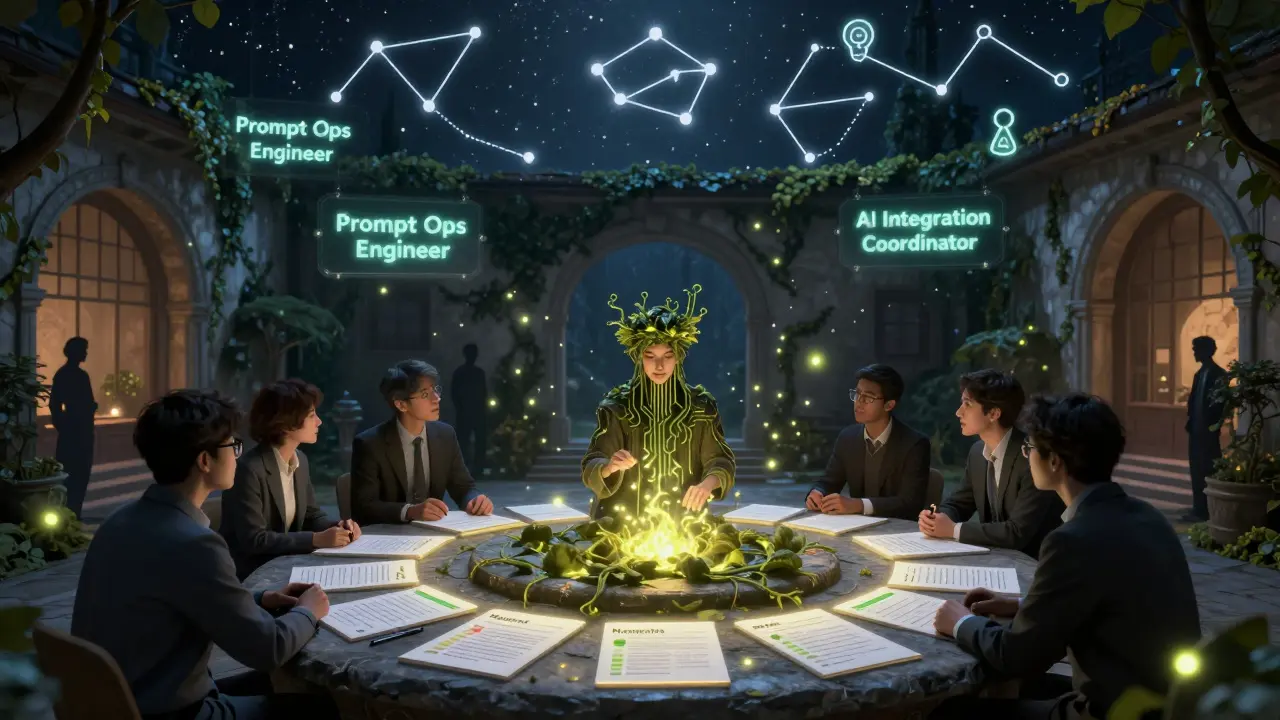
Forget “AI specialist.” The real future is in hybrid roles. Here are the new positions companies are creating in 2025:
- LLM Product Managers: Own the lifecycle of AI-powered features-defining what the model should do, how users interact with it, and how to measure success.
- Prompt Ops Engineers: Not just writers. They’re QA testers for AI outputs, tuning prompts across departments, monitoring for bias, and documenting best practices.
- Agent Quality Assurance Specialists: Monitor AI agents (chatbots, workflow bots) for accuracy, tone, and compliance. They’re the human safety net.
- AI Integration Coordinators: Bridge the gap between legacy systems and new AI tools. They’re the translators between IT and business teams.
These aren’t sci-fi roles. They’re filling gaps right now. Russell Reynolds’ 2025 survey found 83% of executives believe AI will create new jobs in their organizations. The question isn’t whether you’ll need them. It’s whether you’re ready to design them.
What Success Looks Like in 2025
Success isn’t having the most AI tools. It’s having a workforce that can use them-and keep learning.
Companies that win are called “Horizon Builders.” They don’t just hire top talent. They grow it. They redesign roles. They give people time to experiment. They connect learning to real outcomes.
BCG found Horizon Builders achieve 23% higher AI implementation success rates than companies that rely only on hiring. They also pay 35% less to attract talent because they’re not competing for a shrinking pool-they’re building their own.
The future belongs to organizations that treat talent like a living system-not a fixed inventory. You don’t buy AI talent. You cultivate it. You give it space. You let it evolve. And you measure it-not by degrees, but by what people actually do with the tools they’ve learned.
By 2027, 44% of workers’ core skills will be disrupted by AI, according to the World Economic Forum. The companies that thrive won’t be the ones with the smartest algorithms. They’ll be the ones with the smartest people-and the best systems to keep them learning.