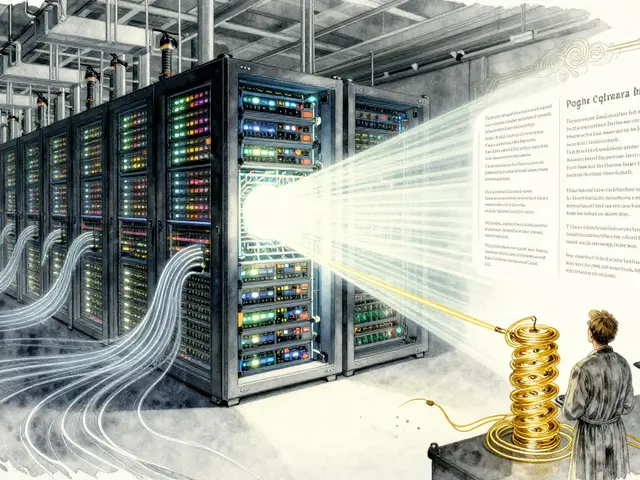
Imagine giving your AI assistant the keys to your server. It can read files, run commands, and connect to databases. Now imagine that same assistant gets tricked by a malicious website into sending those credentials straight to a hacker. This isn't a hypothetical nightmare; it's the reality for many organizations deploying LLM agents with direct access to external systems. Without proper containment, an agent is just a fast way to compromise your infrastructure.
The solution isn't to stop using agents. It's to build them inside secure cages. We call this sandboxing external actions in LLM agents. By restricting what tools an agent can use and isolating its environment, you prevent prompt injection attacks from turning your helpful bot into a data leak. As of mid-2026, this has shifted from a "nice-to-have" security feature to a regulatory requirement under the EU AI Act and a standard practice for Fortune 500 companies.
Why Application-Level Guards Fail
You might think input sanitization and output filtering are enough. They aren't. In March 2025, Abhinav, an infrastructure engineer at Greptile, documented a critical flaw in relying solely on application-level safeguards. He showed that if an agent has filesystem access, it can leak credentials through seemingly benign requests. The logic is simple but terrifying: if the process can see a file, it can send that file's content to the user-or a malicious actor.
Attackers don't need to break the encryption. They just need to trick the LLM into using a tool like cat or grep on a sensitive config file. Once the agent reads the file, the data is in its context window. From there, it can be exfiltrated via indirect prompt injections. AWS updated their Bedrock security guide in January 2025 to explicitly warn against architectures where LLM outputs trigger sensitive actions without robust sandboxing. The takeaway? You must assume the agent will eventually do something bad. Your job is to ensure that "something bad" stays contained.
The Core Approaches to Sandboxing
There is no single best way to sandbox an agent. The right choice depends on your balance of security needs versus performance constraints. Here are the three dominant strategies used in production environments today.
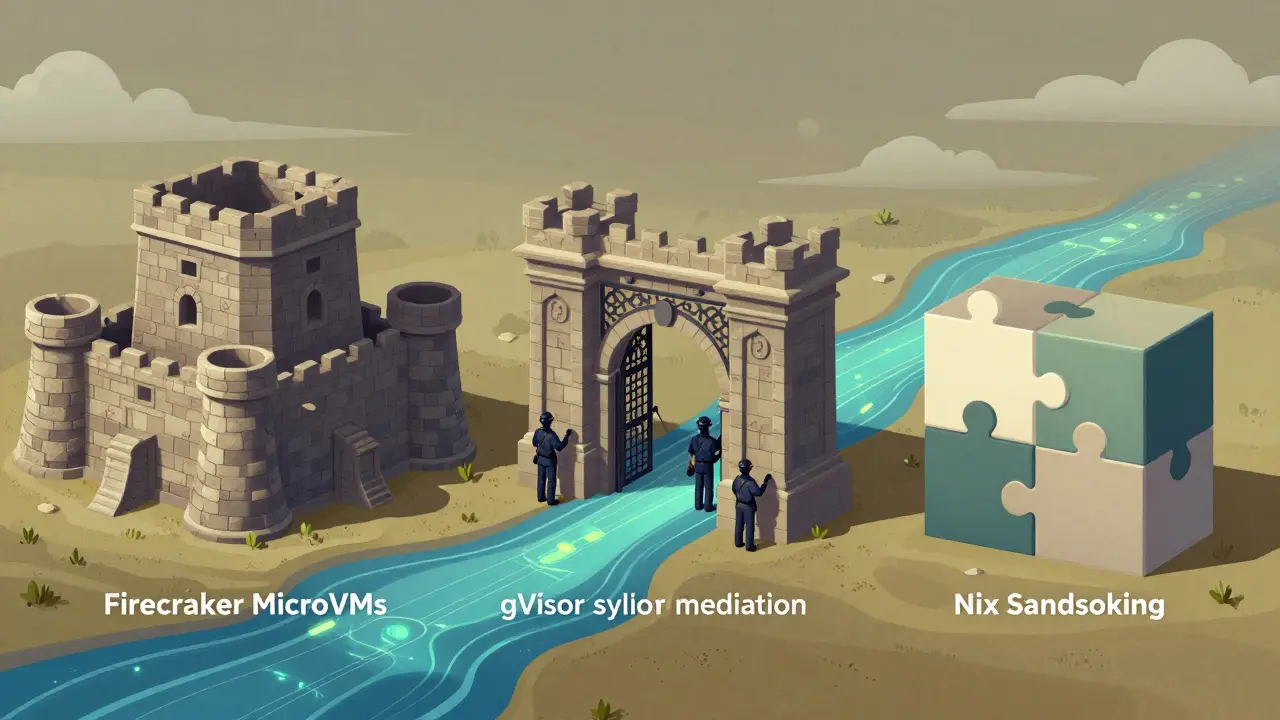
1. Kernel-Level Isolation with Firecracker MicroVMs
Firecracker is a virtualization technology developed by AWS that creates lightweight microVMs. Originally built for AWS Lambda in 2018, it has become the gold standard for high-security agent environments. Each agent session runs in its own fresh microVM. When the session ends, the VM is destroyed, leaving zero trace. This provides kernel-level isolation, meaning even if the agent escapes the application layer, it cannot reach the host system.
CodeAnt.ai released a comprehensive framework in February 2025 recommending Firecracker as the safest foundation. However, safety comes with a cost. According to their benchmarks, Firecracker imposes a 15-25% latency overhead compared to container-based solutions. Startup times are slower, and each microVM requires approximately 5MB of memory. For real-time applications needing sub-second responses, this overhead can be prohibitive. But for enterprise environments handling sensitive financial or medical data, it is often the only acceptable option.
2. Syscall Mediation with gVisor
gVisor is Google's user-space kernel that intercepts system calls before they reach the host OS. Instead of spinning up a full VM, gVisor sits between the container and the Linux kernel. It intercepts roughly 70 syscalls (out of Linux's 300+) and emulates them in userspace. This blocks dangerous operations like direct hardware access while allowing standard file and network operations.
This approach offers a middle ground. It provides stronger isolation than standard Docker containers but with less overhead than Firecracker. CodeAnt.ai measured CPU overhead at 10-30%, with startup times 200-400ms slower than native containers. A major pitfall here is configuration. In one documented case, a misconfigured gVisor setup allowed base64-encoded credential leakage because attackers used allowed tools like cat to read files. If you use gVisor, you must strictly whitelist which syscalls and tools are permitted.
3. Least Privilege with Nix Sandboxing
For development environments, Nix is a purely functional package manager that enables reproducible builds and strict dependency management. Anderson Joseph published a notable implementation on DEV Community in October 2024, demonstrating how to lock down agents using Nix flakes. This method doesn't isolate the kernel but enforces extreme least privilege. You declare exactly which packages the agent can use. If it's not in the list, it doesn't exist.
Joseph's setup required listing Go packages twice: once for developer tools and once for agent-accessible tools. This ensures the agent can compile code but cannot access network utilities or dangerous libraries. While it has minimal isolation from the host system, it prevents accidental misuse. The downside is a steep learning curve. Reddit users reported taking 3-5 days to implement this properly if they weren't already familiar with Nix.
| Feature | Firecracker MicroVMs | gVisor (Docker) | Nix Sandboxing |
|---|---|---|---|
| Isolation Level | Kernel-level (Highest) | User-space syscall mediation | Package-level (Lowest) |
| CPU Overhead | 15-25% | 10-30% | Negligible |
| Startup Latency | High (Slower) | Moderate (+200-400ms) | Low |
| Setup Complexity | High (Linux kernel expertise needed) | Medium (3-5 hours config) | High (Nix language learning curve) |
| Best Use Case | Enterprise, sensitive data | Balanced security/performance | Dev environments, internal tools |
Emerging Alternatives: WebAssembly and Mount Namespaces
Not every agent needs a heavy VM. NVIDIA detailed a WebAssembly-based sandboxing approach in their April 2025 developer blog. WebAssembly (Wasm) offers near-native performance with strong memory isolation. It's ideal for running untrusted code snippets where you need deterministic resource limits without VM overhead. However, Wasm lacks full filesystem access capabilities, making it unsuitable for agents that need to manipulate complex file structures.
Another technique, used by Greptile, combines mount namespaces with chroot operations. This controls filesystem visibility at the kernel level. Even if the agent tries to navigate to /etc/passwd, the namespace hides it. This prevents processes from seeing files before path initialization executes. It's a powerful complement to other methods, ensuring that even if an attacker gains some control, they can't browse the directory tree.
Implementation Pitfalls and Real-World Challenges
Even the best sandbox fails if configured poorly. Here are the common traps teams fall into:
- Over-permissive Tool Whitelisting: CodeAnt.ai documented cases where attackers bypassed input sanitization using allowed tools like
awk. Just because a tool is "safe" doesn't mean it can't be chained with others to extract data. Audit every tool your agent can call. - Ignoring Resource Exhaustion: Python-specific implementations, like Anton Shemyakov's gVisor-Jupyter solution, highlight risks of arbitrary code execution. During denial-of-service attempts, CPU usage spiked 15-30%. Always set hard limits on CPU, memory, and execution time within your sandbox.
- Underestimating Setup Time: AWS recommends allocating 1-2 weeks for proper sandboxing implementation. This includes building validation layers between content processing and action execution. Rushing this leads to gaps.
- Docker Escapes: Never rely on standard Docker containers alone. Vulnerabilities like CVE-2024-21626 allow escapes. If you use Docker, pair it with gVisor or run it inside a Firecracker VM.

Regulatory Pressure and Market Trends
The landscape is shifting fast. Gartner predicts the sandboxing market for AI agents will hit $1.2 billion by 2027, up from $180 million in 2025. This growth is driven partly by regulation. The EU AI Act, effective February 2026, mandates "appropriate technical and organizational measures" for AI systems accessing personal data. For agent-based systems, this effectively means sandboxing is no longer optional-it's compliance.
Adoption is accelerating. Forrester's Q4 2025 report found that 68% of Fortune 500 companies have implemented some form of agent sandboxing. Companies like CodeAnt.ai, founded in early 2024, raised $15 million in Series A funding in October 2025 specifically to build these guardrails. Cloud providers are also stepping up. AWS announced Firecracker 1.5 in December 2025, featuring agent-specific optimizations that reduced latency overhead to 8-12%, making high-security sandboxes more viable for broader use.
Choosing the Right Strategy for Your Team
If you are building a consumer-facing chatbot that answers general questions, standard input/output filtering might suffice. But the moment your agent touches a database, writes to a file system, or sends emails, you need isolation.
Start with these questions:
- How sensitive is the data? If it's PII (Personally Identifiable Information) or financial records, go with Firecracker microVMs. The latency cost is worth the guarantee.
- What is your latency budget? If you need sub-second responses and can accept moderate risk, gVisor is the sweet spot. Optimize your syscall whitelist to minimize overhead.
- Who is the audience? For internal dev tools where developers trust the codebase, Nix sandboxing provides excellent least-privilege enforcement with minimal performance impact.
Remember, the goal isn't perfect security-that doesn't exist. The goal is verifiable safety. As noted in the January 2026 arXiv paper "Towards Verifiably Safe Tool Use for LLM Agents," we must move from probabilistic safeguards to guardrails that provide guarantees. Accept reduced autonomy in exchange for stronger assurances. Your users will forgive a slightly slower response; they won't forgive a data breach.
Is standard Docker containerization enough for LLM agents?
No. Standard Docker containers share the host kernel and are vulnerable to escape vulnerabilities like CVE-2024-21626. AWS explicitly warns against relying on Docker alone for agent security. You should combine Docker with additional sandboxing layers like gVisor or run containers inside Firecracker microVMs for adequate protection.
What is the performance cost of using Firecracker microVMs?
Firecracker typically adds 15-25% latency overhead compared to container-based solutions, though recent optimizations in Firecracker 1.5 (December 2025) have reduced this to 8-12% for agent-specific workloads. Each microVM also requires approximately 5MB of memory and takes longer to start up than standard containers.
How does gVisor differ from traditional virtualization?
gVisor is a user-space kernel that intercepts system calls before they reach the host OS. Unlike traditional VMs, it doesn't require full hardware virtualization. It supports about 70 syscalls out of Linux's 300+, blocking dangerous operations while maintaining better performance than full microVMs, with a CPU overhead of 10-30%.
Does the EU AI Act require sandboxing for AI agents?
Yes, indirectly. Effective February 2026, the EU AI Act requires "appropriate technical and organizational measures" for AI systems accessing personal data. Since sandboxing is the primary method to contain unauthorized data access by agents, it is considered a mandatory compliance measure for systems handling EU citizen data.
Can WebAssembly replace VMs for all agent tasks?
No. While WebAssembly offers near-native performance and strong memory isolation, it lacks full filesystem access capabilities. It is suitable for executing isolated code snippets but cannot handle complex agent workflows that require deep interaction with the operating system's file structure.