
Have you ever asked an AI model a question about a recent event, only to get a confident but completely wrong answer? Or perhaps you needed it to cite a specific company policy, and instead, it hallucinated a plausible-sounding rule that doesn't exist? This is the classic failure mode of traditional Large Language Models (LLMs). They are brilliant at pattern matching but terrible at knowing what they don't know. Their knowledge is frozen in time, locked inside their training data.
This is where Retrieval-Augmented Generation comes in. But here’s the twist: most current implementations treat retrieval as an afterthought-a messy glue job between a search engine and a language model. The new frontier is Retrieval-Aware Transformers, which are architectures designed from the ground up to natively support retrieval. These aren't just models with a plugin; they are systems where the act of finding information is woven into the very fabric of how the model thinks and generates text.
The Problem with "Glued" RAG Systems
To understand why native architectures matter, we first have to look at how we’ve been doing it wrong. Traditional Retrieval-Augmented Generation (RAG) typically follows a linear, disjointed path. You have a user query. A separate retriever component (like a vector database or search engine) fetches relevant documents. Then, those documents are stuffed into the prompt context window of a standard transformer model like GPT-4 or Llama 3. Finally, the model generates an answer.
It sounds simple, but this "post-hoc" approach has serious flaws. The retriever doesn't know what the generator needs. It just grabs the top-k most similar chunks based on embedding similarity. Often, these chunks contain noise, irrelevant details, or conflicting information. When this messy context hits the transformer, the model has to spend precious attention capacity filtering out the garbage. Worse, if the retrieval fails, the model often falls back to its internal weights, leading to hallucinations because it can't distinguish between retrieved fact and learned fiction.
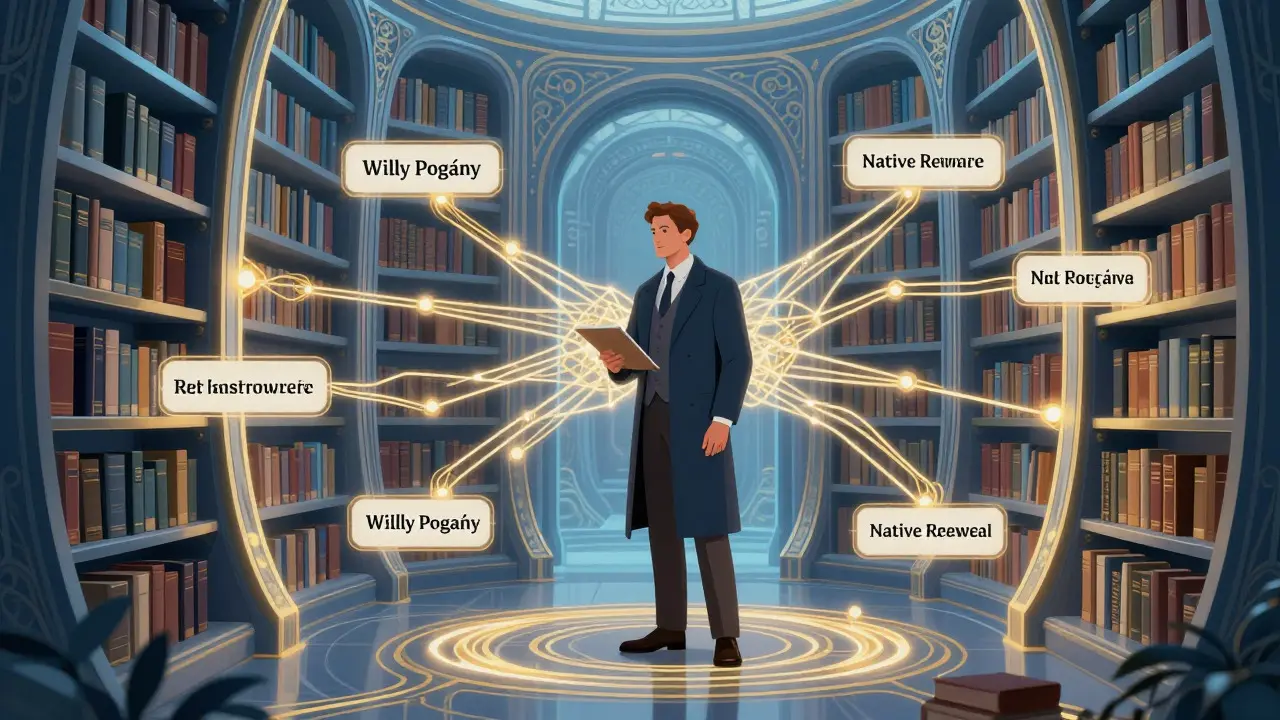
Think of it like hiring a brilliant writer who never leaves their desk. You throw a stack of newspapers at them through a window and say, "Write an article." If the newspapers are irrelevant, the writer guesses. If they’re contradictory, the writer gets confused. Retrieval-aware transformers change the dynamic by giving the writer a direct line to the library, allowing them to ask for specific books while writing.
What Makes a Transformer "Retrieval-Aware"?
A retrieval-aware transformer isn't just a standard model with a bigger context window. It incorporates structural changes that allow the model to interact with external data sources dynamically during inference. According to recent surveys on RAG architectures, innovations occur in three key areas: the retriever, the generator, and the integration layer. Native architectures optimize all three simultaneously.
First, consider the dual-encoder system. In native designs, the model uses specialized encoders to map both queries and documents into a shared high-dimensional embedding space (often 768 or 1024 dimensions). This allows for incredibly fast similarity matching using dense passage retrieval mechanisms. Unlike keyword-based sparse retrieval (like BM25), dense retrieval understands semantic meaning, not just word overlap.
Second, the attention mechanism itself is modified. In a standard transformer, self-attention calculates relationships between tokens in the input sequence. In a retrieval-aware model, the attention layers are augmented to incorporate retrieved context directly. Some advanced architectures inject retrieved vectors into specific layers of the transformer, rather than just prepending them to the input text. This allows the model to weigh external evidence against its internal parameters more effectively.
Third, there is the concept of iterative or multi-hop retrieval. Instead of one-shot fetching, native architectures can perform reasoning steps where the initial retrieval triggers further queries. For example, if a query asks, "Who was the CEO of Company X when it acquired Company Y?" the model might first retrieve the acquisition date, then use that date to retrieve the CEO list for that specific period. This chain-of-thought prompting combined with retrieval creates sophisticated reasoning patterns that single-step RAG cannot match.
| Feature | Standard Transformer + Post-Hoc RAG | Native Retrieval-Aware Transformer |
|---|---|---|
| Integration Method | Prompt injection (context window stuffing) | Architectural integration (attention layer modification) |
| Retrieval Trigger | Static (before generation starts) | Dynamic (can trigger during generation) |
| Hallucination Risk | High (falls back to weights if context is weak) | Low (constrained by native grounding mechanisms) |
| Latency Impact | Variable (depends on external API calls) | Optimized (internalized retrieval logic reduces overhead) |
| Knowledge Updates | Requires re-indexing external DB only | Immediate access to new indexed data without retraining |
Key Technical Components and Infrastructure
Building a retrieval-aware system requires more than just choosing the right model. It demands a robust infrastructure layer. The central entity here is the Vector Database. Tools like Pinecone, Weaviate, Milvus, and Elasticsearch are no longer optional add-ons; they are critical components of the architecture. These databases store the embeddings of your external knowledge base, enabling sub-second retrieval even across millions of documents.
The choice of retrieval method matters immensely. While dense retrieval (embedding-based) is powerful, it sometimes struggles with exact keyword matches. That’s why hybrid approaches, combining dense retrieval with sparse methods like BM25, have become the industry standard. Benchmarks show hybrid systems improve performance by 5-15% over single-method approaches. Furthermore, advanced ranking mechanisms now use learned-to-rank models to adaptively score retrieved documents based on the specific query context, rather than relying solely on static similarity scores.
Scalability is another major concern. As noted by Hugging Face’s integration of Ray with RAG systems, production-scale deployments require distributed retrieval operations. When you’re serving thousands of queries per second, the latency of fetching external data can bottleneck the entire system. Native retrieval-aware architectures often employ compression and quantization techniques to reduce this latency by 40-70%. However, the augmented generation stage still adds a computational overhead of 10-30% compared to standard inference, primarily due to the increased complexity of attention calculations over combined input and retrieved content.
Why Native Integration Beats Fine-Tuning
Developers often face a dilemma: should I fine-tune my model on domain-specific data, or should I use RAG? Fine-tuning involves updating the model’s weights to learn new patterns. It’s expensive, computationally heavy (taking hours to weeks), and results in a static model that quickly becomes outdated. If your company policy changes next week, you’d have to retrain the model again.
Retrieval-aware transformers offer a middle ground that is superior for most dynamic use cases. They maintain the general intelligence of the pre-trained model while gaining access to fresh, specific data. New information added to the external knowledge base becomes immediately accessible without any retraining. This dynamic knowledge update capability is crucial for industries like finance, legal tech, and healthcare, where accuracy and currency are non-negotiable.
Moreover, native retrieval provides transparency. Because the model is grounded in retrieved sources, you can trace every claim back to a specific document. This verifiability is essential for enterprise adoption. In contrast, fine-tuned models operate as black boxes, making it difficult to explain why a certain output was generated.
Challenges and Pitfalls to Avoid
Despite their advantages, retrieval-aware transformers are not a silver bullet. They introduce significant system complexity. Engineering the retrieval component requires deep expertise in information retrieval, not just machine learning. If the retrieval step returns irrelevant information, you risk "retrieval error amplification," where the model confidently generates incorrect answers based on bad data.
Latency is another persistent challenge. Even with optimizations, the additional step of querying a vector database and processing retrieved context adds time to the response. For real-time applications, this can be unacceptable. Developers must carefully balance the depth of retrieval with speed requirements. Techniques like caching frequent queries and using approximate nearest neighbor (ANN) algorithms in vector databases can help mitigate this.
There is also the issue of context window limits. While newer models boast massive context windows (100k+ tokens), stuffing too much retrieved text into the prompt can degrade performance. The model may suffer from "lost in the middle" phenomena, where it ignores information placed in the center of the context. Native architectures address this by intelligently selecting and compressing only the most relevant snippets, rather than dumping raw documents into the mix.
Future Directions: Adaptive and Multimodal Retrieval
The field is evolving rapidly. Future developments will likely focus on adaptive retrieval, where the model decides whether to retrieve information at all, and how much, based on the complexity of the query. Not every question needs a database lookup. An efficient system knows when to rely on its internal knowledge and when to reach out.
Cross-lingual retrieval is also becoming a priority. As global businesses adopt AI, the ability to query documents in one language and generate responses in another, while maintaining accuracy, is critical. Additionally, multimodal retrieval-integrating text, images, and structured data-is on the horizon. Imagine a medical assistant that retrieves not just clinical notes, but also X-rays and lab results, synthesizing them into a coherent diagnosis.
Uncertainty quantification is another emerging area. Users need to know when the retrieved information is reliable versus speculative. Future models will likely provide confidence scores alongside their answers, helping humans make better decisions.
What is the difference between standard RAG and Retrieval-Aware Transformers?
Standard RAG treats retrieval as a separate step before generation, often resulting in a disjointed pipeline. Retrieval-Aware Transformers integrate retrieval mechanisms directly into the model's architecture, allowing for dynamic interaction between the model and external data sources during the generation process. This leads to better handling of context, reduced hallucinations, and more accurate grounding.
Do Retrieval-Aware Transformers eliminate hallucinations completely?
They significantly reduce hallucinations by grounding responses in retrieved facts, but they do not eliminate them entirely. If the retrieval step fails to find relevant information or returns incorrect data, the model may still hallucinate. Therefore, the quality of the external knowledge base and the retrieval algorithm is just as important as the model itself.
Which vector databases are best for Retrieval-Aware Systems?
Popular choices include Pinecone, Weaviate, Milvus, and Elasticsearch. The best choice depends on your specific needs regarding scalability, ease of use, and integration capabilities. For enterprise-grade solutions, managed services from cloud providers like AWS (OpenSearch) and Google Cloud (Vertex AI Search) are also strong options.
How does hybrid retrieval improve performance?
Hybrid retrieval combines dense retrieval (semantic similarity) with sparse retrieval (keyword matching, e.g., BM25). This approach captures both the meaning behind words and exact term matches, addressing the weaknesses of each method individually. Benchmarks show this can improve retrieval accuracy by 5-15%.
Is fine-tuning still necessary if I use Retrieval-Aware Transformers?
In many cases, no. Retrieval-Aware Transformers allow you to keep your model general-purpose while accessing specific domain knowledge via retrieval. Fine-tuning is still useful for adapting the model's tone, style, or specific formatting requirements, but for factual accuracy and up-to-date knowledge, retrieval is generally more efficient and cost-effective.