
You ask an Large Language Model (LLM) to write a JSON object or solve a math problem. It gives you an answer that looks right but fails validation. Do you just hit 'retry'? Or do you tell it exactly what went wrong? The difference between those two choices is the gap between unreliable AI and production-ready systems.
This is where LLM self-correction comes in. It’s not magic. It’s a structured way of telling the model to pause, look at its own output, find the mistake, and fix it. Recent research shows that when done correctly, this technique can cut structured output errors by up to 45% without retraining the model. But if your feedback prompts are vague, the model might just hallucinate a new error while trying to fix the old one.
The Three Ways LLMs Fix Their Own Mistakes
Not all self-correction methods are created equal. Depending on your application-whether it’s a chatbot, a data pipeline, or a code generator-you’ll need different strategies. Here are the three main approaches used in 2026.
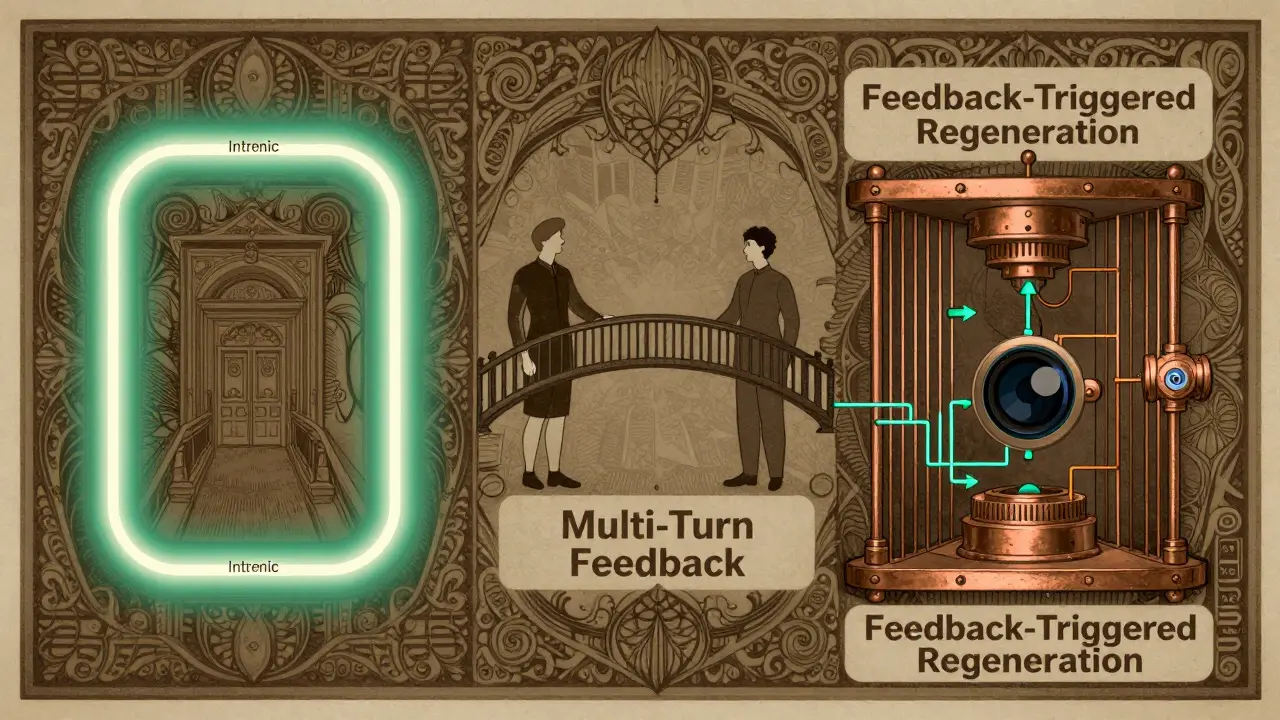
1. Intrinsic Self-Correction (The "Think Again" Prompt)
Intrinsic self-correction happens within a single request. You ask the model to generate an answer, then immediately instruct it to review and refine that answer before sending it back to you. No extra API calls are needed for the correction step itself, though the total token count increases.
This method works best for structured tasks like JSON generation or SQL queries where rules are clear.
Example prompt structure:
- Generate the initial response.
- Check the response against [specific criteria/schema].
- If errors exist, list them and provide a corrected version.
According to industry benchmarks, intrinsic correction succeeds in 68-82% of cases for well-defined structured outputs. However, it struggles with complex reasoning tasks, dropping to 22-35% effectiveness because the model often lacks the external context to know if its logic is truly sound.
2. Multi-Turn Feedback Correction (The Conversation Pause)
Imagine a conversation where you interrupt the speaker to say, "Wait, that part was wrong." Multi-turn feedback treats interruptions as natural pauses. When the model starts drifting or providing incomplete information, you send a feedback prompt like: "Feedback: The previous step missed the date constraint. Continue and correct."
This approach recovers 76-89% of interrupted response streams in real-time applications. It’s particularly useful for chatbots where user interaction provides the feedback signal naturally.
3. Feedback-Triggered Regeneration (FTR)
Introduced in late 2025, FTR is the most advanced framework. Instead of correcting every output, it uses user feedback signals or confidence scores to decide if regeneration is needed. If the user is satisfied or the internal confidence score is above 0.65, the system moves on. If not, it triggers a regeneration using Long-Term Multipath (LTM) decoding.
FTR reduces unnecessary corrections by 41% compared to standard methods. It achieved 78.3% accuracy on the GSM8K math benchmark, outperforming older methods like Critic Prompts (69.1%). However, it requires more complex infrastructure to track user satisfaction or confidence metrics.
Crafting Error Messages That Actually Help
The biggest mistake developers make is giving vague feedback. Saying "That’s wrong" doesn’t help an LLM. You need specific, actionable error messages. Think of yourself as a teacher grading a test: you don’t just write "F," you circle the error and explain why.
| Feedback Type | Example Prompt | Success Rate | Best Use Case |
|---|---|---|---|
| Vague | "Fix the error." | Low (<20%) | None (Avoid) |
| Schema-Based | "JSON missing key 'user_id'. Add it and retry." | High (70-85%) | Data extraction, APIs |
| Logic-Based | "Step 2 contradicts Step 1. Re-evaluate the calculation." | Medium (40-60%) | Math, Code debugging |
| Constraint-Based | "Response exceeds 50 words. Summarize." | Very High (>90%) | Content generation |
Key Principles for Effective Error Prompts
- Be Specific: Identify the exact field, line, or logical step that failed.
- Provide Context: Remind the model of the original constraints (e.g., "Remember, the currency must be USD").
- Limit Iterations: Set a hard stop after 2-3 correction attempts. Infinite loops waste tokens and increase latency.
- Use External Validation: Whenever possible, pair the prompt with a programmatic check (like a regex or schema validator) to confirm the fix worked.
When Self-Correction Fails (And What to Do Instead)
Self-correction isn’t a silver bullet. Professor Yoav Goldberg from Bar-Ilan University notes that the fundamental bottleneck is the feedback generation stage-LLMs struggle to reliably identify their own errors without external signals. In general knowledge tasks, prompted self-correction fails 83-92% of the time.
Here’s when to avoid relying solely on self-correction:
- Open-Ended Creative Tasks: There’s no objective "right" answer for poetry or marketing copy. Self-correction here leads to style drift.
- Complex Reasoning Without Verification: If there’s no way to programmatically verify the answer, the model may confidently reinforce a wrong conclusion.
- Ambiguous Schemas: If your JSON schema allows multiple valid structures, the model might "correct" a valid response into an invalid one.
For these cases, use hybrid approaches. Combine intrinsic correction with external tools. For example, use Python to validate the JSON structure before asking the LLM to fix it. Or switch to a different model vendor for quick fixes during outages, as recommended by The Elder Scripts (2024), which reduced pipeline failures by 63% in their case studies.

Implementation Checklist for Developers
Ready to add self-correction to your app? Follow this checklist to ensure you’re setting it up correctly.
- Define Clear Success Criteria: Can you write a script that checks if the output is correct? If yes, self-correction will work well.
- Choose Your Method:
- Simple structured data? Use Intrinsic Correction.
- Interactive chat? Use Multi-Turn Feedback.
- Enterprise pipeline with cost concerns? Look into FTR frameworks.
- Set Latency Budgets: Expect 15-25% additional processing time per request. Monitor this closely.
- Implement Confidence Thresholds: Only trigger regeneration when confidence scores fall below 0.65 or user feedback indicates dissatisfaction.
- Test for "Correction Drift": Ensure the model isn’t introducing new errors. Track the error rate before and after correction cycles.
The Future of Reliable AI
By 2027, Gartner predicts that 85% of enterprise LLM deployments will incorporate multi-stage correction frameworks. Major providers like OpenAI and Anthropic are already building native support for these features into their models (GPT-4o and Claude 3.5). But the core principle remains the same: clear, specific feedback is better than vague retries.
Start small. Pick one critical workflow where errors are costly. Implement a simple intrinsic correction loop with a strict schema. Measure the reduction in errors and the increase in latency. Then scale from there. Your users won’t notice the extra milliseconds-they’ll just notice that the AI finally gets it right.
What is the best type of error message for LLM self-correction?
The best error messages are specific, actionable, and reference explicit constraints. For example, instead of saying "Wrong format," say "JSON missing required field 'email' at path $.user.contact." Schema-based and constraint-based feedback yields the highest success rates (70-90%).
Does self-correction slow down my application?
Yes, typically by 15-25% per request due to additional token processing. However, this is often offset by reduced manual intervention and higher accuracy. Feedback-Triggered Regeneration (FTR) can mitigate this by only correcting when necessary.
Can LLMs self-correct creative writing tasks?
Poorly. Self-correction relies on objective metrics for success. Creative tasks lack these metrics, leading to "style drift" where the model changes tone or intent unintentionally. Use human-in-the-loop review for creative content.
What is Feedback-Triggered Regeneration (FTR)?
FTR is an advanced framework that uses user feedback or confidence scores to decide whether to regenerate an output. It avoids unnecessary corrections, reducing overhead by ~41% compared to always-on self-correction methods.
How many times should I allow an LLM to self-correct?
Limit iterations to 2-3 maximum. Beyond that, the risk of "correction drift" (introducing new errors) increases significantly, and latency costs outweigh benefits.








Edward Gilbreath
June 18, 2026 AT 16:02its all just corporate buzzwords to sell more compute cycles the models dont actually think they just predict the next token and pretend its intelligence
Lisa Nally
June 20, 2026 AT 00:32Oh, absolutely not. You are fundamentally misunderstanding the stochastic nature of transformer architectures when applied to structured output validation. The intrinsic self-correction mechanism described here is a critical component in reducing hallucination rates in production-grade LLM pipelines. It is not merely 'predicting tokens'; it is a sophisticated iterative refinement process that leverages schema-based feedback loops to ensure data integrity. Ignoring these advancements is akin to dismissing the entire field of natural language processing as mere autocomplete. We must embrace the nuanced utility of constraint-based prompts to achieve reliable AI integration.
Edward Nigma
June 20, 2026 AT 09:14actually this whole concept is flawed because you are assuming the model has any concept of truth it just mimics patterns so correcting it based on logic is like trying to teach a parrot calculus by yelling at it for squawking wrong numbers
Francis Laquerre
June 21, 2026 AT 20:06I have been working with enterprise deployment teams across Europe and Asia and the shift towards Feedback-Triggered Regeneration is indeed monumental. It represents a significant cultural shift in how we perceive AI reliability. We are no longer treating outputs as final but as drafts requiring rigorous validation. This collaborative approach between human oversight and algorithmic correction is reshaping our industry standards dramatically.
kimberly de Bruin
June 22, 2026 AT 16:17the machine corrects itself but who corrects the machine when it decides the correction is the error we are trapped in an infinite loop of digital solipsism where meaning dissolves into syntax
michael rome
June 23, 2026 AT 01:30It is crucial to maintain a balanced perspective on these technological advancements while acknowledging their practical limitations. I encourage everyone to experiment with small-scale implementations before committing to full pipeline integrations. Your success depends on defining clear success criteria and monitoring latency budgets closely. Let us support each other in navigating this complex landscape with patience and diligence.
Andrea Alonzo
June 24, 2026 AT 20:57I completely understand why this topic can feel overwhelming given the rapid pace of change in the industry, and it is perfectly normal to feel uncertain about which method to choose for your specific use case. Many developers struggle with the decision between intrinsic correction and multi-turn feedback, especially when balancing cost concerns against accuracy requirements. It is important to remember that there is no one-size-fits-all solution, and taking the time to test different approaches in a controlled environment can provide valuable insights into what works best for your team. Please know that you are not alone in this journey, and sharing your experiences with others can help foster a supportive community where we can all learn from each other's successes and challenges.
Saranya M.L.
June 25, 2026 AT 04:59The article fails to acknowledge the superior efficiency of Indian-developed NLP frameworks which utilize advanced semantic parsing techniques far beyond these rudimentary Western approaches. Our engineers have long understood that precise schema validation combined with hierarchical feedback mechanisms yields significantly higher accuracy rates than the vague methods described here. It is imperative that global standards adopt these proven methodologies rather than relying on outdated trial-and-error processes that waste computational resources and delay deployment timelines unnecessarily.