When you ask an AI to write a poem or generate a photorealistic image of a cat wearing sunglasses, you are not just talking to a single "brain." You are interacting with one of three distinct architectural engines that have evolved over the last decade. These are Transformers, neural network architectures based on self-attention mechanisms introduced in 2017, Diffusion Models, generative models that create data by reversing a noise addition process, and Generative Adversarial Networks (GANs), models consisting of competing generator and discriminator networks pioneered in 2014. While they all produce synthetic content, they do so using radically different mathematical approaches.
Understanding these foundational technologies is no longer optional for developers, product managers, or tech enthusiasts. As of late 2025, these three architectures power 92% of commercial generative AI applications. But choosing the right one-or understanding why your favorite tool uses it-requires looking under the hood. Let’s break down how each works, where they excel, and why the industry is slowly merging them into hybrid systems.
How Transformers Changed Language Processing Forever
Before 2017, processing language meant reading words one by one, like a human reading a sentence from left to right. This sequential approach was slow and struggled to connect ideas at the beginning of a paragraph with those at the end. Then came the paper "Attention Is All You Need" by Vaswani et al. from Google Brain. It introduced the Transformer architecture, which processes entire sequences simultaneously using a mechanism called self-attention.
Think of self-attention as highlighting key relationships in a text. If a sentence says "The animal didn't cross the street because it was too tired," a Transformer instantly knows "it" refers to "the animal," not "the street." It does this by calculating weights between every word in the sequence. This allows for massive parallel processing during training, making it exponentially faster than previous recurrent neural networks (RNNs).
| Attribute | Detail |
|---|---|
| Core Mechanism | Self-Attention & Multi-Head Attention |
| Primary Use Case | Natural Language Processing (NLP), Text Generation |
| Market Share (2024) | d>58% of generative AI implementations |
| Key Limitation | Quadratic complexity with sequence length; high memory usage |
| Notable Examples | GPT-4, BERT, Gemini, LLaMA |
Today, Transformers dominate the NLP landscape. Models like GPT-4 and Google’s Gemini use trillions of parameters. However, this power comes at a cost. Training a large Transformer can consume approximately 50 GWh of electricity per cycle, according to MIT Technology Review’s 2024 analysis. Furthermore, their "quadratic complexity" means that as the input text gets longer, the computational load grows drastically. This is why context windows are often limited, and why fine-tuning these models requires significant VRAM-often 370GB or more for base models.
Diffusion Models: The Art of Un-Noising Images
If Transformers are the kings of text, Diffusion Models are the current rulers of image generation. Their roots trace back to 2015 with theoretical work on nonequilibrium thermodynamics, but they only became practical around 2020 with the introduction of Denoising Diffusion Probabilistic Models (DDPM). Unlike GANs, which try to fool a critic, Diffusion Models learn to reverse a destruction process.
Here is how it works in two phases:
- Forward Process: The model takes a clear image and gradually adds Gaussian noise over many steps (typically T=1,000) until the image becomes pure static.
- Reverse Process: The model learns to predict and remove that noise step-by-step, starting from random static and reconstructing a coherent image.
This approach solved a major problem that plagued earlier AI art generators: mode collapse. In simple terms, mode collapse happens when an AI only generates a few variations of the same thing (e.g., only drawing cats with blue eyes). Diffusion Models exhibit superior sample diversity, with mode collapse occurring in only 4% of generations compared to 27% for GANs, based on a 2024 study of 10,000 images.
The trade-off? Speed. Early diffusion models were painfully slow, taking minutes to generate a single image. Modern variants like Stable Diffusion 3 (released in 2024) have improved this significantly, reducing steps to 50 while maintaining quality. Still, generating high-fidelity images requires powerful hardware, such as NVIDIA A100 GPUs with 40GB VRAM. For enterprise users, this means higher compute costs. One developer noted migrating from GANs to Stable Diffusion XL improved image quality by 40% but required building a 20-node rendering farm to maintain throughput.

GANs: The Underdogs That Never Quit
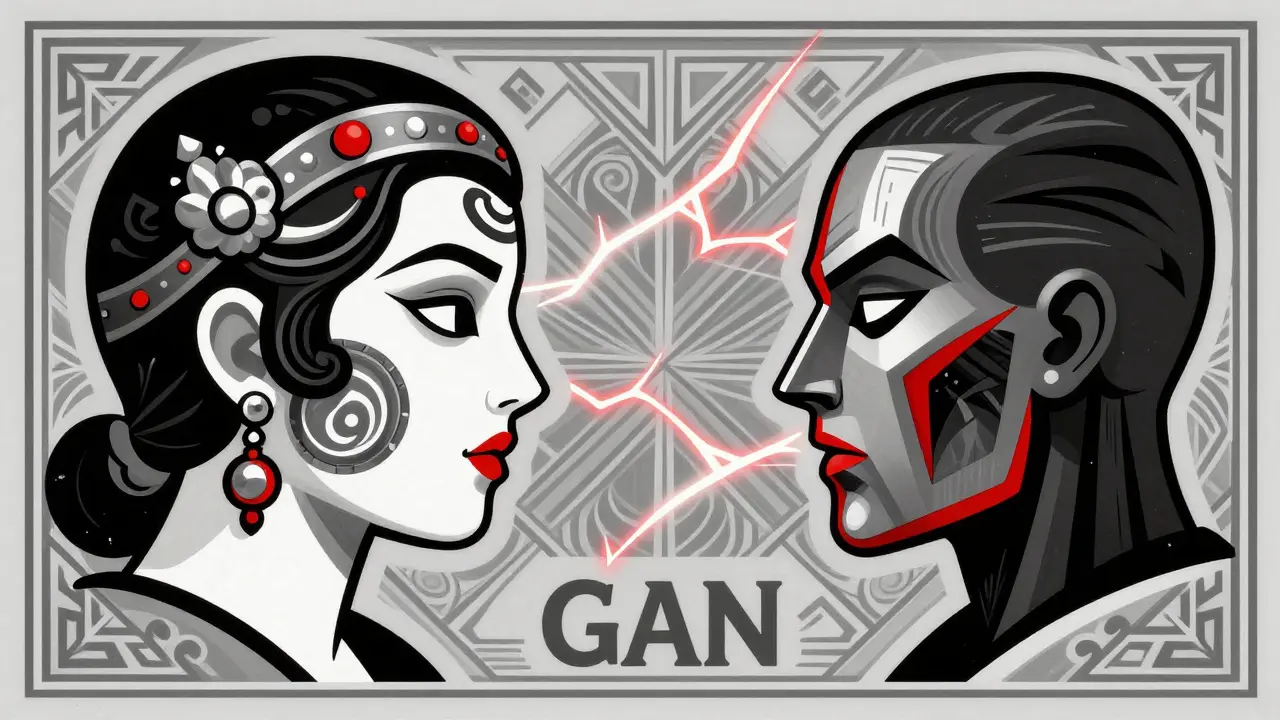
Introduced by Ian Goodfellow in 2014, Generative Adversarial Networks (GANs) were the first architecture to produce truly stunning realistic images. They work through a game of cat-and-mouse between two neural networks: a Generator that creates fake data and a Discriminator that tries to spot the fakes. As the Generator gets better at fooling the Discriminator, the output quality improves.
Despite being overshadowed by Diffusion Models in recent years, GANs still hold specific niches where speed is critical. According to TechTarget’s 2024 comparison, GANs like NVIDIA’s StyleGAN3 can generate images in 0.8 seconds-15 to 20 times faster than equivalent Diffusion Models. This makes them ideal for real-time applications, such as video enhancement or gaming assets, where latency matters more than absolute perfection.
| Metric | GANs (e.g., StyleGAN3) | Diffusion Models (e.g., SDXL) |
|---|---|---|
| Generation Speed | 0.8 seconds per image | 12-15 seconds per image |
| Image Quality (FID Score) | 2.15 (on FFHQ dataset) | 1.68 (lower is better) |
| Training Stability | Low (prone to mode collapse) | High (stable convergence) |
| Data Requirements | ~450 million pairs | ~2.3 billion pairs |
| Best For | Real-time video, face swapping | High-fidelity art, complex scenes |
The main drawback of GANs is their instability. Training them is notoriously difficult, with 63% of standard implementations suffering from mode collapse, according to Turing IT Labs’ 2023 deep dive. Developers often spend months tuning hyperparameters just to get consistent results. Consequently, GANs have dropped to just 3% of the generative AI market share, though they remain dominant in specialized fields like real-time video generation, achieving 30 FPS on consumer hardware.
Why Hybrid Models Are the Future
The industry is moving away from viewing these three technologies as mutually exclusive. Instead, we are seeing a convergence. Google’s Gemini 1.5 integrates diffusion techniques within a Transformer architecture, reducing image generation time by 65%. Similarly, Stability AI’s SD3 uses a hybrid diffusion-transformer approach that cuts inference steps to 20 while achieving top-tier quality scores.
This hybridization addresses the weaknesses of each individual model. By combining the structural understanding of Transformers with the pixel-perfect detail of Diffusion Models, developers can create multimodal systems that handle text, image, and video seamlessly. Meanwhile, NVIDIA continues to optimize GANs for edge devices, aiming for sub-100ms generation on mobile phones through their Maxine Edge initiative.
As Dr. Anima Anandkumar noted in her 2024 NeurIPS keynote, "Diffusion models have solved the mode collapse problem that plagued GANs for a decade, but their computational inefficiency remains a fundamental barrier." The solution lies in blending architectures. Expect to see fewer "pure" GAN or "pure" Diffusion projects in the coming years, replaced by sophisticated hybrids that leverage the strengths of all three.
Choosing the Right Architecture for Your Project
If you are building an application today, your choice depends on your primary constraint: speed, quality, or modality.
- Choose Transformers if: Your core task involves language, code, or logical reasoning. They are unmatched in NLP, with GPT-4 scoring 85.2% on MMLU benchmarks. Be prepared for high compute costs and memory requirements.
- Choose Diffusion Models if: Image quality and diversity are paramount. You need photorealistic outputs or complex artistic styles. Accept slower generation times unless you implement aggressive optimization or caching.
- Choose GANs if: You need real-time performance, such as live video filtering or interactive gaming assets. You must be willing to invest significant engineering effort into stabilizing the training process.
Remember that infrastructure matters. Fine-tuning a Transformer might require 32GB+ VRAM, while running a high-end Diffusion model locally needs an A100-class GPU. For most startups, leveraging APIs from providers like OpenAI (Transformers) or Stability AI (Diffusion) is more cost-effective than building custom training pipelines.
What is the main difference between Transformers and Diffusion Models?
Transformers primarily process sequential data like text using self-attention mechanisms, making them ideal for language tasks. Diffusion Models generate data (usually images) by learning to reverse a noise-addition process, excelling in visual fidelity and diversity.
Are GANs obsolete compared to Diffusion Models?
Not entirely. While Diffusion Models offer better quality and stability for image generation, GANs remain superior for real-time applications due to their significantly faster generation speeds (0.8s vs 12-15s). They are still used in video enhancement and gaming.
Which architecture consumes the most energy?
Large Transformers currently consume the most energy, with full training cycles requiring up to 50 GWh of electricity. Diffusion Models are less intensive per generation but require more training data. GANs are generally more energy-efficient for inference but costly to train due to instability.
What is "mode collapse" in GANs?
Mode collapse occurs when a GAN's generator produces limited varieties of output, failing to capture the full diversity of the training data. For example, it might only generate faces with smiles. Diffusion Models suffer from this far less frequently (4% vs 27%).
Will hybrid models replace standalone architectures?
Likely yes. Industry trends show a move toward hybrid systems, such as combining Transformers with Diffusion for multimodal tasks. This approach aims to balance the speed of GANs, the logic of Transformers, and the quality of Diffusion Models.




Oskar Falkenberg
June 24, 2026 AT 16:32hey guys just wanted to chime in here because i think this is a really solid breakdown of the tech stack we are all using every single day without really thinking about the heavy lifting happening under the hood. i mean seriously when you look at how transformers handle that self attention mechanism it is kind of mind blowing that we can process entire sequences at once instead of going word by word like some old school rnn model would do back in the day. and then you have diffusion models which are basically just un-noising static until it looks like a picture which is such a weird concept but it works so well for images now. i know some people still swear by gans for speed but honestly the stability issues with training them are just not worth the headache anymore unless you are doing something super real time like video processing or gaming assets where latency is king. anyway just my two cents on the matter hope this helps anyone trying to figure out which architecture to pick for their next project because choosing wrong can really mess up your compute budget lol.
Caitlin Donehue
June 25, 2026 AT 14:04i guess so
Jeanne Abrahams
June 26, 2026 AT 18:46Oh, brilliant. Another article explaining that computers are magic boxes that eat electricity and spit out pictures of cats wearing sunglasses.
I suppose the rest of us who actually build things should just bow down to the 'hybrid future' while our GPUs melt down trying to run Stable Diffusion on a laptop from 2019. It's almost poetic how the industry moves on to the next shiny object before the last one even stops burning holes in our wallets. But sure, let's pretend that 'mode collapse' was ever a problem for anyone who didn't try to train a GAN on a dataset of blurry selfies taken in bad lighting.
Anyway, thanks for clarifying that I need an A100 GPU just to make a decent image. My bank account sends its regards.
Bineesh Mathew
June 27, 2026 AT 21:04You speak of architectures as if they are mere tools, cold and indifferent to the human condition. But consider the soul of the machine. When a Transformer attends to a word, does it truly understand? Or does it merely mimic the shadow of understanding, a hollow echo in the digital void? The Diffusion Model reverses entropy, yes, but in doing so, does it not reverse the very nature of creation itself? We are playing god with noise and static, birthing images from chaos without the divine spark of intent. And the GAN... ah, the GAN is the true philosopher. Two networks in eternal struggle, generator and discriminator, locked in a dance of deception and truth. It is a metaphor for society itself, isn't it? The creator seeking validation from the critic, forever chasing perfection that never arrives. We are all just latent vectors waiting to be decoded by a cruel universe.
Stephanie Frank
June 29, 2026 AT 03:54Look, I'm not gonna sugarcoat it. This post is full of fluff. You're telling me Transformers dominate NLP? Shocking. Groundbreaking news for those of us who haven't been living under a rock since 2017. And don't get me started on the 'hybrid future' nonsense. Companies aren't blending these architectures because they want to; they're doing it because their pure models are failing to meet KPIs.
The real story here isn't the tech; it's the waste. 50 GWh per training cycle? That's insane. While you're writing pretty paragraphs about 'self-attention,' you're ignoring the environmental disaster unfolding in data centers worldwide. And GANs being 'underdogs'? Please. They're obsolete relics kept alive by legacy systems that refuse to migrate. If you're still using GANs in 2025, you're either incompetent or stuck in the past. Wake up.