For years, the industry chased one metric above all else: parameter count. We believed that bigger was always better, that throwing more data and compute at a model would magically solve every problem. That era is over. As of mid-2026, the biggest breakthroughs in generative AI architecture aren't coming from making models larger-they're coming from making them smarter, leaner, and more modular. The shift from monolithic blocks to sophisticated system-level frameworks has fundamentally changed how we build, deploy, and trust artificial intelligence.
This isn't just theoretical chatter. Major firms like Zaha Hadid Architects and Foster + Partners have fully integrated these new architectural patterns into their daily workflows. Meanwhile, tech giants are racing to standardize these approaches, with AWS launching specialized Well-Architected Lenses at re:Invent 2025 to guide enterprises through this transition. If you are building or managing AI systems today, understanding these architectural innovations is no longer optional-it's the difference between a scalable product and a costly experiment.
The End of Monolithic Thinking
To understand where we are, we need to look at where we came from. For most of the early generative AI boom, we relied on monolithic architectures. These were single, massive models that handled everything from reasoning to memory retrieval. They worked well enough for simple tasks, but they hit a wall around 500 billion parameters. Beyond that point, inference costs skyrocketed, latency became unbearable, and debugging became nearly impossible.
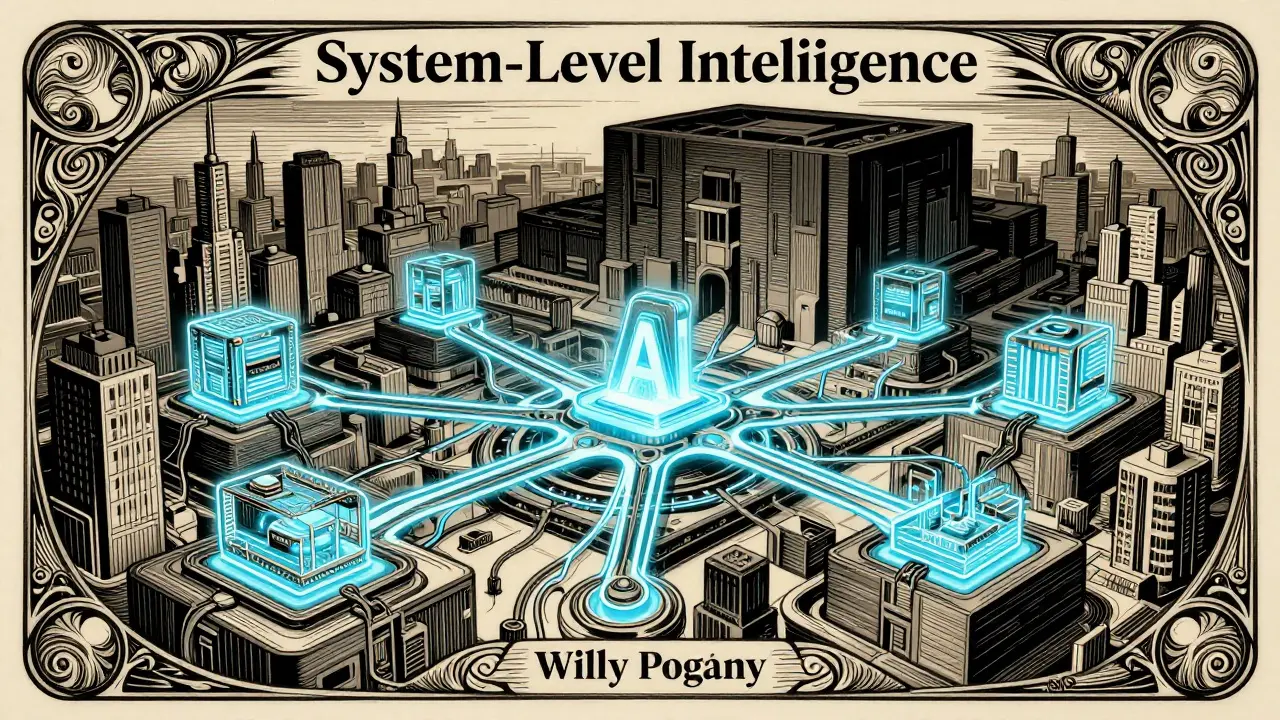
The new approach? System-level intelligence. Instead of one giant brain, modern systems use a hybrid architecture that balances modularity with deep integration. Think of it like a city rather than a single skyscraper. You have specialized districts (modules) for different tasks-reasoning, memory, perception-that communicate efficiently. This mirrors biological intelligence systems, allowing for robustness without the brittleness of earlier handoffs between components.
System-Level Intelligence is an architectural framework that integrates multiple specialized AI components to create a cohesive, efficient, and verifiable system, moving beyond single-model limitations.
Professor Stuart Russell of UC Berkeley noted in late 2025 that this hybrid balance is critical. Without it, we face "brittle handoffs" where one module fails because another didn't format its output correctly. With proper system design, these components work together seamlessly, reducing logical errors by up to 80% on complex tasks.
Mixture-of-Experts: Doing More with Less
If there is one technical innovation defining 2025 and 2026, it is the widespread adoption of Mixture-of-Experts (MoE) architectures. In a traditional dense model, every single parameter activates for every token you generate. It’s inefficient. Imagine reading an entire encyclopedia to answer a question about what you had for breakfast. That’s what dense models do.
MoE changes the game. It allows trillion-parameter models to exist while activating only 3-5% of those parameters per token. How? By routing each input to the specific "expert" sub-network best suited for that task. If the input is code, it goes to the coding expert. If it’s poetry, it goes to the creative writing expert. The result? A 72% reduction in inference costs compared to dense models of equivalent capability.
Of course, nothing is free. MoE introduces 15-20% additional complexity in training and deployment. You need sophisticated load balancing to ensure experts don’t get overloaded. But for enterprise applications where cost and speed matter, the trade-off is undeniable. According to AWS technical documentation from November 2025, this efficiency enables throughput of 300 tokens per second on standard GPU infrastructure-a huge leap for real-time applications.
Verifiable Reasoning and Trust
Early large language models often hallucinated confidently. They made things up because they were predicting the next word, not verifying facts. Modern architectures address this with verifiable reasoning frameworks. We’ve moved past emergent Chain-of-Thought behaviors to explicit, inspectable processes.
These systems now include process supervision. Before generating a final answer, the model checks its own logic against known constraints or external knowledge bases. Ken Huang, an AI Systems Architect, documented in January 2025 that this shift reduced logical errors by 60-80% on complex tasks. This is crucial for industries like healthcare, finance, and law, where a confident wrong answer is worse than no answer at all.
However, complexity brings risk. MIT Professor Aleksander Madry warned in December 2025 that architectural complexity can introduce new vulnerabilities. When you have dozens of interacting modules, a bug in one might cascade unpredictably. This means testing and monitoring must evolve from checking outputs to auditing the entire system flow.

Efficiency Gains: Speed and Energy
Let’s talk numbers. The environmental and economic impact of AI is significant. Older monolithic models were energy hogs. Modern system-level architectures achieve 3.2x faster inference times while reducing energy consumption by 47% compared to 2023 standards. This isn't just good for the planet; it’s good for your bottom line.
Efficient attention mechanisms play a big role here. Traditional attention scales quadratically O(n^2) with sequence length. New mechanisms reduce this to O(n log n) or better. This makes processing long documents, video streams, or extensive codebases feasible without melting servers. State Space Models like Mamba demonstrate this, offering 2.4x faster inference on long sequences, though they currently sacrifice about 12% accuracy on nuanced language tasks compared to Transformers.
| Architecture Type | Inference Cost | Complexity | Best Use Case |
|---|---|---|---|
| Dense Transformer | High | Low | General-purpose chatbots |
| Mixture-of-Experts (MoE) | Low (72% less) | Medium-High | Enterprise-scale applications |
| State Space Models (Mamba) | Very Low | Medium | Long-sequence processing |
| Hierarchical Reasoning | Medium | High | Causal reasoning tasks |
Real-World Implementation Challenges
Reading about these benefits is easy. Implementing them is harder. User feedback from architects and developers reveals a gap between theory and practice. On Reddit’s r/Architecture community, users reported cutting concept visualization time from three days to four hours using tools like Archicad AI Visualizer. However, they also noted struggles with complex structural elements that the AI couldn't handle reliably.
Integration remains the biggest hurdle. A Chaos Blog survey from October 2025 found that while 68% of architecture firms saw improved sustainability analysis, 43% cited integration challenges with existing project management systems as their primary obstacle. Only 32% achieved seamless integration with Building Information Modeling (BIM) workflows.
For software engineers, the challenge is similar. Netflix engineers shared at AWS re:Invent 2025 that their AI-assisted architecture tools reduced scaling prediction errors by 31%. But it took six months of customization to fit their microservices ecosystem. Amazon developers reported that AI-powered recommendations initially generated 18% false positives, requiring manual validation loops. Startup founders on Y Combinator noted that while MVPs could be built in a day instead of a week, 62% said the generated architectures overlooked security best practices.

The Market Landscape and Future Trajectory
The market for AI architecture tools exploded to $18.7 billion in Q3 2025. AWS leads with a 34% share, followed by Google Cloud and Microsoft Azure. But the real story is the shift in mindset. Gartner predicts that by 2027, organizations using system-level AI architectures will achieve 3.5x higher ROI than those sticking with monolithic approaches.
Looking ahead, the trend is toward agentic architectures. AWS highlighted eight scenarios for autonomous systems in late 2025, including autonomous call centers and knowledge worker co-pilots. These systems don't just answer questions; they plan, execute, and verify actions. Meta’s open-sourcing of their Modular Reasoning Framework in January 2026 signals a move toward standardized, composable reasoning blocks.
Regulatory pressure is also shaping architecture. The EU’s AI Act requires specific documentation for high-risk systems, pushing 57% of enterprises to implement additional verification processes. This forces architects to design for transparency from the start, not as an afterthought.
How to Get Started
If you want to adopt these innovations, start small. Don't try to rebuild your entire stack overnight. Begin with predefined architectural patterns. AWS provides eight scenarios in their Generative AI Lens that serve as excellent starting points. Focus on integrating one modular component at a time-perhaps a specialized reasoning module or a memory retrieval system.
Invest in skills. LinkedIn’s analysis of job postings shows that employers seek traditional software architecture knowledge combined with AI model understanding and system integration expertise. The learning curve has decreased since 2023, with developers becoming proficient in 8-12 weeks of focused training. Leverage community resources; GitHub repositories related to AI system architecture grew by 210% year-over-year.
Finally, prioritize monitoring. Because these systems are modular, failures can be subtle. Set up comprehensive logging and tracing across all components. Test for edge cases where modules interact poorly. Remember, the goal isn't just to build a smart model-it's to build a reliable system.
What is the main difference between monolithic and system-level AI architectures?
Monolithic architectures rely on a single, massive model to handle all tasks, which becomes inefficient and expensive at scale. System-level architectures use multiple specialized modules (like reasoning, memory, and perception) that work together. This modular approach reduces costs, improves speed, and allows for easier debugging and updates.
How does Mixture-of-Experts (MoE) reduce costs?
MoE architectures activate only a small fraction (3-5%) of the total parameters for any given input, routing data to the most relevant "expert" sub-network. This decouples model size from inference cost, resulting in up to 72% lower inference expenses compared to dense models of similar capability.
Are MoE models harder to train?
Yes, MoE models introduce 15-20% additional complexity in training and deployment. They require sophisticated load balancing to prevent certain experts from being overwhelmed. However, the operational savings during inference usually outweigh these initial development challenges.
What is verifiable reasoning in AI?
Verifiable reasoning involves explicit, inspectable frameworks where the AI checks its own logic against constraints or external data before producing an output. This process supervision significantly reduces hallucinations and logical errors, making the AI more trustworthy for critical applications.
Why is integration difficult for architecture firms using AI?
Many firms struggle to integrate new AI tools with legacy systems like BIM (Building Information Modeling) and project management software. While AI speeds up conceptual design, connecting it to detailed engineering workflows often requires custom development and causes friction in data exchange.
What are State Space Models (Mamba)?
State Space Models like Mamba are an alternative to Transformers that offer much faster inference on long sequences (2.4x faster). They are highly efficient but currently sacrifice about 12% accuracy on complex language understanding tasks compared to standard Transformers.
How long does it take to learn modern AI architecture?
Developers typically require 8-12 weeks of focused training to become proficient in system-level AI architecture. This includes learning traditional software architecture, AI model behavior, and system integration techniques.
What is the future of AI architecture?
The future points toward agentic architectures that can plan, execute, and verify actions autonomously. Hybrid systems combining multiple specialized components are expected to become the standard, with a focus on bridging semantic intelligence with physical reasoning and ensuring regulatory compliance.