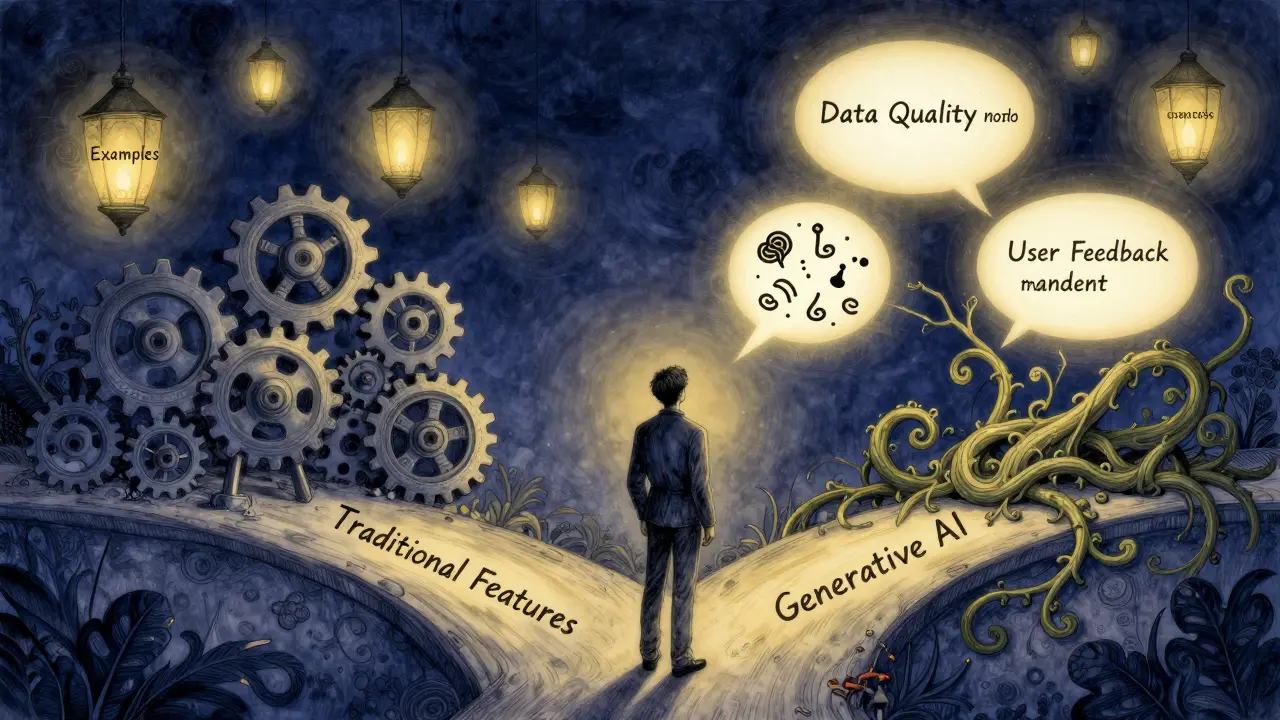
Most product teams still treat generative AI like any other feature. They write user stories, set deadlines, and ship. Then they wonder why adoption is low, users complain about weird outputs, and the feature gets buried in the app. The truth? Generative AI isn’t software. It’s a living system that learns, changes, and sometimes hallucinates. Managing it the old way doesn’t work.
Why Traditional Product Management Fails with Generative AI
Traditional product management assumes predictability. You build a button, it clicks. You write a filter, it sorts correctly. Generative AI? It gives you a different answer every time. One user gets a perfect summary. Another gets nonsense. That’s not a bug-it’s how these models work.
McKinsey found that 85% of AI projects stall after the pilot stage. Why? Poor scoping. Teams skip the hard part: understanding what data they actually have, what the model can realistically do, and how users will react to imperfect outputs. They treat AI like a magic box instead of a tool with limits.
Here’s what breaks:
- Using standard KPIs like ‘feature usage’ when the output is unpredictable
- Shipping full features without testing small versions first
- Not tracking model drift-where the AI slowly gets worse over time
- Expecting engineers to guess what ‘better’ means without clear examples
Successful teams don’t just manage features. They manage uncertainty.
Scoping: Start with Examples, Not Requirements
Don’t write: “Add an AI summary feature.”
Write: “When a user pastes a 10-page legal document, the AI should return a 3-bullet summary highlighting obligations and deadlines, in plain language. If the document is unclear, it should say ‘Can’t summarize-missing key info.’”
That’s the difference between a vague request and a real spec. DeepLearning.AI found teams using concrete examples ship 40% faster. Why? Engineers know exactly what success looks like. Designers can mock up the right UI. QA knows what to test.
Start with 3-5 real user scenarios. Gather actual inputs from your users-emails, support tickets, product logs. Feed them into a model. See what works. What doesn’t. What’s confusing. This isn’t research-it’s prototyping.
Also, check your data. AIPM Guru’s research shows 63% of AI projects fail because teams didn’t assess data quality early. If your training data is full of typos, biased language, or gaps, your AI will be too. Don’t assume your CRM or support logs are ready for AI. Audit them first.
MVPs: Build Capability Tracks, Not Monoliths
Your first version of an AI feature shouldn’t be perfect. It should be useful. And it shouldn’t try to do everything.
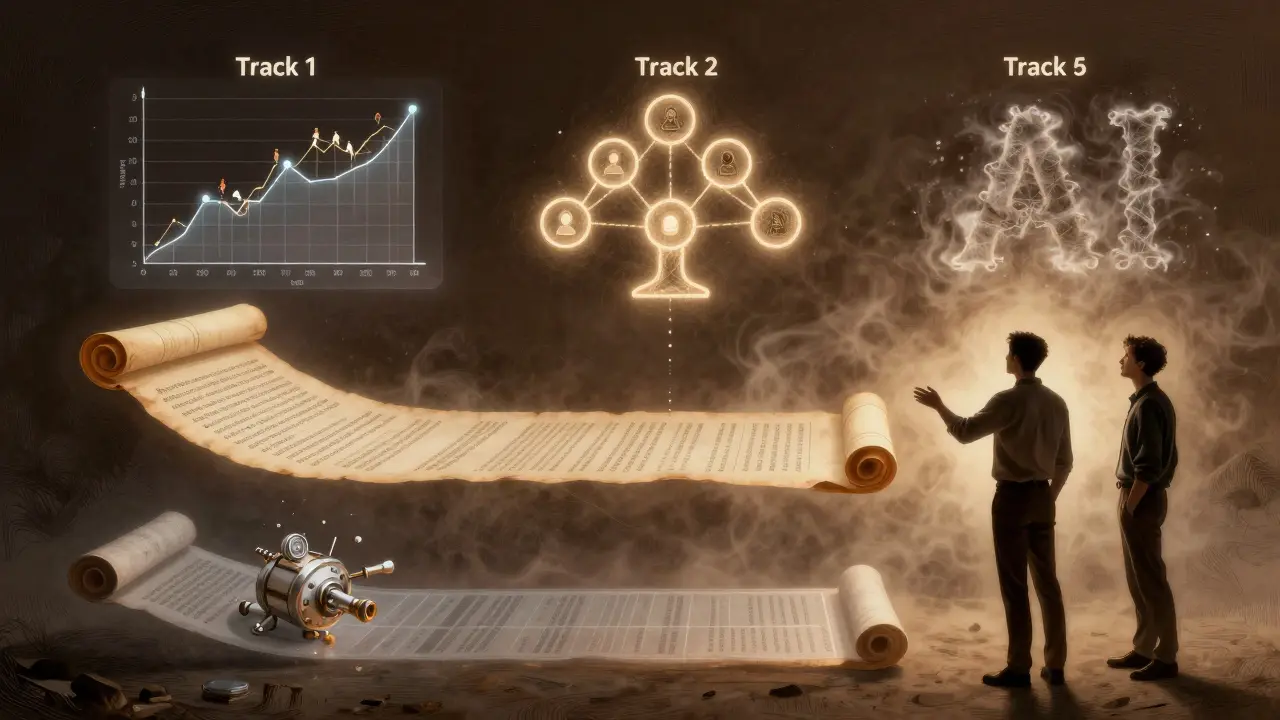
Think in capability tracks:
- Track 1: Analytics - “Show me which customer messages are most common.” (Uses classification, not generation)
- Track 2: Prediction - “This user is 82% likely to churn.” (Uses historical data, not creative output)
- Track 3: Limited Generation - “Here’s a template reply you can edit.” (Uses fixed structures)
- Track 4: Full Generation - “Write a custom email from scratch.” (High risk, high reward)
Launch Track 3 first. A fintech company did this with their customer support AI. Instead of writing full replies, they started with pre-approved templates the agent could tweak. Adoption hit 78% in 3 weeks. Meanwhile, they built Track 4 in the background. When it was ready, they rolled it out as an upgrade-not a replacement.
This approach reduces risk. It gives users confidence. It lets you measure what works before you invest in the complex stuff.
Metrics: Track the Right Things-Not Just Clicks
Traditional metrics like DAU or feature toggle usage are useless for generative AI. You can click a button 100 times and still hate the output.
Leading teams track three layers:
- Technical Performance - Accuracy, latency, toxicity score, model drift rate. If your model’s accuracy drops from 92% to 84% in a month, something’s wrong. Set alerts.
- User Satisfaction - Use in-app feedback: “Was this helpful?” with thumbs up/down. Add a comment box. Don’t rely on NPS alone. Users might say “It’s cool” but never use it again.
- Business Impact - Did support tickets drop? Did sales cycle shorten? Did content engagement increase? Link the AI output to real outcomes.
Pendo.io found 92% of top AI product teams use a single dashboard that shows all three. One company tracked how their AI-generated product descriptions affected conversion rates. When they improved the tone to sound more human, conversions jumped 18% in 6 weeks.
Don’t just measure output. Measure change.
Team Dynamics: Break Down the Jargon Barrier
Engineers say “embedding space.” Product managers say “make it smarter.” Designers say “make it prettier.” Everyone’s talking past each other.
AIPM Guru found 73% of failed AI projects had communication breakdowns. The fix? Translation sessions.
Once a week, have your product manager explain a user problem to the engineer. Then have the engineer explain how the model works to the product manager. No slides. No jargon. Just plain talk.
Example:
Product: “Users keep asking for summaries of long reports. They don’t have time to read them.”
Engineer: “We can use a transformer model to extract key points, but only if the text is clean. If there’s handwritten notes or scanned PDFs, accuracy drops to 40%.”
Product: “So we should only allow uploaded .docx files for now, and tell users if the file isn’t supported.”
That’s progress.
Also, define roles. Who owns the data? Who validates model outputs? Who decides when to retrain? Write it down. Share it.
Structure vs. Flexibility: The Core Mindset Shift
AI product management isn’t about more process. It’s about balancing structure with space to explore.
Here’s the framework:
- Start with structure - Define the problem, the data, the success criteria. Lock this in before coding.
- Allow for exploration - Give engineers 1-2 weeks per sprint to test 3-5 different model approaches. No pressure to ship.
- Adapt based on learnings - If a model performs poorly, pivot. If a user behavior surprises you, change the UI.
- Focus on outcomes, not outputs - Don’t care if the AI wrote 500 summaries. Care if users saved 2 hours a week.
Traditional agile uses 2-week sprints with fixed deliverables. AI teams use “exploration sprints” with flexible outcomes. The goal isn’t to ship a feature-it’s to learn something.

Enterprise vs. Startup: Different Rules
Startups move fast. They combine data strategy and product definition. They run experiments in 72 hours. They don’t need 10-page docs. They need speed.
Enterprises? They need governance. A healthcare company using AI for patient notes had to pass an AI ethics review before launch. That’s not bureaucracy-it’s risk management. 48% of enterprise teams now require formal reviews.
Enterprises also need templates: AI product canvas, risk assessment forms, versioning policies. Simon-Kucher found companies that treat model updates like new features (with new pricing tiers) see 22% higher conversion. Why? Users understand the value difference.
Startups: build fast, learn faster.
Enterprises: build right, then scale.
What’s Next? AI Managing AI
By 2026, AI tools will handle 70% of routine product tasks: writing user stories from support logs, auto-generating reports, flagging model drift. That’s not a threat-it’s a gift.
Product managers won’t disappear. They’ll become strategists. Their job won’t be to write specs. It’ll be to ask the right questions:
- Is this AI solving a real problem-or just looking for a use case?
- Are users trusting this output-or just tolerating it?
- What happens if the AI gets it wrong? Who’s accountable?
Generative AI doesn’t replace product management. It elevates it. The best product managers aren’t the ones who know how to code. They’re the ones who know how to listen-to users, to engineers, and to the quiet, unpredictable voice of the model itself.
How do I know if my AI feature is ready to ship?
It’s ready when it consistently solves a real user problem, even if it’s imperfect. Look for three signs: users are actively using it, feedback scores are above 70% positive, and it’s moving a key business metric (like reduced support tickets or higher engagement). Don’t wait for perfection. Wait for proof.
Can I use the same metrics for AI and non-AI features?
No. Standard metrics like clicks or time-on-page don’t capture AI quality. You need to add technical metrics (accuracy, latency), user satisfaction with output quality, and business impact. A feature that gets 10,000 clicks but 80% negative feedback is a failure.
What’s the biggest mistake teams make when scoping AI features?
Assuming the AI can do more than it can. Many teams ask for “write a full blog post” without checking if their data supports it. Start small: “suggest a headline” or “rewrite this sentence.” Prove value before scaling up.
Do I need to hire AI engineers to manage AI features?
No-but you need AI literacy. You don’t need to code transformers. But you must understand what a model can and can’t do, how data affects output, and what “accuracy” really means. Take a course. Pair with an engineer. Ask questions. 68% of failed AI projects fail because product managers didn’t bridge that gap.
How often should I retrain my AI model?
Not on a schedule-on signals. Monitor for drift: if accuracy drops, if user feedback changes, or if input data shifts (like new customer segments). Some models need retraining monthly. Others last a year. Set up alerts. Don’t guess.
Next Steps: Where to Start Today
Don’t wait for the perfect plan. Start with one thing:
- Pick one user task that’s repetitive or frustrating.
- Gather 20 real examples of that task.
- Run them through a free AI tool (like OpenAI’s playground or Claude).
- Ask: Could this be automated? Would users trust it? What would make it better?
- Write your first concrete example. Not a requirement. An example.
That’s your MVP. That’s your first step. The rest follows.




Teja kumar Baliga
January 20, 2026 AT 19:17Alan Crierie
January 21, 2026 AT 02:32k arnold
January 22, 2026 AT 04:48Tiffany Ho
January 22, 2026 AT 08:56michael Melanson
January 23, 2026 AT 11:26lucia burton
January 24, 2026 AT 18:21Denise Young
January 26, 2026 AT 00:31Nicholas Zeitler
January 26, 2026 AT 14:33