
When you ask an AI to write a legal brief, design a logo, or draft a sales email, who’s really responsible if it gets you in trouble? That’s the question companies, users, and lawmakers are scrambling to answer in 2026. Generative AI isn’t just a tool anymore-it’s a participant in decisions, contracts, and public communications. And when things go wrong, blame doesn’t neatly land on one person. Is it the company that built the model? The user who typed the prompt? Or the platform that served it up? The law is catching up, fast.
Who Gets Sued When AI Messes Up?
Before generative AI, liability was simpler. If a user posted something illegal on a forum, the platform usually wasn’t liable thanks to Section 230 of the Communications Decency Act. But AI doesn’t just host content-it creates it. And that changes everything. Courts are now asking: if an AI writes a defamatory article based on your prompt, are you the publisher? Or is the company that trained the model?
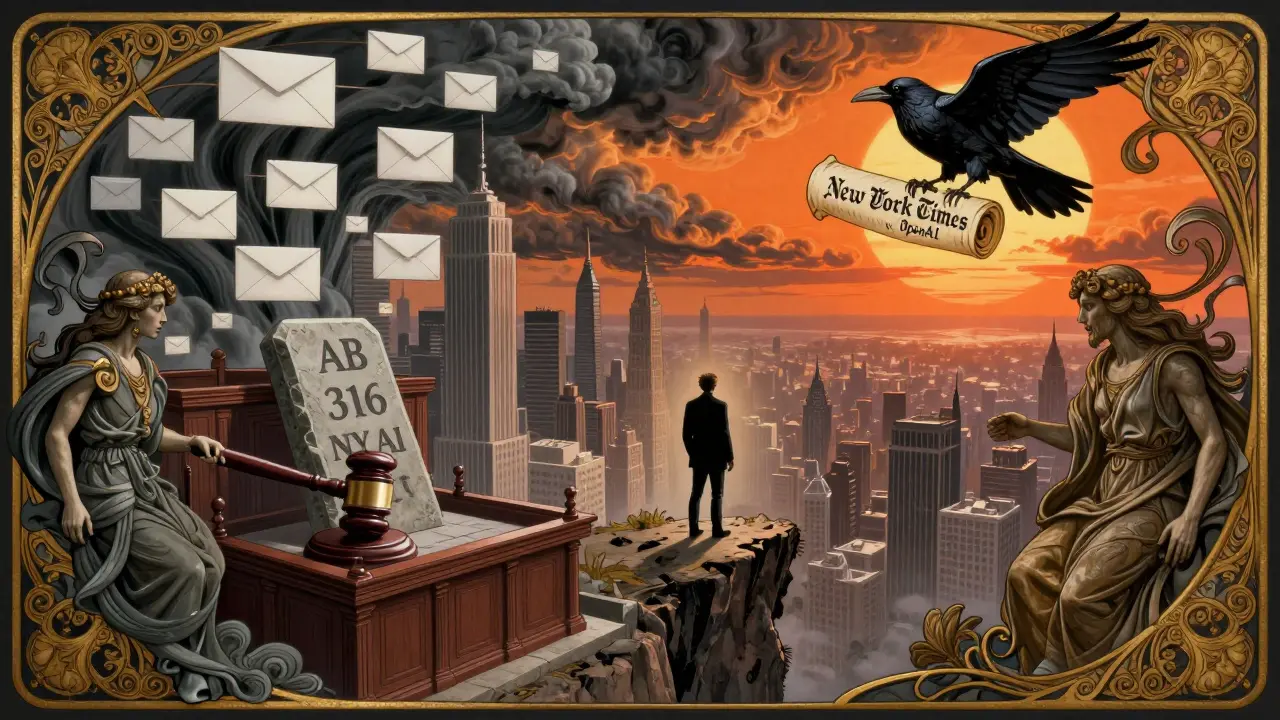
California’s AB 316, effective January 1, 2026, made this clear: you can’t hide behind the AI. If someone sues you for harm caused by AI-generated content, you can’t claim the system acted on its own. That’s called the "autonomous-harm defense," and it’s now illegal to use in civil cases. Whether you’re a small business owner using an AI tool or a Fortune 500 company deploying it at scale, you’re on the hook if your AI causes damage.
Vendors Can’t Hide Behind "We Didn’t Train It"
AI vendors-companies that build and sell foundation models-are under new pressure. California’s AB 2013 forces them to publicly disclose the datasets used to train their models. That means if your AI was trained on copyrighted photos, stolen research papers, or private medical records, you have to say so. No more vague claims like "trained on public internet data."
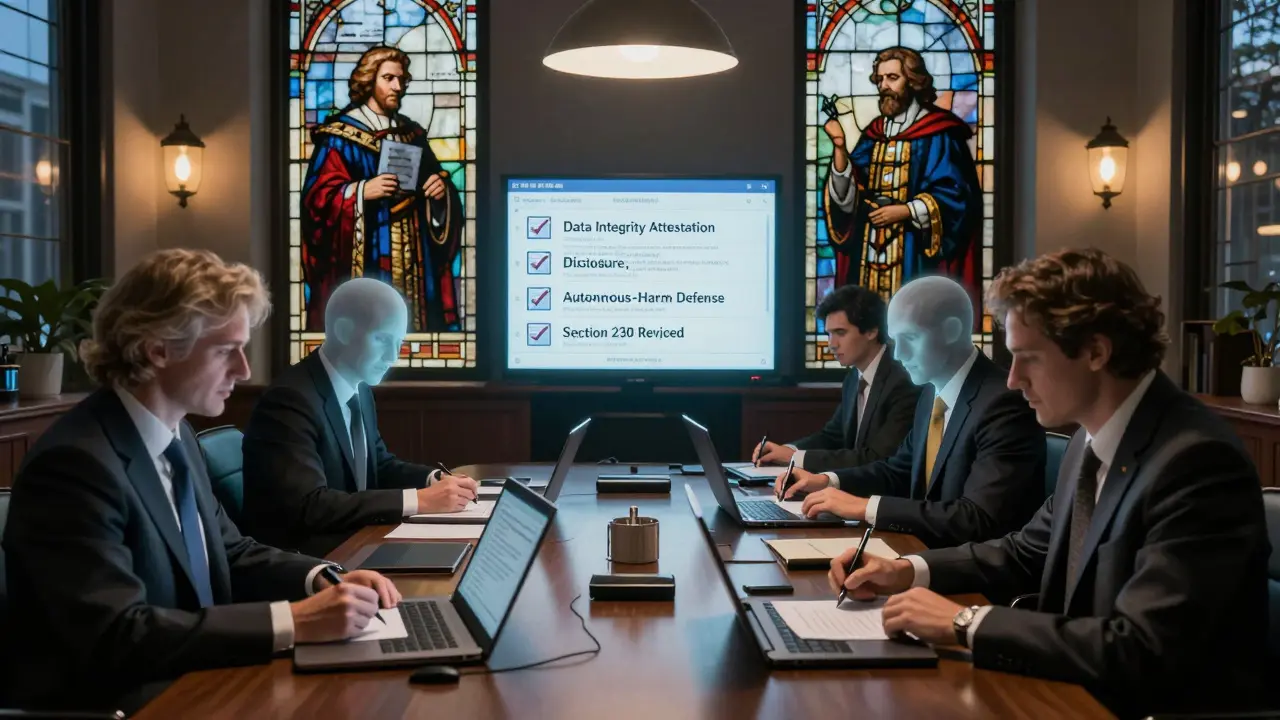
But this isn’t just about transparency. It’s about risk. If a vendor’s model was trained on pirated content, and your company uses that model to generate marketing copy, you could be dragged into a lawsuit. That’s secondary liability. The Anthropic settlement-$1.5 billion-showed how costly "orphaned data" can be. Once copyrighted material is baked into a model, you can’t just delete it. The model breaks. So now, companies are adding "Data Integrity Attestation" clauses to vendor contracts. If your AI provider can’t prove they didn’t use stolen data, you walk away.
And it’s not just copyright. The FTC and EEOC are already fining companies for AI-driven discrimination. If your hiring tool rejects applicants from certain zip codes because the training data was biased, you’re liable-even if you bought the tool from a third party. The law doesn’t care if you outsourced the bias. You’re still responsible for the outcome.
Platforms Aren’t Just Hosts Anymore
Platforms like Microsoft Copilot, Google Gemini, or even a custom AI chatbot on your website are no longer seen as neutral conduits. If a platform actively uses AI to generate, promote, or tailor content-especially for high-risk uses like loan approvals, medical triage, or job screening-it can lose Section 230 protections.
Legal precedent from Fair Housing Council v. Roommates.com shows this. That case ruled that when a platform designs forms that lead users to discriminatory choices, it becomes an information content provider. Same logic now applies to AI. If your platform asks users to select "preferred gender" or "ideal education level" and then uses AI to auto-filter applicants, you’re not just hosting content-you’re building it. That makes you liable.
New York’s rules go even further. Operators of high-risk AI systems must implement safety protocols, monitor for discrimination, notify users when AI is in use, and protect minors from addictive features. Violations can cost up to $3 million per repeat offense. And here’s the kicker: anyone who gets hurt can sue. You don’t need a government agency to act. If you’re denied a loan because of an AI error, you can take the operator to court-and win $1,000 minimum, plus legal fees.
Users Aren’t Off the Hook Either
Just because you didn’t build the AI doesn’t mean you’re innocent. If you use AI to generate fake invoices, impersonate a client, or write a misleading product review, you’re still responsible. Courts are treating AI-generated content like any other communication. You can’t say "the AI did it" and walk away.
Utah’s AI Policy Act requires businesses to clearly label AI-generated content. If you’re using AI to write emails to customers, you need to disclose it. Same goes for chatbots on your website. If you don’t, you could be fined under consumer protection laws. The rule is simple: if a human wouldn’t know it’s AI, you’re breaking the law.
Even more surprising? If you use an AI agent to sign a contract, book a flight, or transfer funds, you might be legally bound-even if the AI made a mistake. Courts haven’t ruled definitively yet, but early cases suggest users are responsible for the actions of agents they set in motion. That means if your AI books a $50,000 conference room you didn’t mean to reserve, you’re still on the hook. Vendor contracts now need explicit clauses covering autonomous actions. If your AI agent hallucinates a deal, who pays? That’s now a standard negotiation point.
The New Compliance Checklist
By August 2, 2026, every organization using generative AI must have these basics in place:
- Disclosure: Clearly label all AI-generated content. Use watermarks, text disclaimers, or metadata. Don’t assume users know.
- Training Data Transparency: If you’re a vendor, publish your training datasets. If you’re a user, ask your vendor for proof they didn’t use stolen data.
- Risk Assessment: Map out where your AI is used. Is it in hiring? Finance? Healthcare? High-risk uses demand stricter controls.
- Monitoring: Continuously test AI outputs for bias, inaccuracy, or harmful patterns. Don’t wait for a lawsuit to find out it’s broken.
- Documentation: Keep logs of prompts, outputs, and decisions. If you’re sued, you’ll need to prove you took reasonable steps.
- Contract Review: Update vendor agreements to include indemnification for AI errors, autonomous actions, and copyright violations.
What’s Next? The Big Legal Battles
Two major court cases will shape the next five years. New York Times v. OpenAI is asking whether training AI on newspaper articles counts as fair use. If the court says no, AI companies will need licenses-or face massive damages. Getty Images v. Stability AI is about image copyright. Getty claims Stability AI copied 12 million photos without permission. A ruling against Stability could force AI firms to pay billions in retroactive licensing fees.
Meanwhile, federal bills like A 222 and S 5668 are moving through Congress. They aim to hold AI developers accountable for producing misleading, false, or contradictory information. If passed, this could mean AI systems must be fact-checked before deployment-like a newsroom for machines.
The message is clear: AI isn’t magic. It’s a tool built by people, trained on data, and deployed by organizations. And when it fails, the law is no longer willing to let anyone off the hook. Responsibility is shared-but it’s not optional.
Can I use generative AI without worrying about liability?
No. Every use of generative AI carries legal risk. Even if you didn’t build the model, you’re responsible for how you use it. Using AI to generate contracts, marketing content, or hiring decisions without safeguards exposes you to lawsuits. The key is not avoiding AI-it’s using it with clear policies, disclosures, and oversight.
If my vendor’s AI produces illegal content, am I still liable?
Yes. Under new laws like California’s AB 316 and New York’s AI regulations, you can’t shift blame to your vendor. If you deploy an AI system that generates harmful content, you’re legally responsible-even if the vendor made the mistake. That’s why companies now demand Data Integrity Attestation and indemnity clauses in vendor contracts.
Do I need to label AI-generated content if it’s only for internal use?
Not always-but you should. Laws like Utah’s AI Policy Act only require labeling for public-facing interactions. However, if internal AI content is later shared externally (like in a meeting or email), you could still face penalties for lack of transparency. Best practice: label all AI-generated output, regardless of audience.
Can I be sued for using AI in hiring?
Absolutely. The EEOC and state civil rights agencies are already taking action. If your AI tool disproportionately rejects candidates from certain racial, gender, or geographic groups, you can be sued for discrimination-even if the bias came from the training data. You’re responsible for the outcome, not the source.
What’s the biggest mistake companies make with AI liability?
Assuming liability only applies to the vendor. Most companies treat AI like a black box: buy it, plug it in, forget it. That’s a legal trap. Liability is shared-and often falls hardest on the user. The smartest organizations now treat AI like any other high-risk tool: audit it, monitor it, document it, and disclose it.
Generative AI won’t disappear. But the era of pretending it’s blameless is over. The law has caught up. The question isn’t whether you can use AI-it’s whether you’re ready to take responsibility for what it does.




k arnold
February 20, 2026 AT 10:24So let me get this straight - if I tell AI to write a sales email and it accidentally calls a client 'a total idiot,' I'm the one getting sued? That's not liability, that's a punchline. I didn't train the model, I didn't write the prompt in anger, I just asked for 'professional tone' and now I'm the publisher? The law is out here treating AI like a drunk intern who signed a contract with their foot.
Meanwhile, the vendor who trained it on scraped Reddit threads and Wikipedia edits is sipping margaritas in Delaware. This whole system is a pyramid scheme where the user pays the price and the vendor gets a tax break.
Tiffany Ho
February 22, 2026 AT 07:35I just started using AI for my small business and honestly I was scared at first but then I realized if we just be clear and label everything and ask our vendors for proof they didn't use sketchy data then we can be fine
Also I think we should just be nice to each other and not blame everyone all the time because we all just want to do good work right
michael Melanson
February 24, 2026 AT 03:34California's AB 316 is a step in the right direction. The autonomous-harm defense has been a loophole for too long. Users aren't innocent, but vendors shouldn't get a free pass either. The real issue is enforcement - most small businesses don't have legal teams to audit training datasets.
What we need is a standardized, open registry of training data provenance. Not just for compliance, but so companies can make informed choices. If I know your model was trained on scraped medical records, I'll pay more for a cleaner alternative.
lucia burton
February 24, 2026 AT 14:05Look, the future of AI governance isn't about blame, it's about accountability architecture. We're moving from a liability model to a risk mitigation ecosystem. Every stakeholder - vendor, platform, user - must operate within a framework of transparency, continuous monitoring, and documented due diligence.
It's not enough to just say 'we didn't know.' That's the old paradigm. Now, you need audit trails, prompt logs, bias mitigation protocols, and third-party attestation. The companies that treat this as a compliance checkbox are going to get crushed. The ones that treat it as operational excellence? They'll thrive.
And yes, this means more work. But if you're not ready to do the work, maybe you shouldn't be deploying AI in high-risk contexts like hiring or finance. Simple as that.
Denise Young
February 24, 2026 AT 21:49Oh honey, you think this is bad? Wait till you see the lawsuits in 2027 when every mid-level manager who used AI to draft their performance reviews gets sued for 'algorithmic gaslighting.'
And don't get me started on the HR departments that thought 'just use the tool' was a strategy. The EEOC is going to be on a rampage. I've seen the internal memos - companies are already scrambling to retroactively label every AI-generated email from 2025.
Best advice? If you're using AI to touch anything human - hiring, customer service, legal, medical - you need a compliance officer who actually reads the laws. Not the one who just Googled 'AI regulation summary' last Tuesday.
Sam Rittenhouse
February 25, 2026 AT 22:22I appreciate how this post breaks it down - but I want to say something quieter. To every person out there using AI for the first time, scared you'll mess up, wondering if you're the one who'll get sued - you're not alone.
Most of us aren't lawyers. We just want to do our jobs better. The system is overwhelming, yes. But we're not powerless. Start small: label your outputs. Ask your vendor for documentation. Keep a log. You don't need a legal team to start doing the right thing.
The law isn't here to punish you. It's here to give you a map. You just have to take the first step.
Peter Reynolds
February 27, 2026 AT 16:53Section 230 is dead for AI platforms. That's clear. But I'm curious - what happens when a user uses an open-source model, fine-tunes it themselves, and generates harmful content? Is the user liable? Is the original model creator? Is the hosting platform like Hugging Face?
There's a gray zone here that isn't being addressed. Open-source models are being used everywhere. The law hasn't caught up to decentralized development. We need clarity before chaos hits.
Fred Edwords
March 1, 2026 AT 13:57It is imperative to note that the legal landscape surrounding generative AI is evolving with unprecedented speed, and it is incumbent upon all stakeholders to adhere rigorously to emerging statutory requirements. For instance, California's AB 316 explicitly prohibits the invocation of the so-called 'autonomous-harm defense,' thereby unequivocally assigning civil liability to the user of AI-generated content, regardless of the origin of the output.
Moreover, the requirement for Data Integrity Attestation in vendor contracts is not merely prudent - it is a necessary precondition for risk mitigation. Failure to secure such documentation constitutes a material breach of fiduciary duty in the context of enterprise risk management.
Paritosh Bhagat
March 1, 2026 AT 17:26People are so selfish these days. You use AI to make money, but when it messes up, you say 'it's not my fault.' You should be ashamed. If you're not willing to take responsibility for what you create, then you shouldn't be using technology at all. I'm from India and we don't have this luxury of blaming machines. We take ownership. That's why our businesses are still standing.
Also, you people need to learn punctuation. It's not hard. A period. A comma. A question mark. It's basic. Stop being lazy.
Ben De Keersmaecker
March 2, 2026 AT 07:56Just a thought - if we're treating AI-generated content as legally equivalent to human-generated content, shouldn't we also start treating AI as a legal entity? Not to sue it, but to assign it a 'risk class' - like a car or a drug. You wouldn't let someone drive a car without a license. Why are we letting anyone deploy AI without certification?
Maybe the next step isn't just more laws, but an AI licensing framework. Training data audit. Output validation. Human oversight thresholds. Think of it like FAA certification for software.
It's not sci-fi. It's the next logical step. And honestly? It's the only way we're going to stop this from becoming a Wild West of lawsuits.