
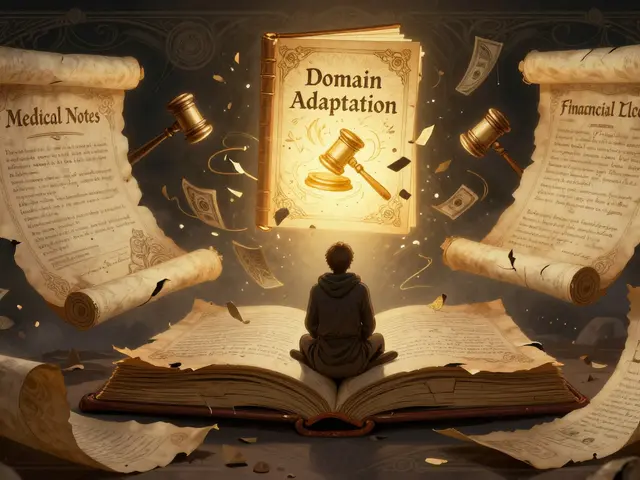
When you fine-tune a large language model (LLM) to handle a new task-say, answering medical questions or analyzing legal contracts-you expect it to get better at that task. But what if it starts forgetting how to answer basic questions it used to handle perfectly? That’s catastrophic forgetting, and it’s one of the biggest hidden problems in modern AI. It happens because full fine-tuning changes every single parameter in the model. Think of it like rewriting an entire textbook instead of adding a footnote. The model learns the new material so well that it overwrites what it knew before. A GPT-J or LLaMA-3 model trained on scientific papers might suddenly fail at simple math or common-sense reasoning. And once that knowledge is gone, it’s often gone for good. This isn’t just a research curiosity. If you’re using LLMs in real-world applications-healthcare, customer service, finance-catastrophic forgetting can lead to dangerous errors. A model that forgets how to explain basic terms could mislead patients. A customer service bot that loses its understanding of common complaints might frustrate users and damage your brand. The good news? We’re not helpless. Researchers have built real, working techniques to stop this from happening. Some are old ideas adapted for language models. Others are brand-new breakthroughs from 2025. Let’s cut through the hype and look at what actually works.
Why LoRA Isn’t the Magic Bullet Anymore
For years, Low-Rank Adaptation (LoRA) was the go-to solution. It didn’t retrain the whole model. Instead, it added tiny, low-rank matrices-like small add-ons-to the existing layers. You kept the original model frozen, saved on memory, and trained just those little adapters. It was fast. It was cheap. And everyone assumed it prevented forgetting. Turns out, that assumption was wrong. New research from Legion Intel in early 2025 tested LoRA in continual learning setups. They didn’t just check if the model got better at the new task. They also tested it on old tasks it had learned before. The result? LoRA performed no better than full fine-tuning at preserving prior knowledge. The small parameter changes weren’t enough to stop the model from overwriting its old understanding. This was a shock. LoRA was supposed to be the answer. But it’s not. It’s efficient, yes. But it doesn’t solve the core problem. If you’re using LoRA and haven’t tested your model on past tasks, you might be flying blind.Functionally Invariant Paths (FIP): The Geometry Fix
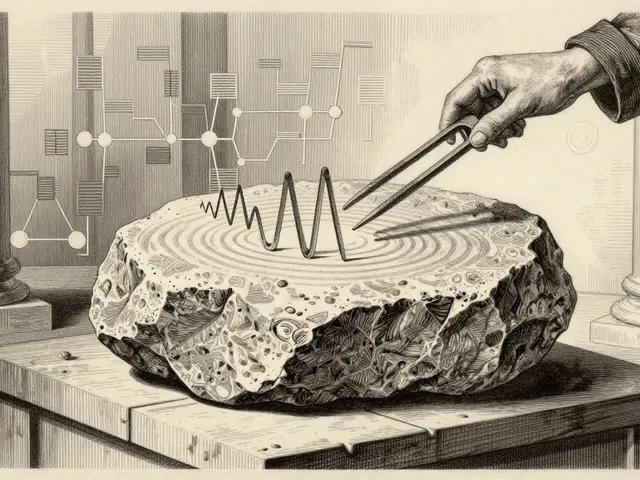
If changing parameters doesn’t prevent forgetting, maybe the problem isn’t the parameters themselves-it’s how we move through them. FIP, developed at Caltech and validated in 2025, takes a radically different approach. Instead of trying to freeze weights, it treats the model’s parameter space like a curved landscape. Imagine walking across a hilly terrain. You can take a long path that goes up and down, or a short one that cuts straight across. FIP doesn’t care about the distance you travel. It cares about where you end up functionally. In practice, FIP guides the model to make large parameter changes-but in directions that keep its behavior on old tasks stable. It’s like retraining the model to answer medical questions, but only in ways that don’t mess up its ability to answer “What’s 2+2?” The model learns the new skill deeply, but its core understanding stays intact. What’s wild? FIP often makes bigger changes to weights than LoRA. Yet it prevents forgetting better. This flips the old belief that small changes = less forgetting. It’s not about how much you move-it’s about where you move. FIP isn’t easy to implement. It requires complex optimization and understanding of Riemannian geometry. But for high-stakes applications where accuracy across multiple domains matters, it’s one of the most effective tools we have.Elastic Weight Consolidation (EWC) and EWCLoRA: The Importance Filter
EWC has been around since the 1990s, originally for image classifiers. But it’s found new life in LLMs. EWC works by figuring out which parameters are most important for old tasks. It uses something called the Fisher Information Matrix to score each weight. High scores mean that weight was critical for past performance. During fine-tuning, EWC puts a brake on those weights. It doesn’t stop them from changing entirely-but it makes it harder. The model is forced to find new ways to learn the new task without touching the most vital parts. EWCLoRA combines this with LoRA. Instead of applying EWC to the whole model, it applies it only to the small LoRA adapters. This gives you the speed of LoRA with the memory protection of EWC. It’s a smart middle ground: you still train lightweight adapters, but now you know which ones can’t be messed with. It’s not perfect. EWC requires storing a snapshot of the original model’s weights and computing the Fisher matrix-which takes memory and time. But if you’re working with a model that needs to handle multiple domains over time, and you can afford the overhead, EWCLoRA is one of the most reliable options.
The 20x Faster Method: Layer-Wise Importance and Dynamic Regularization
In January 2025, a paper on arXiv dropped a bombshell: a method that’s 20 times faster than older techniques and uses 90% less storage. Here’s how it works. First, you run a quick pass over general data-like Wikipedia or Common Crawl-and measure how much each parameter contributes to performance. You don’t need to train anything. Just observe. Then, during fine-tuning on your domain-specific data, you apply a dynamic regularization term. Each layer gets its own importance score. If a layer is critical for general knowledge, it gets strong regularization. If it’s mostly used for task-specific patterns, it’s allowed to change freely. This isn’t just smart. It’s adaptive. Older methods treated all layers the same. This one lets the model decide, on the fly, where to protect and where to innovate. Experiments on GPT-J and LLaMA-3 showed this method outperformed EWC, LoRA, and even FIP in some cases. It didn’t just prevent forgetting-it improved performance on the new task too. And because it’s lightweight, you can run it on a single consumer GPU. For most teams, this is the new gold standard.Rehearsal, Distillation, and Token Masking: The Wildcards
Some techniques don’t try to fix the model. They fix the training data. Rehearsal keeps a small memory of old examples. Every time you train on new data, you mix in a few old ones. It’s like studying for a new exam while reviewing flashcards from last semester. Simple. Effective. Works well with any fine-tuning method. Distillation uses the original model as a teacher. You train the new model not just to match the correct answers, but to mimic how the old model answered those same questions. It’s like asking an expert to tutor a student-not just give the right answer, but explain how they think. And then there’s Selective Token Masking (STM), a 2025 breakthrough that’s completely different. Instead of focusing on weights, STM looks at tokens-the individual words or subwords. It masks out tokens with high perplexity (the ones the model is least confident about) during fine-tuning. The idea? If the model is struggling to predict a word, it’s probably because that word ties into general knowledge. By masking them, you force the model to rely on its core understanding instead of overfitting to new patterns. STM was tested on Gemma 2, Llama 3, and others. It worked consistently. It’s not a full solution on its own, but paired with another method, it’s powerful.
What Should You Use?
There’s no one-size-fits-all. Your choice depends on your constraints.- If you’re on a tight budget and need speed: Try the 2025 layer-wise method. It’s fast, cheap, and effective.
- If you’re doing continual learning over many tasks: Use EWCLoRA. It balances efficiency and protection.
- If accuracy across domains is non-negotiable and you have compute: Go with FIP. It’s the most robust.
- If you’re already using LoRA: Don’t assume it’s safe. Add rehearsal. Just 5% of old data mixed in cuts forgetting by half.
- If you’re experimenting: Try STM alongside your main method. It’s low-cost and often helps.
The Future Is Hybrid
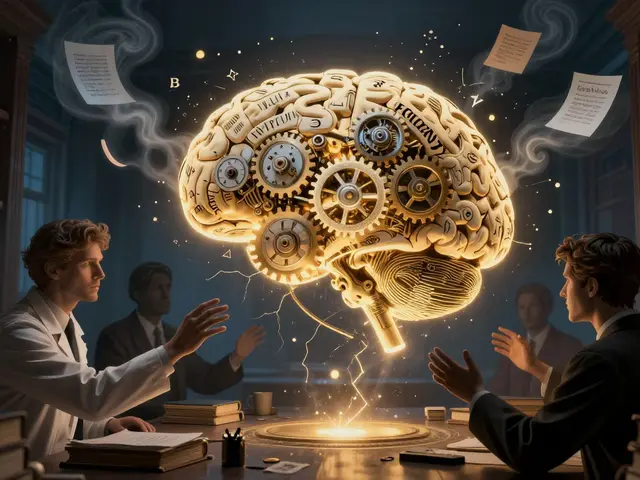
The field is moving fast. In 2024, we thought LoRA was enough. In 2025, we learned it wasn’t. Now, we’re seeing hybrid systems: FIP for core stability, rehearsal for robustness, and STM for fine-tuning noise reduction. The next big leap won’t be a single technique. It’ll be a workflow. Train with dynamic regularization. Validate with rehearsal. Enhance with token masking. Monitor with periodic checks. Catastrophic forgetting isn’t a bug. It’s a feature of how neural networks learn. But we’re learning how to work with it-not against it. And that’s what’s going to make LLMs truly useful in the real world.What exactly is catastrophic forgetting in LLMs?
Catastrophic forgetting happens when a large language model loses its ability to perform well on previously learned tasks after being fine-tuned on new ones. This occurs because full fine-tuning updates all model parameters, overwriting the knowledge that helped it succeed on earlier tasks. For example, a model trained to answer medical questions might start failing at basic math or common-sense reasoning after fine-tuning.
Does LoRA prevent catastrophic forgetting?
No, contrary to earlier assumptions, LoRA does not reliably prevent catastrophic forgetting. Research from 2025 shows that while LoRA is computationally efficient and reduces memory use, it doesn’t protect the model’s original knowledge during continual learning. The small parameter updates in LoRA adapters are still enough to overwrite important general knowledge. Always test performance on prior tasks after using LoRA.
What’s the difference between EWC and FIP?
EWC (Elastic Weight Consolidation) prevents forgetting by identifying important parameters and restricting their changes during fine-tuning. It’s like putting locks on key parts of the model. FIP (Functionally Invariant Paths), on the other hand, doesn’t restrict changes-it guides them. FIP treats parameter space as a curved surface and steers updates so the model’s behavior stays consistent with past tasks, even if weights change a lot. EWC is about limiting movement; FIP is about smart movement.
Can I combine multiple techniques?
Yes, and many teams do. For example, you can use the 2025 layer-wise regularization method as your base, add 5-10% rehearsal data from previous tasks, and apply Selective Token Masking during fine-tuning. This hybrid approach leverages the speed of dynamic regularization, the robustness of rehearsal, and the noise-reduction of token masking. Combining techniques often outperforms any single method.
How do I know if my model is forgetting?
Before fine-tuning, test your model on 10-20 examples from its original training data. After fine-tuning, run the same examples again. If performance drops by more than 5%, catastrophic forgetting is likely happening. You should also test across multiple domains-for example, if you fine-tuned for legal docs, check if it still understands medical terminology or general facts. Regular validation on old tasks is essential.
Is there a free or low-cost way to start preventing forgetting?
Yes. Start with rehearsal: keep a small set (1-5%) of your original training data and mix it into every fine-tuning batch. It’s simple, requires no extra code, and reduces forgetting by up to 50% in most cases. Pair it with the 2025 layer-wise method if you can, or at least monitor performance on old tasks. You don’t need advanced methods to make a big difference.





Yashwanth Gouravajjula
February 13, 2026 AT 00:50Simple. Effective. Done.
Kevin Hagerty
February 13, 2026 AT 22:10Janiss McCamish
February 14, 2026 AT 17:50Stop chasing hype. Start measuring.
Richard H
February 16, 2026 AT 10:25Also, FIP? Sounds like a sci-fi startup name. Give me something that works, not a PhD thesis.
Kendall Storey
February 17, 2026 AT 14:06Also, STM? Tried it. Didn’t hurt. Might help. Worth a shot. Low risk, high reward. Go for it.
Ashton Strong
February 18, 2026 AT 04:09For practitioners seeking sustainable, scalable solutions, I would strongly recommend adopting this hybrid methodology as a foundational best practice.
Steven Hanton
February 19, 2026 AT 12:41Small checks. Big impact.
Pamela Tanner
February 20, 2026 AT 13:17Kristina Kalolo
February 21, 2026 AT 17:10