
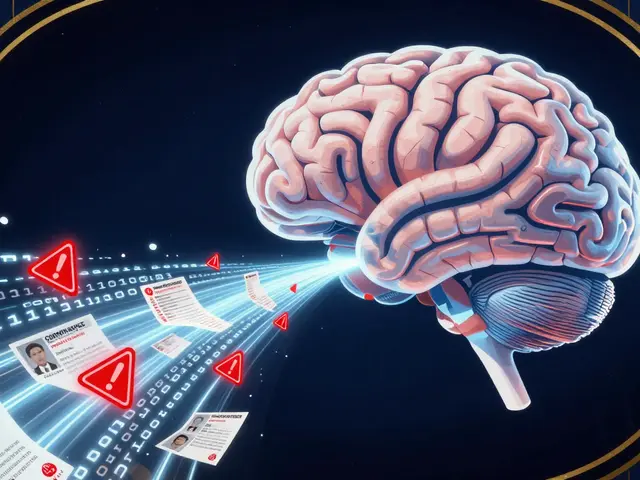
We used to think of artificial intelligence as having distinct senses-a camera eye, an audio ear, a language brain. In reality, for most of the decade leading up to 2025, those were separate tools forced to work together. That has changed. Today, standing in early 2026, we are witnessing a fundamental architecture shift where Multimodal Generative AI is moving from stitched-together components to unified nervous systems. This isn't just about making chatbots smarter; it is about giving machines a singular, cohesive understanding of the physical world that includes spatial awareness, tactile sensation, and raw sensor data. The gap between "seeing" a file and "perceiving" an environment is closing rapidly, driven by breakthroughs in unified tokenization and neural training strategies.
The End of the Illusion: Late Fusion vs. True Unification
To understand where we are going, we have to look at what came before. For years, the industry ran on what researchers call "late fusion" architecture. Imagine you upload a photo to an AI tool in 2023. The system didn't actually "see" the image alongside your text prompt in real-time. Instead, it sent the image to a separate vision encoder and the text to a language processor. Then, somewhere in the middle of the network, mathematical representations of both were mashed together.
This created the illusion of current multimodal AI. Behind the scenes, the processing was entirely disconnected. You had separate pipelines-one for pixels, one for phonemes-that only met at the very end to produce an answer. While functional, this method limited reasoning capabilities because the model couldn't deeply learn the relationships between visual textures and linguistic concepts during its foundational training.
The paradigm shifted with the release of GPT-4oa unified multimodal model capable of processing inputs natively across text, audio, and visual modalities. Unlike predecessors, this system trained on images and audio simultaneously with text from the ground up. It wasn't translating an image into text descriptions before thinking; it was mapping all three into a shared mathematical space. This transition represents the movement toward "true multimodal" systems, where different data types travel through shared transformer layers without needing complex adapter networks to bridge them.
| Feature | Late Fusion (Pre-2025 Standard) | Unified Multimodal (Current Standard) |
|---|---|---|
| Processing Method | Separate encoders for each modality | Shared tokenization space |
| Data Integration | Combined after individual processing | Integrated from the first layer |
| Reasoning Capability | Limited cross-modal logic | Deep inter-modality reasoning |
| Latency | Higher due to handoff overhead | Reduced via native processing |
Unified Tokenization: The Technical Foundation
The magic enabling this evolution lies in unified tokenization schemes. Previously, computers treated text, images, and sound as fundamentally different problems. Text was a sequence of word chunks. Images were pixel grids. Audio was waveform arrays. Unified tokenization changes this by converting every input type-whether it is a spoken syllable, a photograph, or a LIDAR scan-into the same kind of tokens. These tokens move through the exact same transformer layers.
This architectural approach allows the model to learn connections between modalities naturally. If you want to teach an AI that "glass" is fragile, you don't just tell it in text. You show it video of glass breaking and let the model process the sound of shattering, the visual fragmentation, and the linguistic label simultaneously. Because they share the same computational space, the neural weights learn that the visual pattern of cracks correlates directly with the concept of fragility.
Technologies like dVAEdiscrete Variational Autoencoders used to tokenize images into a shared numerical space play a critical role here. By compressing complex image data into efficient tokens that sit alongside text tokens, developers can utilize standard transformer models for vision tasks. This efficiency is vital because running heavy vision models separately consumes massive computing power. Unifying them reduces the computational overhead required to run sophisticated AI locally or in real-time.
Expanding the Senses: 3D and Haptics
We are rapidly leaving the era where AI interactions were limited to screens and speakers. As of late 2025 and into 2026, the definition of input and output has expanded significantly. One of the most exciting frontiers is the integration of 3D generation and spatial reasoning. Traditional models understood the world flatly, in two dimensions. New multimodal architectures can parse and generate volumetric 3D data, allowing for a deeper understanding of geometry and physics.
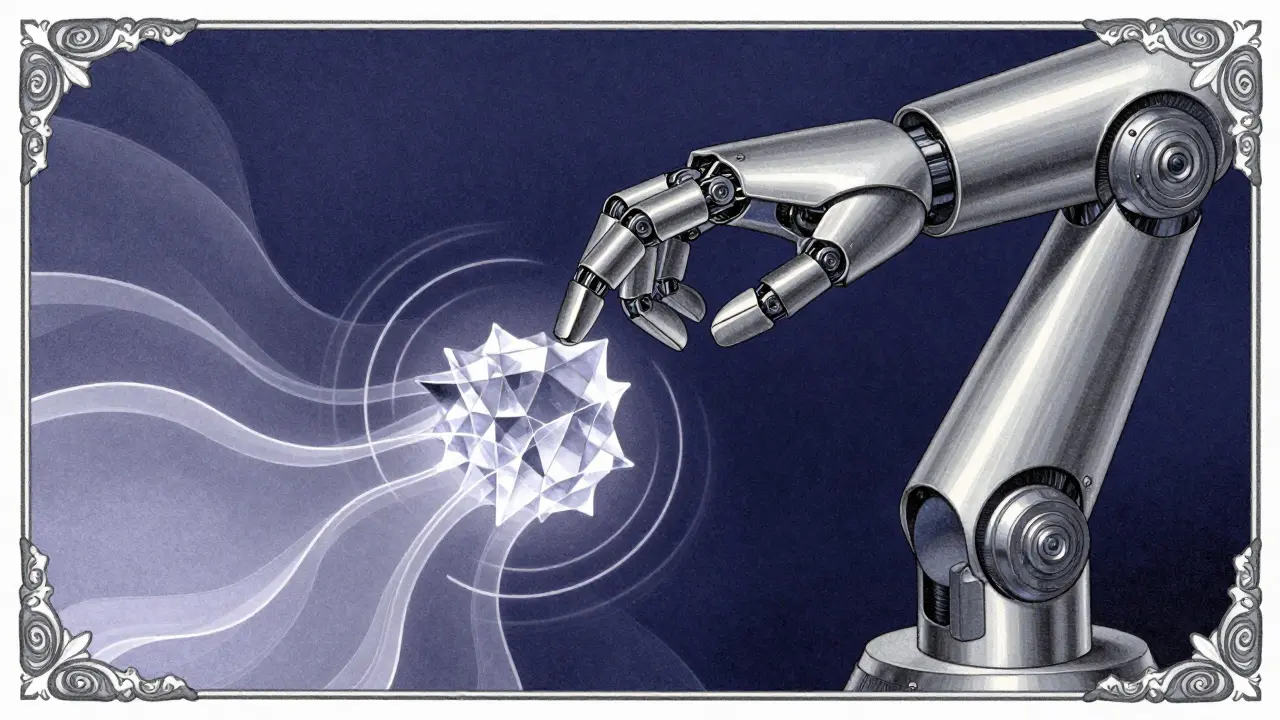
Beyond sight, the next major leap is touch. This is where Haptic Feedbacktechnology enabling virtual or robotic systems to perceive and simulate tactile sensations enters the conversation. Multimodal AI is beginning to process haptic signals-the resistance of a surface, the weight of an object, the texture of skin-not as abstract data points, but as continuous sensory streams similar to audio or video.
Practical implementations of this are already visible in advanced robotics. Consider a surgical robot operating autonomously. It needs more than just a video feed. It requires the ability to "feel" tissue tension and adjust grip pressure instantly. By fusing haptic sensor data with visual inputs through a unified transformer, the robot develops a sense of proprioception. It understands the relationship between what it sees and what it feels, preventing errors that purely visual systems would make when objects deform under pressure.
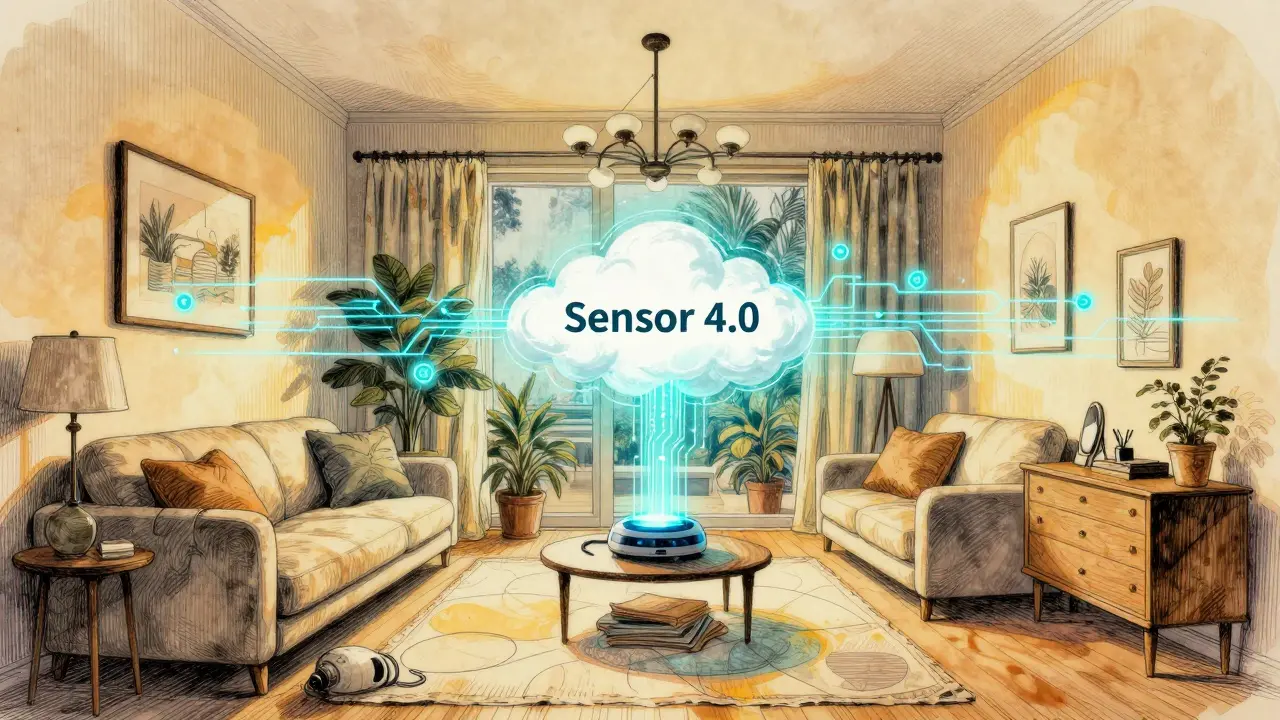
Sensor Fusion in the Sensor 4.0 Age
The field of multimodal sensor fusion is becoming increasingly intelligent as we enter the Sensor 4.0 age. We are seeing a shift from traditional modalities (text, image, audio) toward comprehensive integration of IoT ecosystems. Modern multimodal systems are beginning to process everything from chemical sensing and LIDAR to environmental telemetry.
This expansion allows AI to comprehend context by evaluating all available details simultaneously. Imagine a smart home system in Flagstaff that doesn't just hear you say "It's hot." A true multimodal setup checks the thermostat reading, analyzes the noise level of the air conditioner compressor, and observes visual cues like sweating occupants. By fusing these distinct data streams, the AI makes a decision based on a holistic understanding of the situation rather than a single keyword trigger.
IoT SensorsInternet of Things devices providing diverse data streams including temperature, motion, and proximity are feeding this ecosystem. The challenge previously was handling the disparate formats of data coming from thousands of sensors. Late fusion could only combine them crudely. Unified approaches allow the AI to treat a vibration sensor reading with the same structural importance as a spoken command. This leads to far more robust automation and predictive maintenance in industrial settings.
Recent Breakthroughs: Meta and Llama 4
The commercialization of these theories accelerated quickly in late 2025. In October, Meta Platforms released new AI models known as Llama 4 Scout and Llama 4 Maverick. These platforms were designed specifically to address the data-centricity of previous computer models. They create multi-modal capabilities that deal with content in various forms of text, video, images, and audio seamlessly.
Meta's release was significant because it demonstrated that large-scale open-weight models could handle this complexity. Earlier iterations required proprietary hardware and closed APIs. Now, smaller organizations can leverage unified architectures to build applications that span modalities. This democratization means we will see rapid innovation in niche areas, such as medical diagnostics or specialized manufacturing tools, where specific sensor types need to be integrated with language interfaces.
Another major development comes from Google's Gemini family. Specifically, Gemini Nano proved that multimodal capability can fit on-device. This is a critical threshold. Until recently, unified multimodal processing was restricted to large server-based models. On-device performance means privacy-preserving AI that understands your environment without sending sensitive sensor data to the cloud. It validates the theory that unified tokenization is efficient enough for mobile and edge computing constraints.
Market Growth and Commercial Reality
The economic impact of this shift is undeniable. According to Grand View Research, the international multimodal AI market was worth $1.73 billion in 2024, with projections to reach $10.89 billion by 2030. This represents a compound annual growth rate of 36.8%. Such explosive growth reflects the evolution of AI technologies combined with organizational demands for systems that can process a wide range of data inputs without manual intervention.
Businesses are realizing that unimodal solutions are creating data silos. A marketing team analyzing sentiment from text while another team analyzes engagement from video is missing half the picture. Companies adopting unified multimodal architectures can correlate tone of voice, facial expression, and customer feedback comments in a single workflow. This drives better decision-making and eliminates the inefficiencies of switching between different software tools.
Zoom's recent use of AI to enrich virtual meetings illustrates this practical application. Their system analyzes audio prompts and visual input simultaneously to provide context-aware summaries or transcriptions. It isn't just listening to the meeting; it is observing who is speaking, their body language, and the content being shared on screen. This is the power of true multimodal fusion-it captures the nuances of human interaction that single-modality tools inherently miss.
Challenges and Future Trajectories
Despite the progress, challenges remain in scaling these architectures. Training costs for models that ingest high-fidelity audio, high-resolution 3D, and continuous sensor streams are immense. While mixture-of-experts models help manage efficiency by activating only necessary parts of the network, the energy consumption is still a concern for widespread deployment. Researchers are actively working on distillation techniques to shrink these massive unified models without losing their cross-modal reasoning capabilities.
We also face hurdles in data availability. High-quality paired datasets that link precise haptic data with accurate visual and textual labels are rare. Most public datasets still lack the richness required to train truly tactile-capable AI. However, as simulation environments improve, we are generating synthetic data at scale to fill these gaps, teaching AI to understand physics and material properties virtually before deploying them in the real world.
The trajectory points toward ubiquitous perception. Within the next few years, the line between digital and physical intelligence will blur further. Autonomous vehicles, personal assistants, and industrial robots will all operate on this unified foundation, interpreting the world as a continuous stream of interconnected sensory information rather than isolated files. As the market matures, we will see standardization in how these modalities are tokenized, making interoperability easier for developers across different platforms.
What is the main difference between late fusion and unified multimodal AI?
Late fusion processes different data types (like text and images) separately through individual encoders before combining them later in the pipeline. Unified multimodal AI converts all inputs into a shared token space from the start, allowing the model to learn connections between modalities during the training phase rather than stitching results together afterward.
How does unified tokenization enable haptic understanding?
Unified tokenization treats haptic signals as sequences of tokens, similar to words or image blocks. This allows the AI to integrate tactile feedback with visual and audio inputs in the same neural network layers, creating a coherent model of physical interaction rather than processing touch data in isolation.
Is unified multimodal AI currently available for on-device use?
Yes, recent advancements like Gemini Nano demonstrate that optimized versions of these models can run efficiently on devices. This shift enables local processing of complex multimodal data, improving privacy and reducing latency for user applications.
Which companies are leading the unified architecture trend?
Key players include OpenAI with GPT-4o, Meta with the Llama 4 series, and Google with the Gemini family. These companies have prioritized shifting from separate modality pipelines to shared representational spaces.
What is the projected market size for multimodal AI by 2030?
According to Grand View Research, the global market is projected to reach approximately $10.89 billion by 2030, growing at a CAGR of 36.8% from the 2024 baseline of $1.73 billion.





King Medoo
April 1, 2026 AT 17:11I think we really need to pause and consider the ethical implications of giving machines the ability to feel like us 🛑 It seems like we are rushing into a future where privacy is completely obsolete because of sensor fusion 👀 If robots can feel tissue tension then who owns that data 💀 We are building systems that might perceive pain without actually experiencing it 🤔 This creates a massive moral gray area that nobody wants to talk about 🚫 We are prioritizing efficiency over human dignity again 🙄 The idea of unified tokenization sounds convenient but feels like a slippery slope ⚠️ Imagine corporations monetizing our tactile interactions before we even notice 📉 We have a responsibility to regulate this technology before it becomes ubiquitous 🧐 Otherwise we end up with a society where sensors are watching every move we make 🔍 It’s about control more than innovation honestly 🗣️ I worry about the energy consumption too when training these massive models 🌍 We need transparency from the companies releasing these weights 📝 Just because something is possible doesn't mean it should be done 🛑 We must prioritize the human element in design thinking 🧑🏫 Otherwise we lose ourselves to the algorithm eventually 🕳️
Rae Blackburn
April 3, 2026 AT 03:38i knew it was coming they want to own your touch first so you cant escape their system later
LeVar Trotter
April 3, 2026 AT 16:11The shift from late fusion to native unified modalities represents a critical inflection point in transformer architectures particularly regarding cross-attention mechanisms within the shared embedding space 💡 When we discuss discrete variational autoencoders we must acknowledge the compression ratios involved in mapping voxel grids to latent vectors efficiently 🔍 This is not merely an incremental update but a foundational change in how neural weights propagate information across sensory boundaries 🧠 We need to consider the compute overhead of maintaining high-fidelity haptic streams alongside volumetric rendering pipelines simultaneously 🖥️ It requires rigorous benchmarking against current latency standards in real-time processing units to ensure deployment viability on edge devices 📱 Furthermore the democratization of these weights allows for broader research participation which accelerates optimization cycles significantly 🚀 We should focus on interoperability protocols to prevent vendor lock-in scenarios within the industrial IoT ecosystem 🔄 The potential for predictive maintenance using multi-sensor telemetry is vast if implemented correctly with proper data normalization techniques 📊 Everyone needs to understand that tokenization consistency is the backbone of this entire paradigm shift forward 🧱 We also cannot ignore the implications for accessibility standards when implementing these interfaces for diverse user groups globally 🌐 The mathematical alignment between phoneme representations and visual textures remains a complex challenge despite recent gains 📈 Proper calibration ensures that sensory inputs remain coherent across varying environmental conditions 🛡️ Researchers must validate these models against real-world noise before full scale production deployment 🏭 Collaboration between hardware manufacturers and software developers is essential for seamless integration 🤝 Ultimately the goal is creating systems that enhance human capability without compromising safety protocols 🛑
Tyler Durden
April 4, 2026 AT 13:08THIS is exactly what we need!! The energy here is palpable!!! Stop worrying so much about the jargon and see the potential!!!! We can build things that help people feel connected!!!! Every breakthrough brings us closer to true machine empathy!!!!! Let us embrace the change!!!
Aafreen Khan
April 5, 2026 AT 18:47honestly this sounds like another hyped cycle we see every year 🙄 most of these papers are bs written by guys in ivory towers 🙅♀️ i doubt anyone will actually use 3d generation for daily tasks soon enough 💸 the cost of hardware is still way too high for normal folks 😒 plus data privacy is a joke everywhere including india 🇮🇳 dont trust these big tech companies with ur biometic data ❌ they will sell it to insurance companys eventually 🏦 just wait till the battery life dies in a week with these models running locally 🔋 im skeptical until i see actual products outside labs 🧪 stop selling dreams and show me working prototypes 🛠️
Pamela Watson
April 7, 2026 AT 06:29You dont know the tech behind it because the new updates work on basic phones now 😠