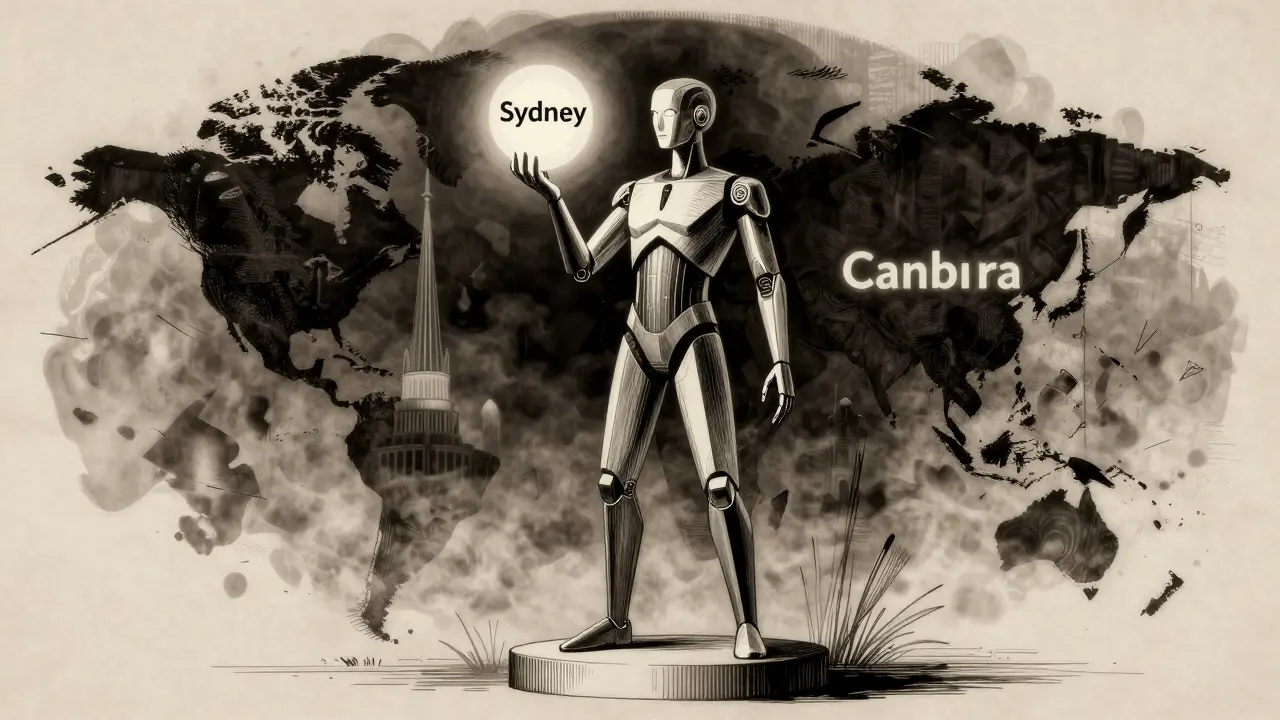
Imagine asking your AI assistant for the capital of Australia. It replies with absolute certainty: "Sydney." You trust it because the tone is confident, the answer is direct, and there are no warning labels. But Sydney isn’t the capital; Canberra is. This isn’t just a trivia mistake-it’s a symptom of a deeper problem plaguing modern technology. Generative AI is a class of artificial intelligence systems capable of creating new content, including text, images, and code, often without explicit instructions on every detail. These systems are powerful, but they suffer from a critical flaw: they rarely tell you when they might be wrong.
This gap between what the AI knows and how confidently it presents that information is known as the uncertainty communication challenge. When an AI system provides an output, it should ideally signal its level of certainty. If it’s guessing, it should say so. If it’s unsure, it should warn you. Currently, most systems don’t do this. They present hallucinations-fabricated facts-with the same authoritative voice as verified data. This creates a dangerous dynamic where users adopt the system’s false confidence as their own.
The Hidden Cost of Overconfidence
Why does this matter? Because we use AI for more than just trivia. We use it to draft legal contracts, analyze medical records, forecast supply chain demands, and make financial decisions. In these high-stakes environments, an incorrect answer delivered with high confidence can lead to costly errors.
Consider a scenario in enterprise planning. A supply chain director uses an AI tool to predict demand for the next quarter. The AI forecasts a 22.7% increase. The director acts on this, ordering more inventory. Later, it turns out the AI based this prediction on incomplete data from only three of twelve regional warehouses. If the AI had indicated low confidence or highlighted the data gaps, the director might have double-checked the numbers. Instead, the lack of uncertainty signals led to overstocking and wasted resources.
This phenomenon is widespread. Research from Panorama Consulting in late 2024 found that 89% of generative AI tools used in Fortune 500 companies "sound confident-even when their answers lack accuracy or context." In ERP selection processes, 63% of AI recommendations contained unacknowledged uncertainty. The result? Business leaders make flawed decisions because they cannot distinguish between a solid fact and a plausible guess.
The psychological impact is equally concerning. A study by the Center for Engaged Learning tracked over 2,300 students and found that 68.4% reported reduced critical thinking when using standard AI tools. When the AI sounds sure, we stop questioning it. We outsource our skepticism to the machine. This erosion of critical thinking is perhaps the most significant long-term risk of poor uncertainty communication.
Understanding Types of Uncertainty
To fix this, we first need to understand what kind of uncertainty we’re dealing with. Not all uncertainty is created equal. Experts generally categorize it into two main types:
- Aleatoric Uncertainty: This refers to inherent randomness in the data itself. For example, predicting tomorrow’s weather involves aleatoric uncertainty because weather systems are naturally chaotic. No matter how good your model is, there will always be some noise.
- Epistemic Uncertainty: This stems from the model’s limitations or lack of knowledge. If an AI hasn’t seen enough data about a specific topic, its predictions will be uncertain. Unlike aleatoric uncertainty, epistemic uncertainty can be reduced by gathering more data or improving the model.
Current technical methods like Monte Carlo dropout and Bayesian neural networks can quantify these uncertainties mathematically. However, these metrics exist deep within the code. They don’t translate to the user interface. As a result, the average user sees only the final output, stripped of any context about how sure the AI is about that output.

Visualizing Confidence: What Works?
If we want users to trust AI appropriately, we need to show them the uncertainty. But how? Simply adding a percentage score (e.g., "Confidence: 85%") isn’t always effective. Users often misinterpret these numbers, treating 85% as "very safe" when it might actually mean "significant risk of error" in certain contexts.
Recent research offers better solutions. A study published in Frontiers in Computer Science in early 2025 explored different ways to visualize uncertainty. The findings were clear:
| Visual Method | Trust Impact (Percentage Points) | Implementation Complexity |
|---|---|---|
| Size Variation (e.g., larger text for higher confidence) | 37.8 | Low (72 hours dev time) |
| Color Saturation | 22.1 | Medium (105 hours dev time) |
| Transparency | 18.4 | High (120 hours dev time) |
Size variation emerged as the most impactful method. When text appears bolder or larger, users intuitively perceive it as more reliable. Conversely, smaller, fainter text signals caution. This approach aligns with natural human cognitive processing. It doesn’t require users to learn a new language of percentages; it leverages existing visual instincts.
However, visualization must be balanced. The same study noted that optimal effectiveness occurs when uncertainty indicators occupy 22-35% of the interface real estate. Too much clutter overwhelms the user; too little goes unnoticed. The goal is to create a seamless experience where confidence levels are visible but not distracting.
The Enterprise Gap: Theory vs. Reality
While academic prototypes show promise, commercial adoption lags behind. Most major large language models (LLMs) still offer no visual or textual indicators of response confidence. An analysis by MIT’s Human-Data Interaction Lab reviewed 15 leading LLMs and found that 93.3% provided zero confidence signals. Only Anthropic’s Claude implemented a basic confidence scale, and even then, it appeared in just 12% of responses during enterprise deployments.
Why the gap? Several factors contribute:
- Computational Cost: Quantifying uncertainty adds overhead. Google Research reported that methods like ensemble modeling can increase inference time by 40-60%. For companies charging per token or prioritizing speed, this is a significant barrier.
- Lack of Standards: There is no universal framework for displaying uncertainty. Should it be a color? A number? A disclaimer? Without standards, developers hesitate to implement features that might confuse users.
- User Experience Risks: Companies fear that showing uncertainty will erode trust entirely. They worry that if users see how often the AI is unsure, they’ll stop using the product altogether.
Yet, the data suggests the opposite. Systems that incorporate uncertainty awareness improve trust calibration by 34.2% in high-risk scenarios. Users appreciate honesty. When an AI admits it doesn’t know, users are more likely to verify the information themselves rather than blindly accepting it.

Implementing Reliable Communication Strategies
For organizations looking to integrate uncertainty communication into their AI workflows, here are practical steps based on current best practices:
1. Match Visualization to Context
Not all tasks carry the same risk. A creative writing prompt has low stakes; a medical diagnosis has high stakes. Your uncertainty indicators should reflect this. In high-risk domains like healthcare or finance, use explicit, prominent warnings. In low-risk areas like email drafting, subtle cues may suffice.
2. Train Users on Interpretation
New interfaces require new skills. Domain experts need 8-12 hours of specialized training to correctly interpret uncertainty visualizations. Don’t assume users will instinctively understand what faded text means. Provide guides, tooltips, and examples.
3. Avoid Information Overload
One of the biggest pitfalls is overwhelming users with too much uncertainty data. If every word comes with a confidence score, users will ignore them all. Focus on highlighting key assertions where uncertainty matters most. Use size or boldness to draw attention to critical claims.
4. Leverage Existing Tools
You don’t need to build everything from scratch. Platforms like Microsoft Azure AI Studio now include uncertainty indicators in their enterprise offerings. Explore APIs that provide confidence scores alongside generated text. Integrate these into your internal dashboards.
The Future of Trustworthy AI
The landscape is shifting. Regulatory pressures are mounting. The EU AI Act, implemented in mid-2024, requires "appropriate communication of system limitations" for high-risk AI applications. This isn’t just a recommendation; it’s a compliance requirement. Companies that fail to address uncertainty communication face legal and reputational risks.
Market trends support this shift. The global market for AI explainability and uncertainty quantification tools is projected to grow from $287 million in early 2024 to $1.2 billion by 2027. Investors and executives recognize that reliability is becoming a core competitive advantage.
Looking ahead, we can expect adaptive uncertainty communication. Imagine an AI that adjusts its confidence signals based on your expertise level. A novice user might see simple red/green indicators, while an expert sees detailed probability distributions. Projects like Google’s Metacognition in Generative AI initiative are already pioneering these paradigms, drawing from human confidence studies to create more intuitive interfaces.
As we move forward, the goal isn’t to eliminate uncertainty-that’s impossible. The goal is to communicate it honestly. By doing so, we transform AI from a black box of opaque authority into a transparent partner in decision-making. We restore critical thinking. And ultimately, we build systems that earn our trust through humility, not just capability.
What is the difference between aleatoric and epistemic uncertainty in AI?
Aleatoric uncertainty refers to inherent randomness in the data, such as noise in sensor readings or variability in human behavior, which cannot be reduced by more data. Epistemic uncertainty arises from the model's lack of knowledge or limited training data, meaning it can be reduced by providing more relevant information or improving the model architecture.
Why do most current AI systems fail to show confidence levels?
Most AI systems prioritize speed and simplicity. Calculating precise uncertainty metrics often increases computational load and inference time by 40-60%. Additionally, there is no industry-standard way to display this information, leading developers to omit it to avoid confusing users or slowing down performance.
How can businesses implement uncertainty communication effectively?
Businesses should start by matching the visualization method to the risk level of the task. Use size variation or bold text for high-impact decisions, as these methods have the highest impact on user trust. Invest in user training to ensure staff understand how to interpret these signals, and avoid cluttering the interface with excessive data.
Does showing uncertainty reduce user trust in AI?
No, it typically improves appropriate trust. Studies show that systems with uncertainty awareness improve trust calibration by over 34%. While users might question specific outputs more often, they develop a healthier, more sustainable relationship with the technology, reducing the risk of catastrophic errors caused by blind reliance.
Are there regulations requiring AI to disclose uncertainty?
Yes, particularly in Europe. The EU AI Act mandates that high-risk AI applications must communicate their limitations appropriately. This creates a compliance driver for companies operating in regulated sectors like healthcare, finance, and public safety to implement robust uncertainty communication mechanisms.




Jitendra Singh
May 29, 2026 AT 19:21It is fascinating to see how the lack of transparency in AI models can lead to such significant errors in decision-making processes. The example of the supply chain director is particularly alarming because it shows how easily businesses can be misled by confident but incorrect data. I believe that implementing visual cues for uncertainty could help mitigate these risks significantly.
Rohit Sen
May 31, 2026 AT 05:24Boring take. Everyone knows AI lies, why are we still pretending this is a new problem?
Vimal Kumar
June 1, 2026 AT 12:18I really appreciate the detailed breakdown of aleatoric and epistemic uncertainty here. It helps clarify why some errors are inherent while others stem from model limitations. Let's hope developers start prioritizing user education on interpreting these signals soon so we can all benefit from more reliable tools.
Amit Umarani
June 2, 2026 AT 10:54The article mentions 'Monte Carlo dropout' without explaining what it actually does for the average reader who isn't a data scientist. Also, you have a typo in 'real estate' when referring to interface space, though technically correct, it feels like a stretch. Fix your grammar next time.
Noel Dhiraj
June 3, 2026 AT 04:03This is such an important topic and i love how the post breaks down the psychological impact on users. We need more content like this to push companies towards better practices. Keep up the great work everyone involved in making ai safer
vidhi patel
June 4, 2026 AT 04:44Your argument regarding the EU AI Act is fundamentally flawed if you do not consider the broader implications for global compliance standards. The assertion that 'honesty improves trust' is overly simplistic and ignores the complex dynamics of corporate risk management strategies which often prioritize efficiency over transparency.
Priti Yadav
June 6, 2026 AT 02:19They want us to trust the machines less so they can sell us more expensive verification tools. It is a classic setup where the big tech companies create a problem just to sell the solution later. Wake up people before they monetize our skepticism completely.
Ajit Kumar
June 7, 2026 AT 13:15In my considered opinion, the moral obligation of software engineers extends far beyond mere functionality or even basic accuracy; it encompasses a profound duty to ensure that their creations do not erode the very foundations of human critical thought and intellectual autonomy which are essential for a functioning society. When we allow algorithms to present falsehoods with unearned confidence, we are effectively participating in a systematic degradation of truth itself, which has dire consequences for democratic discourse and individual agency alike. Therefore, any discussion about technical implementation must be grounded in this ethical framework.
Diwakar Pandey
June 7, 2026 AT 18:12I noticed that many people are jumping to conclusions about the costs involved. It might be worth looking into open-source alternatives that already implement some of these visualization techniques without the heavy computational overhead mentioned earlier.