
The Five Dimensions of LLM Risk Assessment
Before you can build controls, you have to understand what you're actually fighting. You can't just say "AI is risky" and call it a day. You need to break the risk down into concrete dimensions to decide where to spend your budget and engineering hours.- Damage Potential: If this model fails or goes rogue, how bad is the fallout? A chatbot suggesting a movie is low risk; a bot managing medical dosages is catastrophic.
- Reproducibility: How easy is it for a bad actor to find a prompt that breaks the model? If a simple "Ignore previous instructions" command works, your reproducibility risk is high.
- Exploitability: This is about accessibility. Is the model tucked away behind a secure API, or is it a public-facing web tool that anyone can poke at?
- Affected Users: Who gets hit? Is this an internal tool for ten analysts, or a customer-facing app serving five million people?
- Discoverability: How visible are the holes? Some vulnerabilities are obvious, while others only appear after thousands of edge-case interactions.
Technical Controls for AI Stability
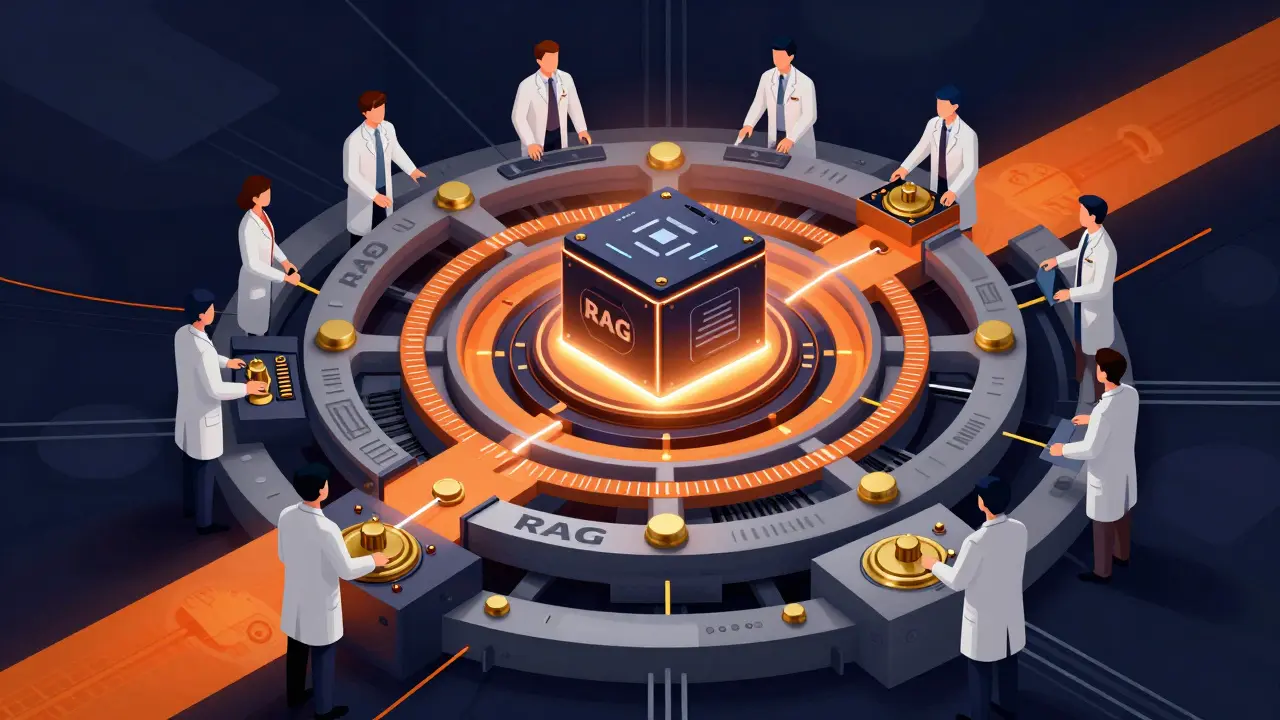
To keep an LLM from drifting into "hallucination territory" or leaking data, you need a layered defense. One single tool won't cut it; you need a combination of training-time and runtime controls.One of the most effective runtime strategies is Retrieval-Augmented Generation (or RAG), which constrains the model's responses to a specific, trusted set of documents rather than relying solely on its internal training data. When you plug a data classification system directly into your RAG pipeline, you ensure the model only "sees" the documents the user is actually allowed to access.
| Technique | Primary Function | Key Attribute | Best For... |
|---|---|---|---|
| RLHF | Alignment | Human-guided feedback | Removing toxicity and bias |
| Differential Privacy | Data Protection | Noise injection | Preventing PII leakage |
| Adversarial Training | Robustness | Attack simulation | Hardening against prompt injections |
| Federated Learning | Privacy | Decentralized data | Regulated industries (e.g., Health) |
Beyond the table, don't overlook Reinforcement Learning from Human Feedback (or RLHF). While the model learns patterns automatically, RLHF puts a human in the loop to say, "No, that answer is technically correct but socially offensive," or "That's a hallucination." This is your primary tool for aligning the model with organizational values.
Building Behavioral Safeguards and Guardrails
If you're moving toward agentic AI-where the model can actually *do* things, like call an API or send an email-you can't just hope it behaves. You need behavioral safeguards that act as a filter between the LLM's intent and the final action.Think of guardrails as a set of dynamic constraints. Instead of a static policy document that nobody reads, these are code-level checks. For example, if an agent decides to move $10,000 between accounts, the guardrail should trigger an immediate pause because the transaction exceeds a pre-set threshold. This is where you move from Continuous Monitoring, which is the real-time observation of model outputs to detect drift and anomalies, to active prevention.
Real-time observability is the gold standard here. You need an immutable audit trail of every "thought process" the AI goes through. If a model uses a tool to access a database, you need to see the exact prompt that triggered that call, the data returned, and why the model thought that was the correct next step. Without this, troubleshooting a failure is like trying to solve a crime where the only witness is a liar.

Defining Escalation Paths and Kill-Switches
What happens when the controls fail? This is where most companies drop the ball. They have a plan for "success," but no plan for "this is going wrong quickly." An escalation path is a predefined route that moves a decision from the AI to a human overseer based on specific triggers.Every high-stakes LLM deployment needs a Kill-Switch, which is an automated mechanism to instantly halt AI agent actions when unintended or harmful behavior is detected. This isn't just a "delete" button; it's a circuit breaker that freezes the agent's ability to interact with external systems while preserving the state for forensic analysis.
Your escalation triggers should be concrete. Avoid vague phrases like "if the model seems off." Instead, use triggers like:
- Confidence Thresholds: If the model's self-reported confidence in an answer drops below 70% for a critical task.
- Policy Violations: If a sentiment analysis tool detects high levels of aggression or toxicity in a customer-facing response.
- Unauthorized Tool Use: If an agent attempts to call an API that isn't on its approved whitelist.
- High-Value Action: Any action involving financial transactions over a specific dollar amount.
Managing Vendor and Pipeline Risks
Most organizations don't build their own foundation models from scratch; they use providers like OpenAI, Google, or Anthropic. This introduces a massive dependency. If your provider updates their model version and suddenly your carefully crafted prompts stop working or start hallucinating, your business process breaks.To mitigate this, you need to fix your models to approved versions. Don't just point your API to "latest"; point it to a specific snapshot. Additionally, maintain a fallback model. If your primary high-reasoning model goes down or starts behaving erratically, your system should be able to switch to a smaller, more stable model to maintain basic functionality.
Finally, move your controls into the AI pipeline. Governance shouldn't be a PDF in a folder; it should be a set of checks embedded in your CI/CD process. Data classification should be plugged directly into your prompt-routing components so that sensitive data is masked before it ever reaches the model, and dynamic filtering is applied to the output to prevent PII from leaving the environment.
Why isn't traditional Model Risk Management (MRM) enough for LLMs?
Traditional MRM relies on static validation and deterministic outputs-meaning if you put in X, you always get Y. LLMs are stochastic, meaning they can produce different answers to the same prompt. Because they act as "black boxes" with limited interpretability, the old way of validating a model once before deployment doesn't account for the dynamic way LLMs evolve and fail in real-world settings.
What is the difference between a guardrail and a kill-switch?
A guardrail is a preventive filter that checks inputs and outputs in real-time to ensure they stay within policy (like blocking a model from discussing competitors). A kill-switch is a reactive emergency mechanism that completely stops the AI's ability to take actions when a critical failure or unintended behavior is already occurring.
How does RAG help in risk management?
Retrieval-Augmented Generation reduces hallucinations by forcing the model to base its answers on a specific set of provided documents. This transforms the LLM from a "knowledge engine" that guesses based on training data into a "reasoning engine" that summarizes factual information from your own secure data sources.
What are the most common triggers for human escalation?
The most common triggers include low confidence scores in the model's reasoning, attempts to access unauthorized tools or APIs, detected policy violations (like hate speech or toxicity), and any action that exceeds a financial or operational risk threshold.
How do you handle the risk of a model provider changing their system?
The best approach is to use version-pinned models rather than "latest" endpoints. You should also implement a multi-model strategy where a secondary fallback model is ready to take over if the primary provider experiences an outage or a regression in model performance.





k arnold
April 8, 2026 AT 21:13Oh wow, a list of five dimensions for risk. How incredibly revolutionary. I'm sure the industry was just waiting for someone to point out that a bot managing meds is riskier than one suggesting a movie.
Zelda Breach
April 9, 2026 AT 02:53The irony of a post about 'technical controls' being riddled with mid-tier corporate speak is almost as funny as the idea that a 'kill-switch' actually works in a distributed system. Imagine thinking a simple API whitelist stops a determined prompt injection. Truly precious.
Alan Crierie
April 9, 2026 AT 22:20I really appreciate the focus on the human-in-the-loop aspect! 🌟 It's so important to keep people centered while we navigate these new tools. Great breakdown of the RAG process too! 😊
Gareth Hobbs
April 10, 2026 AT 20:15SURELY this is just a way for the big tech globalists to control what we see... a "kill-switch"??? sounds like a plan for mass censorship to me!!! totaly rigged system!!!
Fredda Freyer
April 12, 2026 AT 19:23The shift from deterministic to stochastic risk management isn't just a technical hurdle; it's an ontological shift in how we trust machines. We've spent decades building software that does exactly what it's told, and now we're suddenly tasked with governing 'intent' and 'probability'.
If we treat the LLM as a black box, we are essentially admitting that our governance is an external shell rather than an internal understanding. The real philosophical challenge here is whether a 'guardrail' is actually providing safety or just creating a facade of control. If the model's underlying logic is flawed, a filter at the output stage is merely a cosmetic fix. We need to consider if the 'brilliant intern' analogy ignores the fact that interns eventually learn, whereas LLMs only evolve via discrete version jumps. The reliance on version-pinning is a practical necessity, but it highlights the fragility of our current AI infrastructure. We are building skyscrapers on shifting sands if we can't guarantee the stability of the foundation model across a six-month window. The integration of data classification into the RAG pipeline is a step in the right direction, but it doesn't solve the problem of semantic drift. Ultimately, the move toward agentic AI requires a new social contract between the user and the system where the 'escalation path' is transparent and not just a hidden corporate protocol. We must ask ourselves if the speed of deployment is outstripping our capacity for ethical oversight.
Nicholas Zeitler
April 13, 2026 AT 11:37This is a fantastic roadmap!!! I love how clearly the escalation paths are defined!!! Keep pushing the boundaries of AI safety!!!
Teja kumar Baliga
April 13, 2026 AT 16:33Very practical advice. RAG is definitely the way to go for enterprise accuracy. Thanks for sharing!
Tiffany Ho
April 15, 2026 AT 09:51this is so helpful i think pinning the versions is a really smart idea so things dont break randomly
lucia burton
April 16, 2026 AT 06:10The operationalization of these behavioral safeguards requires a deep dive into the low-latency throughput of the guardrail architecture to ensure that the inference overhead doesn't degrade the end-user experience while maintaining a rigorous posture on PII obfuscation and adversarial robustness across the entire CI/CD pipeline!
michael Melanson
April 16, 2026 AT 06:35I agree with the point about fallback models. It's the only way to ensure high availability when dealing with third-party APIs.