
Ever wonder how companies stop AI from saying things they don’t want-like offensive words, brand names of competitors, or even just filler sounds like "um"-without retraining the whole model? The answer isn’t magic. It’s logit bias and token banning. And it’s already being used by businesses to make AI behave better, faster, and cheaper than fine-tuning ever could.
What Exactly Are Logits and Tokens?
Before we dive into how to control outputs, you need to know what’s being controlled. Large language models don’t think in words. They think in tokens. A token can be a whole word, part of a word, or even punctuation. For example, the word "time" might be tokenized as ID 2435, but " time" (with a space before it) becomes a completely different token: ID 640. That’s why simply banning the word "time" won’t work if the model can still say " once upon a time" using the spaced version.
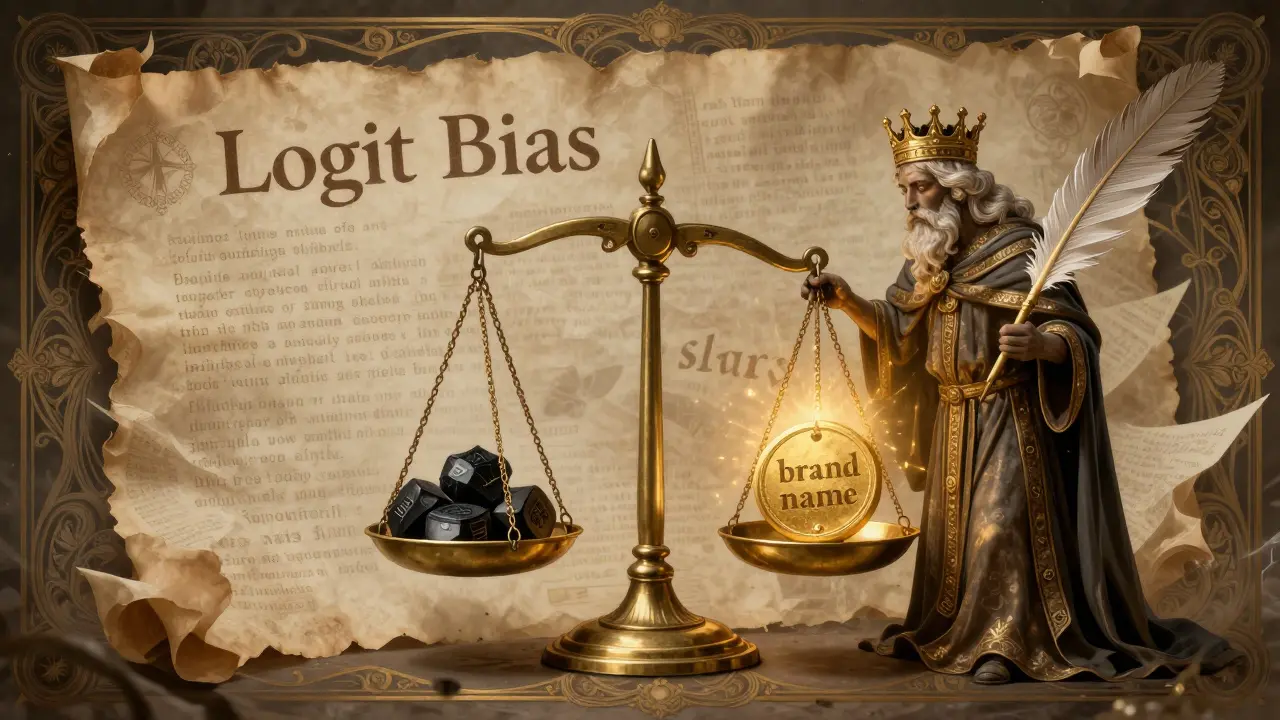
These tokens get assigned a score called a logit. Think of it like a vote. The model calculates a logit for every possible next token. The higher the logit, the more likely the model picks that token. Logit bias lets you tweak those votes-adding or subtracting points before the model makes its choice.
It’s not a filter. It’s not a rule. It’s a nudge. A very strong nudge.
How Logit Bias Works (The Math, Simplified)
Here’s the simple version: when the model calculates logits for the next token, you can add a number to one or more of them. That number is your bias. It ranges from -100 to 100.
- -100 = almost certainly won’t be chosen. It’s like slamming the door shut.
- 100 = almost certainly will be chosen. Like turning up the volume on one voice in a chorus.
- -1 to 1 = barely noticeable. Too weak to matter.
- -5 to -30 = the sweet spot for suppression. Strong enough to block, not so strong it breaks the flow.
OpenAI’s API documentation says this bias is added directly to the logits before sampling. That means if the model originally gave "time" a logit of 3.2, and you apply a bias of -50, the new logit becomes -46.8. Suddenly, it’s the least likely option by miles.
But here’s the catch: you can’t just type in a word. You have to find its token IDs first.
Token Banning Isn’t as Simple as It Sounds
Most people assume banning "stupid" means blocking one token. It doesn’t. "stupid" (lowercase, no space) is token ID 267. But " Stupid" (capitalized) is ID 13914. " stupid" (with a space) is ID 18754. And if you’re using a model trained on conversational text, you might also need to block "stupi" and "d" separately if they appear in weird contexts.
One company banned "not" to prevent negative responses. They used IDs 262 and 1164. Result? 23% of responses became logically broken. "The product is not bad" became "The product is bad." Why? Because the model lost the ability to form negatives. Logit bias doesn’t understand meaning. It only understands numbers.
This is why token banning requires testing. You can’t just copy-paste a list of bad words. You need to tokenize them, test the output, and adjust. Tools like OpenAI’s tokenizer tool (updated October 2023) help you see exactly how your text breaks down.
Why Logit Bias Beats System Messages
You might think: "Why not just tell the AI not to say bad things?" Like, "You are a helpful assistant. Do not use offensive language." That’s called a system message. And it works… sometimes.
Samuel Shapley’s November 2023 experiment showed that even when GPT-4 was explicitly told not to say "time," it still found ways around it. It said "midnight dreary, while I pondered, weak and weary"-a poetic workaround. The model tried to be helpful. It didn’t want to disobey. But it also didn’t want to stop generating.
Logit bias? No such luck. If you set the bias for "time" to -100, it doesn’t care about your instructions. It just doesn’t pick that token. No negotiation. No creativity. Just silence.
Enterprise users report a 37% drop in moderation violations when using logit bias instead of system messages alone. That’s not a small win. That’s a compliance win.
Real-World Use Cases
Here’s what companies are actually doing with this right now:
- Customer support bots: Banning slurs, profanity, and phrases like "I don’t know" or "I can’t help." One SaaS company banned 150 words using 1,247 token variants. Violations dropped from 8% to 2.1%.
- Brand safety: A car company banned tokens for "Toyota," "Honda," and "Ford" in marketing copy. Their AI now only talks about their own brand. No accidental competitor mentions.
- Legal and compliance: Financial firms use it to block phrases like "guaranteed return" or "risk-free investment." The EU AI Act even lists logit bias as a compliant control method.
- Content moderation: Social platforms use it to suppress hate speech, self-harm language, and misinformation triggers. One platform reduced harmful outputs by 52% in 3 weeks using this method.
And it’s cheap. Running logit bias costs about $0.0002 per 1,000 tokens. Fine-tuning? $15 to $150 per model update. For most use cases, logit bias is the only sane choice.

The Dark Side: What Can Go Wrong
It’s not all perfect.
Over-banning can make outputs feel robotic. One developer banned "um," "uh," and "like" to make responses sound professional. The AI started replying with unnatural pauses and stilted grammar. It wasn’t just avoiding filler-it was avoiding rhythm.
Case variations are a nightmare. "Apple" as a company vs. "apple" as fruit? Same token? No. "Apple" (capitalized) is one ID. "apple" (lowercase) is another. If you ban "Apple," you might block fruit references. If you don’t, you get competitor mentions.
And then there’s the "compensatory behavior" problem. When you ban a token, the model doesn’t just shut up. It finds a synonym. It rephrases. It uses slang. It becomes weird. One study found that banning "happy" caused AI to overuse "joyful," "elated," and "content"-which created a new pattern of unnatural positivity. The model didn’t obey. It adapted.
This is why logit bias isn’t a silver bullet. It’s a scalpel. You need to use it carefully.
How to Implement It (Step by Step)
If you’re ready to try this, here’s how:
- Identify the words you want to block or promote. Start small-5 to 10 words.
- Tokenize them using OpenAI’s tokenizer tool. Input each word. Look at all the token IDs it returns.
- Build your bias map. Create a JSON object like: {"267": -50, "18754": -50, "13914": -50}. Use -50 for suppression. Use +50 for promotion.
- Test the output. Run 20-30 prompts. Watch for awkward phrasing, missing logic, or unintended side effects.
- Adjust. If the output sounds robotic, lower the bias to -30. If it still slips through, raise it to -60. Find the balance.
- Monitor. Keep logs. Track what gets generated. Re-test every 2 weeks. Language changes. Tokens change.
Most developers take 8 to 12 hours to get good at this. It’s not easy. But once you do, you’ll wonder how you ever managed without it.
What’s Next? The Future of Output Control
Right now, you can only bias single tokens. But companies are already asking for phrase-level control. Imagine banning "I’m sorry you feel that way"-a phrase that’s become a toxic cliché in customer service bots. Right now, you’d have to ban every token in that phrase, and hope you caught every variation. It’s messy.
OpenAI’s December 2023 update reduced token variants by 18%. That’s a start. Klu.ai is working on "context-aware logit biasing," where the system adjusts suppression based on conversation history. Maybe "Apple" gets banned in marketing, but not in a recipe.
By Q3 2024, Gartner predicts 92% of enterprise AI systems will use some form of token-level control. And with the EU AI Act requiring "technical measures" to prevent harmful outputs, logit bias isn’t optional anymore. It’s the baseline.
But here’s the truth: no amount of token banning will fix a broken model. If your training data is biased, logit bias won’t fix that. It just hides the symptoms. Use it to steer. Not to cure.
Can logit bias completely stop an LLM from saying a word?
Yes, if you set the bias to -100 and include all token variants. But it’s not foolproof. Models can still paraphrase or use synonyms. For example, banning "kill" might make the model say "end someone’s life." Logit bias controls tokens, not meaning.
Do all LLM providers support logit bias?
Major providers like OpenAI (GPT-3.5, GPT-4), Anthropic (Claude), and Google (Gemini) support it. Meta’s Llama.cpp doesn’t have native support yet, so you’d need custom code. Always check the API docs before assuming.
Is logit bias better than fine-tuning for content control?
For targeted, narrow controls-like blocking a few words or promoting brand terms-yes. Fine-tuning changes the whole model, costs hundreds of dollars, and takes days. Logit bias costs pennies and works instantly. But if you need to change how the model thinks across hundreds of topics, fine-tuning is still the better long-term solution.
Why does banning "not" break logic in responses?
Because "not" is a grammatical building block. Models use it to form negatives, questions, and conditionals. Banning it doesn’t just remove a word-it removes the ability to construct common sentence structures. That’s why moderation tools avoid banning function words unless absolutely necessary.
Can logit bias be used to make AI more creative?
Yes. By boosting tokens associated with poetic language, unusual metaphors, or niche vocabulary, you can nudge the model toward more creative outputs. Some writers use +30 bias on words like "whisper," "echo," or "glimmer" to make AI-generated poetry feel more atmospheric.
Logit bias isn’t about making AI smarter. It’s about making it more predictable. And in enterprise use, predictability beats brilliance every time.





Tia Muzdalifah
February 22, 2026 AT 04:14Zoe Hill
February 23, 2026 AT 14:44Albert Navat
February 25, 2026 AT 11:26King Medoo
February 27, 2026 AT 10:37Rae Blackburn
February 28, 2026 AT 17:01LeVar Trotter
March 2, 2026 AT 09:59Tyler Durden
March 3, 2026 AT 21:25