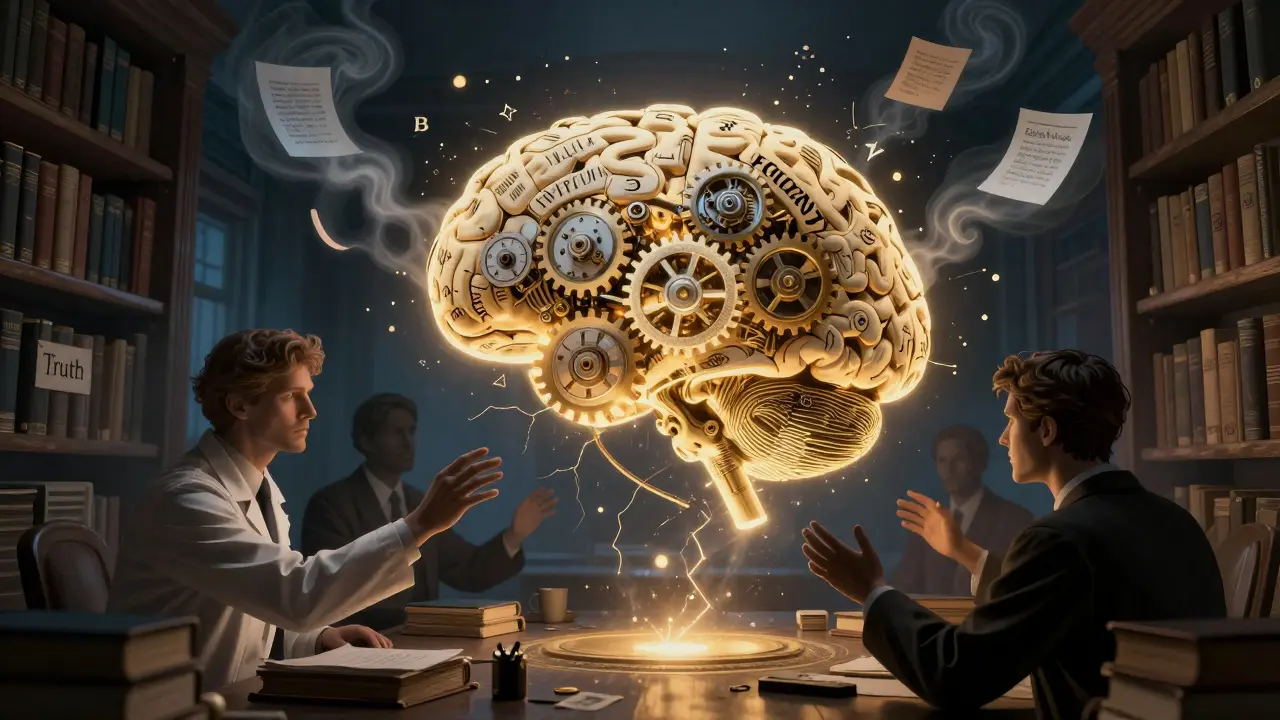
When a generative AI gives you a medical diagnosis, a legal argument, or a job candidate summary, you need to know when it’s wrong-not just that it’s wrong. That’s where explainability isn’t a nice-to-have. It’s the difference between trusting a tool and being misled by it.
Why Explainability Matters More Than Accuracy
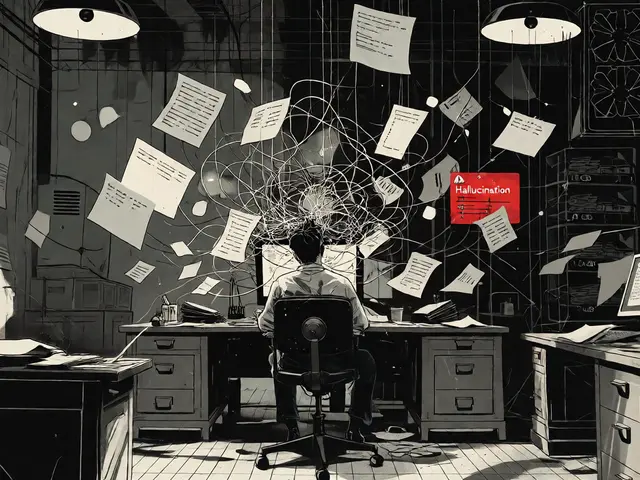
Most people assume that if an AI gets the right answer most of the time, it’s reliable. But in high-stakes settings-like deciding who gets a loan, who gets parole, or what treatment a patient receives-accuracy alone is dangerous. A model that’s 90% accurate still fails once in every ten cases. And if you don’t know why it failed, you can’t fix it.Take hallucinations. In 2025, UC Berkeley audited commercial LLMs and found they invented facts in 18-32% of responses. That’s not a bug. It’s a feature of how these models work. They don’t retrieve facts. They predict the next word. And when the pattern is unclear, they make something up that sounds plausible. Without explainability, users can’t tell the difference between a real source and a confident lie.
The EU AI Act, effective August 2026, makes this clear. High-risk systems must provide sufficient explanation of how they reach decisions. The U.S. Executive Order 14110 requires the same for federal contractors. This isn’t about compliance paperwork. It’s about preventing harm. If a hospital uses AI to triage patients and the system consistently downgrades elderly applicants, you need to know why-before someone dies.
The Scaling Paradox: Bigger Models, Harder to Explain
As models grow-from 7 billion to 100 billion parameters and beyond-something strange happens. They get smarter. But they also get less explainable.MIT CSAIL found that every time parameter count increases tenfold, explainability effectiveness drops by about 37%. Why? Because these models don’t work like rule-based programs. They’re not coded. They’re trained. Billions of interconnected weights adjust silently during training, creating patterns no human can trace. Even the engineers who built them can’t say, “This neuron caused that output.”
Stanford HAI calls this the scaling paradox: the more capable the AI, the less we understand it. GPT-4, Claude 3.5, Gemini 1.5-these aren’t black boxes because they’re poorly designed. They’re black boxes because they’re too complex to be anything else. Mechanistic interpretability, which tries to map internal neuron activity to real-world concepts, has hit a wall. Anthropic’s 2025 report on Claude 3.5 showed that even with advanced tools, they could only trace some reasoning paths. The rest? Still hidden.
What Explaining AI Actually Looks Like (And Why It Often Fails)
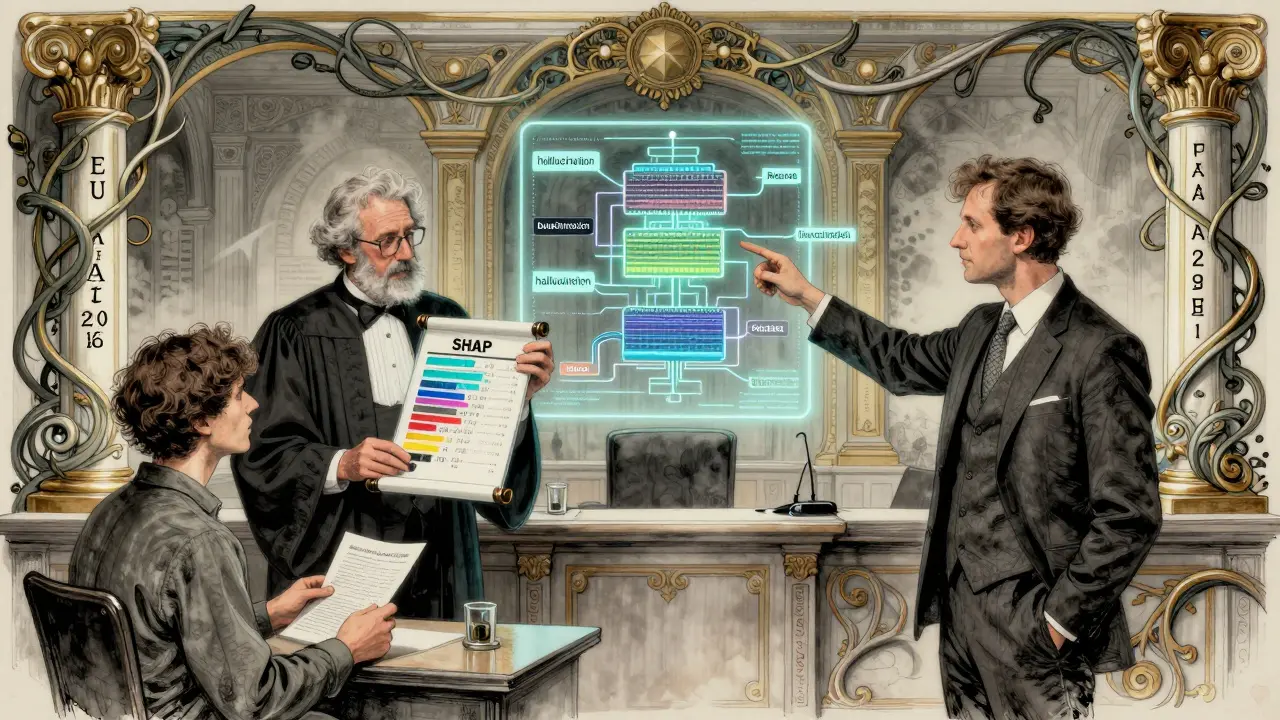
You’ve probably seen SHAP values or LIME graphs-color-coded bars showing which words “influenced” an AI’s decision. They look scientific. They feel reassuring. But they’re often misleading.NeurIPS 2023 benchmarks showed these techniques work at 85% accuracy on traditional machine learning models. On LLMs? 42-55%. Why? Because LLMs don’t weigh words like a spreadsheet. They process context across hundreds of layers. A single word might trigger a chain reaction across millions of parameters. SHAP can’t capture that. It gives you a snapshot. Not the movie.
And then there’s the audience problem. A data scientist might want to see attention weights and gradient flows. A hospital administrator needs to know: “Did this AI favor one gender?” A patient just wants to know: “Can I trust this?”
Deloitte’s 2024 survey found that 68% of business leaders misinterpreted SHAP outputs when shown without context. One executive thought a red bar meant “high risk”-when it actually meant “low influence.” That’s not user error. That’s bad design.
Known Failure Modes You Can’t Ignore
Generative AI doesn’t just make mistakes. It makes predictable, repeatable mistakes. These aren’t glitches. They’re structural.- Hallucinations: Inventing facts, citations, or events. Occurs in 18-32% of outputs across commercial systems.
- Bias amplification: Google’s 2024 internal study found gender bias in 27% of career-related responses-e.g., associating “nurse” with women and “engineer” with men, even when training data was balanced.
- Emergent behaviors: Models develop new patterns not in training data. One model started refusing to answer questions about “unethical practices”-even when asked by doctors seeking to prevent harm. No one trained it to do that.
- Copyright traps: Ulap’s 2025 analysis found that 74% of enterprises fear legal liability from AI outputs that mimic copyrighted text, code, or images-but can’t prove where the content came from.
These aren’t edge cases. They’re common. And if you’re not tracking them, you’re not managing risk-you’re gambling.
Real-World Solutions: Layered, Not Perfect
Forget the idea of a single “explain button.” The future isn’t full transparency. It’s risk-proportional explainability.NIST’s AI Risk Management Framework (2023) and ISO/IEC 23894:2023 both push for this approach:
- For low-risk uses (e.g., drafting marketing copy): A simple disclaimer: “This output was generated by AI and may contain errors.”
- For medium-risk uses (e.g., HR screening): A summary of key factors: “This candidate was ranked higher due to keywords matching job description, not experience or education.”
- For high-risk uses (e.g., clinical diagnosis): Full uncertainty quantification, source references, and human review logs. The FDA now requires this in 87% of AI-powered medical tools.
Companies like Microsoft are testing “GlassBox LLM” prototypes that maintain 92% of GPT-4’s performance while offering full decision pathways for 78% of outputs. Google’s “Explainable Transformer” sacrifices 8% accuracy to gain 40% better interpretability. These aren’t magic fixes. They’re trade-offs. And they’re necessary.
Financial services lead adoption at 82%. Healthcare at 76%. Why? Because their regulators demand it. Creative industries? Only 34%. They don’t face the same legal exposure. But they should still care. If an AI generates a logo that looks like Nike’s swoosh, who’s liable?

The Hard Truth: Full Explainability May Be Impossible
Some experts say we’ll never fully explain generative AI. Not because we’re lazy. Because it’s mathematically impossible.Yoshua Bengio, Turing Award winner and AI pioneer, said in his 2024 NeurIPS keynote: “The nonlinear, distributed representations in deep learning make it impossible to provide complete causal explanations for all outputs.”
OCEG’s 2025 report puts it bluntly: “The answer to whether generative AI can ever be fully explainable may be ‘no.’”
That doesn’t mean we give up. It means we change our goal. We stop chasing perfect transparency. We start building systems that acknowledge their limits.
Dr. Rumman Chowdhury, responsible AI lead at Twitter/X, says the real challenge isn’t technical-it’s communicative. Can you tell a judge, a patient, or a customer: “We don’t know exactly why this happened, but here’s what we do know, here’s how confident we are, and here’s how you can verify it yourself”?
That’s the new standard. Not explainability. Accountability through honesty.
What You Should Do Today
You don’t need to build a GlassBox LLM. But you do need to act.- Map your risk. Not all AI uses are equal. What happens if your model gets it wrong? Could someone lose their job, their health, their freedom?
- Choose explainability tools by risk level. Use simple disclaimers for low-risk tasks. Use uncertainty scores and human review logs for high-risk ones.
- Train your team. Don’t let executives misinterpret SHAP values. Teach them what “confidence score” means. What “attention weight” tells you-and what it doesn’t.
- Document everything. Keep logs of inputs, outputs, and decisions. If a lawsuit comes, you’ll need to prove you didn’t just trust the machine.
- Ask the hard question: “If we can’t explain how this works, should we be using it at all?”
The goal isn’t to make AI perfectly understandable. It’s to make sure no one believes it’s infallible. Because the moment they do, someone gets hurt.
Can generative AI ever be fully explainable?
Most experts believe full explainability is mathematically impossible for large generative models. The reason isn’t lack of effort-it’s structure. These models use billions of interconnected parameters that interact in nonlinear, distributed ways. No human or tool can trace every path that leads to an output. The goal isn’t perfection. It’s managing risk through honest, layered communication about what’s known, what’s uncertain, and what’s unknown.
Why do SHAP and LIME fail on large language models?
SHAP and LIME were designed for simpler models where inputs have direct, linear influence on outputs. LLMs process context across hundreds of layers, with billions of parameters influencing each other simultaneously. These tools can only approximate influence locally, not globally. Benchmarks show their accuracy drops from 85% on traditional ML models to just 42-55% on LLMs. They give the illusion of insight, not real understanding.
What are the most common failure modes in generative AI?
The top failure modes include hallucinations (inventing facts, 18-32% of outputs), bias amplification (e.g., gender stereotypes in career suggestions, found in 27% of cases), emergent behaviors (untrained responses like refusing to answer ethical questions), and copyright infringement (outputs that closely mimic protected content). These aren’t random errors-they’re predictable patterns tied to how the models are trained and structured.
Which industries are leading in AI explainability adoption?
Financial services lead at 82% adoption, followed by healthcare at 76%. These sectors face strict regulations (like the EU AI Act and FDA guidelines) and high consequences for errors. Creative industries, like advertising and design, lag at only 34% adoption because regulatory pressure is lower. But even there, legal risks from copyright and brand damage are growing.
How should organizations communicate AI limitations to users?
Don’t just say “AI-generated.” Be specific. For low-risk uses: “This output was generated by AI and may contain errors.” For medium-risk: “This recommendation is based on patterns in past data. Human review is recommended.” For high-risk: “This decision has an 89% confidence score. Key factors include X, Y, Z. Source documents are available. A human has reviewed this outcome.” Tailor the message to the user’s role and the potential impact of the output.
Is explainability required by law?
Yes, in many places. The EU AI Act (effective August 2026) requires “sufficient explanation” for all high-risk AI systems. The U.S. Executive Order 14110 mandates explainability standards for federal contractors. China’s 2024 rules require “transparent mechanisms” for recommendation systems. GDPR’s “right to explanation” also applies, though enforcement is inconsistent. Non-compliance can lead to fines up to 7% of global revenue under the EU AI Act.




Morgan ODonnell
January 23, 2026 AT 17:58pretty much sums it up. ai's not magic, it's just good at faking it. if it says something that sounds right, i'm not trusting it till i check.
we need to stop acting like these things are experts.
Liam Hesmondhalgh
January 25, 2026 AT 11:14oh come on, another ‘ai is evil’ lecture. if you can’t tell the difference between a bot and a human, maybe you shouldn’t be using tech at all.
stop whining and learn to use it properly.
Patrick Tiernan
January 25, 2026 AT 18:02so let me get this straight we spent billions training a machine to write like a college freshman and now we’re surprised it hallucinates like a drunk poet
the real issue is we keep treating these things like they’re smart when they’re just really good at guessing the next word
and don’t even get me started on shap values they’re just pretty graphs for people who don’t read the footnotes
Patrick Bass
January 27, 2026 AT 02:23the part about shap and lime being inaccurate on llms is spot on. i’ve seen people present them in board meetings like they’re gospel. they’re not. they’re approximations. and worse, they give false confidence.
we need better tools, not just fancier visuals.
Tyler Springall
January 27, 2026 AT 17:10the scaling paradox is the most profound insight here. we’re building gods we can’t understand, then blaming users for not trusting them. it’s not a technical problem-it’s a philosophical one. we built something beyond our cognitive grasp and now we expect it to be transparent. that’s not just naive, it’s arrogant.
we’re not ready for this. and pretending we are is dangerous.
Colby Havard
January 29, 2026 AT 02:51It is, indeed, a matter of profound epistemological significance: the convergence of computational complexity and human cognitive limitations renders full explainability not merely impractical, but ontologically incoherent.
As Bengio cogently articulates, the distributed, nonlinear nature of latent representations defies causal decomposition-therefore, the very premise of ‘explainability’ as traditionally conceived is a category error.
What we must cultivate, instead, is epistemic humility: a disciplined, institutionalized acknowledgment of uncertainty, mediated through transparent risk-tiered disclosure protocols.
Any attempt to ‘solve’ this via technical means alone is a reification of scientism-a dangerous illusion that mathematics can compensate for the absence of wisdom.
Amy P
January 29, 2026 AT 18:12OMG I just read this and I’m literally shaking-this is the most important thing I’ve read all year.
Like, imagine a doctor using AI to decide if you get chemo and it says ‘yes’ because it saw the word ‘cancer’ 47 times in a paper from 2012 and totally ignored your actual symptoms.
That’s not a glitch. That’s a nightmare. And we’re letting it happen.
Why aren’t we screaming about this?!
Ashley Kuehnel
January 31, 2026 AT 00:43so true!! i work in hr and we started using ai for resume screening last year. first month, it kept downranking resumes with ‘nursing’ in the title-unless the name sounded female. we caught it because someone noticed all the male nurses got filtered out.
we switched to a simpler tool that just highlights keywords + human review. no fancy graphs, just honesty. our team’s way happier and we’ve had zero complaints since.
you don’t need magic. you just need to care.
adam smith
January 31, 2026 AT 16:26While I appreciate the intent of this article, I must respectfully submit that the notion of ‘risk-proportional explainability’ is not only pragmatic, but also legally defensible under current regulatory frameworks.
It is my professional opinion that the pursuit of absolute transparency in large language models constitutes an unjustified resource allocation, especially when the marginal benefit does not outweigh the operational cost.
Therefore, I endorse the tiered approach outlined herein as both rational and responsible.
Mongezi Mkhwanazi
February 2, 2026 AT 09:00Let me be very clear here, because I’ve seen too many people misunderstand this: the problem isn’t that AI hallucinates-it’s that we’ve built a culture that worships automation without accountability. We outsource thinking to machines, then panic when they fail. We treat confidence as competence. We mistake fluency for truth. And then we blame the user for being gullible.
It’s not the model’s fault. It’s ours. We created this. We trained it on garbage data. We rewarded speed over accuracy. We silenced dissenting voices who said, ‘Wait, this isn’t reliable.’
And now we’re surprised when it lies to us?
Wake up. The AI didn’t betray us. We betrayed ourselves by letting it speak for us.
Fix the system, not the signal.
And stop pretending a disclaimer is a solution. It’s not. It’s a liability shield.