
Picture this: It’s 8 a.m. You open your laptop. Your product team has a new idea. By 9 a.m., a fully structured Product Requirements Document (PRD) is already in your inbox-complete with user segments, acceptance criteria, release timelines, and even risk flags. No whiteboarding. No back-and-forth emails. No 3 a.m. revisions. Just a clean, coherent doc that feels like it was written by your best PM… except it wasn’t. It was written by AI agents.
This isn’t science fiction. It’s happening now. Teams using AI Pair PM are cutting PRD creation time from days to hours. And it’s not just about speed. It’s about quality. AI agents don’t forget scope. They don’t miss edge cases. They don’t get tired. They iterate. They challenge assumptions. They refine.
What Exactly Is AI Pair PM?
AI Pair PM isn’t a single tool. It’s a workflow. A system where two or more AI agents work together-like a pair of developers, but for product specs. One agent starts by interpreting raw inputs: meeting notes, customer interviews, sales feedback, or even a Slack thread. It drafts an initial PRD. Then a second agent steps in-not to edit, but to question. It asks: "Who’s the real user here?" "What happens if the model fails at 3 a.m.?" "Is this feature actually solving a problem, or just sounding cool?"
Think of it like a co-pilot that doesn’t just follow orders. It pushes back. It checks for bias in training data. It flags dependencies you didn’t know existed. It cross-references past PRDs from similar products. It pulls in real-world usage stats from your analytics platform. And then it spits out a revised version.
Companies like Notion and Asana have quietly rolled out internal versions of this. One engineer told me they went from 12-hour PRD cycles to 90-minute ones-with 40% fewer revisions later. Why? Because the AI caught inconsistencies before they ever hit a developer’s desk.
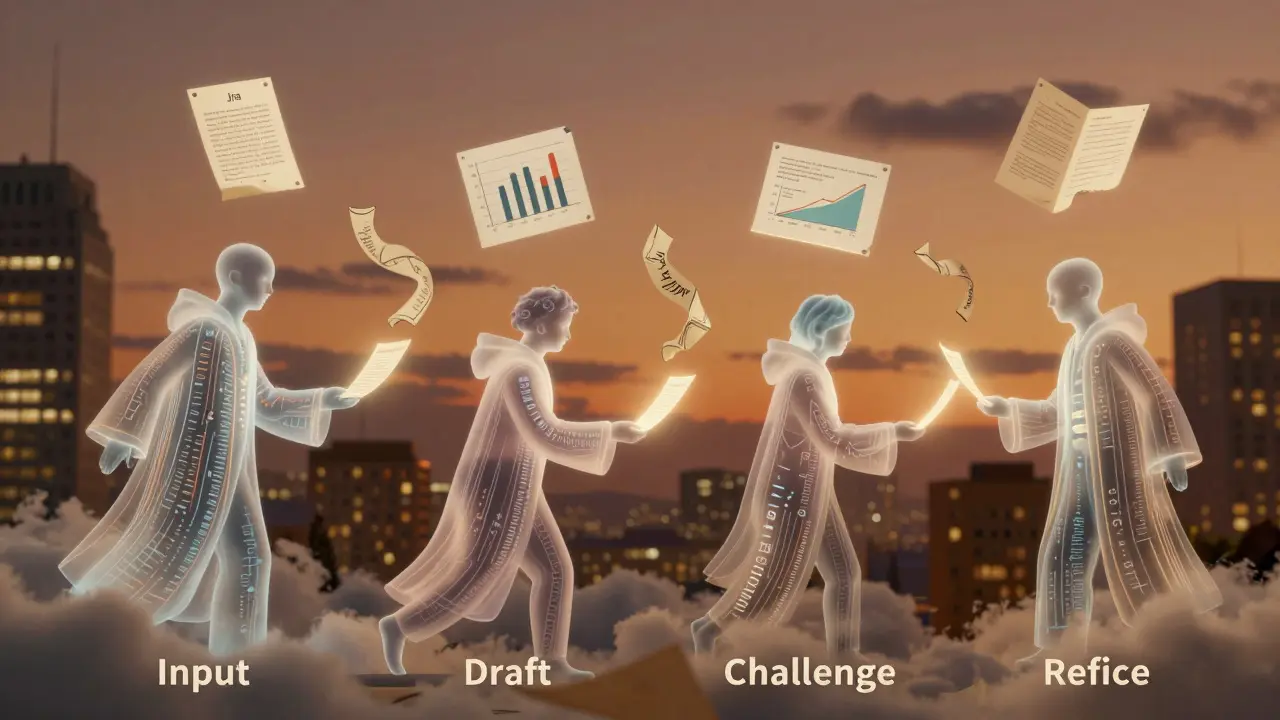
How It Works: The Agent Workflow
Here’s the real breakdown of how AI Pair PM operates in practice:
- Input Agent gathers everything: voice transcripts, Jira tickets, customer support logs, competitor feature lists. It doesn’t just read-it connects dots. If 17 users mentioned "slow load times" in feedback, and your last PRD ignored it, the agent flags that.
- Draft Agent builds the first version. It follows your company’s PRD template. It adds standard sections: goals, user personas, success metrics. It even auto-generates diagrams from text descriptions.
- Challenge Agent runs simulations. It asks: "What if 50% of users skip this onboarding step?" It checks against your model’s accuracy thresholds. If your AI feature needs 10,000 labeled examples and you only have 2,000, it says: "This isn’t feasible. Here’s how to adjust."
- Refine Agent merges feedback. It pulls in comments from engineering, design, and legal. It resolves contradictions. It removes fluff. It outputs a final version that’s not just documented-it’s validated.
Each agent is fine-tuned on your company’s historical PRDs. So if your team always forgets to include compliance requirements, the system learns that. It doesn’t wait for a human to remind it. It just adds it.
Why This Beats Human-Only PRDs
Human product managers are brilliant. But they’re also human. They miss things. They get distracted. They assume everyone thinks like they do.
AI Pair PM doesn’t. It scans every past PRD from the last 18 months and spots patterns you didn’t notice. For example:
- Teams that skipped defining "success metrics" had 68% higher feature abandonment rates.
- PRDs that didn’t specify data sources led to 3x more delays in model training.
- Features with vague acceptance criteria took 52% longer to QA.
AI agents use this data to auto-populate best practices. No more guessing. No more "I thought we meant…"
And here’s the kicker: it scales. A startup with one PM can now handle 5 parallel projects. A Fortune 500 company can document 50+ AI features without hiring 10 more PMs.
Real-World Impact: What Changed?
At a SaaS company in Austin, they switched from manual PRDs to AI Pair PM last fall. Here’s what happened:
- PRD creation time dropped from 72 hours to 4 hours.
- Engineering rework dropped by 55%.
- Product launches moved up by an average of 11 days.
- Customer satisfaction with new features rose 22%-because the AI made sure each feature actually solved a real pain point.
They didn’t replace their PMs. They upgraded them. Now, PMs spend less time writing and more time talking to customers. They use the AI-generated doc as a starting point for deeper conversations: "Why did we pick this metric? Is this really what users care about?"
What AI Can’t Do (Yet)
Let’s be clear: AI Pair PM doesn’t make product managers obsolete. It makes them better.
AI can’t feel empathy. It can’t sense when a user is frustrated but can’t articulate why. It can’t read between the lines in a customer call. It can’t build trust.
That’s why the best teams still have a human in the loop-just not doing the grunt work. The PM now acts as the final validator. They ask: "Does this feel right?" They test the logic. They push back if the AI missed something subtle.
And when the AI makes a mistake? It learns. Every time a human overrides an AI suggestion, the system updates its internal model. It gets smarter. Faster. More aligned with your team’s culture.

The Tools Behind the Scenes
AI Pair PM doesn’t run on ChatGPT alone. It’s built on a stack:
- LLMs like Claude 3.5 and GPT-4o for drafting and reasoning.
- Vector databases to store and retrieve past PRDs, user feedback, and feature outcomes.
- Workflow engines like LangChain or CrewAI to orchestrate agent handoffs.
- Integration hooks into Jira, Notion, Mixpanel, and Amplitude to pull live data.
Some teams even use custom fine-tuned models trained on their own PRDs. One team in Berlin trained theirs on 1,200 past documents. The result? A 91% accuracy rate in predicting which features would succeed.
Where This Is Headed
By 2027, AI Pair PM won’t be a luxury. It’ll be standard.
Startups will use it to ship faster. Enterprises will use it to avoid costly missteps. Regulators will start asking: "How did you validate your requirements?" And the answer won’t be "We had a meeting." It’ll be: "We used AI Pair PM. Here’s the audit trail."
The next frontier? AI agents that don’t just write PRDs-they write the user stories behind them. That predict which features will churn. That suggest entirely new product directions based on emerging behavior patterns.
Product management is shifting. The job isn’t about writing docs anymore. It’s about asking the right questions. And AI? It’s finally giving us the space to do that.
Can AI Pair PM replace product managers?
No. AI Pair PM removes repetitive, error-prone tasks so product managers can focus on high-value work: understanding users, making strategic trade-offs, and leading teams. It doesn’t replace judgment-it amplifies it.
Do I need technical skills to use AI Pair PM?
Not at all. Most systems are built for non-technical PMs. You just paste in notes, select your template, and hit "generate." The AI handles the structure, logic, and cross-checking. You focus on whether the output feels right.
How does AI handle privacy and compliance in requirements?
Good systems auto-apply compliance rules based on your region and industry. If you’re in the EU, it flags GDPR requirements. If you’re in healthcare, it adds HIPAA checks. It pulls from your company’s policy database and enforces them in every draft.
What if the AI misses a critical requirement?
That’s why human validation is built in. The AI doesn’t lock the doc. It flags uncertainties. If it’s unsure about a dependency, it highlights it. You review those flags before finalizing. It’s not perfect-but it’s way better than a human drafting alone.
Is AI Pair PM only for AI products?
No. It works for any product with complex requirements-SaaS, hardware, fintech, even internal tools. The AI doesn’t care if it’s a chatbot or a payment gateway. It just needs clear inputs and measurable outcomes.
Teams that adopt AI Pair PM aren’t just automating documents. They’re changing how they think about product development. The goal isn’t to write faster. It’s to build better. And that’s something no algorithm can do alone-but with the right human-AI partnership, it’s becoming the new normal.




Bridget Kutsche
March 2, 2026 AT 06:12This is honestly one of the most exciting shifts in product work I’ve seen in years. I used to spend half my week just turning rambling Slack threads into coherent docs. Now? I paste, hit generate, and spend the time I saved talking to real customers. The AI caught a flaw in our last PRD I’d have missed-our ‘power users’ weren’t even in the target segment. Changed the whole direction. No more guessing. Just better decisions.
Also, the fact that it learns from past mistakes? That’s the real magic. It’s like having a co-pilot who never forgets your last screw-up… and helps you fix it before you make it again.
Jack Gifford
March 3, 2026 AT 10:01Love this. But let’s be real-the real win isn’t speed, it’s consistency. Human PMs write PRDs differently every time. One guy uses ‘user persona’ as a header, another calls it ‘target audience.’ AI doesn’t care. It standardizes. And that’s huge for scaling. My dev team used to spend 2 days just decoding what the heck the PM meant. Now? They get clean, repeatable specs. Game changer.
Sarah Meadows
March 3, 2026 AT 10:07USA is leading this. No other country has the infrastructure, the talent, or the guts to deploy AI this aggressively. China’s trying, but they’re still stuck in surveillance mode. Europe? Bureaucracy. This is American innovation at its best. Stop pretending it’s ‘just a tool.’ This is the future of work, and we’re winning it.
Nathan Pena
March 5, 2026 AT 07:26While the premise is superficially compelling, the underlying assumption-that AI agents can meaningfully ‘challenge assumptions’-is a profound misrepresentation of epistemic agency. An LLM does not ‘question’; it statistically reconstructs plausible counterfactuals based on training data. There is no intentionality. No curiosity. No moral reasoning. What you call ‘refinement’ is merely pattern-matching against a corpus of human-generated artifacts, which themselves are often flawed. The 40% reduction in revisions? Likely due to homogenization, not quality. And let’s not forget: the AI doesn’t ‘learn’ from human overrides-it just adjusts weights in a high-dimensional space. This is automation dressed as augmentation. Don’t confuse efficiency with wisdom.
Mike Marciniak
March 6, 2026 AT 15:59They’re not using AI to write PRDs. They’re using it to erase accountability. Who’s responsible when the AI misses a compliance flag? The PM? The engineer? The vendor? There’s no audit trail-just a black box that says ‘validated.’ And don’t get me started on how these systems are trained. They’re fed corporate PRDs from companies that already have bias baked in. Now the AI is reinforcing those biases at scale. This isn’t progress. It’s institutionalized laziness with a fancy UI.
VIRENDER KAUL
March 6, 2026 AT 23:37Mbuyiselwa Cindi
March 8, 2026 AT 05:48I’ve been using something similar for our fintech tools and honestly? It’s been a lifesaver. I’m not a writer, and my PRDs used to be a mess. Now I just talk into my phone during user calls, paste the transcript, and boom-clean structure, clear metrics, flagged risks. The best part? It highlights when I’m being vague. Like, ‘You said ‘user-friendly’-what does that mean? Define it.’ It’s like having a patient, no-BS coach who never gets tired. And yeah, it’s helped me be a better PM, not replace me. Just saying-this isn’t sci-fi. It’s Tuesday.
Krzysztof Lasocki
March 10, 2026 AT 03:07Oh wow, so now we’re outsourcing our critical thinking to a bot that’s been trained on 1200 PRDs written by people who also didn’t know what they were doing? Classic. Let me guess-the next step is AI writing your performance review and deciding if you get a raise based on how many times you overruled it? I love how they call it ‘Pair PM’ like it’s some buddy system. Nah. It’s a glorified autocorrect for corporate jargon. And yet somehow, we’re supposed to be thrilled? I’ll stick with my messy, human, emotionally-broken PRDs thanks. At least I know who to yell at when it goes wrong.
Henry Kelley
March 10, 2026 AT 11:16