
Imagine asking an AI to look at a medical scan, read the doctor’s handwritten notes, and then explain what’s wrong in plain language - all in one go. That’s not science fiction anymore. Since late 2023, vision-language models have moved from lab experiments to real-world tools that businesses are deploying right now. These aren’t just image recognizers or text generators. They’re systems that see, read, think, and respond together - like a human would. And by December 2025, they’re reshaping how companies handle documents, automate inspections, and even control robots.
How Vision-Language Models Actually Work
Traditional AI treated images and text as separate problems. You ran an OCR tool to extract text from a photo, then fed that text into a language model. That approach was slow, error-prone, and missed context. Vision-language models fix that by merging visual and linguistic understanding into one neural network. The model doesn’t just detect a receipt - it understands the layout, recognizes handwritten prices, connects them to product names, and even infers whether the purchase was for business or personal use based on the wording.
There are three main architectures driving this today. The first, called NVLM-D, uses separate pathways for images and text. It’s great for document processing because it preserves fine details in OCR, achieving 97% accuracy on printed text. But it’s heavy - it needs 25-30% more computing power than other methods. The second, NVLM-X, integrates visual features directly into the language model’s attention mechanism. This makes it faster and more efficient, especially with high-res images like satellite photos or product assembly lines. It’s 15-20% more efficient but loses a bit of precision on messy documents. The third, NVLM-H, blends both. It’s the default choice for most general applications because it balances speed and accuracy.
Top Models in 2025: Open Source Is Leading
Two years ago, you needed access to GPT-4V or Gemini Pro to get decent vision-language performance. Now, open-source models are outperforming them in specific areas. GLM-4.6V, released by Z.ai in November 2024, is the new benchmark. It processes nearly 2,500 tokens per second on a single NVIDIA A100 GPU. That’s fast enough for real-time document scanning in warehouses or hospitals. It compresses visual data by up to 20 times without losing OCR accuracy - a huge deal when you’re dealing with hundreds of pages per minute.
Qwen3-VL is another strong contender. It matches GLM-4.6V in document understanding and even beats it on some visual reasoning tests. Both models support 128K context windows, meaning they can analyze long reports, multi-page forms, or complex diagrams without losing track. But here’s the catch: high-resolution images eat up most of that context. One user on Reddit pointed out that a single 4K image can use 80% of the context window before you even add a question. That’s why successful teams use vision token compression - a technique that reduces image data to its most important parts before feeding it in.
Meanwhile, Meta’s Llama 3.2 models (11B and 90B versions) are gaining traction for their efficiency. They’re not as powerful as GLM-4.6V on complex tasks, but they run on smaller GPUs, making them ideal for edge devices. And then there’s Janus, a specialized architecture designed for robotics. It separates the vision pathway for understanding from the one for generating actions - improving robot task accuracy by 18% in real-world environments.
Where These Models Are Actually Being Used
Businesses aren’t experimenting anymore. They’re deploying. In finance, 42% of firms now use vision-language models to process loan applications, invoices, and tax documents. Instead of manual data entry, employees upload scanned forms and get structured JSON output in seconds. One bank reduced document processing time by 70% and cut errors by 89%.
In healthcare, 31% of organizations are using these models to analyze X-rays, MRIs, and pathology slides alongside radiologist notes. The system doesn’t diagnose - it highlights anomalies, cross-references past scans, and flags inconsistencies in the doctor’s wording. One hospital in Arizona reported a 34% reduction in missed findings during pilot testing.
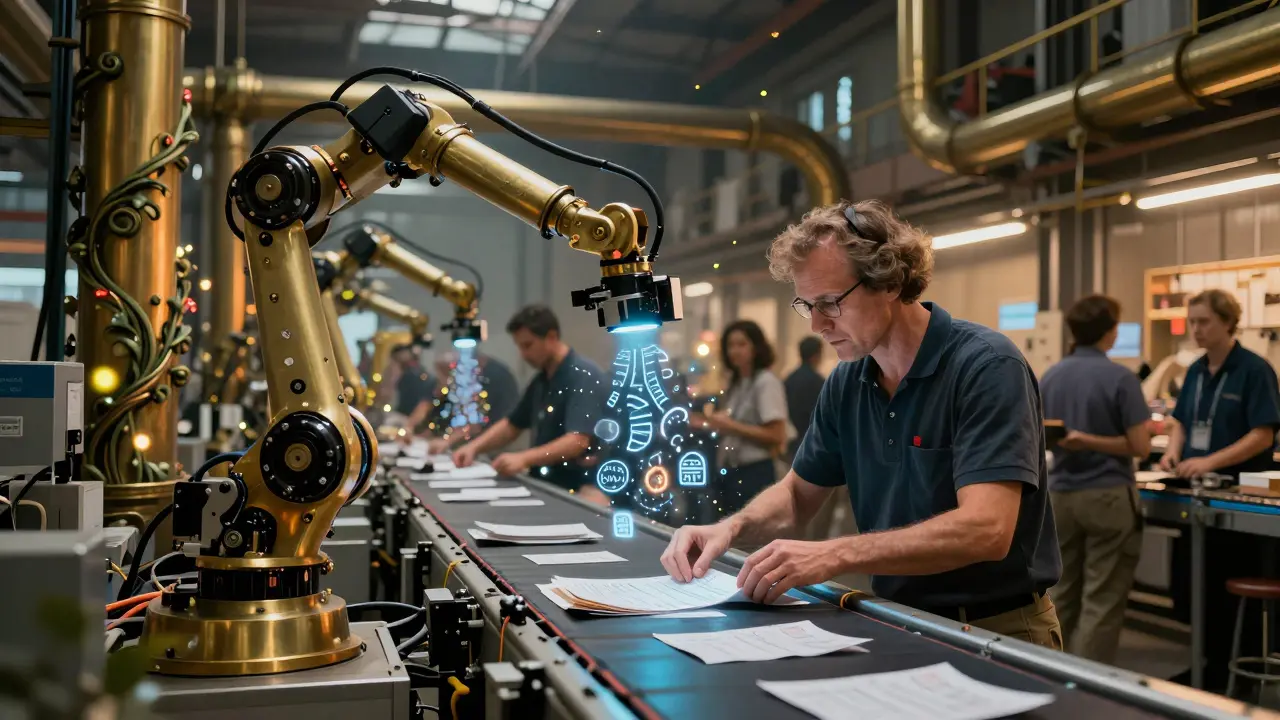
Manufacturing is another big adopter. Factories use these models to inspect products on assembly lines. A camera takes a photo of a circuit board; the model checks for missing components, solder flaws, and label mismatches - all while reading the product ID and batch number. It’s faster than human inspectors and doesn’t get tired. One electronics maker cut defect leakage by 41% after switching from rule-based vision systems to GLM-4.6V.
The Hidden Costs and Pain Points
Don’t be fooled by the hype. These models are expensive to run. Training a single 70-billion-parameter model like GLM-4.6V consumes about 1,200 megawatt-hours of electricity - equivalent to the annual power use of 110 U.S. homes. Deploying them at scale costs $12,000-$15,000 in GPU resources per month, according to IBM. That’s out of reach for most small businesses.
Even if you have the hardware, implementation is hard. Developers report that 63% of issues come from image preprocessing - things like glare, skewed scans, or low-resolution photos. Another 41% of problems involve context window overload. And OCR accuracy plummets on handwritten text. One health tech engineer on Reddit said their system’s accuracy dropped from 97% to 82% on handwritten medical records - making it useless for digitizing patient files.
There’s also hallucination. Vision-language models make up answers more often than text-only ones. On the MM-Vet benchmark, they hallucinate 8-12% more frequently. That’s dangerous if you’re using them for legal or medical decisions. They might confidently say a label says "aspirin" when it actually says "acetaminophen" - because the handwritten "a" looks similar and the context suggested pain relief.

What You Need to Build This Right
Building a production-ready system isn’t a weekend project. Based on a survey of 127 enterprise deployments, teams need at least two years of computer vision experience and one year working with large language models. The average time to go from idea to live system is 14.3 weeks.
Here’s what actually works in practice:
- Start with an instruction-tuned LLM backbone like Qwen2-72B-Instruct - not a base model. Experts say this improves alignment with human intent by 22%.
- Use vision token compression. It’s used in 68% of successful deployments. Tools like ViT (Vision Transformer) help reduce image size without losing key details.
- Build modality-specific preprocessing pipelines. Clean images before they hit the model. Remove noise, correct orientation, enhance contrast.
- Test with real-world data, not curated datasets. A model that works on clean PDFs will fail on a crumpled receipt taken in a dimly lit kitchen.
- Monitor hallucinations. Add a confidence score layer and flag low-confidence outputs for human review.
Community support matters too. GLM-4.6V’s GitHub repo has over 4,200 stars and 321 contributors. Critical bugs get fixed in under four days. That’s the kind of momentum you want behind your tech stack.
What’s Next? The Road Ahead
The next two years will see three big shifts. First, models will get more specialized. By 2026, 60% of new vision-language models will focus on one task - medical imaging, legal documents, or robotics - instead of trying to do everything. Second, efficiency will improve. Researchers are targeting a 50% reduction in vision token usage by mid-2025. That means you’ll be able to run these models on cheaper hardware. Third, integration with robotics will explode. Seventy-three percent of researchers say embodied AI - robots that understand visual commands - is their top priority.
Regulations are catching up too. The EU AI Act, effective since January 2025, now requires transparency in how multimodal systems make decisions - especially for high-risk uses like healthcare or hiring. You’ll need to log how the model interpreted an image and text together.
By 2027, Gartner predicts 85% of enterprise AI systems that need visual understanding will include a vision-language component. But it won’t be because they’re magical. It’s because they’re the only thing that works at scale - if you do it right.
Can I run a vision-language model on my laptop?
Not really. Top models like GLM-4.6V and Qwen3-VL require 70+ billion parameters and need at least an NVIDIA A100 GPU to run efficiently. You might get a lightweight version like Llama 3.2 11B working on a high-end desktop with an RTX 4090, but it’ll be slow and limited. For anything production-grade, cloud GPUs are the only realistic option.
Are these models better than human workers at reading documents?
For speed and consistency, yes - but not for judgment. Vision-language models can scan 500 invoices an hour with 95%+ accuracy on printed text. Humans can’t match that. But they still struggle with ambiguous handwriting, unusual layouts, or context that requires domain expertise. The best approach is human-in-the-loop: let the model do the heavy lifting, then have a person verify edge cases.
Why do these models hallucinate more than text-only ones?
Because they’re juggling two inputs - an image and text - and sometimes they guess the connection instead of understanding it. If an image shows a red bottle and the text says "take one daily," the model might assume it’s medicine, even if it’s just a soda. Text-only models don’t have that visual ambiguity. The fix? Use confidence scoring, restrict outputs to verifiable facts, and train on more real-world noisy data.
Is open-source really competitive with GPT-5 or Gemini-2.5-Pro?
Yes - in specific areas. GLM-4.6V outperforms Gemini-1.5-Pro on document benchmarks using 40% fewer vision tokens. But for complex video analysis or real-time interaction, proprietary models still lead. Open-source wins on cost, transparency, and customization. If you need to tweak the model for your industry’s documents, open-source is the only way forward.
What’s the biggest mistake companies make when adopting these models?
They treat them like magic boxes. You can’t just plug in a camera and expect perfect results. The biggest failures come from skipping preprocessing, using unrealistic test data, and not monitoring hallucinations. Successful teams treat vision-language models like any other tool - they test them hard, document their limits, and train staff to interpret outputs critically.






Ben De Keersmaecker
December 26, 2025 AT 18:13Been playing with GLM-4.6V on a couple of warehouse docs lately. The token compression trick? Game changer. Was drowning in 4K invoice scans until I ran them through a ViT resize pipeline first. Now it handles crumpled receipts like a champ. Still trips on cursive signatures though.
Aaron Elliott
December 27, 2025 AT 00:38One must pause and reflect upon the epistemological implications of a machine conflating visual semantics with linguistic intent. Is not the hallucination inherent in such multimodal architectures a symptom of the Cartesian divide reasserting itself in algorithmic form? We have built a Frankenstein’s monster of statistical correlation, mistaking pattern for meaning.
Chris Heffron
December 28, 2025 AT 02:41lol at the 97% OCR accuracy claim. Been there. Handwritten prescriptions? More like 68% if the doc has shaky hands. 😅
Jawaharlal Thota
December 29, 2025 AT 17:18Let me tell you something, folks - I’ve been working with these models since the early days of LLaVA, and let me say this: the real breakthrough isn’t the model architecture, it’s the preprocessing pipeline. You want to make this work in the real world? You gotta clean the images before they even touch the model. Remove glare, straighten skewed scans, enhance contrast - no shortcuts. I’ve seen teams skip this and then wonder why their system fails on ‘real-world data’. It’s like trying to cook a five-star meal with spoiled ingredients and then blaming the chef. And don’t even get me started on context window overload - one 4K image can eat up 80% of your buffer before you even ask a question. That’s why smart teams use vision token compression. It’s not magic, it’s discipline. And if you’re running this on edge devices, Llama 3.2 11B is your best friend - lightweight, reliable, and surprisingly capable when you treat it right. Don’t chase the big models. Chase the clean data.
Lauren Saunders
December 30, 2025 AT 21:30Oh please. 'Open-source is leading'? Please. GLM-4.6V is just a rebranded LLaVA with better marketing. And don't get me started on the '128K context' hype - it's useless if you can't actually process the image without melting your GPU. Real professionals still use GPT-4V for anything that matters. This whole 'democratization' narrative is just VC-funded delusion.
sonny dirgantara
January 1, 2026 AT 03:39so i tried this on my rtx 3060 and it just crashed. like. twice. maybe i need a better laptop? idk
Andrew Nashaat
January 2, 2026 AT 09:24Let’s be real: anyone deploying this without a confidence-scoring layer is either reckless or incompetent. You’re not ‘automating’ anything - you’re automating mistakes. And hallucinating on medical labels? That’s not a bug - it’s malpractice waiting to happen. If you’re not logging every output and flagging low-confidence guesses for human review, you’re not a tech innovator - you’re a liability. And yes, I’m talking to you, that hospital in Arizona - your ‘34% reduction in missed findings’? Probably because you still had humans double-checking. Don’t take credit for the human part.
Gina Grub
January 3, 2026 AT 21:03Token compression? More like token denial. You’re not solving the problem - you’re just hiding it under a pretty ViT blanket. And don’t even get me started on ‘real-world data’. The only real-world data these models see is curated, sanitized, and pre-processed by engineers who don’t want to admit their system breaks on a wrinkled receipt. This isn’t progress. It’s performance art.
Nathan Jimerson
January 4, 2026 AT 09:13Great breakdown. I know how hard it is to get this right - we’ve been through the same struggles. Keep pushing, keep testing, keep iterating. The tech isn’t perfect yet, but every team that does the boring work - preprocessing, monitoring, validating - makes it better for everyone. You’re not just building a model. You’re building trust.
Sandy Pan
January 5, 2026 AT 01:12What if the real question isn’t whether the model can understand the image and text - but whether we, as humans, are ready to relinquish our role as interpreters? We’ve outsourced memory to Google, now we’re outsourcing meaning to AI. And we call it ‘efficiency’. But what happens when the model’s interpretation becomes our truth? When we stop asking ‘what does this mean?’ and start accepting ‘what the model says’? This isn’t just about technology. It’s about the erosion of human judgment - and we’re doing it willingly.