
Remember when asking an AI to write an email felt like magic? That was the past. Today, we are stepping into a world where that same AI doesn't just write the email-it checks your calendar, finds the relevant project files, drafts the message based on those files, and sends it to the right person without you lifting a finger. This is the promise of autonomous agents built on large language models (LLMs). But here is the catch: while the hype suggests these systems are ready to replace entire departments, the reality in mid-2026 is much more nuanced. We are in what industry analysts call the 'Era of Autonomy,' but most of us are still wrestling with tools that can hallucinate, get stuck in loops, or simply refuse to act when things get tricky.
If you are trying to decide whether to build an agent system for your business or if you are just curious about where this technology stands, you need to separate the marketing noise from the engineering truth. These agents are powerful, yes. But they are not perfect servants. They are probabilistic engines that require careful guardrails. Let’s look at what they can actually do right now, where they fail, and how you can use them effectively without getting burned.
What Exactly Is an Autonomous Agent?
To understand the limits, we first have to define the machine. A standard chatbot is reactive. You ask, it answers. An autonomous agent is proactive. It has goals, not just prompts. According to IBM’s 2025 analysis, the key difference is that an agent can "scope out a project and complete it with all the necessary tools they need and with no help from humans."
Think of it like hiring a junior intern versus talking to a reference librarian. The librarian gives you information when asked. The intern takes a vague instruction like "Plan our Q3 marketing strategy," breaks it down into research, drafting, and scheduling tasks, uses various software tools to execute those steps, and presents the final result.
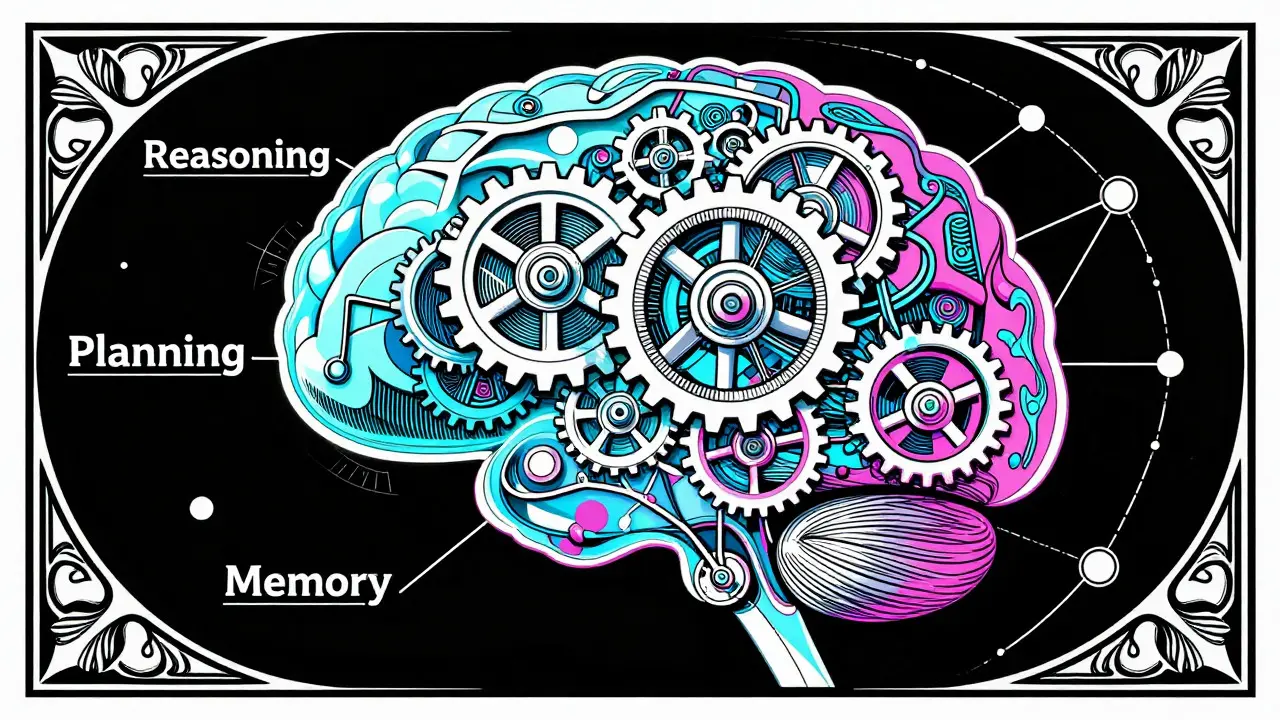
Technically, these agents rely on three core cognitive mechanisms detailed in recent arXiv reviews:
- Reasoning: Using chain-of-thought (CoT) training to break complex problems into smaller logical steps.
- Planning: Creating a sequence of actions to achieve a goal, often using long context windows (now up to 200,000 tokens) to keep track of the big picture.
- Memory: Storing past interactions and results to inform future decisions, allowing the agent to learn from its own mistakes within a session.
However, as Deloitte points out, current gen AI chatbots "lack the degree of agency and autonomy that agentic AI promises." Most systems today are hybrid-they automate parts of the workflow but still require human oversight for critical decisions. We are largely sitting at Level 1 and Level 2 of maturity, where automation is present but full independence is rare.
The Current State of Play: Who Is Building What?
The market for autonomous agents has split into two distinct camps. Understanding this divide helps you choose the right tool for your needs. On one side, you have specialized proprietary solutions. On the other, versatile open-source alternatives.
| Model/Platform | Type | Key Strength | Best Use Case |
|---|---|---|---|
| GPT-4o / GPT-5.1 | Proprietary | Advanced reasoning, robust function calling | Complex orchestration, general-purpose agents |
| Harvey AI | Specialized Proprietary | Legal domain expertise, validated by 200+ companies | Contract review, legal research |
| Qwen 2.5 | Open Source / Hybrid | Native cultural understanding, Asian market dominance | Regional business operations, multilingual support |
| LLaMA 3.3 | Open Source | Cost-effective, high MMLU score (83.6%) | Custom internal tools, data privacy-focused apps |
| EXAONE 3.0 | Specialized | 94% accuracy in technical/scientific tasks | Scientific research, engineering workflows |
Proprietary models like GPT-4o are often chosen because they offer "advanced reasoning" and seamless integration with external tools. They are the heavy lifters. Meanwhile, open-source models like LLaMA 3.3 have gained massive traction, with Hugging Face reporting over 500 million monthly downloads. This democratization means you don’t need a billion-dollar budget to experiment with agents anymore. You can run capable models locally, which is a huge win for data privacy.
Vertical specialization is also changing the game. Instead of one generic agent doing everything poorly, we see models optimized for specific domains. Harvey AI dominates legal services. EXAONE 3.0 leads in scientific research. If you are building an agent for a niche field, looking at these specialized models might yield better results than forcing a generalist model to do the job.
Capabilities: What Can They Actually Do Right Now?
Let’s talk about the wins. When configured correctly, autonomous agents can handle workflows that used to take hours of manual labor. Here are the most reliable capabilities as of mid-2026:
- Multimodal Analysis: Modern agents aren’t just text processors. Thanks to Large Multimodal Models (LMMs), they can recognize objects in images, read text from charts, and even process audio. Apideck notes that this allows agents to "process different types of data at the same time." Imagine an agent that watches a video tutorial, extracts the code snippets, tests them, and integrates them into your repository.
- Tool Use and Function Calling: Agents can interact with APIs. They can check inventory levels, update CRM records, or trigger Slack notifications. This is the bridge between thinking and acting.
- Adaptive Reasoning: MIT researchers recently developed techniques that allow LLMs to use "as little as one-half the computation as existing methods" while maintaining accuracy. This means agents can become faster and cheaper to run, making real-time decision-making more viable.
- Decomposition of Complex Tasks: An agent can take a vague goal like "optimize our ad spend" and break it down into: pull last month’s data, identify underperforming channels, calculate potential savings, and draft a report.
The shift from "orchestrated workflows"-where a big model directs smaller models-to single-agent systems is underway. As individual agents become more capable, the need for complex multi-agent hierarchies decreases. IBM’s Hay predicts that "individual agents get more capable," simplifying the architecture for developers.
The Limits: Where Agents Fail (And Why It Matters)
This is the part vendors rarely highlight in their demos. Autonomous agents are brittle. They excel in structured environments but crumble in chaos. Here are the hard limits you must respect:
1. The Hallucination Loop Even with improved reasoning, LLMs are probabilistic. They guess the next word. When an agent is given autonomy, a small hallucination early in a chain of thought can cascade into a catastrophic failure later. If an agent misreads a date in a contract, it might schedule a meeting for the wrong year. Without human-in-the-loop verification, these errors go unnoticed until they cause damage.
2. Overconfidence and Calibration Issues MIT researchers Park and Greenewald highlighted a critical issue: current models are often overconfident. They generate a single probability score for their answers, masking uncertainty. An agent might say, "I am 99% sure this code works," when it is actually guessing. New calibration methods are being developed to provide a range of probability scores, but widespread adoption is still pending.
3. Context Window Fatigue While context windows have expanded to 200,000 tokens, stuffing too much information into an agent’s memory degrades performance. The "needle in a haystack" problem persists. If you feed an agent a year’s worth of emails and ask it to find one specific detail, it may still miss it or retrieve irrelevant info. Memory management is a skill you must engineer, not just a feature you turn on.
4. Edge Cases and Unforeseen Scenarios IBM researcher Gajjar warns that handling complex decision-making requires "big leaps in contextual reasoning and testing for edge cases." Agents struggle when the rules change mid-task. If an API endpoint changes format unexpectedly, many agents will crash rather than adapt. They lack true common sense; they only have pattern matching.

Implementation Strategy: How to Build Safely
If you want to deploy autonomous agents, do not start with full autonomy. Start with assistance. Here is a pragmatic roadmap for 2026:
- Start with Single-Agent Systems: Don’t try to build a complex multi-agent society yet. Focus on one agent that does one job well. For example, an agent that exclusively handles customer ticket triage.
- Implement Human-in-the-Loop (HITL): For any action that has financial or reputational risk, require human approval. Use the agent to draft the action, then let a human click "Approve." This builds trust and catches errors.
- Use Structured Outputs: Force your agent to output data in JSON or XML formats rather than free text. This makes it easier to validate the agent’s logic programmatically before executing any tool calls.
- Leverage Open Source for Privacy: If you are dealing with sensitive data, consider fine-tuning models like LLaMA 3.3 or Mistral Large. Running inference locally keeps your data off third-party servers.
- Monitor for Drift: Agent performance degrades over time as underlying data changes. Set up monitoring to detect when an agent’s success rate drops below a certain threshold.
Documentation quality varies wildly. Academic frameworks like MetaGPT and CAMEL offer transparent insights into how agents communicate and reason. Commercial black-box solutions may be easier to integrate but harder to debug. Choose based on your team’s technical capacity.
Future Outlook: The Next 12 Months
We are entering a period of rapid consolidation. Capitole Consulting predicts four accelerating trends for late 2026:
- Sophisticated Personalization: Agents will remember your preferences and working style, adapting their tone and output format automatically.
- Domain-Specific Specialization: Generalist agents will lose ground to vertical specialists in law, medicine, and engineering.
- Complete Democratization: Tools will make it possible for non-coders to build simple agents using natural language instructions.
- Multi-LLM Collaboration: Agents will dynamically switch between different models based on the task-using a cheap model for simple queries and a powerful model for complex reasoning.
The computational cost bottleneck is easing thanks to adaptive reasoning techniques. This means agents will become faster and cheaper to run. However, the fundamental challenge remains: trust. Until we solve verifiable reasoning-the ability for an agent to prove *why* it made a decision-full autonomy will remain risky for high-stakes industries.
For now, treat autonomous agents as powerful co-pilots, not autopilots. They can do the heavy lifting, but you must keep your hands on the wheel.
Are autonomous agents ready for enterprise production use?
Mostly yes, but with caveats. As of Q1 2025, AWS Insights reports that most agentic AI applications remain at Level 1 and 2 maturity. This means they are great for automating discrete, low-risk tasks like data entry or initial customer screening. For high-stakes decisions involving finance or compliance, human oversight is still essential due to risks of hallucination and overconfidence.
What is the difference between a chatbot and an autonomous agent?
A chatbot is reactive; it responds to prompts with information. An autonomous agent is proactive; it has goals and can use tools to achieve them. For example, a chatbot can tell you the weather. An agent can check the weather, see it’s raining, and automatically reschedule your outdoor event on your calendar.
Which LLM is best for building autonomous agents?
It depends on your needs. For general-purpose reasoning and robust tool integration, proprietary models like GPT-4o or GPT-5.1 are top choices. For data privacy and cost control, open-source models like LLaMA 3.3 or Mistral Large are excellent. For specialized fields, consider domain-specific models like Harvey AI for legal tasks or EXAONE 3.0 for scientific research.
How do I prevent my AI agent from hallucinating?
You can’t eliminate hallucinations entirely, but you can mitigate them. Use Retrieval-Augmented Generation (RAG) to ground the agent in verified data. Implement structured outputs so you can validate logic programmatically. Finally, always include a human-in-the-loop for critical actions. Recent MIT research also suggests using calibration methods that provide probability ranges rather than single confident scores.
What are the biggest security risks of autonomous agents?
The main risks are unauthorized actions and data leakage. Since agents can interact with APIs and databases, a poorly constrained agent could delete records or expose sensitive information. Always apply the principle of least privilege-give the agent only the permissions it strictly needs. Monitor agent activity logs closely for unusual patterns.
Will autonomous agents replace human workers?
Not immediately. Deloitte notes that while agents can automate workflows, they lack the contextual nuance and accountability required for many roles. In the short term, agents will augment human workers by handling repetitive tasks, freeing up humans for strategic decision-making. Full replacement is unlikely without significant leaps in reliability and ethical reasoning.
What is "adaptive reasoning" in LLMs?
Adaptive reasoning is a technique developed by MIT researchers that allows LLMs to adjust their computational effort based on the difficulty of the question. This can reduce computation costs by up to 50% while maintaining accuracy. It makes running autonomous agents more efficient and affordable, addressing a major bottleneck in deployment.