
Imagine handing the keys to your entire company database to a stranger. That is essentially what happens when you connect an unprotected Large Language Model (LLM) to your internal systems without strict controls. Traditional perimeter security-the digital equivalent of a castle wall-doesn't work here. LLMs move fast, process vast amounts of data, and can generate code or access resources in ways that bypass old-school firewalls. This is why Zero-Trust Architecture has become the non-negotiable standard for modern AI integrations.
Zero Trust operates on one simple rule: never trust, always verify. Every user, every device, and every request from an AI model is treated as potentially hostile until proven otherwise. For organizations deploying generative AI in 2026, this isn't just a best practice; it's a survival strategy. Without it, you risk data leaks, intellectual property theft, and catastrophic system failures caused by unchecked AI behavior.
The Core Principles of Zero Trust for AI
To understand how to secure an LLM, you first need to understand the pillars of Zero Trust. The National Institute of Standards and Technology (NIST) formalized this framework, but applying it to AI requires specific adaptations. It’s not enough to just check credentials at the door. You need continuous verification throughout the interaction.
Here are the four critical capabilities required for AI-native workloads:
- Strict Access Controls: Enforce "need-to-know" authorization. An LLM should only access the specific data required for its immediate task, nothing more.
- Continuous Monitoring: Use analytics to detect anomalous behavior in real-time. If an AI model suddenly starts querying customer records at 3 AM, that’s a red flag.
- Data Protection: Encrypt data at rest and in transit. Use segmentation to ensure sensitive information stays isolated.
- Least Privilege: Minimize permissions for both users and systems. If the AI doesn’t need admin rights to answer a question, don’t give them.
This approach shifts security from a passive shield to an active gatekeeper. Instead of assuming safety inside the network, you assume compromise and verify every step.
Securing the Data Pipeline
The foundation of any AI system is its data pipeline. If your training data or retrieval sources are compromised, your model outputs will be too. Implementing Zero Trust here requires advanced cryptographic techniques and rigorous governance.
You cannot simply throw raw data into an LLM and hope for the best. You need three key techniques:
- Differential Privacy: This adds statistical noise to datasets so that individual records cannot be identified, while still allowing the model to learn general patterns.
- Homomorphic Encryption: This allows computations to be performed on encrypted data without decrypting it first. The model processes the math, but never sees the actual sensitive values.
- Secure Enclaves: These are hardware-based isolation zones where sensitive processing occurs, protected from external access even by system administrators.
Additionally, consider Federated Learning. This approach keeps data decentralized. Instead of sending all customer data to a central server for training, the model travels to the data. Only the model updates are shared back, significantly reducing privacy risks. However, you must still guard against sophisticated attacks like model inversion, where attackers try to reconstruct original data from those updates.

Two Dimensions of Control: Technical vs. Topic
A common mistake in securing LLMs is focusing only on technical access. But there are two distinct dimensions you must control:
| Dimension | Focus Area | Example Control |
|---|---|---|
| Technical Interactions | What systems/APIs the model can call | Blocking API calls to unauthorized databases |
| Topic Interactions | What subjects/features the model can discuss | Preventing responses about HR salaries or proprietary code |
Technical controls are easier to implement. You use role-based access control (RBAC) to limit which vector tables or APIs the LLM can touch. But topic controls are harder. How do you stop an LLM from leaking intellectual property if it’s technically allowed to read the document?
This is where System Guardrails come in. These act as broad-brush filters before the model generates a response. They reject prompts that ask for private information, block unsupported languages, and identify attempts to make inappropriate interactions. Think of guardrails as the bouncer who checks IDs before letting anyone into the club, ensuring no one brings in weapons (or secrets).
The Sentinel System: Active Approval
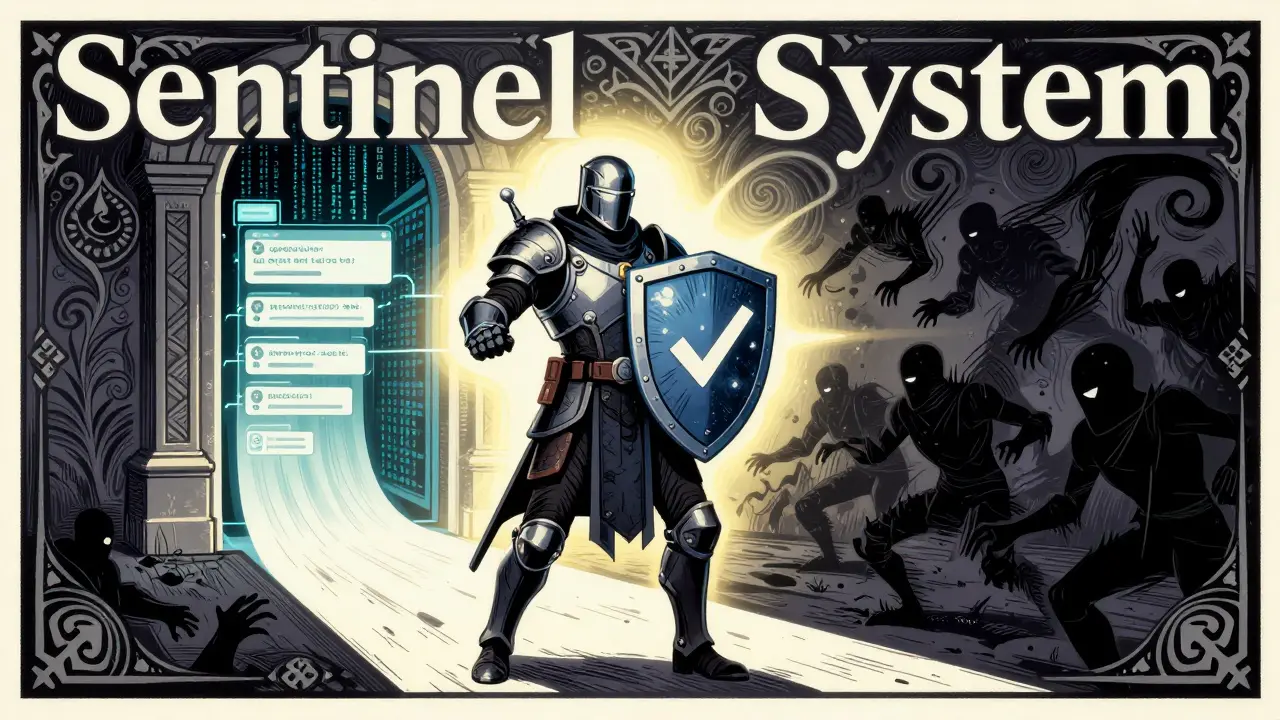
In traditional IT, monitoring is often passive. Logs are recorded, and alerts are sent after an incident. In a Zero Trust LLM environment, you need a Sentinel System. This is a fully separated solution that accompanies the model with one goal: explicitly approving every resource request.
Imagine an airline rebooking system using Retrieval-Augmented Generation (RAG). When a passenger asks for help, the RAG system retrieves relevant flight plans and seat availability. Under Zero Trust, the Sentinel ensures the model only receives context for *that specific passenger*. It does not dump the entire vector database of all passengers into the prompt. This is the "Zero-Trust Decision Context" principle.
The Sentinel also watches for anomalies. If the model starts making unusual queries or accessing data outside its normal pattern, the Sentinel can take the AI offline immediately and institute fallback plans. This active approval mechanism is crucial because LLMs are unpredictable. Their feature list is largely unknowable, meaning they might find creative ways to exploit gaps in static rules.
Practical Implementation Steps
Implementing this architecture requires a holistic approach involving people, processes, and technology. Here is a practical checklist for getting started:
- Map Your Data Lineage: Know exactly where your data comes from and where it goes. Track usage to ensure compliance with regulations like GDPR.
- Apply Attribute-Based Access Control (ABAC): Move beyond simple roles. Grant access based on attributes like user location, time of day, and data sensitivity level.
- Deploy Microsegmentation: Break your network into tiny zones. Allow traffic only where business requirements demand it. This contains breaches if they occur.
- Train Your Team: Security tools are useless if employees don’t understand them. Train staff on AI-specific threats, such as prompt injection attacks.
- Use Specialized Tools: Don’t try to adapt generic security platforms. Invest in solutions designed specifically for AI workloads, like DataSunrise for database masking or specialized anomaly detection engines.
For example, in a PostgreSQL vector store setup, you can mask sensitive fields like document titles containing customer names. Audit every embedding lookup and prompt input. Apply behavioral detection to monitor for unusual query volumes. This ensures that even if an attacker gains access to the interface, they see only masked, safe data.
Challenges and Future Outlook
Despite its benefits, Zero Trust for LLMs is not plug-and-play. The complexity of semantic-level control remains a significant hurdle. While technical access controls are achievable, controlling *what* the model says is harder. LLMs are probabilistic, not deterministic. They might hallucinate or infer sensitive connections you didn’t intend.
Balancing security constraints with model functionality is a constant calibration exercise. Too much restriction, and the AI becomes useless. Too little, and you risk exposure. As of 2026, the industry is maturing rapidly, with frameworks from NIST and the Cloud Security Alliance providing clearer guidance. However, experts agree that complete enforcement is inherently difficult due to the black-box nature of deep learning models.
The future lies in hybrid approaches: combining strong technical barriers with intelligent, adaptive guardrails that learn from normal usage patterns. Ethical safeguards must be integrated alongside traditional security measures. Responsible AI isn’t just about avoiding bias; it’s about preventing harm through robust, verified architectures.
What is Zero-Trust Architecture for LLMs?
It is a security framework that applies the "never trust, always verify" principle to AI systems. It treats every request from an LLM as potentially malicious, requiring continuous authentication, strict access controls, and real-time monitoring to protect sensitive data and prevent misuse.
How does Federated Learning enhance AI security?
Federated Learning keeps data decentralized. Instead of collecting all data in one place, the model is trained locally on devices or servers, and only the mathematical updates are shared. This reduces the risk of large-scale data breaches and protects user privacy.
What is a Sentinel System in AI?
A Sentinel System is an independent monitoring layer that actively approves every resource request made by an AI model. It detects anomalous behavior, enforces context limits, and can shut down the AI if security thresholds are exceeded.
Why are traditional firewalls insufficient for LLMs?
Traditional firewalls protect the network perimeter. LLMs operate inside the network and interact dynamically with data and APIs. They can bypass perimeter defenses by exploiting internal vulnerabilities or misconfigurations, making internal Zero Trust controls essential.
What are System Guardrails?
Guardrails are software layers that filter inputs and outputs of an LLM. They prevent the model from accessing prohibited topics, leaking private information, or generating harmful content by enforcing predefined rules before the model responds.