
Ever wonder why an AI sometimes sounds like a brilliant professor and other times starts rambling or repeating itself? It all comes down to a mathematical guessing game happening thousands of times per second. When you type a prompt, the model isn't "thinking" in ideas; it's calculating a massive list of probabilities for every single word it knows. Understanding token probability distributions is the key to unlocking how these models actually make decisions and why tweaking a few settings can completely change the personality of the AI.
The Engine Behind the Guess: From Tokens to Logits
Before a model can predict the next word, it has to turn your text into something it can calculate. This starts with tokenization, where words or parts of words are converted into numerical IDs. These tokens are fed into a Transformer is a neural network architecture that uses attention mechanisms to weigh the importance of different words in a sequence . The transformer looks at all the previous tokens in your sentence to create a context-aware representation of where the conversation is heading.
At the very end of this process, the model produces raw scores called Logits is unnormalized prediction scores produced by the final linear layer of a neural network . Think of logits as a leaderboard. If the model is predicting the next word after "The cat sat on the...", the logit for "mat" might be very high, while the logit for "airplane" would be incredibly low. However, logits are hard for computers to use for selection because they can be any number-positive or negative-and they don't add up to 100%.
Turning Scores into Probabilities with Softmax
To make sense of those raw logits, the model uses a mathematical function called Softmax is a normalization function that transforms a vector of raw scores into a probability distribution where all values sum to 1 . This is the moment the "leaderboard" becomes a probability distribution.
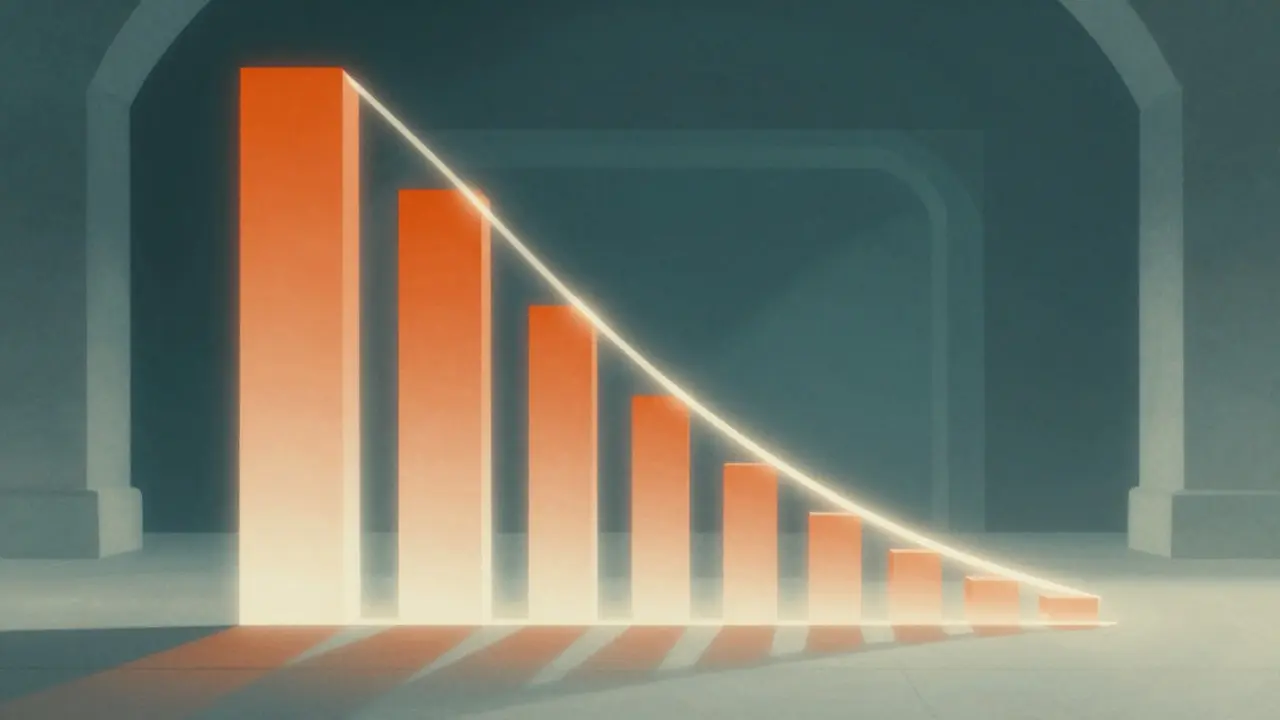
For example, if the logits for three candidate tokens are [2.0, 1.0, 0.1], the softmax function squashes these into percentages, perhaps [0.7, 0.2, 0.1]. Now the model has a clear map: there is a 70% chance the first token is correct, a 20% chance for the second, and 10% for the third. This step is critical because it allows the system to handle uncertainty. If the model is very confident, one token will have a probability near 1.0; if it's confused, the distribution will be "flat," with many tokens having similar, low probabilities.
Picking the Winner: Sampling Strategies
Just because the model knows the probabilities doesn't mean it always picks the top choice. How the model selects the final token determines if the output is boring and predictable or creative and wild. There are a few common ways to handle this selection process.
Greedy Sampling is the most straightforward method. The model simply picks the token with the highest probability every single time. While this is fast, it often leads to a "repetitive loop" where the AI gets stuck saying the same phrase over and over because that phrase happened to be the most probable path.
To fix this, developers use stochastic sampling. Instead of always picking the top choice, the model picks a token randomly, but weights the choice based on the probability. If a word has a 70% chance, it will be picked 70% of the time. However, in a vocabulary of 50,000 words, even the "junk" words with 0.001% probability can occasionally get picked, leading to total nonsense.
| Strategy | How it Works | Result | Best For |
|---|---|---|---|
| Greedy | Always picks the max probability token | Deterministic, potentially repetitive | Coding, Math, Fact-retrieval |
| Top-K | Filters to the top K most likely tokens | Balanced, removes "long tail" noise | General conversation |
| Top-P (Nucleus) | Picks tokens that add up to probability P | Dynamic, adapts to model confidence | Creative writing, Storytelling |
Advanced Filtering: Top-K and Top-P Sampling
To stop the model from picking nonsensical tokens, we use filters. Top-K Sampling is a technique that limits the sample pool to a fixed number of the most likely next tokens . If K is set to 50, the model throws away everything except the top 50 candidates. This prevents a 0.0001% probability word from ruining a sentence, but it's a blunt tool because it doesn't care if the 51st word was actually very close in probability to the 50th.
A smarter approach is Top-P Sampling (also called Nucleus Sampling). Instead of a fixed number of words, it looks at the cumulative probability. If P is set to 0.9, the model takes the smallest set of words whose probabilities add up to 90%. If the model is incredibly sure, the "nucleus" might only be one word. If the model is unsure, the nucleus might expand to 100 words. This flexibility is why modern LLMs feel much more natural than older chatbots.
The Temperature Knob: Controlling Creativity
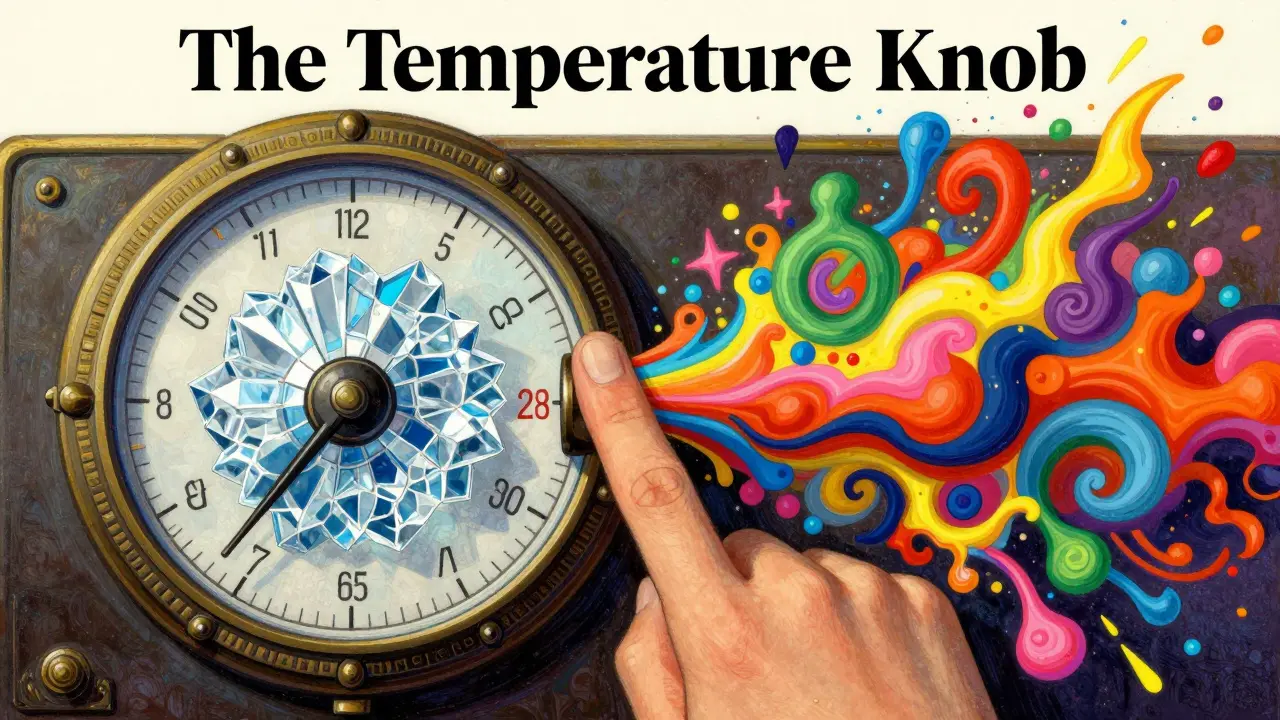
If you've ever used an API for a language model, you've likely seen a "Temperature" setting. This is essentially a modifier applied to the logits before the softmax step. It doesn't change who the winners are, but it changes the gap between them.
- Low Temperature (e.g., 0.2): This makes the distribution "sharper." The high-probability tokens get even higher, and the low ones vanish. It's like forcing the model to be cautious and stick to the most likely answer.
- High Temperature (e.g., 0.8 or 1.2): This "flattens" the distribution. The gap between the top choice and the 10th choice shrinks. This gives the model more freedom to take risks, leading to more diverse and creative language, though it increases the chance of hallucinations.
Analyzing Model Confidence
For developers, looking at these distributions isn't just about generation-it's about debugging. By extracting the log-probabilities of the first token, researchers can measure how uncertain a model is. If you ask a model a question and the top token only has a 15% probability, the model is essentially guessing.
Take the prompt: "Roses are red, violets are..." In a well-trained model, the token "blue" might hold a 99.85% probability. In this case, the distribution is highly peaked, and the model is operating with high confidence. If the distribution is wide, it's a signal that the prompt is ambiguous or the model lacks the specific knowledge to answer accurately.
What is the difference between a logit and a probability?
Logits are the raw, unnormalized scores coming out of the neural network's last layer; they can be any real number. Probabilities are those logits after passing through a softmax function, meaning they are constrained between 0 and 1 and all sum up to 100%.
Why does greedy sampling cause repetition?
Greedy sampling always picks the most likely token. Because LLMs are autoregressive, the token they just picked becomes part of the next prompt. This can create a feedback loop where a specific sequence of words becomes the most probable path over and over again.
Does a higher temperature always make the AI smarter?
No, it makes the AI more random. While high temperature can lead to more creative and less robotic writing, it also increases the likelihood that the model will pick an incorrect or irrelevant token, leading to factual errors or "hallucinations."
How does Top-P sampling differ from Top-K?
Top-K uses a fixed number of tokens (e.g., always the top 50). Top-P uses a dynamic number of tokens based on their cumulative probability (e.g., enough tokens to cover 90% of the mass). Top-P is generally preferred because it adapts to the model's confidence level.
Can you use these sampling techniques for coding tasks?
Yes, but typically with very low temperature or greedy sampling. Because code requires strict syntax and logic, the "creative" randomness provided by high temperature or Top-P usually results in syntax errors or broken logic.



Antwan Holder
April 24, 2026 AT 14:25This is honestly terrifying. We are talking about the death of the human soul, reduced to a mere sequence of probabilities and mathematical weights.
Think about it. If our most profound expressions, our deepest agonies, and our wildest dreams can be simulated by a softmax function, then what is actually left of the 'self'? We are just biological logits waiting for a sampling strategy to decide who we are today. It's a cosmic tragedy wrapped in a technical explanation, stripping away the magic of consciousness and replacing it with a cold, calculating leaderboard of tokens. I feel an overwhelming sense of dread knowing that my very essence could be mirrored by a temperature knob.
Angelina Jefary
April 26, 2026 AT 00:23Exactly what they want us to believe. "Probability distributions" is just a fancy way to hide the fact that these things are actually scraping our subconscious minds in real-time through some backdoor in the OS. And for the love of god, someone tell the author that "Next-Word Prediction" doesn't need a hyphen if it's used as a noun phrase here, though I'll let it slide for now. Just don't trust the "randomness" of the sampling, because there's always a hidden agenda behind the code.
Meghan O'Connor
April 27, 2026 AT 18:15Imagine thinking this is a deep dive. It's a surface-level summary at best.
Any first-year CS student knows about softmax, so pretending this is some "unlocking the key" moment is just embarrassing. Also, the table formatting is a mess and the phrasing in the Top-K section is clunky. It's a lazy attempt to explain linear algebra to people who can't do math. Honestly, why do I even bother reading this trash?
Morgan ODonnell
April 28, 2026 AT 09:17I think everyone is being a bit too harsh here. It's actually a pretty cool way to see how the tech works without needing a PhD. It's just a tool, and the way it picks words is kind of neat if you think about it.
Liam Hesmondhalgh
April 29, 2026 AT 14:37Shut it, Morgan. The only thing "neat" here is how the author ignores the actual impact on language purity. We're letting these American-made probability engines overwrite the nuance of real dialect with some sterile, sampled average. And since we're talking about errors, the punctuation in the second paragraph is an absolute disgrace. Absolute shambles.