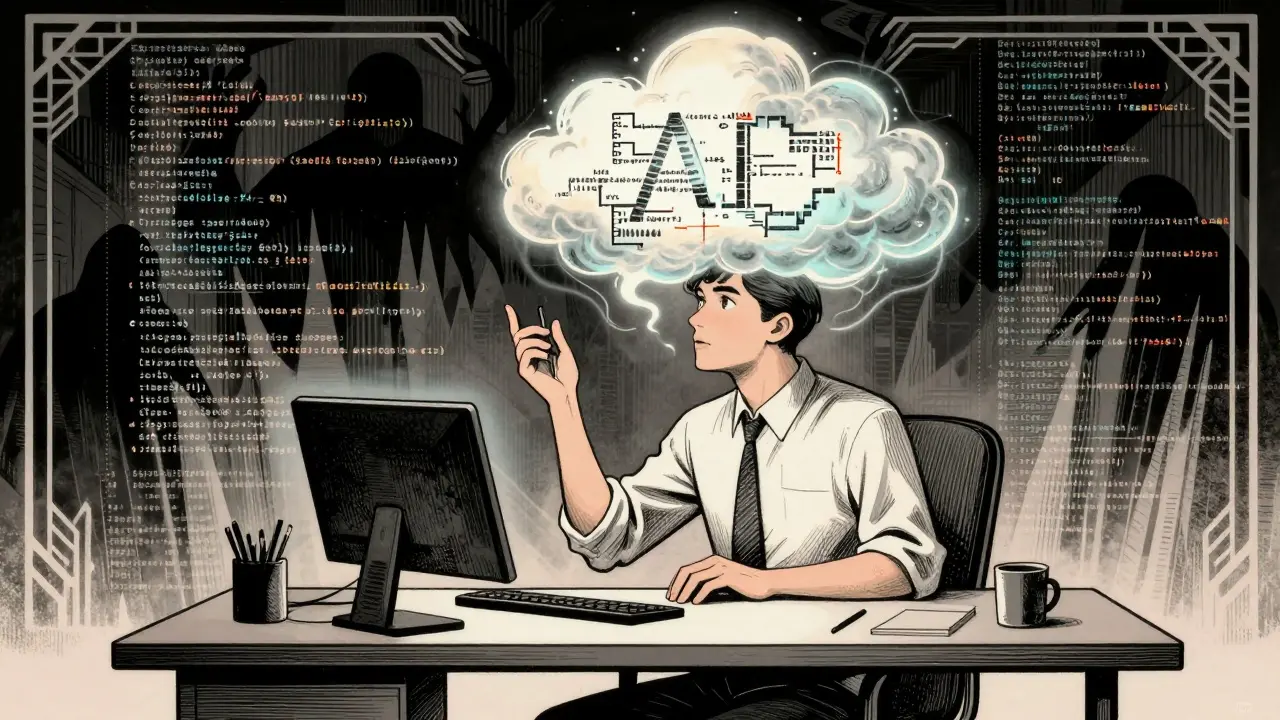
Remember when writing code meant typing every line yourself? That era is fading fast. In 2025, vibe coding emerged as a dominant development paradigm where developers describe functionality in natural language to large language models (LLMs), letting the AI generate the entire application structure. It’s fast. It’s intuitive. And it is incredibly dangerous if you don’t know what you’re looking at.
The problem isn’t that vibe coding fails; it’s that it succeeds too quickly. Research from New York University and benchmark analyses like BaxBench show that between 40% and 62% of AI-generated code contains security flaws. When you skip the manual review step-the traditional safety net-you aren’t just speeding up development; you’re accelerating the deployment of vulnerabilities. This guide walks you through a lightweight threat modeling workshop designed specifically for this new reality.
Why Traditional Threat Modeling Fails Vibe Coding
Traditional threat modeling assumes a linear process: design, code, review, test. Vibe coding shatters this timeline. Developers iterate in minutes, not days. If you try to force a heavy, document-heavy threat modeling process into this workflow, it becomes a bottleneck that teams bypass entirely.
Contrast Security noted in 2024 that vibe coding creates a workflow incompatible with legacy security gates like static scanning. The code changes so rapidly that by the time a scan finishes, the codebase has already moved on. Worse, developers often lack the deep technical knowledge to evaluate the AI’s output. They trust the "vibe"-the fact that the app works-rather than the architecture. This leads to applications with complex logical flaws that function perfectly during testing but collapse under attack at runtime.
The goal of this workshop isn’t to slow down development. It’s to build a mental model that allows developers to spot red flags before they hit production. We need to shift from "Is this code correct?" to "What can an attacker do with this code?"
Workshop Phase 1: Mapping the Invisible Attack Surface
In vibe-coded apps, the attack surface is often invisible because the developer didn’t build the infrastructure manually. You might have clicked "deploy" on a platform like Lovable or Cursor, but did you know what APIs were exposed?
Exercise: The Asset Extraction Drill
Start your workshop by taking a recently vibe-coded application and mapping its external footprint. Use tools similar to Escape Tech’s Visage Surface scanner to identify:
- All exposed hosts and web applications.
- Hidden APIs and endpoints that weren’t explicitly requested.
- Metadata leaks, including WAF configurations, cloud provider details, and framework versions.
Escape Tech found over 2,000 vulnerabilities across 14,600 scanned assets from vibe-coded apps. Many of these were simple misconfigurations left behind by AI defaults. For example, Supabase API routes often expose anonymous JWT tokens in Lovable web apps. If you don’t know these exist, you can’t secure them. This exercise forces the team to confront the reality that "it works" does not mean "it is secure."

Workshop Phase 2: Hunting for Logic Flaws
Static Application Security Testing (SAST) tools struggle with AI-generated code because they look for known patterns. Vibe coding generates unique, often convoluted logic that doesn’t match standard vulnerability signatures. The real danger lies in business logic errors.
Exercise: The "Happy Path" Breaker
Take a core feature of your app-say, a user checkout flow-and ask: "How can I break this without breaking the UI?"
- Can a user modify the price parameter in the request body?
- Does the AI-generated code verify ownership of the resource being accessed?
- Are there race conditions where two requests processed simultaneously bypass validation?
Databricks documented a case where a vibe-coded snake battle arena game contained arbitrary code execution vulnerabilities despite functioning correctly. These are logic flaws, not syntax errors. Your workshop must teach participants to think like attackers who understand consequences, whereas AI only understands syntax.
Workshop Phase 3: Defending Against Slopsquatting
A new threat specific to AI-assisted development is "slopsquatting." Attackers monitor for AI hallucinations-instances where the LLM suggests a package name that sounds legitimate but doesn’t exist or points to a malicious repository. They then create packages with those names, embedding backdoors.
Exercise: Package Verification Audit
Guide your team through vetting third-party dependencies introduced by the AI.
- Check the origin of every npm/pip/package installed.
- Verify the maintainer’s history and reputation.
- Look for recent spikes in downloads or unusual commit patterns.
GuidePoint Security warned in May 2025 that if organizations don’t have integrated AppSec controls, malicious code may not be discovered until after deployment. Since vibe coders often accept AI suggestions blindly, this manual verification step is critical.

Workshop Phase 4: Implementing Runtime Protection
You cannot catch everything in pre-production. With vibe coding, the code changes too fast. You need visibility in production.
Strategy: Shift-Right Monitoring
Introduce concepts like Application Vulnerability Monitoring (AVM), used by platforms like Contrast. Unlike static scans, AVM works inside live applications to identify vulnerabilities as code executes. It detects anomalies in behavior rather than just matching code patterns.
Teach your team to implement automated remediation loops. When a vulnerability is flagged in the CI/CD pipeline, the system should automatically recommend training labs or fixes. SecureFlag’s ThreatCanvas approach integrates with vulnerability scanners using SARIF formats to provide hands-on learning moments directly within the development workflow.
| Approach | Effectiveness in Vibe Coding | Key Limitation | Best Use Case |
|---|---|---|---|
| Static Analysis (SAST) | Low | High false positives; misses logic flaws | Catch basic syntax errors |
| Dynamic Testing (DAST) | Medium | Struggles with complex business logic | Identify exposed endpoints |
| Runtime Monitoring (AVM) | High | Requires instrumentation | Detect exploitation attempts |
| Lightweight Threat Modeling | High | Requires cultural shift | Prevent architectural flaws |
Practical Tips for Facilitators
Running this workshop requires a different tone than traditional security training. Avoid jargon. Focus on speed and validation.
- Use Real Examples: Reference the early 2025 incident where a "vibe coder" revealed his SaaS platform was under attack due to lack of security knowledge. Make it relatable.
- Emphasize Least Privilege: Teach developers to ensure AI-generated code runs with minimum privileges needed. This limits damage if a flaw is exploited.
- Create a Feedback Loop: Integrate findings directly into the prompt engineering process. If the AI generates insecure code, refine the prompt to include security constraints.
Speed without validation is risk. By incorporating these lightweight threat modeling practices, you empower your team to move fast without leaving the door open for attackers.
What is vibe coding and why is it risky?
Vibe coding is a development method where users describe desired functionality in natural language to LLMs, which then generate the code. It is risky because it bypasses traditional code review, leading to high rates of security flaws (40-62%) that are often logical rather than syntactic, making them hard to detect with standard tools.
How does threat modeling differ for AI-generated code?
Traditional threat modeling focuses on static architecture. For AI-generated code, it must focus on dynamic validation and logic flaws. Since AI lacks understanding of consequences, threat modeling must emphasize identifying hidden APIs, verifying third-party packages, and monitoring runtime behavior rather than just reviewing source code.
What is slopsquatting?
Slopsquatting is an attack vector where attackers monitor for AI hallucinations regarding package names. They create malicious packages with similar names to legitimate ones, tricking the AI into suggesting them. This introduces backdoors into the application before deployment.
Why do static scanners fail against vibe-coded apps?
Static scanners rely on known vulnerability patterns. AI-generated code often uses unique, complex logic structures that don't match these patterns. Additionally, the rapid iteration cycle of vibe coding means the codebase changes faster than scans can complete, rendering results obsolete quickly.
How can I integrate threat modeling into a fast-paced workflow?
Use lightweight workshops focused on asset mapping and logic breaking. Integrate automated runtime monitoring (like AVM) to catch issues in production. Embed security checks into the CI/CD pipeline using SARIF standards to provide immediate feedback without slowing down development significantly.