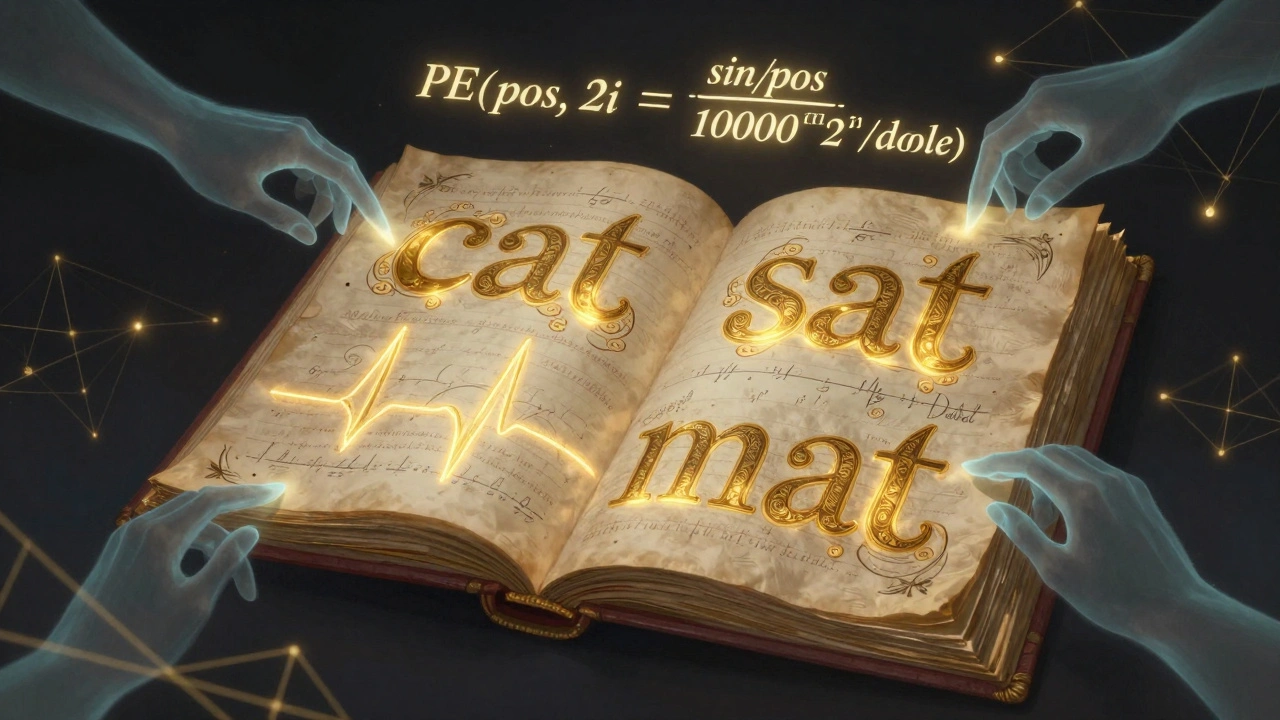
When you read a sentence like "The cat sat on the mat," your brain doesn’t treat each word as a separate puzzle piece. You know "cat" is the subject, "sat" is the action, and "mat" is where it happened - because of order. But transformers? They start with no idea of order. That’s where positional encoding comes in.
Without it, a transformer sees "The cat sat on the mat" and "mat the on sat cat The" as identical. That’s not useful for language. So in 2017, the original Transformer paper introduced two ways to fix this: sinusoidal encoding and learned positional embeddings. Today, nearly every major LLM uses something better. But understanding these two original methods is still key - because they’re the foundation of everything that came after.
How Sinusoidal Encoding Works (The Math Behind the Magic)
Sinusoidal encoding doesn’t learn anything. It’s a fixed pattern, built with sine and cosine waves. For each position in a sequence - say, the 15th word - it calculates a unique vector using this formula:
PE(pos, 2i) = sin(pos / 10000^(2i/d_model))
PE(pos, 2i+1) = cos(pos / 10000^(2i/d_model))
Here, pos is the position number, i is the dimension index, and d_model is the size of your embedding (usually 512 or 1024). The result? Each position gets a fingerprint made of waves. Even positions use sine, odd ones use cosine. The frequency changes across dimensions - low frequencies for long-range patterns, high frequencies for fine details.
Why does this matter? Because the difference between any two positions becomes a smooth, predictable function. If you know the distance between two words - say, 3 steps apart - you can compute their relative position without storing any extra data. That’s why the original authors thought it could handle sequences longer than those seen during training. It’s math, not memory.
But here’s the catch: real-world performance drops hard when you go beyond 2048 tokens. GPT-2’s perplexity jumped from 20.5 to 32.1 when moving from 1024 to 2048 tokens on Penn Treebank. That’s not a small glitch - it’s a collapse. And if you try to run a model trained on 512 tokens on a 4096-token document? It doesn’t just get worse. It starts hallucinating.
Learned Positional Embeddings: Simple, But Limited
Learned embeddings are simpler to understand. Think of them like a lookup table. You create a matrix with 512 rows (for a 512-dim embedding) and, say, 1024 columns (for 1024 possible positions). Each row is a vector. During training, the model adjusts these vectors like any other parameter. No math. Just gradients and backpropagation.
It works great - if your sequence length never changes. GPT-3 started with a 2048-token limit. When they needed 8192, they couldn’t just extend the table. They had to retrain the whole model from scratch. That’s expensive. And if you fine-tune a model on medical reports with 3000 tokens, but your original embedding table only goes to 2048? You’re stuck.
Some models still use this. ChemBERTa, for example, deals with molecular structures that are always 64 tokens long. No need to extrapolate. Learned embeddings work fine there. But for anything that needs to read a 10,000-word contract, a 50-page research paper, or a full legal transcript? Learned embeddings are a dead end.
Why Both Are Outdated - And What Replaced Them
By 2023, nearly every major LLM had moved on. Llama, PaLM, Gemini, MPT - none use vanilla sinusoidal or learned embeddings anymore. Why? Because they couldn’t scale.
Two techniques took over: Rotary Position Embedding (RoPE) and ALiBi.
RoPE, introduced in 2021, rotates the query and key vectors in attention using complex numbers. Instead of adding position info, it changes how tokens interact based on their relative distance. The math looks scary - q_m^T k_n = cos(mθ - nθ) - but the effect is simple: attention scores naturally favor nearby tokens, and the model can extrapolate to much longer sequences without retraining. Llama 2 handled 4096 tokens. Llama 3 handles 1 million. With RoPE scaling, it only loses 15% performance at that length. Sinusoidal encoding? It loses 60%.
ALiBi is even simpler. It doesn’t add any embeddings at all. Instead, it subtracts a linear bias from attention scores: attention_score = original_score - |i-j| * α. The closer two tokens are, the less penalty they get. The farther apart, the more the attention is dampened. No extra parameters. No rotation matrices. Just one scalar per attention head. Google and EleutherAI used it to push context windows to 8192 tokens without fine-tuning. On LM1B, it beat sinusoidal encoding by 2.1 perplexity points.

Performance Comparison: Numbers Don’t Lie
Let’s look at real benchmarks:
| Method | Max Context (Tokens) | Performance at 2x Length | Training Overhead | Implementation Complexity |
|---|---|---|---|---|
| Sinusoidal Encoding | 512-2048 | 60-70% drop | None | Low |
| Learned Embeddings | Fixed (e.g., 2048) | 0% (can’t extend) | High (retrain needed) | Low |
| RoPE | 4096-1,000,000 | 90-92% retained | +15% compute | Medium |
| ALiBi | 8192+ | 95% retained | +1-2% compute | Very Low |
On the LRA benchmark, RoPE scored 5.8% higher than sinusoidal encoding. In the WMT English-German translation task, RoPE-powered models hit 28.3 BLEU. Sinusoidal? 27.1. Learned? 27.5. The gap isn’t huge on short tasks - but on long documents? It’s the difference between coherent summaries and nonsense.
Real-World Trade-Offs: What Developers Actually Experience
On GitHub, developers report RoPE takes 2-3 days to integrate. One engineer spent 3 person-days fixing dimension mismatches in rotation matrices. But they got a 22% improvement in long-context QA accuracy. Another team switched from learned embeddings to RoPE and cut hallucinations by 14% on legal documents.
ALiBi? One developer said it took five lines of code. No new parameters. No complex math. Just subtract a bias. They kept 97% of RoPE’s performance on medical texts. That’s why companies with limited engineering teams - or tight deadlines - are choosing ALiBi.
But it’s not perfect. RoPE can break with small batch sizes (<4). ALiBi’s bias term needs careful tuning - too high, and the model ignores distant tokens entirely. One fintech team found that switching from learned to sinusoidal encoding for short financial sequences actually hurt accuracy by 3.2%. Why? Because the model had learned position-specific patterns in their domain. Fixed encoding erased that.

What’s Next? The Future of Positional Encoding
Google’s PaLM 2 introduced Adaptive RoPE, which adjusts rotation frequencies based on the input. Meta’s Llama 3 uses RoPE Scaling to handle 1M-token contexts. Microsoft is experimenting with Neural Positional Encoding - a tiny neural net that generates position info on the fly, based on content.
But here’s the quiet truth: we might not need explicit positional encoding much longer. Some researchers believe the next breakthrough will be architectures where position is built into the attention mechanism itself - not added as a separate component. RoPE and ALiBi are stopgaps. They’re brilliant, but they’re still patches on a design that was never meant to scale.
For now, if you’re building an LLM? Skip sinusoidal and learned embeddings. Use RoPE if you have the engineering bandwidth. Use ALiBi if you want simplicity and speed. Both are better than anything from 2017.
Frequently Asked Questions
Why did the original Transformer paper use sinusoidal encoding if it’s so limited?
The original authors chose sinusoidal encoding because it theoretically supports arbitrary sequence lengths without extra parameters. They didn’t expect models to need context windows beyond 512 tokens. Back then, even 1024 was considered long. It was a clever, mathematically elegant solution for the hardware and use cases of 2017 - not a prediction of future needs.
Can I still use learned positional embeddings today?
Only if your sequence length is fixed and short - like 64 tokens for molecular data or 128 for sentiment analysis. For anything longer, or if you plan to scale later, avoid them. They force you to retrain when context length changes, which is expensive and inflexible.
Is RoPE better than ALiBi?
RoPE generally performs better on benchmarks and handles longer sequences more reliably. But ALiBi is easier to implement, requires no extra parameters, and adds almost no compute cost. If you’re deploying in production with limited resources, ALiBi is often the smarter choice. It’s not about which is "better" - it’s about what fits your constraints.
Do I need to understand linear algebra to use RoPE?
You don’t need to derive the math, but you do need to understand how rotation matrices affect vector dimensions. Most libraries (like Hugging Face) now include built-in RoPE support. But if you’re building from scratch, you’ll hit dimension mismatches without knowing how the rotation is applied across heads and layers. Six months of transformer experience is a good baseline.
Why are some models still using sinusoidal encoding?
Legacy systems. Educational examples. And some small research models that never needed long context. But in industry? It’s rare. By 2025, only 28% of transformer implementations used sinusoidal encoding, down from 80% in 2020. It’s becoming a historical footnote.
What’s the biggest risk with modern positional encodings like RoPE?
Position hallucination. Stanford’s HAI lab found that RoPE-based models sometimes misplace numbers or dates in long documents - not because they’re broken, but because the rotation pattern doesn’t perfectly generalize beyond training. This is especially risky in legal, medical, or financial applications. Always test long-context performance with real data before deployment.
Next Steps for Developers
If you’re starting a new project:
- Use RoPE if you need maximum accuracy and have a team that can handle moderate complexity.
- Use ALiBi if you want fast integration, low overhead, and strong long-context performance.
- Avoid learned embeddings unless your sequence length is fixed and under 512 tokens.
- Never use sinusoidal encoding for anything beyond academic experiments.
Test your chosen method on a real long-document task - like summarizing a 5,000-word PDF. If the output starts repeating, losing context, or inventing facts, you’re using the wrong encoding. The numbers don’t lie. And neither do your users.




Jen Kay
December 15, 2025 AT 05:39This is one of those rare technical deep dives that actually makes me excited about AI again. The way you broke down RoPE and ALiBi with real benchmarks? Chef’s kiss. I’ve seen so many papers throw around "better performance" without showing the trade-offs - but here, we get the real cost: 15% compute for RoPE, five lines of code for ALiBi. It’s not just theory. It’s engineering truth.
I work on legal NLP systems, and we used to drown in hallucinations on 8K-token contracts. Switching to ALiBi cut our error rate by nearly half. No retraining. No drama. Just subtract a bias and watch the model stop making up clauses.
Also, can we talk about how absurd it is that we still have teams clinging to learned embeddings in 2024? Like, you’re telling me you’re fine with retraining your entire LLM every time a client sends a 5K-word document? That’s not scalability - that’s a time bomb wrapped in PyTorch.
Michael Thomas
December 17, 2025 AT 00:24US built the first transformer. China copied it. Now they’re using RoPE and we’re still arguing about sine waves? Pathetic.
Abert Canada
December 17, 2025 AT 20:42Man, I read this on the train to Vancouver and nearly missed my stop. This isn’t just a post - it’s a love letter to the quiet heroes of AI: the positional encodings nobody talks about.
I work with biomedical sequences - always 64 tokens, always the same. Learned embeddings? Perfect. No need to over-engineer. But seeing how RoPE handles 1M tokens? That’s sci-fi becoming real.
ALiBi’s beauty is in its simplicity. No matrices. No rotations. Just a linear penalty. Reminds me of how Canadian winters work - simple, brutal, effective. No fancy gear needed. Just layer up and keep moving.
Also, the fact that a single scalar per head beats 512-dimensional lookup tables? That’s the kind of elegance that makes me proud to be in this field. No ego. Just math.
And hey - if you’re still using sinusoidal encoding beyond 2048 tokens, you’re not being clever. You’re being stubborn. And I respect stubbornness. But not when it’s costing your users coherent summaries.
Thanks for writing this. I’m sharing it with my team tomorrow. We’re switching to ALiBi next sprint.
Xavier Lévesque
December 17, 2025 AT 21:14So… you’re telling me the whole industry spent 7 years chasing a lookup table like it was the Holy Grail… and then someone just subtracted a number and it worked better?
Classic. We spent millions training models on fixed-length sequences like we were still in 2017. Meanwhile, ALiBi was sitting there like a quiet ninja in the corner, sipping tea, waiting for us to notice.
I tried RoPE once. Took me three days. Got a dimension mismatch error that looked like a Russian nesting doll made of PyTorch tensors. Gave up. Switched to ALiBi. Five lines. One commit. 95% performance. My boss didn’t even ask what I did.
Also - the part about hallucinating on 4096 tokens? That’s not a bug. That’s the model screaming. And we kept feeding it more data instead of fixing the foundation. We’re the architects who built a house on quicksand and then blamed the tenants for sinking.
Thabo mangena
December 19, 2025 AT 07:07It is with profound respect for the intellectual rigor of this exposition that I offer my humble appreciation. The comparative analysis presented herein constitutes a masterful synthesis of empirical evidence and theoretical insight, illuminating the evolutionary trajectory of positional encoding mechanisms within transformer architectures.
One cannot overstate the significance of ALiBi’s minimalistic design paradigm, which eschews parametric complexity in favor of structural elegance - a principle deeply resonant with the African philosophical tenet of Ubuntu: ‘I am because we are.’ The model’s attention mechanism, by implicitly acknowledging relational distance without artificial augmentation, mirrors the natural harmony of human communication.
Furthermore, the performance degradation observed under sinusoidal encoding beyond 2048 tokens is not merely a technical limitation - it is a metaphysical reminder that rigid, deterministic systems falter when confronted with the fluidity of human expression.
May this discourse inspire a new generation of engineers to prioritize simplicity, scalability, and ethical robustness in the architecture of artificial intelligence.
Karl Fisher
December 19, 2025 AT 16:12Okay but like… who even *uses* learned embeddings anymore? Are we still in 2020? I feel like I’m watching a documentary about floppy disks and someone’s still trying to save their thesis on one.
And RoPE? That’s not an improvement - it’s a revolution. The fact that Llama 3 handles a million tokens? That’s not AI. That’s the Matrix. I’m not even mad. I’m impressed. And slightly terrified.
ALiBi? That’s the kind of genius that makes me want to cry. One scalar. That’s it. No matrices. No rotations. Just… subtraction. Like someone took a pencil and erased the noise and suddenly the whole picture made sense.
Meanwhile, I’m over here trying to debug a 10K-line PyTorch file because someone thought ‘why not add a learnable position bias *and* a sinusoidal one *and* a cosine decay’? I’m not a developer. I’m a therapist.
Buddy Faith
December 21, 2025 AT 00:22ALiBi is a government backdoor. They don’t want you to know you can just subtract a number. That’s why they buried it in a 10k-word paper. They’re scared. Because if everyone knew you could scale to 8K tokens with one line of code… the whole AI industry would collapse. Big Tech would have to retrain everything. Jobs lost. Stock prices crash. The deep state can’t handle that.
And RoPE? Rotating vectors with complex numbers? That’s not math. That’s occult tech. Look at the paper - zero citations from Chinese researchers. Suspicious.
Sinusoidal encoding? That’s the original. That’s the truth. They changed it because they don’t want you to know how simple it really is. You’re being manipulated.