
You just received a 150-page vendor agreement. The deadline is Friday. Your junior associate is already buried in discovery, and the partner wants a summary of liability clauses by noon. Sound familiar? This bottleneck has defined legal work for decades. But Large Language Models (LLMs) are changing the game. They don't just read; they analyze, summarize, and flag risks faster than any human team could manage alone.
This isn't about replacing lawyers. It's about automating the tedious parts so you can focus on strategy. If you're wondering how to actually use these tools for real-world contracts, this guide breaks down exactly what works, where models fail, and how to spot the risks before they become lawsuits.
Key Takeaways
- Speed vs. Accuracy: LLMs process long contracts significantly faster than manual review, but accuracy depends heavily on segmentation strategies.
- Risk Detection: Modern models excel at spotting uncapped liabilities and one-sided indemnities, though proprietary models currently outperform open-source ones in precision.
- Context Matters: Simple summarization fails without hierarchical chunking; you need chain-of-thought prompting to preserve legal nuance.
- Human-in-the-Loop: Treat LLM outputs as first drafts. Always verify critical clauses against standard libraries.
Why Traditional Review Fails at Scale
Let's be honest: manual contract review doesn't scale. A typical commercial contract might have 50 to 100 pages of dense legalese. Reading it line-by-line takes hours. Multiply that by hundreds of deals a year, and you see the problem. Traditional methods rely on keyword searches or basic pattern matching. These tools find words like "indemnity" or "termination," but they miss context. They can't tell if an indemnity clause is mutual or one-sided. They can't detect if a limitation of liability is capped at fees paid or unlimited.
This is where Natural Language Processing (NLP) techniques using Large Language Models step in. Unlike simple keyword search, LLMs understand semantic relationships. They know that "shall be liable for all damages" implies a different risk profile than "liable only for direct damages." Recent research from Payne (2024) highlights that combining LLMs with thoughtful segmentation allows them to capture critical obligations with high accuracy. The key isn't just throwing text at the model; it's how you structure the input.
Mastering Summaries Without Losing Nuance
The biggest trap in using LLMs for legal docs is hallucination or oversimplification. You ask for a summary, and the model gives you a paragraph that sounds right but misses a crucial exception in Section 4.2(b). To avoid this, you need a hybrid approach.
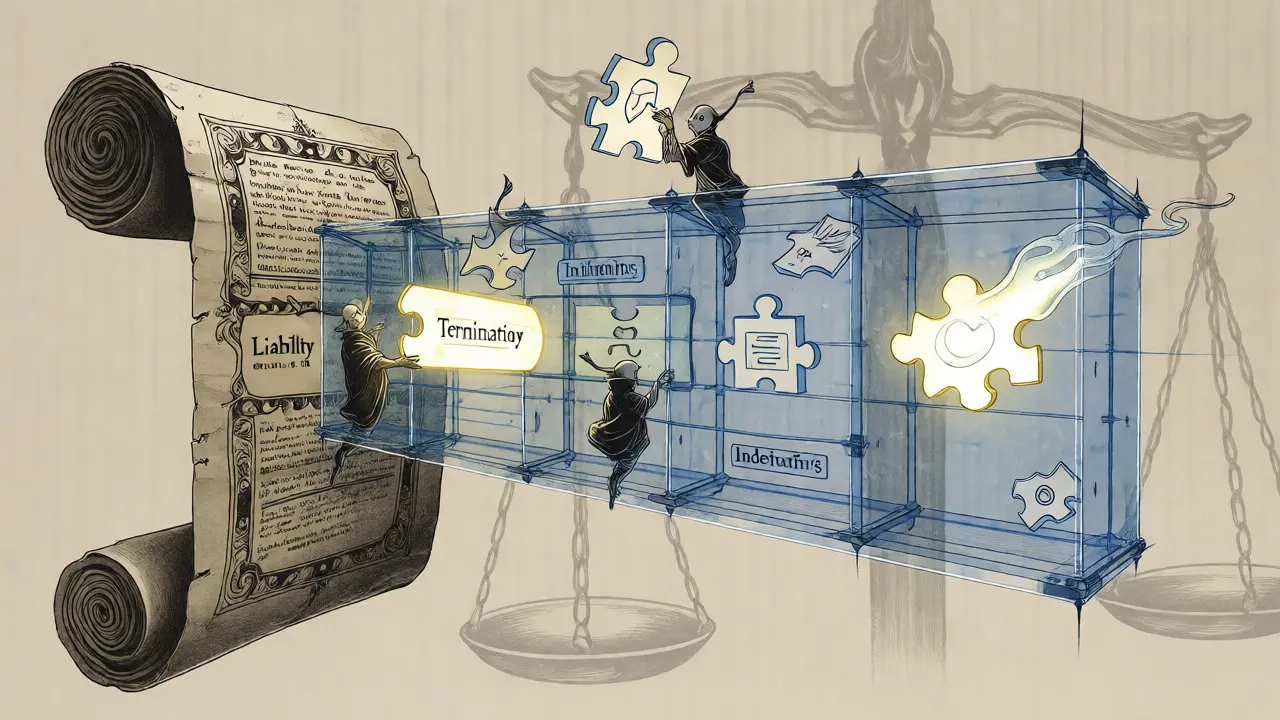
Start with hierarchical segmentation. Don't feed the whole contract into the prompt if it exceeds the token limit. Break it down by sections: Preamble, Definitions, Obligations, Termination, Liability. Process each section separately, then synthesize the results. This preserves context within each block while managing memory constraints.
Next, use chain-of-thought prompting. Instead of asking "Summarize this," ask "Identify the primary obligations of Party A, list any conditions precedent, and note any exceptions." This forces the model to reason through the text rather than just skimming. Studies using ROUGE and BERTScore metrics show that this method yields summaries with high semantic likeness to expert-created references. Errors become rare when you guide the model's reasoning path explicitly.
Extracting Clauses Like a Pro
Clause extraction is more precise than summarization. You want specific data points: What is the termination notice period? What is the governing law? Is there an arbitration clause?
Here’s where Clause Libraries come into play. Every legal specialization has standard clauses. By integrating a library of standard terms, your LLM system can perform two checks simultaneously:
- Verification: Does the extracted clause match the standard definition? If not, why?
- Detection: Are any standard clauses missing from the document?
For example, if your library says a standard confidentiality clause must include a survival period, and the LLM flags that the current draft lacks one, you’ve caught a gap instantly. Fine-tuning models on these libraries enhances performance significantly because legal language follows predictable patterns. Proprietary models like those from OpenAI often handle this better than open-source alternatives due to larger training datasets on legal corpora, but open-source models are catching up fast with specialized fine-tuning.
Detecting Risk Signals Automatically
This is the highest-value application. Risk signals are subtle. They’re not always flagged by keywords. They’re structural anomalies.
Consider uncapped liability. A human reviewer spots this quickly. An LLM trained to recognize risk patterns can scan thousands of contracts and highlight every instance where liability isn't limited to direct damages or capped at a multiple of fees. Another common risk is broad indemnification. Look for phrases like "any and all claims" versus "claims arising directly from negligence." The former is a red flag; the latter is standard.
| Risk Category | Red Flag Indicator | Standard/Low Risk Alternative |
|---|---|---|
| Liability Cap | No cap mentioned or "unlimited liability" | Capped at 1x annual fees |
| Indemnification | One-way indemnity favoring vendor | Mutual indemnity for third-party IP claims |
| Termination | Vendor can terminate for convenience | Termination for cause with cure period |
| Governing Law | Jurisdiction unfamiliar to client | Client's home state or neutral venue |
Benchmarking studies like ContractEval show that proprietary models generally outperform open-source ones in correctness and output effectiveness. However, "laziness"-where the model incorrectly reports no relevant clause exists-is a known issue. Mitigate this by adjusting temperature settings lower for factual extraction tasks to reduce creative hallucinations.
Implementation Strategy: From Prompt to Production
How do you actually deploy this? You don't need to build a custom LLM from scratch. Most organizations integrate via APIs.
First, define your workflow. Do you need a quick triage tool for intake, or deep analysis for negotiation? For triage, use a lightweight model to extract metadata: parties, dates, value. For deep analysis, use a more powerful model with detailed prompts.
Second, implement matter-aware context. A generic summary is useless if it doesn't know who your client is. Feed the model background info: "We represent the Buyer. Focus on risks to the Buyer." This shifts the model's attention to clauses unfavorable to your side. Matter-aware systems connect the document analysis to the broader transaction context, providing insights that pure text processing misses.
Third, set up human verification loops. Never auto-sign based on LLM output. Use the tool to generate a checklist of flagged items. Have a paralegal or associate review only the flagged sections. This reduces review time by 60-80% while maintaining quality control.

Pitfalls to Avoid
Not everything is smooth sailing. Here are the traps I've seen teams fall into:
- Token Limit Blindness: Ignoring context windows leads to fragmented understanding. Always segment logically.
- Over-Trusting Confidence Scores: LLMs often sound confident even when wrong. Verify facts.
- Data Privacy Risks: Sending sensitive client data to public cloud APIs requires strict compliance checks. Ensure your provider offers enterprise-grade security and zero-retention policies.
- Ignoring Jurisdictional Nuances: A clause valid in New York might be unenforceable in California. Generic models may miss local statutory overrides unless specifically prompted or fine-tuned.
Frequently Asked Questions
Can LLMs replace junior associates for contract review?
No, they augment them. LLMs handle routine extraction and initial risk flagging, freeing associates to focus on negotiation strategy and complex judgment calls. Think of it as a super-powered paralegal, not a replacement lawyer.
Are open-source LLMs good enough for legal work?
They are improving rapidly. While proprietary models currently lead in benchmark tests for correctness and laziness, open-source models offer better privacy control and customization options. For internal use cases where data sensitivity is paramount, open-source is a viable strong alternative.
How accurate are LLM-generated contract summaries?
Accuracy is high when using structured prompting and segmentation. Research indicates high word similarity and semantic likeness to expert summaries. However, errors still occur, particularly with nuanced conditional logic, so human review remains essential for final approval.
What is the biggest technical challenge in legal LLM analysis?
Managing token limits without losing context. Long contracts exceed standard context windows. Solutions involve hierarchical chunking and chain-of-thought prompting to maintain coherence across document sections.
Do I need to fine-tune my own model?
Not necessarily. Many firms start with prompt engineering and retrieval-augmented generation (RAG) using existing clause libraries. Fine-tuning is beneficial if you have massive amounts of proprietary historical data and specific niche terminology that general models struggle with.
Next Steps for Your Team
If you're ready to try this, start small. Pick one type of contract-say, NDAs or standard service agreements. Run ten recent examples through an LLM tool. Compare the output to what your team produced manually. Measure the time saved and the accuracy of the risk flags. Once you trust the baseline, expand to more complex MSA agreements. Remember, the goal isn't to eliminate human oversight, but to elevate it.