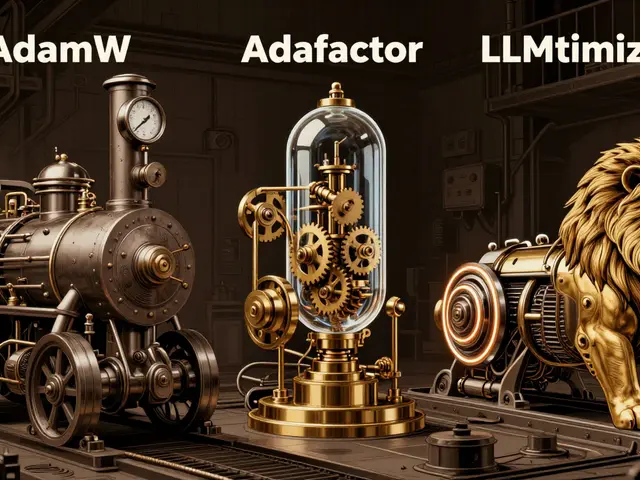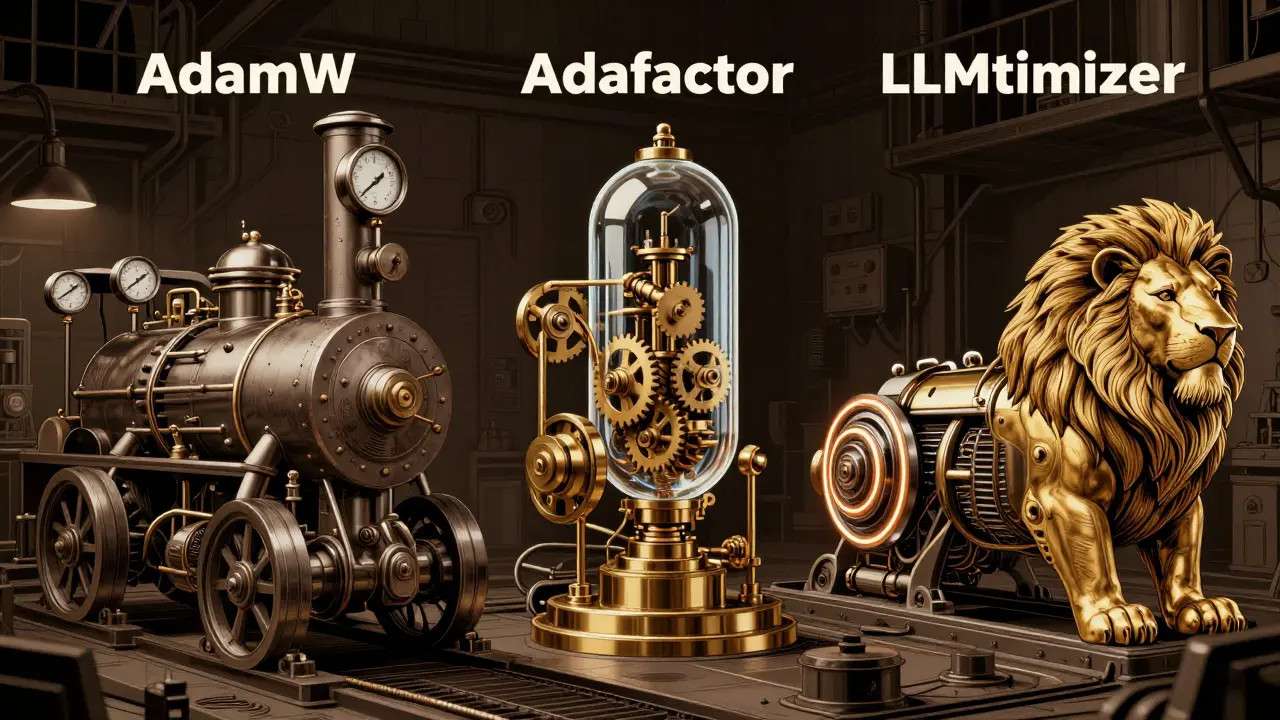
You’ve spent weeks curating your dataset and tuning your architecture. Now comes the moment that makes or breaks your training run: picking an optimizer. It’s not just a hyperparameter; it’s the engine driving your model’s learning. In 2026, the landscape has shifted. While AdamW remains the reliable workhorse, memory constraints are forcing teams to look at alternatives like Adafactor and the rising star, Lion.
If you’re training Large Language Models (LLMs) today, you aren’t just optimizing for accuracy anymore. You’re optimizing for GPU hours, VRAM limits, and convergence speed. The wrong choice can mean days of wasted compute or models that simply fail to generalize. Let’s cut through the academic noise and look at what actually happens when you swap these engines under the hood.
The Baseline: Why AdamW Still Dominates
AdamW is a variant of the Adam optimizer that decouples weight decay from gradient updates. Developed by Ilya Loshchilov and Frank Hutter in 2017, it fixed a critical flaw in the original Adam algorithm where weight decay was incorrectly applied to adaptive gradients.
Why does everyone still use it? Because it works. As of late 2025, AdamW powers roughly 75-80% of published LLM research. It offers a robust balance between convergence speed and generalization. If you train a GPT-style model with AdamW, you know exactly what performance tier to expect. It consistently achieves 2-4% higher downstream accuracy on benchmarks like SuperGLUE and MMLU compared to newer challengers.
However, there is a cost. AdamW maintains two moving averages per parameter (first and second moments). This results in a 3x memory overhead compared to the model weights themselves. For a 7-billion-parameter model, this means you need significantly more VRAM than the model size suggests. If your hardware isn’t top-tier, this overhead becomes a hard ceiling on your batch size.
Adafactor: The Memory Saver That Missed the Mark
Adafactor is an optimization algorithm designed to reduce memory usage by approximating second-moment statistics using factorized matrices. Created by Noam Shazeer and Mitchell Stern at Google in 2018, it was built specifically for large transformer models where memory was the bottleneck.
The theory was sound: approximate the second-moment matrix as the outer product of two vectors. This cuts memory usage down to approximately 1.5x the model size. On paper, it looked like the perfect solution for scaling transformers without buying more GPUs.
In practice, however, Adafactor has fallen out of favor for many practitioners. Recent studies, including an ACL Anthology paper from 2025, show that Adafactor performs strictly inferior to AdamW for GPT-2 small pretraining, lagging behind by 3-5% in loss metrics. It also converges 8-12% slower than AdamW. Community feedback highlights its sensitivity; one Reddit user reported three failed training runs due to Adafactor’s sensitive learning rate schedule before switching back to AdamW.
While it saves memory, the trade-off in convergence speed and final performance often isn’t worth it unless you are severely constrained by VRAM and cannot afford any other alternative.
Lion: The New Contender for Production
Lion is a lightweight optimizer discovered through evolutionary search that uses a sign-based update rule requiring only first-moment estimates. Introduced by Chen et al. in July 2023, it eliminates the need for second-moment calculations entirely.
Lion is gaining serious traction in production environments. Unlike AdamW, which stores full precision second moments, Lion only requires the first moment estimate. This reduces memory overhead to 2x the model size-half that of AdamW. More importantly, it enables faster communication in distributed training. Distributed Lion implementations have been shown to reduce communication needs by up to 30x compared to full-precision allreduce operations.
The speed gains are real. Benchmarks from mid-2024 show Lion achieving up to 2.3x faster training in GPU hours compared to AdamW for equivalent model sizes. A senior engineer reported switching from AdamW to Lion reduced their memory footprint by 35% for a 7B parameter model, allowing them to increase batch size by 2.1x without adding hardware. Another team saved $18,500 on AWS p4d instances by avoiding Out-Of-Memory errors thanks to Lion’s efficiency.
Google has already deployed Lion in search ads CTR models where memory constraints are tight. However, it’s not a magic bullet. Lion requires careful hyperparameter tuning. One practitioner noted it required more tuning for a 1.3B model but ultimately converged 19% faster. If you use default settings, you might see slower convergence initially.
Head-to-Head Comparison
| Feature | AdamW | Adafactor | Lion |
|---|---|---|---|
| Memory Overhead | 3x Model Size | 1.5x Model Size | 2x Model Size |
| Convergence Speed | Standard | Slower (8-12% vs AdamW) | Faster (up to 2.3x GPU hours) |
| Downstream Accuracy | Highest (+2-4%) | Lower (-3-5% vs AdamW) | Comparable/Slightly Lower |
| Hyperparameter Sensitivity | Low | High | Moderate |
| Best Use Case | Research & General Purpose | Extreme Memory Constraints | Production & Large Scale |
When to Choose Which Optimizer
Choosing an optimizer isn’t about finding the “best” one universally. It’s about matching the tool to your specific constraints. Here is how to decide based on your current situation.
- Stick with AdamW if: You prioritize maximum downstream accuracy and have sufficient VRAM. If you are doing academic research or building a foundational model where every percentage point of MMLU score matters, AdamW is the safe bet. Its community support is unmatched, with over 1,200 Stack Overflow questions tagged specifically for it.
- Switch to Lion if: You are hitting memory walls or want to reduce training costs. If you are deploying in production and need to maximize throughput, Lion’s ability to handle larger batch sizes and faster communication makes it superior. Just be prepared to spend a few days tuning your learning rates.
- Consider Adafactor only if: You are working with legacy codebases or extremely limited hardware where even Lion’s 2x overhead is too much. However, be aware that you may sacrifice convergence speed and final performance.
Implementation Tips for Smooth Transitions
Moving away from AdamW requires attention to detail. The Harvard Kempner Institute study noted that adaptivity on both the last layer and LayerNorm parameters is particularly necessary for retaining performance. If you switch to Lion or Adafactor, ensure your implementation applies adaptive updates correctly to these critical layers.
For Lion, start with a lower learning rate than you would for AdamW. The sign-based update rule can be aggressive. Monitor your validation loss closely during the first few epochs. If you see instability, reduce the learning rate by 10-20%. Most teams report taking 3-5 days to fully integrate Lion into their pipelines, so plan your sprint accordingly.
Don’t ignore the emerging variants. AdamS, introduced in 2025, improves throughput over AdamW by 35.8% while maintaining comparable performance. If you love AdamW but hate its slowness, AdamS might be the middle ground you need. Similarly, Sophia offers lower validation loss but requires 15-20% more computational resources, making it a niche choice for those who can afford the extra compute.
The Future of Optimizer Selection
The optimizer landscape is fragmenting. Gartner predicts that memory-optimized optimizers like Lion will capture 35-40% of the LLM training market by 2027. We are moving away from a one-size-fits-all approach toward dynamic selection. Google’s 2026 roadmap includes "optimizer-aware scheduling," which dynamically selects optimizers based on the training phase and resource constraints.
For now, you have to make the call manually. But the trend is clear: as models grow larger, memory efficiency will outweigh marginal gains in accuracy. If you can achieve 99% of AdamW’s performance with 50% less memory, that’s a win for most businesses. Start experimenting with Lion in your next non-critical project. You might find it pays for itself in saved GPU hours.
Is Lion better than AdamW for LLM training?
Lion is better than AdamW in terms of memory efficiency and training speed, often reducing GPU hours by up to 2.3x. However, AdamW typically achieves 2-4% higher downstream accuracy on benchmarks. Choose Lion if you are constrained by memory or cost; choose AdamW if maximum accuracy is your priority.
Why is Adafactor falling out of favor?
Adafactor is falling out of favor because it converges slower (8-12% behind AdamW) and achieves lower final performance metrics. While it saves significant memory (1.5x overhead), newer options like Lion offer better speed and similar memory savings (2x overhead) with improved convergence properties.
How much memory does AdamW use compared to the model size?
AdamW uses approximately 3x the memory of the model size. This is because it stores two moving averages (first and second moments) for each parameter in addition to the model weights themselves.
Can I use Lion for fine-tuning small models?
Yes, but it requires careful hyperparameter tuning. Lion’s sign-based update rule can be sensitive to learning rates. For small models where memory is not a constraint, AdamW is often easier to implement and more robust out-of-the-box.
What is AdamS and how does it compare to AdamW?
AdamS is a variant of AdamW introduced in 2025 that improves throughput by 35.8% while maintaining comparable performance. It addresses AdamW’s primary weakness of slow processing time without sacrificing the accuracy benefits of the original algorithm.