
You ask an AI a question about your health or a legal matter. It gives you a confident answer. But where did that information come from? If the model can't show its work, you're left guessing. This is the core problem with Large Language Models (LLMs) today: they hallucinate facts and hide their sources. Users don't just want answers; they need proof. That's why source citation and evidence linking have become the critical infrastructure for building trust between humans and machines.
Think of it like this. If a doctor tells you to take a specific medication but refuses to name the study behind it, would you trust them? Probably not. The same logic applies to AI. As we integrate these models into high-stakes areas like healthcare and finance, the ability to audit every statement becomes non-negotiable. We aren't just looking for "better" AI; we are looking for verifiable AI. This article breaks down how modern systems link claims to evidence, why current methods often fail, and what technical frameworks actually build user confidence.
The Dual Nature of LLM Knowledge
To understand why citations are hard, you have to look at how LLMs think. They don't have a library card. Their knowledge comes from two distinct places, and mixing them up causes chaos.
- Parametric Knowledge: This is what the model learned during training. It's baked into the weights of the neural network. It's fast, but it's static. If the world changed after the training cutoff date, the model doesn't know unless told.
- Non-Parametric Knowledge: This is real-time data retrieved from the internet or a database. It's fresh, but it requires a search engine to find it.
Most modern systems use a hybrid approach. When you ask a question, the system might open a candidate space of URLs, scan their content, and extract evidence on the fly. This process isn't magic; it's engineering. It involves parsing HTML, extracting structured data like JSON-LD, and ranking passages based on how well they match your intent. If the system fails to properly separate what it "knows" from what it "found," the citations become misleading. You end up with a model citing a source that doesn't actually support its claim-a phenomenon known as unsupported attribution.
How Retrieval-Augmented Generation Works
The dominant technology for fixing this is Retrieval-Augmented Generation (RAG). Instead of relying solely on memory, RAG pulls relevant documents from an external knowledge base before generating an answer. Think of it as an open-book exam. The model reads the book (the retrieved documents) and then writes the essay (the response).
A typical RAG pipeline has two main parts: a retriever and a generator. The retriever uses vector similarity search to find chunks of text that match your query. The generator-the LLM-then synthesizes those chunks into a coherent answer. Crucially, the system prompt must instruct the LLM to cite specific sources. If the instruction is vague, the model might generate a generic list of links at the end. Better implementations force inline citations, linking each sentence directly to the paragraph where the fact came from.
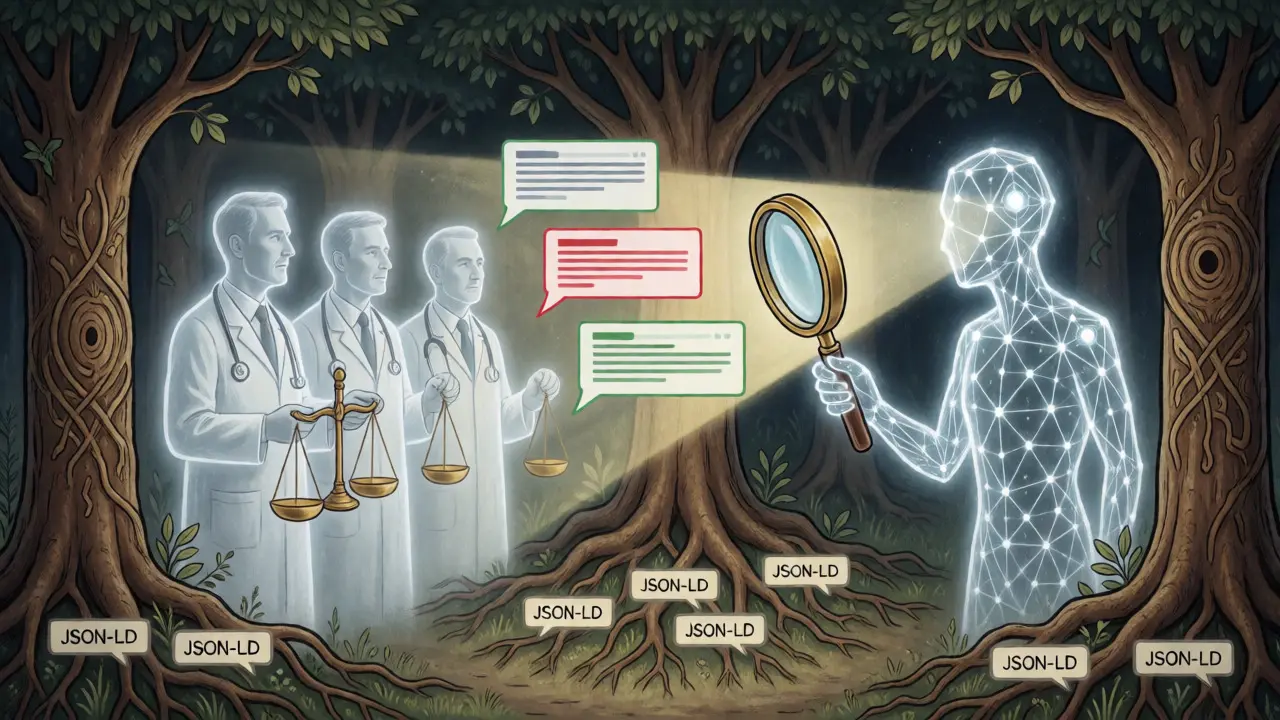
However, simply retrieving documents isn't enough. The system needs to understand structure. Structured data formats like Schema.org markup provide explicit references to entities and relationships. When a source includes JSON-LD or RDFa, the AI can verify entity identity using unique identifiers like Q-IDs. This increases the evidential value of the source because the machine understands exactly who or what is being discussed, rather than guessing based on keyword matches.
Pre-Hoc vs. Post-Hoc Citation Methods
There are two ways to handle citations during generation, and both have flaws if used alone. Developers often debate which is better, but the best results come from combining them.
| Method | Process | Pros | Cons |
|---|---|---|---|
| Pre-Hoc | Identifies and retrieves citations *during* content generation. | Ensures every claim has a source ready before it's written. | Can interrupt flow; may retrieve irrelevant sources if initial query is poor. |
| Post-Hoc | Evaluates and refines citations *after* content creation. | Allows for natural writing; filters out weak links later. | Risk of "citation laundering" where sources are added to support already-generated (possibly wrong) text. |
| Mixed Approach | Initial retrieval followed by post-generation refinement. | Balances accuracy with fluency; mitigates IP and ethical risks. | Computationally more expensive; complex to implement. |
The mixed approach is gaining traction. It starts with pre-hoc identification to ensure the model has access to the right data. Then, it uses post-hoc evaluation to check if the generated sentences actually align with those sources. This two-step process helps catch errors where the model might say something plausible but incorrect. It also addresses ethical concerns. By verifying links after the fact, companies can reduce the risk of misrepresenting intellectual property.

Measuring Trust: The SourceCheckup Framework
How do we know if a citation is good? Researchers have developed rigorous evaluation frameworks to measure this. One notable example is SourceCheckup, an automated agent-based pipeline designed to evaluate the relevance and supportiveness of sources in LLM responses.
In medical domains, precision matters most. A study involving three US-licensed doctors annotated 400 statement-source pairs. They compared human consensus against an AI verification model. The result? The AI achieved 88.7% agreement with the doctors. The inter-doctor agreement was 86.1%. Statistically, there was no significant difference. This suggests that with the right framework, AI can verify its own sources almost as reliably as experts.
This metric assesses whether a statement can be attributed to at least one provided source. It also measures precision-the percentage of sources that don't support any statement. High precision means the model isn't just dumping links to look smart. It's intentionally attributing facts. For users, this distinction is vital. A long list of links is noise. A targeted citation is signal.
Correcting Unsupported Statements
Even with good retrieval, models sometimes make statements that only partially match their sources. Maybe they exaggerate a statistic or miss a crucial caveat. To fix this, developers use correction agents like SourceCleanup. This tool takes a single statement and its corresponding source, then returns a modified version that is fully supported.
For example, if a model says "Drug X cures 90% of patients," but the source says "Drug X improved symptoms in 90% of participants," SourceCleanup rewrites the output to reflect the nuance. This reduces over-citation issues and ensures that the final text doesn't mislead the reader. It’s a safety net for when the generative process drifts slightly from the factual ground truth.
The Impact of Structured Data on Visibility
If you publish content online, you might wonder how to get cited by LLMs. It’s different from traditional SEO. Traditional SEO relies on backlinks and domain authority. LLM visibility relies on evidence weighting. Models prioritize sources that offer clear, structured data.
When a website uses Schema.org markup, it provides explicit definitions of entities. This helps the AI perform entity recognition and linking. If your page clearly defines what a product is, how it relates to other concepts, and who published it, the LLM is more likely to trust and cite it. Multi-hop reasoning allows models to connect disparate pieces of information through entity graphs. If your content fits neatly into these graphs, it gets higher weight in the synthesis phase.
This shift moves us from link-building to authority-building. Creating pillar pages with supporting cluster pages, enriched with structured data, makes your content more digestible for machines. It’s not about gaming the algorithm; it’s about speaking the language of the model. Clear semantics lead to clearer citations.
Practical Pitfalls and Risks
Implementing citation systems isn't without risk. Over-citation is a real problem. Some models dump ten links for a simple fact, cluttering the interface and annoying users. Others provide footnotes that break the reading flow. Finding the balance requires careful UI/UX design alongside backend engineering.
Another challenge is meta-analysis complexity. How does an LLM weigh one credible study against another? If two sources contradict each other, how should the model present the conflict? Current systems struggle with ambiguity. They might pick the first result or average the findings, neither of which is always correct. Transparently handling contradictions is key to maintaining trust. Users need to see that the AI acknowledges uncertainty rather than presenting a false consensus.
Finally, consider the latency cost. Real-time retrieval and verification add time to response generation. In conversational AI, speed is currency. Balancing thoroughness with responsiveness remains a delicate act for developers.
Why do LLMs sometimes cite sources that don't support their claims?
This usually happens due to a disconnect between retrieval and generation. The model might retrieve a relevant document but fail to map specific sentences to specific claims. Without strict alignment instructions, the LLM generates text based on its internal parametric knowledge and then attaches a loosely related source afterward, creating a mismatch.
What is the difference between parametric and non-parametric knowledge in LLMs?
Parametric knowledge is stored within the model's weights from training data, making it fast but potentially outdated. Non-parametric knowledge is retrieved from external databases or the web in real-time, ensuring freshness but requiring additional computational steps for retrieval and integration.
How does structured data like Schema.org help LLM citations?
Structured data provides explicit metadata about entities and relationships. This allows LLMs to accurately identify and link concepts, reducing ambiguity. It increases the evidential value of a source by confirming the context and validity of the information, making the model more likely to trust and cite it.
Can LLMs verify their own citations effectively?
Yes, with specialized frameworks. Studies show that AI verification models can achieve over 88% agreement with human experts in domains like medicine. These models analyze the semantic relationship between a statement and its source to determine if the source truly supports the claim.
What is the risk of over-citation in AI responses?
Over-citation clutters the user experience and can obscure the actual answer. It may also raise intellectual property concerns if too much copyrighted material is quoted or linked excessively. It creates cognitive load for the user, who must sift through unnecessary references to find the core information.






Chris Neal
September 6, 2026 AT 22:59you're missing the point entirely about latency costs being a dealbreaker for consumer apps. nobody wants to wait 3 seconds for an answer just so they can click a link that leads to a paywall or a dead 404 page. the real issue isn't whether the model *can* cite, it's whether the citation is actually useful when you're trying to get a quick fact during a conversation. if i have to open five tabs to verify one sentence, the AI has already failed me. speed and accuracy are at odds here and we need to pick one.
Vishnu Vardhan Reddy M S
September 8, 2026 AT 08:28oh wow, finally someone said what everyone else was too polite to whisper in the comments section!
seriously though, this is exactly why my medical chatbot gives me anxiety. i don't care if it agrees with doctors 88% of the time, i want to know which doctor and which study before i change my meds. but yeah, the latency thing is real. i'd rather have a fast wrong answer than a slow right one sometimes.
Kyle Ware
September 8, 2026 AT 09:06the distinction between parametric and non-parametric knowledge is crucial here
most users conflate the two and assume the model "knows" things like a human does
it doesn't
it predicts tokens based on weights
when you add RAG you are essentially forcing the model to look at a specific context window before predicting the next token
this reduces hallucinations but increases computational overhead
we should also consider that structured data like JSON-LD helps because it provides unambiguous entity resolution
keyword matching is fragile
entity linking is robust
if developers focus on better schema implementation on their end the retrieval quality improves naturally
no amount of prompt engineering fixes bad data structure
Iva Grekova
September 8, 2026 AT 11:24i love how this breaks down the technical side without making it feel impossible to grasp.
the part about over-citation really resonated with me because i use these tools for research and getting ten links for one simple definition is just exhausting. it feels like the AI is trying too hard to prove itself instead of just helping me learn.
maybe the solution is smarter UI design where citations collapse unless you hover? or maybe we just need to accept that verification takes work and set expectations accordingly?
either way excited to see how SourceCleanup evolves because nuance is everything in academic writing.
Onyinyechi Nwosu
September 10, 2026 AT 03:18trust is built on transparency not just accuracy
if the ai admits uncertainty and shows its sources clearly i am more likely to forgive a small error
but if it presents a guess as fact with no backup then i lose confidence completely
structured data is definitely the way forward for clarity