
You’ve probably heard the hype. Vibe coding is the new normal where you describe what you want in plain English, and an AI writes the code for you. It feels like magic until your production server crashes because the AI hallucinated a database schema that doesn’t exist. The problem isn’t the AI’s capability; it’s the lack of guardrails. Without proper oversight, vibe coding turns into "vibe checking"-where you’re just hoping the output works instead of knowing it does.
The solution isn’t to abandon AI tools. It’s to embed Human-in-the-Loop (HITL) practices directly into your workflow. This isn’t about micromanaging every semicolon. It’s about strategic checkpoints where human judgment overrides algorithmic guesswork. If you’re using tools like Cursor, GitHub Copilot, or Replit Agent, you need a system that keeps you in control without slowing you down to a crawl. Here’s how to do it right.
Understanding the Risks of Unchecked Vibe Coding
Vibe coding relies on Large Language Models (LLMs) predicting the next token based on context. They are probabilistic, not deterministic. This means they can produce syntactically correct code that is logically flawed. A common pitfall is the "hallucinated dependency." An AI might import a library that sounds plausible but isn’t installed in your environment. Or worse, it might write a function that looks efficient but introduces a subtle security vulnerability, like failing to sanitize user input in a SQL query.
When you skip human verification, these errors propagate. You accept the code because it compiles. Then, three weeks later, you’re debugging a race condition that the AI introduced because it didn’t understand the concurrency model of your specific framework. HITL practices stop this cascade by forcing validation at critical junctures.
Establishing Clear Intent Before Generation
The biggest mistake developers make with vibe coding is vague prompting. Saying "make this faster" is useless. The AI needs constraints. HITL starts before the first line of code is generated. You must define the boundaries of the task explicitly.
- Specify the Stack: Tell the AI exactly which versions of libraries to use. "Use React 18 with TypeScript and Tailwind CSS," not just "build a UI component."
- Define Success Criteria: List out the edge cases the code must handle. If you’re writing a payment processor, mention invalid credit card numbers, network timeouts, and duplicate transaction IDs.
- Provide Context Files: Don’t assume the AI knows your project structure. Explicitly reference existing utility functions or API contracts so the AI doesn’t reinvent the wheel.
By front-loading this information, you reduce the cognitive load during the review phase. You aren’t guessing if the AI understood you; you gave it a checklist.
The Three-Tier Review Strategy
Not all code requires the same level of scrutiny. Treating every AI-generated snippet equally leads to fatigue. Instead, adopt a tiered review system based on risk.
| Risk Tier | Code Type | Review Action | Time Investment |
|---|---|---|---|
| Low | Boilerplate, simple getters/setters, basic UI styling | Visual scan + auto-formatting | < 30 seconds |
| Medium | Data transformation logic, API integrations, state management | Unit test creation + logic walkthrough | 5-10 minutes |
| High | Authentication, financial calculations, database migrations, security patches | Full peer review + integration testing | 15+ minutes |
For low-risk code, trust the tool. For high-risk code, treat the AI as a junior developer who needs constant supervision. This distinction saves hours per week while keeping critical systems stable.

Mandatory Test-Driven Validation
Never merge AI-generated code without tests. In fact, use the AI to write the tests first. Ask the model: "Write unit tests for this function before implementing it." This forces the AI to articulate its assumptions about inputs and outputs. When it then generates the implementation, you have an immediate feedback loop.
If the AI-generated tests fail, the implementation is wrong. If the tests pass, you still need to verify that the tests themselves are meaningful. AI often writes trivial tests that assert `true === true`. Your job is to ensure the tests cover negative paths and boundary conditions. For example, if you ask for a date parser, ensure the tests check for leap years, invalid months, and timezone offsets.
Contextual Awareness and Project Memory
AI models have limited context windows. They forget previous instructions if the conversation gets too long. HITL practice involves actively managing this context. Periodically summarize the current state of the project and feed that summary back into the prompt. "We have completed the authentication module. Now we are building the profile page. Do not modify the auth files."
This prevents the AI from accidentally refactoring working code while trying to fix a minor issue elsewhere. It also helps when switching between tasks. Keeping a "project memory" document that you update manually ensures that even if the AI loses track, you don’t.
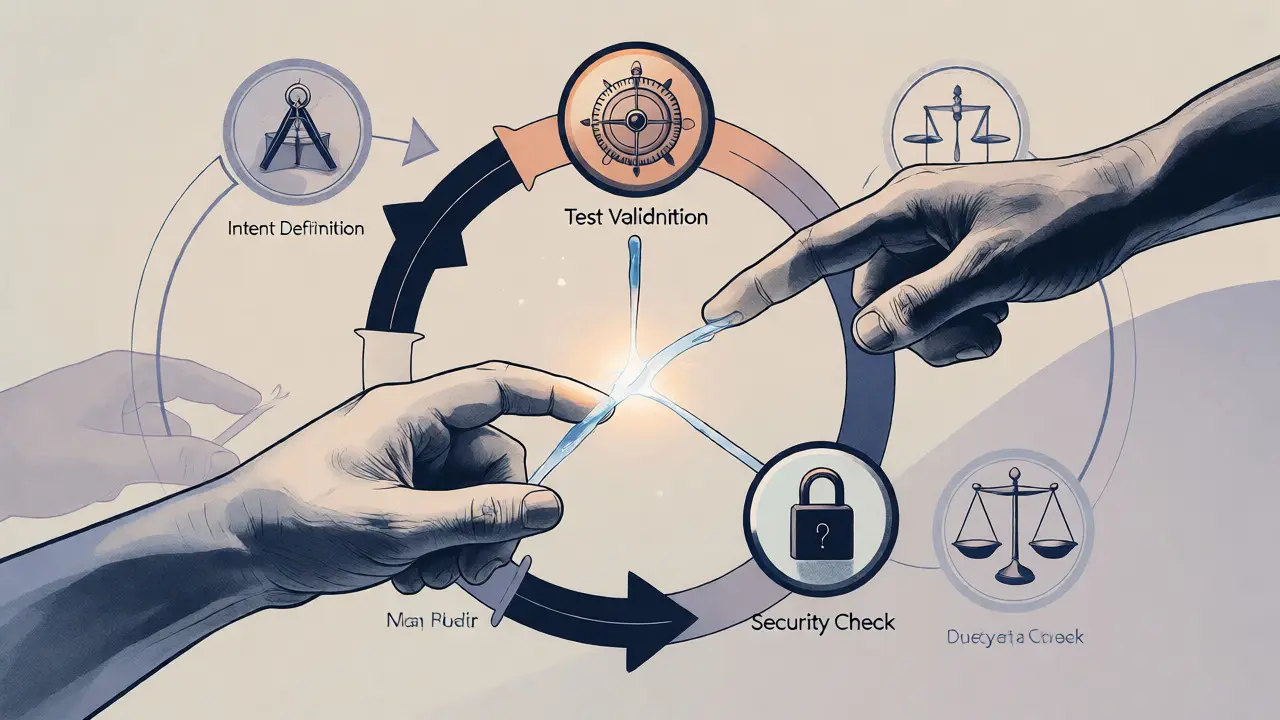
Security and Compliance Checks
AI doesn’t inherently know your company’s compliance rules. It doesn’t know that storing passwords in plain text is forbidden, or that PII (Personally Identifiable Information) must be encrypted at rest. These are human-defined constraints. Integrate static analysis tools into your pipeline. Tools like SonarQube or Snyk can catch obvious security flaws in AI-generated code. However, they won’t catch logical business rule violations. That’s where manual review comes in. Always check for hardcoded secrets, unvalidated redirects, and improper error handling that might leak stack traces to users.
Iterative Refinement Over One-Shot Generation
Don’t expect perfect code on the first try. Vibe coding works best in short, iterative loops. Generate a small chunk of code. Review it. Refine the prompt. Generate again. Trying to generate an entire feature in one go usually results in spaghetti code that’s hard to debug.
Break complex features into micro-tasks. "Create the interface for the user service." Once approved, "Implement the getUserById method." This granular approach makes it easier to pinpoint where the AI went wrong and allows you to maintain architectural integrity.
Documenting Decisions for Future Reference
When the AI suggests a non-obvious solution, document why you accepted it. Was it more performant? Did it align better with existing patterns? Adding comments explaining the "why" helps future developers (including your future self) understand the intent behind the code. This is crucial for maintaining velocity as the team grows.
Vibe coding accelerates development, but only if you stay in the driver’s seat. By combining clear intent setting, tiered reviews, rigorous testing, and security checks, you transform AI from a risky gamble into a reliable partner. Start small, pick one project, and implement these HITL steps today. Your future self will thank you when the deployment goes smoothly.
What is vibe coding?
Vibe coding is a software development approach where programmers use natural language prompts to instruct AI tools to write code. The focus shifts from syntax mastery to describing intent and reviewing output, allowing developers to build applications faster by leveraging large language models.
Why is human-in-the-loop necessary for AI coding?
AI models are probabilistic and can hallucinate dependencies, introduce security vulnerabilities, or misunderstand complex business logic. Human-in-the-loop practices ensure that code is reviewed for correctness, security, and alignment with project standards, preventing costly errors in production.
How do I prevent AI from breaking existing code?
Provide explicit context about the project structure and constraints. Use version control to isolate changes, and always run regression tests after AI modifications. Clearly specify which files should not be modified unless explicitly requested.
Can AI replace code reviews entirely?
No. While AI can assist in code reviews by spotting style issues or potential bugs, it lacks understanding of broader architectural goals and business context. Human reviewers remain essential for evaluating design decisions and ensuring code quality meets team standards.
What tools support effective vibe coding workflows?
Popular tools include Cursor, GitHub Copilot, Replit Agent, and Amazon CodeWhisperer. Integrating these with CI/CD pipelines, static analysis tools like SonarQube, and unit testing frameworks enhances safety and efficiency.