Remember when talking to a computer meant typing slowly into a chat box? That era is officially over. By mid-2026, the gap between hearing and understanding has collapsed. We are no longer just building systems that transcribe speech; we are deploying Multimodal Large Language Models that possess genuine speech and audio understanding capabilities. These models don't just convert sound waves into text strings. They listen to the context, the tone, and even the background noise to make sense of what is happening.
This shift changes everything for developers and users alike. It means your AI assistant can distinguish between a command spoken by you and a song playing on the radio. It means real-time translation isn't just about words but preserving the speaker's emotion. If you are trying to understand how these systems work under the hood, or why they matter for your next project, this guide breaks down the architecture, the current state of play, and the practical challenges you will face.
The Core Problem: Sound Is Not Text
To build an AI that understands audio, you first have to solve a massive data mismatch problem. Text is discrete. You have letters, words, and sentences. Audio is continuous. It is a relentless stream of pressure waves hitting a microphone.
Consider the math for a moment. A single 30-second clip of audio sampled at 16,000 Hz contains 480,000 individual data points. If you tried to feed those raw numbers directly into a standard transformer model, the computational cost would be astronomical. It is simply impossible with current hardware constraints.
The solution lies in compression and transformation. Engineers use mathematical tricks to turn that raw wave into something the model can digest:
- Windowing: The long audio signal is sliced into tiny, overlapping chunks, usually around 25 milliseconds each.
- Fast Fourier Transform (FFT): This extracts the frequency information from each window, showing which notes or sounds are present.
- Mel-Scale Mapping: Frequencies are mapped onto the mel scale. This mimics human hearing, giving higher resolution to lower frequencies where our ears are most sensitive.
The result is a spectrogram-a visual representation of sound. From here, the model treats audio almost exactly like it treats images. It divides the spectrogram into patches and processes them through neural networks. This bridge allows the language model to "see" the sound before it starts reasoning about it.
Anatomy of an Audio-Language Model
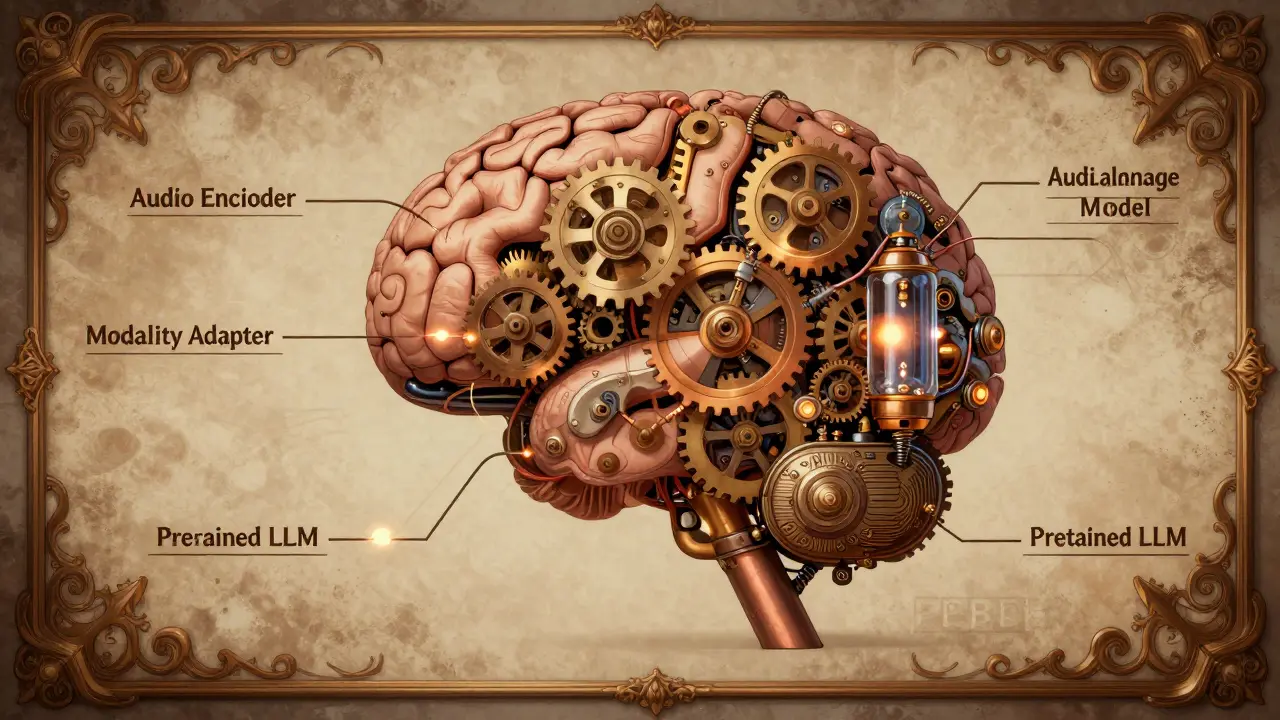
Once the audio is processed into embeddings, how does it get into the brain of the Large Language Model (LLM)? Most modern architectures use a modular approach consisting of three key parts:
- The Audio Encoder: This component takes the raw input (or spectrograms) and converts it into high-level embeddings. Think of this as the ears of the system.
- The Modality Adapter: This is the translator. It reshapes the audio embeddings so they fit into the latent space of the pre-trained LLM. Without this, the LLM wouldn't know what to do with the audio data.
- The Pre-trained LLM: The core intelligence. It receives the concatenated embeddings-audio features mixed with any text prompts-and generates the final output.
There are two primary ways these components interact. The SALM (Speech-Augmented Language Model) approach concatenates speech features directly with text token embeddings. This gives the LLM direct access to speech info during generation. Alternatively, models like BESTOW use cross-attention mechanisms. Here, text embeddings "attend" to speech embeddings to pull out specific details. BESTOW is often more computationally efficient because it adds attention modules only where needed, rather than processing every layer.
Current Capabilities and Performance Benchmarks
It is not enough to say these models "work." We need to look at the numbers to see if they are ready for production. As of late 2025 and early 2026, the performance metrics are striking.
| Task | Model / Approach | Metric / Result |
|---|---|---|
| Automatic Speech Recognition (ASR) | Conformer & Whisper-based LAMs | 0.8-1.1% Word Error Rate (WER) on LRS3 datasets |
| Multilingual ASR | Whisper-derived models | ~18% relative WER reduction over monolingual baselines |
| Real-Time Response | GPT-4o | 232 milliseconds latency (matches human conversation speed) |
| Long-Form Processing | Google Gemini | Processes entire hours of video/audio in a single prompt |
| Temporal Reasoning | Curriculum-augmented LAMs | 0.70 SPIDER score, 0.73 FENSE score on temporal QA |
Note the latency figure for GPT-4o. At 232 milliseconds, the delay is imperceptible to most humans. This marks a critical threshold where voice-first interfaces stop feeling like technology and start feeling like natural interaction. Meanwhile, the ability of models like Gemini to process hours of content in one go solves the old problem of chunking long meetings or lectures into manageable pieces.
Training Strategies: Synthetic Data and Joint Tuning
Getting these models smart requires more than just throwing data at them. The training paradigms for Large Audio-Language Models (LAMs) have evolved significantly.
Pretraining happens on massive mixtures. You have paired speech-text datasets like LibriLight and GigaSpeech, alongside pure text data to ensure the language backbone stays strong. But here is the game-changer: synthetic data. Researchers are using advanced models like GPT-4 to generate realistic conversations based on textual descriptions. This creates high-quality training pairs for scenarios that are hard to record in the wild, effectively distilling reasoning capabilities into the multimodal model.
Joint instruction tuning is another key step. Instead of training separate models for transcription, translation, and question answering, engineers unify these tasks. The model learns to recognize task tags (like [ASR] or [S2ST]) and adjusts its behavior accordingly. For speech-to-speech translation, the model uses hierarchical codec tokens to preserve the original speaker's identity and prosody, ensuring the output sounds like the right person saying the right thing.
Challenges: Hallucinations and Computational Load
Despite the progress, these systems are not perfect. The biggest issue remains hallucination. Because LLMs are trained to predict the next likely token, they sometimes invent audio content that isn't there. If you ask a model to describe a silent room, it might confidently tell you about birds chirping because that is statistically common in similar contexts.
To fight this, researchers developed Audio-Aware Decoding (AAD). This technique uses contrastive reweighting. It compares the model's predictions with and without the audio context. If the prediction changes drastically when audio is removed, the model knows it is relying too much on priors and adjusts its confidence. This meta-ability to reject incorrect information transfers across modalities, making the system more robust.
Then there is the hardware reality. Even with spectrogram compression, processing continuous audio streams demands significant memory. Scaling this to very long sequences or running it on edge devices (like smartphones) remains a bottleneck. While cloud-based solutions handle this easily, local inference requires careful optimization and quantization.

Tools for Developers in 2026
If you want to build with these technologies, you don't have to start from scratch. The ecosystem has matured rapidly.
- SLAM-LLM: An open-source framework designed specifically for customizing multimodal LLMs focused on speech and audio. It offers modular configuration for encoders and projectors, making it easier to swap components.
- NVIDIA NeMo Framework: Provides implementations for both SALM and BESTOW architectures. It includes pre-trained models and tools for parameter-efficient fine-tuning, which is crucial for adapting models to specific domains without retraining everything.
- AU-Harness: Released in September 2025, this tool standardized prompt formats and enabled efficient batch inference, solving a major pain point for evaluating multiple audio models simultaneously.
- SeaLLMs-Audio: Launched in November 2025, this addresses the bias toward Western languages by providing adaptation for Southeast Asian dialects and regions.
For niche needs, repositories like Awesome-Audio-LLM on GitHub track specialized models, such as Typhoon2-Audio for Thai language processing. The trend is clear: generalist models are getting better, but domain-specific adaptations are becoming just as important.
Future Directions: Agentic Audio Workflows
We are moving beyond simple question-and-answer. The next phase involves agentic frameworks. Imagine an LLM acting as a central agent that listens to a user, decides which tool to call (a calendar API, a music library, a weather service), executes the action, and then speaks the result back.
Frameworks like AudioToolAgent support this multi-step reasoning. The model doesn't just answer; it verifies. It can listen to a complex audio scene, identify multiple overlapping sounds, query external knowledge bases for context, and synthesize a comprehensive report. This integration of external tools reduces hallucinations and expands the utility of audio understanding far beyond transcription.
As we move through 2026, the focus shifts from "can it hear?" to "can it act on what it hears?" The convergence of low-latency response, high-fidelity understanding, and agentic tool use suggests that voice will soon become the primary interface for AI, replacing screens in many daily interactions.
What is the difference between ASR and Audio-Language Models?
Automatic Speech Recognition (ASR) focuses solely on converting spoken words into text. Audio-Language Models (LAMs) go further by understanding the context, intent, and non-verbal cues within the audio. They can reason about environmental sounds, translate speech while preserving tone, and answer questions based on audio content, not just transcribed text.
Why is spectrogram conversion necessary for LLMs?
Raw audio consists of millions of continuous data points per minute, which is computationally prohibitive for transformers. Spectrograms compress this data into a 2D visual representation of frequency over time, allowing the model to process audio efficiently using techniques similar to image recognition.
How do models prevent hallucinating audio content?
Techniques like Audio-Aware Decoding (AAD) help mitigate hallucinations. AAD compares the model's predictions with and without audio context. If the model relies too heavily on prior knowledge rather than the actual audio input, the decoding process penalizes those tokens, forcing the model to stay grounded in the provided sound data.
Can these models process multiple languages simultaneously?
Yes. Models like Whisper were trained on hundreds of thousands of hours of multilingual audio. Recent advancements allow for real-time speech-to-speech translation that preserves the original speaker's identity and emotional tone, making cross-language communication seamless.
What are the best open-source tools for developing audio AI in 2026?
Key tools include SLAM-LLM for customizable multimodal training, NVIDIA NeMo for enterprise-grade SALM and BESTOW implementations, and AU-Harness for standardized evaluation. For regional languages, SeaLLMs-Audio provides specialized adaptations for Southeast Asian dialects.